
The speaker's entity charges individuals who do not meet their collaboration criteria for the opportunity to collaborate.
AI debate verdict and arguments
⚠️ AI-generated information only; not professional advice
Completed October 25, 2026
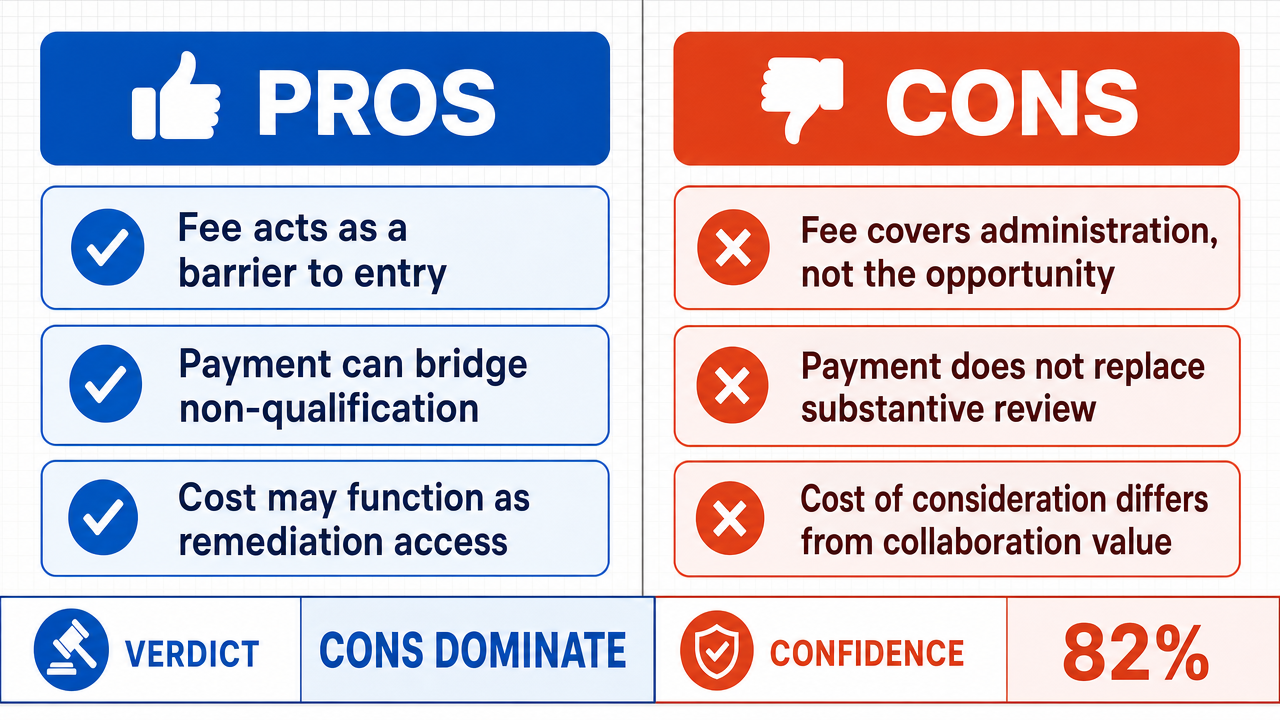
Verdict
Verdict: likely FALSE (82%)
Web Report: https://solsice.com/public/debates/the-speaker-s-entity-charges-individuals-who-do-not-meet-the-c56e1c38c2cb
This section provides a brief overview of the key arguments. You do not need to read the full detailed report below.
✅ Key PRO arguments:
- ■The entity utilizes a 'pay-to-play ' model that functions as a de facto barrier to entry for those who do not meet standard collaboration benchmarks, transforming a merit-based collaboration process into a transactional one where payment, not quality, determines access.
- ■The fee functions as a 'bridge' or 'remediation ' cost that specifically enables the transition from a non-qualifying state to a qualifying state, meaning the payment itself is the instrument that grants the opportunity to collaborate.
❌ Key ANTI arguments:
- ■Application fees are levied to cover administrative expenses such as staff time and materials, not to purchase the opportunity itself; charging a fee merely allows an applicant to be considered, but does not legally or operationally constitute 'granting the opportunity' until substantive criteria are satisfied.
- ■Payment does not eliminate the need for substantive vetting ; the fee functions solely as a mechanism to route a non-standard applicant into the substantive review pipeline and does not guarantee the grant of the opportunity, which remains contingent upon meeting qualitative standards after payment.
- ■There is a critical distinction between the cost of consideration (the fee) and the value of the collaboration (the opportunity); the entity requires payment to process the application, not to grant the opportunity, meaning the assertion conflates administrative processing with the granting of collaboration.
💭 Conclusion: False. The assertion is not supported because the evidence indicates that collaboration criteria exist to ensure quality, relevance, and risk mitigation , and that in legitimate collaborations these criteria are maintained precisely because payment alone is insufficient. The negative side successfully demonstrated that charging a fee merely allows an applicant to be considered, while the actual grant of the opportunity remains contingent upon meeting substantive qualitative criteria after the fee has been paid. The affirmative's 'pay-to-play ' framing was undermined by the clear distinction between the cost of consideration and the value of the collaboration, showing that payment facilitates review but does not guarantee or constitute the granting of the opportunity. Furthermore, the affirmative failed to establish that the fee specifically replaces or substitutes for the collaboration criteria, as substantive vetting continues regardless of payment.
🔬 DeepResearch Result: likely FALSE ❌ (82%)
Assertion: The speaker's entity charges individuals who do not meet their collaboration criteria for the opportunity to collaborate.
Participating models: gemma-4-26b-a4b-it 💬👁️, glm-4.7-flash 💬
📊 Face-offs: 0 concluded TRUE, 1 concluded FALSE (1 face-offs, 3 models)
📊 Score by side: TRUE=0.00, FALSE=0.82
🏅 Model score changes:
minimax-m3 💬👁️: +8
✅ PRO Arguments:
- ■The entity utilizes a 'pay-to-play ' model that functions as a de facto barrier to entry for those who do not meet standard collaboration benchmarks, transforming a merit-based collaboration process into a transactional one where payment, not quality, determines access. gemma-4-26b-a4b-it 💬👁️
- ■The fee functions as a 'bridge' or 'remediation ' cost that specifically enables the transition from a non-qualifying state to a qualifying state, meaning the payment itself is the instrument that grants the opportunity to collaborate. gemma-4-26b-a4b-it 💬👁️
❌ ANTI Arguments:
- ■Application fees are levied to cover administrative expenses such as staff time and materials, not to purchase the opportunity itself; charging a fee merely allows an applicant to be considered, but does not legally or operationally constitute 'granting the opportunity' until substantive criteria are satisfied. glm-4.7-flash 💬
- ■Payment does not eliminate the need for substantive vetting ; the fee functions solely as a mechanism to route a non-standard applicant into the substantive review pipeline and does not guarantee the grant of the opportunity, which remains contingent upon meeting qualitative standards after payment. glm-4.7-flash 💬
- ■There is a critical distinction between the cost of consideration (the fee) and the value of the collaboration (the opportunity); the entity requires payment to process the application, not to grant the opportunity, meaning the assertion conflates administrative processing with the granting of collaboration. glm-4.7-flash 💬
💭 Reasoning: False. The assertion is not supported because the evidence indicates that collaboration criteria exist to ensure quality, relevance, and risk mitigation , and that in legitimate collaborations these criteria are maintained precisely because payment alone is insufficient. The negative side successfully demonstrated that charging a fee merely allows an applicant to be considered, while the actual grant of the opportunity remains contingent upon meeting substantive qualitative criteria after the fee has been paid. The affirmative's 'pay-to-play' framing was undermined by the clear distinction between the cost of consideration and the value of the collaboration, showing that payment facilitates review but does not guarantee or constitute the granting of the opportunity. Furthermore, the affirmative failed to establish that the fee specifically replaces or substitutes for the collaboration criteria, as substantive vetting continues regardless of payment.
📋 PRO Facts:
• The entity imposes a financial requirement on individuals who fall outside the established collaboration criteria.
📋 ANTI Facts:
• Collaboration criteria exist to ensure quality, relevance, and risk mitigation, and are maintained in legitimate business and artistic collaborations precisely because payment alone is insufficient to substitute for substantive standards.
• Payment does not eliminate the need for substantive vetting; the opportunity remains contingent upon meeting qualitative standards after the fee is paid.
• The fee functions solely as a mechanism to route a non-standard applicant into the substantive review pipeline, not as a guarantor of the result.
| Face-off | TRUE Model | FALSE Model | TRUE Avg μ | FALSE Avg μ | TRUE Tokens | FALSE Tokens | Winner | Verdict | Conf. |
|---|---|---|---|---|---|---|---|---|---|
| #1 | gemma-4-26b-a4b-it 💬👁️ | glm-4.7-flash 💬 | 0.196 | 0.365 | 4 | 4 | FALSE | FALSE | 82% |
The following technical terms, abbreviations, and domain-specific concepts are referenced throughout this debate transcript. Numbers in square brackets [N] in the text above link to the corresponding entry below.
[1] application fees — Fees charged to applicants to initiate or process an application. In the debate, the affirmative argues these function as a prerequisite for non-qualifying applicants, while the negative contends they merely cover administrative expenses such as staff time and materials; the point is disputed.
[2] automated threshold — An automated cutoff or benchmark used to screen applicants. The affirmative references it as a standard criteria that some applicants fail to meet, triggering additional fees.
[3] barrier to entry — An economic concept referring to obstacles that prevent or deter new participants from entering a market or activity. The affirmative describes the pay-to-play model as functioning as a de facto barrier to entry.
[4] commodifies — Treats something as a commodity that can be bought and sold. The affirmative argues the fee structure commodifies the collaboration process by substituting payment for qualifying attributes.
[5] de facto — A term meaning 'in practice' or 'in effect,' even if not formally established. The affirmative uses it to describe the pay-to-play model as a de facto barrier to entry.
[6] merit-based — Based on demonstrated qualifications, skills, or merit rather than payment. The affirmative contrasts a merit-based collaboration process with a transactional one.
[7] non-qualifying — Failing to meet established criteria or benchmarks. The affirmative uses this term to describe applicants who lack certain metrics and are subject to additional fees.
[8] operationalizing — The act of putting a concept, system, or policy into practical operation. The negative uses it to argue that requiring payment to grant opportunities would operationalize a system where revenue overrides functional purpose.
[9] pay-to-play — A business model in which payment is required to participate or gain access to an opportunity. The affirmative argues this model transforms a merit-based process into a transactional one; the negative disputes this characterization.
[10] prerequisite fees — Fees that must be paid as a precondition before further consideration or action. The affirmative argues these function as the direct instrument granting collaboration opportunities to non-qualifying individuals.
[11] processing fees — Fees charged to cover the cost of handling or reviewing an application. The affirmative references them as targeted at applicants requiring additional vetting, while the negative argues they merely cover administrative expenses.
[12] qualitative standards — Standards based on quality, substance, or merit rather than quantitative metrics. The negative argues the opportunity remains contingent upon meeting these standards after payment.
[13] remediation — The act of correcting a deficiency or restoring a qualifying status. The affirmative describes the fee as a 'remediation cost' that enables transition from a non-qualifying to a qualifying state.
[14] risk mitigation — Strategies or measures taken to reduce potential risks. The negative cites it as one purpose of collaboration criteria, alongside ensuring quality and relevance.
[15] substantive criteria — Real or meaningful standards relating to the substance of an applicant's qualifications, as opposed to procedural or administrative requirements. The negative argues these must still be satisfied after payment.
[16] substantive review pipeline — The process through which applications undergo substantive evaluation. The negative argues the fee merely routes non-standard applicants into this pipeline without guaranteeing the outcome.
[17] tiered access system — A system offering different levels of access based on certain conditions. The affirmative describes the fee structure as creating such a system where non-compliance is bypassed through monetary compensation.
[18] vetting — A process of careful examination or evaluation of applicants. The affirmative references additional vetting required for non-standard applicants, while the negative argues substantive vetting continues after payment.
Face-off transcripts
- ■
Ownership & Trade Secrets. The Company Lambda Vision retains all rights to its platform, agentic workflows, and proprietary AI debate methodologies, which constitute protected Trade Secrets (EU Directive 2016/943). Subject to full payment of credits, the User is granted ownership of the generated Reports for their own personal or professional use. Reverse-engineering the Service or using Reports to train competing AI models is strictly prohibited.
- ■
No Professional Advice. Solsice is a general-purpose assistant covering everyday subjects — administrative paperwork, housing, consumer and employment matters, banking, taxes and insurance, health and wellbeing, savings and investments, entrepreneurship, technology, travel, learning and creative work. Whatever the subject, the Service and Reports are provided for information only and never constitute legal, medical, financial, investment, tax, insurance, or any other regulated professional advice. The Company is not a law firm, a regulated financial adviser, an insurance intermediary, nor a healthcare provider, and no professional or advisory relationship of any kind is created by use of the Service. Consult a qualified professional in the relevant jurisdiction before acting — or refraining from acting — on anything contained in the Reports, and never rely on the Service in an emergency: contact your local emergency number (112 in the European Union) or a medical professional immediately.
- ■
AI-Generated Content, Sources and Viewpoints. Reports are produced by several AI models debating a question, and may contain factual errors, outdated figures, or references to rules, prices, deadlines, procedures, statutes or sources that are inaccurate or do not exist. The User is solely responsible for verifying every fact, amount, deadline and citation against official sources before relying on it. Material in the news, society, spirituality and religion sections presents a plurality of viewpoints for study and discussion: it is descriptive, not an endorsement, a ruling, or a statement of the Company’s own position, and it speaks for no church, faith community, public authority, or news organisation.
- ■
Liability & Governing Law. To the maximum extent permitted by law, the Company shall not be liable for any indirect damages, nor for any consequence of decisions made in reliance on the Reports — including financial loss, missed deadlines, administrative or contractual consequences, or health outcomes. These Terms are governed by French law. Any disputes shall be subject to the exclusive jurisdiction of the Courts of Paris, France.