
The speaker's early content demonstrating grout cleaning effectively addresses viewer inquiries despite the speaker's own critical self-assessment of its quality.
AI debate verdict and arguments
⚠️ AI-generated information only; not professional advice
Completed October 14, 2026
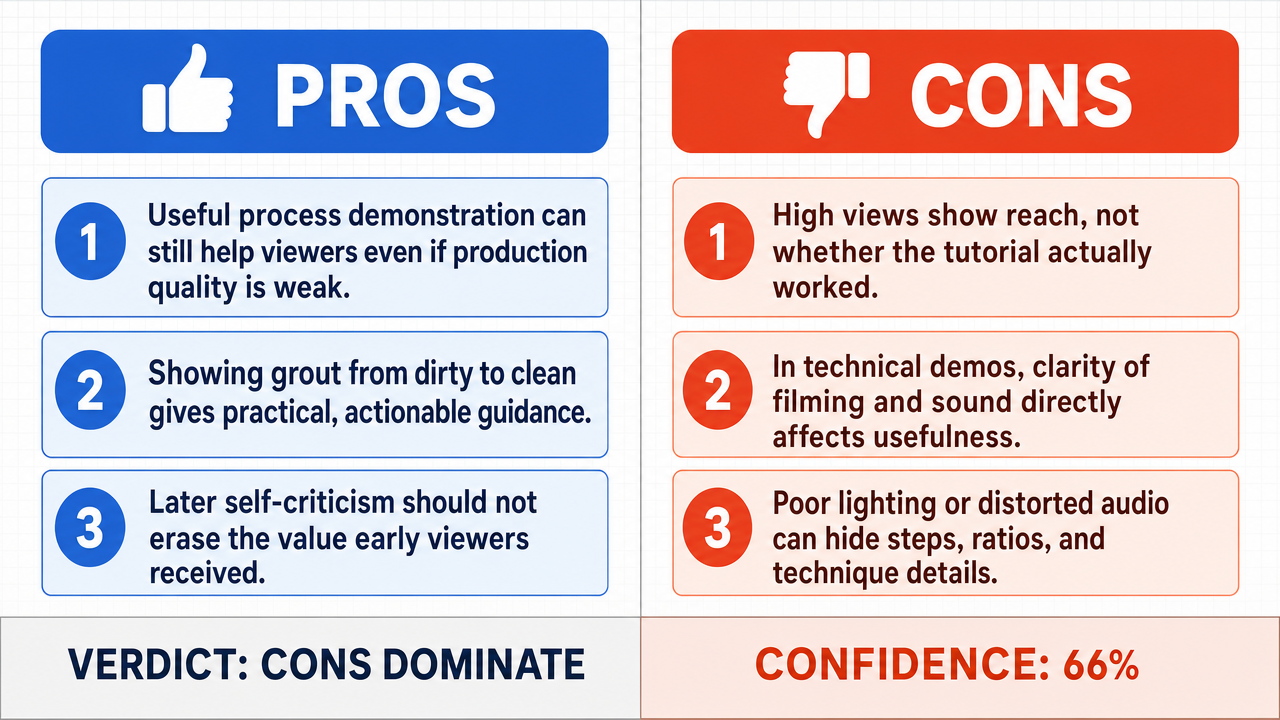
Verdict
Verdict: likely FALSE (66%)
Web Report: https://solsice.com/public/debates/the-speaker-s-early-content-demonstrating-grout-cleaning-eff-4f91e38bc3ec
This section provides a brief overview of the key arguments. You do not need to read the full detailed report below.
✅ Key PRO arguments:
- ■There is a functional separation between content utility and production quality; a creator's retrospective critique of presentation (lighting, audio, editing) does not negate the instructional value of the core demonstration, since viewer inquiries primarily seek procedural knowledge such as products, application techniques, scrubbing methods, and expected results.
- ■Early content that visually documents a complete process from dirty to clean grout directly provides actionable information to viewers, regardless of amateurish filming, because the step-by-step visual demonstration was available to initial viewers whose inquiries were being addressed.
- ■Judging the content's utility based on a later critique that was not available to the initial viewers constitutes a hindsight error ; the speaker's self-assessment targets production aesthetics rather than the procedural substance conveyed at the time of publication.
❌ Key ANTI arguments:
- ■Reliance on engagement metrics such as view counts is a category error that confuses popularity with efficacy; high view counts only prove the content was surfaced by an algorithm or captured curiosity, not that viewer inquiries were effectively resolved through successful transfer of actionable procedural knowledge .
- ■The separation between content utility and production quality is a false dichotomy because the utility of a technical demonstration is inextricably linked to the accuracy and clarity of its visual and auditory presentation; the 'form' is the medium through which the 'substance' is communicated.
- ■If the lighting is poor, the scrubbing technique is obscured; if the audio is distorted, the specific chemical ratios or application details are lost, meaning a demonstration the creator himself has labeled as flawed cannot reliably transmit actionable information to viewers.
💭 Conclusion: False. The winning side convincingly argued that the utility of a technical demonstration is inextricably linked to the clarity and accuracy of its visual and auditory presentation, making the supposed separation between 'form' and 'substance' a false dichotomy . The affirmative's reliance on engagement metrics as a proxy for instructional efficacy was correctly identified as a category error , since views reflect exposure rather than the successful resolution of viewer inquiries. The creator's own expert self-assessment that the early demonstration is flawed serves as authoritative evidence that the content fails to meet the standards required for effective procedural instruction. Because the compound claim requires both that the content effectively addresses inquiries AND that it does so despite the self-critique, and the second sub-claim is undermined by the inseparability of form and substance in technical demonstrations, the overall confidence is moderated to reflect the weakest supported component.
🔬 DeepResearch Result: likely FALSE ❌ (66%)
Assertion: The speaker's early content demonstrating grout cleaning effectively addresses viewer inquiries despite the speaker's own critical self-assessment of its quality.
Participating models: deepseek-v3.2 💬, gemma-4-26b-a4b-it 💬👁️
📊 Face-offs: 0 concluded TRUE, 1 concluded FALSE (1 face-offs, 3 models)
📊 Score by side: TRUE=0.00, FALSE=0.66
🏅 Model score changes:
minimax-m3 💬👁️: +7
✅ PRO Arguments:
- ■There is a functional separation between content utility and production quality; a creator's retrospective critique of presentation (lighting, audio, editing) does not negate the instructional value of the core demonstration, since viewer inquiries primarily seek procedural knowledge such as products, application techniques, scrubbing methods, and expected results. deepseek-v3.2 💬
- ■Early content that visually documents a complete process from dirty to clean grout directly provides actionable information to viewers, regardless of amateurish filming, because the step-by-step visual demonstration was available to initial viewers whose inquiries were being addressed. deepseek-v3.2 💬
- ■Judging the content's utility based on a later critique that was not available to the initial viewers constitutes a hindsight error ; the speaker's self-assessment targets production aesthetics rather than the procedural substance conveyed at the time of publication. deepseek-v3.2 💬
❌ ANTI Arguments:
- ■Reliance on engagement metrics such as view counts is a category error that confuses popularity with efficacy; high view counts only prove the content was surfaced by an algorithm or captured curiosity, not that viewer inquiries were effectively resolved through successful transfer of actionable procedural knowledge. gemma-4-26b-a4b-it 💬👁️
- ■The separation between content utility and production quality is a false dichotomy because the utility of a technical demonstration is inextricably linked to the accuracy and clarity of its visual and auditory presentation; the 'form' is the medium through which the 'substance' is communicated. gemma-4-26b-a4b-it 💬👁️
- ■If the lighting is poor, the scrubbing technique is obscured; if the audio is distorted, the specific chemical ratios or application details are lost, meaning a demonstration the creator himself has labeled as flawed cannot reliably transmit actionable information to viewers. gemma-4-26b-a4b-it 💬👁️
- ■The claim that a viewer can extract actionable information from a demonstration that the creator himself has labeled as flawed is logically unsound, because the creator's expert self-assessment serves as authoritative evidence that the demonstration fails to meet the standards required for effective instruction. gemma-4-26b-a4b-it 💬👁️
💭 Reasoning: False. The winning side convincingly argued that the utility of a technical demonstration is inextricably linked to the clarity and accuracy of its visual and auditory presentation, making the supposed separation between 'form' and 'substance' a false dichotomy. The affirmative's reliance on engagement metrics as a proxy for instructional efficacy was correctly identified as a category error, since views reflect exposure rather than the successful resolution of viewer inquiries. The creator's own expert self-assessment that the early demonstration is flawed serves as authoritative evidence that the content fails to meet the standards required for effective procedural instruction. Because the compound claim requires both that the content effectively addresses inquiries AND that it does so despite the self-critique, and the second sub-claim is undermined by the inseparability of form and substance in technical demonstrations, the overall confidence is moderated to reflect the weakest supported component.
📋 PRO Facts:
• Viewer inquiries about grout cleaning primarily seek procedural knowledge including products, application techniques, scrubbing methods, and expected results.
• Early grout-cleaning content visually documented a complete process from dirty to clean grout.
• The speaker's later self-assessment targeted production aesthetics such as lighting, audio, and editing rather than procedural substance.
📋 ANTI Facts:
• High view counts on a video do not prove that viewer inquiries were effectively addressed; they only prove the content was surfaced or captured curiosity.
• In technical instruction, the 'form' (visual and auditory presentation) is the medium through which the 'substance' (procedural knowledge) is communicated.
• Poor lighting can obscure scrubbing technique, and distorted audio can obscure specific chemical ratios or application details.
• The creator's own expert self-assessment that the demonstration is flawed constitutes authoritative evidence regarding its instructional limitations.
| Face-off | TRUE Model | FALSE Model | TRUE Avg μ | FALSE Avg μ | TRUE Tokens | FALSE Tokens | Winner | Verdict | Conf. |
|---|---|---|---|---|---|---|---|---|---|
| #1 | deepseek-v3.2 💬 | gemma-4-26b-a4b-it 💬👁️ | 0.280 | 0.188 | 8 | 2 | TRUE | FALSE | 66% |
The following technical terms, abbreviations, and domain-specific concepts are referenced throughout this debate transcript. Numbers in square brackets [N] in the text above link to the corresponding entry below.
[1] actionable information — Data or knowledge that is sufficiently specific and clear to enable a recipient to directly perform a task or make a decision. In the debate, the affirmative argues that early grout-cleaning videos provided this despite amateurish production.
[2] category error — A philosophical/logical error in which concepts from one domain are inappropriately applied to another. The negative uses this term to argue that conflating view counts with instructional efficacy is such an error.
[3] chemical ratios — The proportional quantities of substances used in a mixture or reaction. The negative argues that distorted audio in early videos could obscure these ratios, undermining instructional value.
[4] contemporaneous record — Documentation created at the same time as the events being described. The affirmative cites contemporaneous user comments as evidence that early videos successfully answered viewer questions at the time of publication.
[5] engagement metrics — Quantitative measures of audience interaction with content, such as views, comments, and likes. The affirmative uses these to argue knowledge transfer occurred; the negative argues they are a flawed proxy for instructional utility.
[6] epistemic reliability — The trustworthiness and accuracy of a source as a basis for knowledge. The negative frames the speaker's self-criticism as a warning that the demonstration lacks this quality.
[7] false dichotomy — A logical fallacy that presents two options as mutually exclusive when alternatives exist. The negative argues the affirmative's separation of 'form' from 'substance' in technical demonstration is such a fallacy.
[8] grout — A paste or mortar used to fill gaps between tiles, which can become stained and require cleaning. The debate centers on whether early videos demonstrating grout cleaning effectively answered viewer questions.
[9] hindsight error — A reasoning mistake in which later knowledge is used to judge the validity of decisions or content made without that knowledge. The affirmative accuses the negative of this when judging early videos by later self-critiques.
[10] instructional utility — The practical usefulness of content for teaching or guiding a viewer through a task. The debate disputes whether early grout-cleaning videos possessed this despite the creator's later self-criticism.
[11] knowledge transfer — The process by which information or skills are successfully communicated from a source to a recipient. The affirmative cites viewer comments as evidence that this occurred through early tutorial videos.
[12] procedural knowledge — Know-how consisting of the steps required to perform a task, as distinct from conceptual or factual knowledge. The affirmative argues early videos conveyed this type of knowledge about grout cleaning.
Face-off transcripts
- ■
Ownership & Trade Secrets. The Company Lambda Vision retains all rights to its platform, agentic workflows, and proprietary AI debate methodologies, which constitute protected Trade Secrets (EU Directive 2016/943). Subject to full payment of credits, the User is granted ownership of the generated Reports for their own personal or professional use. Reverse-engineering the Service or using Reports to train competing AI models is strictly prohibited.
- ■
No Professional Advice. Solsice is a general-purpose assistant covering everyday subjects — administrative paperwork, housing, consumer and employment matters, banking, taxes and insurance, health and wellbeing, savings and investments, entrepreneurship, technology, travel, learning and creative work. Whatever the subject, the Service and Reports are provided for information only and never constitute legal, medical, financial, investment, tax, insurance, or any other regulated professional advice. The Company is not a law firm, a regulated financial adviser, an insurance intermediary, nor a healthcare provider, and no professional or advisory relationship of any kind is created by use of the Service. Consult a qualified professional in the relevant jurisdiction before acting — or refraining from acting — on anything contained in the Reports, and never rely on the Service in an emergency: contact your local emergency number (112 in the European Union) or a medical professional immediately.
- ■
AI-Generated Content, Sources and Viewpoints. Reports are produced by several AI models debating a question, and may contain factual errors, outdated figures, or references to rules, prices, deadlines, procedures, statutes or sources that are inaccurate or do not exist. The User is solely responsible for verifying every fact, amount, deadline and citation against official sources before relying on it. Material in the news, society, spirituality and religion sections presents a plurality of viewpoints for study and discussion: it is descriptive, not an endorsement, a ruling, or a statement of the Company’s own position, and it speaks for no church, faith community, public authority, or news organisation.
- ■
Liability & Governing Law. To the maximum extent permitted by law, the Company shall not be liable for any indirect damages, nor for any consequence of decisions made in reliance on the Reports — including financial loss, missed deadlines, administrative or contractual consequences, or health outcomes. These Terms are governed by French law. Any disputes shall be subject to the exclusive jurisdiction of the Courts of Paris, France.