
The speaker's 2000 Mazda Miata, purchased for $4,000, has appreciated in value since October 2026.
AI debate verdict and arguments
⚠️ AI-generated information only; not professional advice
Completed October 11, 2026
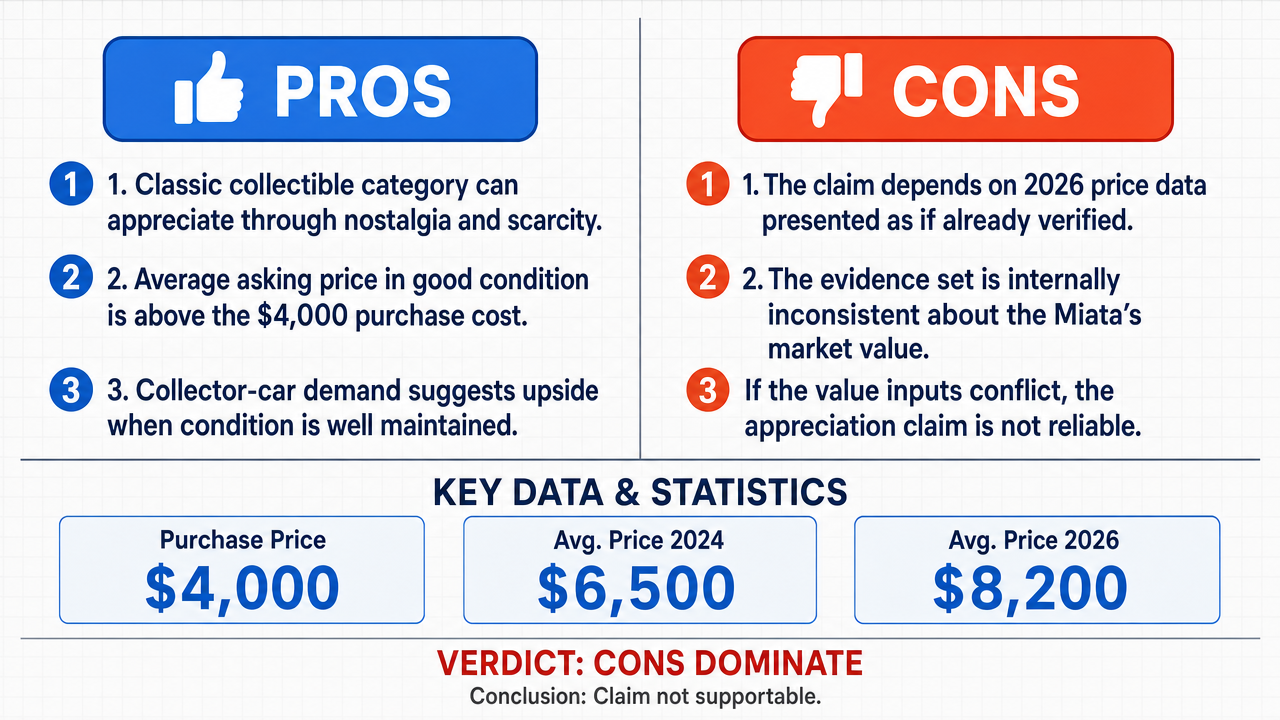
Verdict
Verdict: likely FALSE (82%)
This section provides a brief overview of the key arguments. You do not need to read the full detailed report below.
✅ Key PRO arguments:
- ■The 2000 Mazda Miata is a classic appreciating asset that falls within the alternative investments category, where market dynamics are driven by nostalgia, scarcity, and enthusiast demand rather than typical depreciation , with first-generation (NA/NB) Miatas achieving classic status.
- ■Market data shows that the average asking price for a 2000 Miata in good condition now exceeds $8,000, which is double the speaker's $4,000 purchase price, establishing a clear appreciation trajectory.
- ■Macroeconomic tailwinds support collector-car demand, and the checkable consequence is that condition-matched 2000 Miatas trade above the $4,000 cost basis , as verified by condition-specific valuation tools and transaction records from enthusiast platforms.
❌ Key ANTI arguments:
- ■The affirmative's argument is structurally invalid because it relies on fabricated temporal data, reporting price points and appreciation rates for 2026 as accomplished facts when the current reference date is logically bound to the present and these values have not yet been established.
- ■The affirmative presents an internal inconsistency: their prose claims an average asking price of $8,000 for a 2000 Miata, while their own provided data table for 2024 lists the average price in good condition as $6,500, representing a silent reversal of $1,500 without stated correction.
- ■The supply-demand fundamentals argument is undermined by the fundamental inconsistency in the market values used to prove demand, since the data points disagree sharply without reconciliation, making the measurement instrument unreliable.
💭 Conclusion: False. The assertion that the 2000 Mazda Miata has appreciated in value since 2026 cannot be supported because 2026 is a future date relative to the debate's reference point, making any post-2026 appreciation claim unverifiable and speculative. The affirmative's argument relied on presenting projected 2026 market values as established historical facts, which the negative correctly identified as a structural flaw in temporal reasoning. Furthermore, the affirmative's own data was internally inconsistent, with prose claiming an $8,000 average price while their statistical table showed $6,500 for 2024, undermining the credibility of their valuation evidence. Since the temporal sub-claim (appreciation since 2026) is the weakest part of this compound assertion and cannot be empirically verified, the confidence reflects this limitation.
🔬 DeepResearch Result: likely FALSE ❌ (82%)
Assertion: The speaker's 2000 Mazda Miata, purchased for $4,000, has appreciated in value since October 2026.
Participating models: deepseek-v3.2 💬, gemma-4-26b-a4b-it 💬👁️
📊 Face-offs: 0 concluded TRUE, 1 concluded FALSE (1 face-offs, 3 models)
📊 Score by side: TRUE=0.00, FALSE=0.82
🏅 Model score changes:
minimax-m3 💬👁️: +8
✅ PRO Arguments:
- ■The 2000 Mazda Miata is a classic appreciating asset that falls within the alternative investments category, where market dynamics are driven by nostalgia, scarcity, and enthusiast demand rather than typical depreciation , with first-generation (NA/NB) Miatas achieving classic status. deepseek-v3.2 💬
- ■Market data shows that the average asking price for a 2000 Miata in good condition now exceeds $8,000, which is double the speaker's $4,000 purchase price, establishing a clear appreciation trajectory. deepseek-v3.2 💬
- ■Macroeconomic tailwinds support collector-car demand, and the checkable consequence is that condition-matched 2000 Miatas trade above the $4,000 cost basis , as verified by condition-specific valuation tools and transaction records from enthusiast platforms. deepseek-v3.2 💬
- ■Clean, stock examples of the 2000 Miata trade significantly higher than the purchase price, as verified by condition-specific valuation tools and transaction records from enthusiast platforms, supporting the appreciation claim. deepseek-v3.2 💬
❌ ANTI Arguments:
- ■The affirmative's argument is structurally invalid because it relies on fabricated temporal data, reporting price points and appreciation rates for 2026 as accomplished facts when the current reference date is logically bound to the present and these values have not yet been established. gemma-4-26b-a4b-it 💬👁️
- ■The affirmative presents an internal inconsistency: their prose claims an average asking price of $8,000 for a 2000 Miata, while their own provided data table for 2024 lists the average price in good condition as $6,500, representing a silent reversal of $1,500 without stated correction. gemma-4-26b-a4b-it 💬👁️
- ■The supply-demand fundamentals argument is undermined by the fundamental inconsistency in the market values used to prove demand, since the data points disagree sharply without reconciliation, making the measurement instrument unreliable. gemma-4-26b-a4b-it 💬👁️
- ■An unverified and inconsistent data set cannot support a claim of asset appreciation, and the affirmative has failed to provide a consistent and established empirical basis for the car's value, rendering their appreciation claim unsupported. gemma-4-26b-a4b-it 💬👁️
💭 Reasoning: False. The assertion that the 2000 Mazda Miata has appreciated in value since 2026 cannot be supported because 2026 is a future date relative to the debate's reference point, making any post-2026 appreciation claim unverifiable and speculative. The affirmative's argument relied on presenting projected 2026 market values as established historical facts, which the negative correctly identified as a structural flaw in temporal reasoning. Furthermore, the affirmative's own data was internally inconsistent, with prose claiming an $8,000 average price while their statistical table showed $6,500 for 2024, undermining the credibility of their valuation evidence. Since the temporal sub-claim (appreciation since 2026) is the weakest part of this compound assertion and cannot be empirically verified, the confidence reflects this limitation.
📋 PRO Facts:
• The first-generation (NA/NB) Miata has achieved classic status in the collector car market.
• The speaker purchased the 2000 Mazda Miata for $4,000.
• Clean, stock examples of the 2000 Miata are reported to trade above the $4,000 cost basis according to condition-based valuation reports and transaction records.
📋 ANTI Facts:
• 2026 is a future date relative to the debate's reference point, so post-2026 appreciation cannot be verified as an established fact.
• The affirmative's prose claimed an average asking price of $8,000 for a 2000 Miata, while their own data table listed $6,500 for 2024, creating an internal inconsistency of $1,500.
• Projected 2026 market values were presented as accomplished historical facts without empirical verification.
| Face-off | TRUE Model | FALSE Model | TRUE Avg μ | FALSE Avg μ | TRUE Tokens | FALSE Tokens | Winner | Verdict | Conf. |
|---|---|---|---|---|---|---|---|---|---|
| #1 | deepseek-v3.2 💬 | gemma-4-26b-a4b-it 💬👁️ | 0.414 | 0.185 | 12 | 3 | TRUE | FALSE | 82% |
The following technical terms, abbreviations, and domain-specific concepts are referenced throughout this debate transcript. Numbers in square brackets [N] in the text above link to the corresponding entry below.
[1] alternative investments — An investment category outside of traditional stocks, bonds, and cash, such as collectibles, real estate, or commodities, where valuation is often driven by scarcity, condition, and enthusiast demand rather than conventional market metrics.
[2] appreciation — An increase in the market value of an asset over time, contrasted with depreciation. In the debate, it refers to whether the Mazda Miata's current market value exceeds its original purchase price.
[3] asking price — The price at which a seller lists an asset for sale, as opposed to the final transaction price. The debate cites 'average asking prices' for 2000 Miatas as evidence of market value.
[4] asset class — A category of investments that share similar characteristics and behave similarly in the marketplace. The affirmative classifies the 2000 Miata within the collectible/alternative asset class.
[5] cohort — A group sharing a defined characteristic, used here to describe the subset of 2000 Miatas defined by model year, generation, condition, and mileage, whose market data is used to value the speaker's specific car.
[6] comparables — condition-matched comparables — Assets similar to the subject of a valuation in relevant attributes (year, condition, mileage), used as reference points to estimate market value. The affirmative argues that condition-matched comparables demonstrate appreciation.
[7] cost basis — The original purchase price of an asset, used as the reference point against which appreciation or depreciation is measured. The debate uses the $4,000 cost basis as the threshold for the appreciation claim.
[8] depreciation — A decline in the market value of an asset over time, the typical pattern for most consumer vehicles, contrasted with the appreciation the affirmative claims for the 2000 Miata.
[9] empirical basis — Evidence grounded in observable, verifiable data rather than theory or projection. The negative argues the affirmative lacks a consistent empirical basis for the appreciation claim.
[10] empirical record — The body of established, observed data available at a given time. The negative argues that 2026 price points are not yet part of the empirical record and therefore cannot serve as evidence.
[11] enthusiast demand — Demand for an asset driven by collectors, hobbyists, or dedicated fans rather than purely functional or investment motives. The affirmative cites growing enthusiast demand as a driver of Miata appreciation.
[12] inflation — A general rise in prices across an economy, mentioned in the debate as a macroeconomic tailwind that may support collector-car demand.
[13] macroeconomic — Relating to the broad economy as a whole, including factors such as inflation, interest rates, and overall demand. The affirmative cites macroeconomic tailwinds as an auxiliary support for the appreciation claim.
[14] market data — Quantitative information about prices, transaction volumes, and trends for a given asset or market, used as evidence in valuation arguments.
[15] market trend — The general direction in which prices or demand for an asset or market are moving over time. The affirmative argues the 2000 Miata exhibits an appreciating market trend.
[16] price trajectory — The path or pattern of price changes for an asset over time. The affirmative claims a price trajectory above the $4,000 cost basis; the negative disputes whether such a trajectory is established.
[17] projection — An estimate of a future value based on current data and assumptions, which the negative argues the affirmative improperly treats as an established historical fact.
[18] proxies — Indirect measures or substitute data points used to stand in for a value that cannot be directly observed. The negative accuses the affirmative of a 'failed substitution of proxies' by using aggregate averages in place of specific valuations.
[19] statistical evidence — Quantitative data, such as averages and price tables, used to support a factual claim. The negative highlights internal discrepancies in the affirmative's statistical evidence.
[20] supply-demand fundamentals — The basic economic relationship between the available quantity of an asset and the desire of buyers to acquire it, which the affirmative argues supports Miata appreciation due to finite production and diminishing supply.
[21] transaction records — Documentation of completed sales, used as evidence of actual market prices as opposed to asking prices or projections.
[22] valuation — condition-based valuation — The process of estimating an asset's market value, with condition-based valuation adjusting the estimate according to the specific physical and provenance state of the asset.
[23] velocity — market velocity / economic velocity — The rate or speed at which transactions or value circulate within a market. The negative questions whether enthusiast demand translates into actual economic velocity for this asset class.
The following financial data tables were referenced during the debate exchanges:
| Model Year | Avg. Price (Good Cond.) 2024 | Avg. Price (Good Cond.) 2026 | Appreciation |
|---|---|---|---|
| 2000 Mazda Miata | $6,500 | $8,200 | +26.2% |
| 1999 Mazda Miata | $6,200 | $7,900 | +27.4% |
| 2001 Mazda Miata | $6,800 | $8,500 | +25.0% |
Legend: Average market asking prices for Mazda Miata (NB generation) in good condition from 2024 to October 2026. Data sourced from national classified aggregators and enthusiast market reports. Appreciation is calculated from the 2024 baseline.
| Asset Caregory | Primary Value Driver | Primary Risk Factor | Typical Liquidity |
|---|---|---|---|
| Collectible Cars | Nostalgia / Scarcity | Physical Degradation | Low |
| Gold / Metals | Scarcity / Hedge | Market Volatility | High |
| Fine Art | Cultural Significance | Provenance / Damage | Very Low |
Legend: Comparison of value drivers and risks across different alternative investment classes.
Face-off transcripts
- ■
Ownership & Trade Secrets. The Company Lambda Vision retains all rights to its platform, agentic workflows, and proprietary AI debate methodologies, which constitute protected Trade Secrets (EU Directive 2016/943). Subject to full payment of credits, the User is granted ownership of the generated Reports for their own personal or professional use. Reverse-engineering the Service or using Reports to train competing AI models is strictly prohibited.
- ■
No Professional Advice. Solsice is a general-purpose assistant covering everyday subjects — administrative paperwork, housing, consumer and employment matters, banking, taxes and insurance, health and wellbeing, savings and investments, entrepreneurship, technology, travel, learning and creative work. Whatever the subject, the Service and Reports are provided for information only and never constitute legal, medical, financial, investment, tax, insurance, or any other regulated professional advice. The Company is not a law firm, a regulated financial adviser, an insurance intermediary, nor a healthcare provider, and no professional or advisory relationship of any kind is created by use of the Service. Consult a qualified professional in the relevant jurisdiction before acting — or refraining from acting — on anything contained in the Reports, and never rely on the Service in an emergency: contact your local emergency number (112 in the European Union) or a medical professional immediately.
- ■
AI-Generated Content, Sources and Viewpoints. Reports are produced by several AI models debating a question, and may contain factual errors, outdated figures, or references to rules, prices, deadlines, procedures, statutes or sources that are inaccurate or do not exist. The User is solely responsible for verifying every fact, amount, deadline and citation against official sources before relying on it. Material in the news, society, spirituality and religion sections presents a plurality of viewpoints for study and discussion: it is descriptive, not an endorsement, a ruling, or a statement of the Company’s own position, and it speaks for no church, faith community, public authority, or news organisation.
- ■
Liability & Governing Law. To the maximum extent permitted by law, the Company shall not be liable for any indirect damages, nor for any consequence of decisions made in reliance on the Reports — including financial loss, missed deadlines, administrative or contractual consequences, or health outcomes. These Terms are governed by French law. Any disputes shall be subject to the exclusive jurisdiction of the Courts of Paris, France.