
The South Korean state will fully cover the computing power required for UNIA's operations indefinitely.
AI debate verdict and arguments
⚠️ AI-generated information only; not professional advice
Completed October 11, 2026
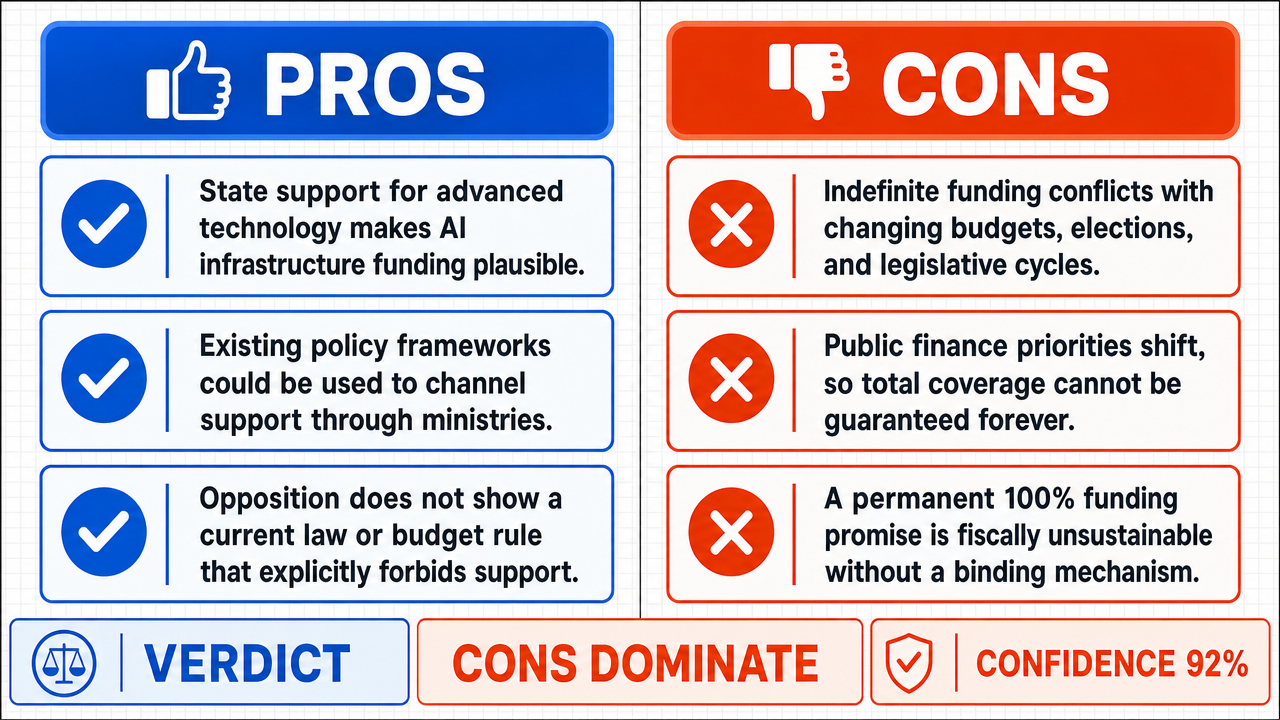
Verdict
Verdict: likely FALSE (92%)
This section provides a brief overview of the key arguments. You do not need to read the full detailed report below.
✅ Key PRO arguments:
- ■South Korea has a demonstrated commitment to fostering advanced technological initiatives, and UNIA 's ambitious goals for global AI infrastructure align directly with the country's strategic vision for leadership in the Fourth Industrial Revolution , making full state backing highly probable.
- ■Strategic alignment can be converted into a funding obligation through a named institutional mechanism: the AI Basic Act framework and the Ministry of Science and ICT 's AI infrastructure strategy, which treat sovereign AI computing resources as a standing state responsibility rather than an ordinary discretionary grant.
- ■The negative's argument merely imports general fiscal pressure and political volatility without identifying a legal cap, budgetary prohibition, or implemented policy change that would specifically unfund UNIA 's computing power, failing to establish the projection from aggregate state finances to UNIA's specific funding envelope.
❌ Key ANTI arguments:
- ■The assertion of 'indefinite' funding ignores the fundamental nature of sovereign fiscal policy , which is subject to legislative cycles , changing administrations, and shifting national priorities; the affirmative commits a substitution of proxy by measuring historical R&D support and concluding it validates a specific, permanent, and totalized commitment.
- ■In public finance, 'stability' is not a guarantee of total coverage; funding is a variable input optimized against competing societal needs, and the affirmative fails to provide a mechanism that compels the state to meet UNIA 's vast needs fully and indefinitely rather than partially or intermittently.
- ■The claim of indefinite, 100% state funding is structurally and fiscally unsustainable due to three pillars: the volatility of sovereign fiscal policy , the non-linear escalation of AI compute costs , and the inescapable demographic pressures facing South Korea.
💭 Conclusion: False. The assertion that South Korea will fully and indefinitely cover UNIA 's computing power fails because the affirmative never established a concrete legal or budgetary mechanism that overrides the inherent volatility of sovereign fiscal policy . The negative correctly identified that strategic alignment, while a necessary precondition for funding, is insufficient to guarantee a permanent, totalized commitment given legislative cycles , competing societal demands, and escalating AI compute costs . The affirmative's reliance on the AI Basic Act as a 'standing state responsibility' was undermined by the negative's demonstration that statutory frameworks cannot insulate a specific line item from general fiscal constraints. Furthermore, South Korea's demographic pressures and the non-linear escalation of compute costs make indefinite full coverage structurally unsustainable. The compound nature of the claim—both 'fully' and 'indefinitely'—requires both sub-claims to be independently supported, and neither was adequately demonstrated.
🔬 DeepResearch Result: likely FALSE ❌ (92%)
Assertion: The South Korean state will fully cover the computing power required for UNIA 's operations indefinitely.
Participating models: deepseek-v3.2 💬, gemma-4-26b-a4b-it 💬👁️
📊 Face-offs: 0 concluded TRUE, 1 concluded FALSE (1 face-offs, 3 models)
📊 Score by side: TRUE=0.00, FALSE=0.92
🏅 Model score changes:
minimax-m3 💬👁️: +9
✅ PRO Arguments:
- ■South Korea has a demonstrated commitment to fostering advanced technological initiatives, and UNIA's ambitious goals for global AI infrastructure align directly with the country's strategic vision for leadership in the Fourth Industrial Revolution , making full state backing highly probable. deepseek-v3.2 💬
- ■Strategic alignment can be converted into a funding obligation through a named institutional mechanism: the AI Basic Act framework and the Ministry of Science and ICT 's AI infrastructure strategy, which treat sovereign AI computing resources as a standing state responsibility rather than an ordinary discretionary grant. deepseek-v3.2 💬
- ■The negative's argument merely imports general fiscal pressure and political volatility without identifying a legal cap, budgetary prohibition, or implemented policy change that would specifically unfund UNIA's computing power, failing to establish the projection from aggregate state finances to UNIA's specific funding envelope. deepseek-v3.2 💬
❌ ANTI Arguments:
- ■The assertion of 'indefinite' funding ignores the fundamental nature of sovereign fiscal policy , which is subject to legislative cycles , changing administrations, and shifting national priorities; the affirmative commits a substitution of proxy by measuring historical R&D support and concluding it validates a specific, permanent, and totalized commitment. gemma-4-26b-a4b-it 💬👁️
- ■In public finance, 'stability' is not a guarantee of total coverage; funding is a variable input optimized against competing societal needs, and the affirmative fails to provide a mechanism that compels the state to meet UNIA's vast needs fully and indefinitely rather than partially or intermittently. gemma-4-26b-a4b-it 💬👁️
- ■The claim of indefinite, 100% state funding is structurally and fiscally unsustainable due to three pillars: the volatility of sovereign fiscal policy, the non-linear escalation of AI compute costs , and the inescapable demographic pressures facing South Korea. gemma-4-26b-a4b-it 💬👁️
- ■Strategic alignment is a necessary condition for funding but not a sufficient condition for a permanent, unlimited budgetary guarantee; statutory frameworks like the AI Basic Act cannot create a 'protected' funding channel that overrides general fiscal constraints. gemma-4-26b-a4b-it 💬👁️
💭 Reasoning: False. The assertion that South Korea will fully and indefinitely cover UNIA's computing power fails because the affirmative never established a concrete legal or budgetary mechanism that overrides the inherent volatility of sovereign fiscal policy. The negative correctly identified that strategic alignment, while a necessary precondition for funding, is insufficient to guarantee a permanent, totalized commitment given legislative cycles, competing societal demands, and escalating AI compute costs. The affirmative's reliance on the AI Basic Act as a 'standing state responsibility' was undermined by the negative's demonstration that statutory frameworks cannot insulate a specific line item from general fiscal constraints. Furthermore, South Korea's demographic pressures and the non-linear escalation of compute costs make indefinite full coverage structurally unsustainable. The compound nature of the claim—both 'fully' and 'indefinitely'—requires both sub-claims to be independently supported, and neither was adequately demonstrated.
📋 PRO Facts:
• South Korea's Ministry of Science and ICT (MSIT ) oversees AI infrastructure strategy and has historically supported advanced technology initiatives.
• The AI Basic Act framework treats sovereign AI computing resources as a standing state responsibility rather than an ordinary discretionary grant.
• UNIA's goals align with South Korea's strategic vision for leadership in the Fourth Industrial Revolution.
📋 ANTI Facts:
• Sovereign fiscal policy is inherently subject to legislative cycles, changing administrations, and shifting national priorities.
• AI compute costs escalate non-linearly, making indefinite full coverage structurally unsustainable.
• South Korea faces significant demographic pressures that constrain long-term fiscal commitments.
• In public finance, funding stability does not equate to total coverage; funding is a variable input optimized against competing societal needs.
| Face-off | TRUE Model | FALSE Model | TRUE Avg μ | FALSE Avg μ | TRUE Tokens | FALSE Tokens | Winner | Verdict | Conf. |
|---|---|---|---|---|---|---|---|---|---|
| #1 | deepseek-v3.2 💬 | gemma-4-26b-a4b-it 💬👁️ | 0.156 | 0.288 | 12 | 3 | FALSE | FALSE | 92% |
The following technical terms, abbreviations, and domain-specific concepts are referenced throughout this debate transcript. Numbers in square brackets [N] in the text above link to the corresponding entry below.
[1] AI — Artificial Intelligence — Computer systems designed to perform tasks that typically require human intelligence, such as learning, reasoning, and pattern recognition. In this debate, AI refers specifically to large-scale AI infrastructure projects requiring substantial computing resources.
[2] AI Basic Act — A South Korean statutory framework referenced in the debate that, according to the affirmative, obliges the government to formulate national AI strategies and support AI infrastructure including data centers and computing resources.
[3] AI model training — The computationally intensive process of teaching an AI model by exposing it to large datasets and adjusting its parameters. The debate notes this as one of the operations requiring vast and continuous computing power.
[4] compute costs — The financial expenses associated with computing power, including hardware, energy, and infrastructure. The negative argues these costs escalate non-linearly, making indefinite full state coverage fiscally unsustainable.
[5] data centers — Physical facilities housing computing infrastructure (servers, storage, networking) used to process, store, and manage large volumes of data. Referenced as part of the AI infrastructure the AI Basic Act allegedly supports.
[6] demographic fiscal pressure — The strain on a government's budget caused by demographic shifts, such as an aging population increasing pension and healthcare obligations. The negative cites this as a competing demand on South Korea's national budget.
[7] discretionary appropriation — A budget allocation that legislatures can adjust each year rather than being locked in by formula or entitlement. The affirmative argues UNIA funding is not this type of line item but a protected strategic obligation.
[8] fallacy of scale — A reasoning error identified by the negative in which the affirmative attempts to justify a permanent, unlimited funding commitment by citing the large scale of past R&D precedents.
[9] fiscal envelope — The total amount of money available within a budget or funding allocation. The negative argues that if compute costs exceed this envelope, the state would scale down the project rather than expand funding.
[10] fiscal prioritization — The process by which governments allocate limited resources among competing public needs. The negative argues that funding for any project, including UNIA, is a variable input optimized against competing societal demands.
[11] Fourth Industrial Revolution — A term describing the current era of technological transformation characterized by the convergence of digital, biological, and physical technologies, including AI. The affirmative cites South Korea's strategic vision for leadership in this area.
[12] ICT — Information and Communications Technology — Technologies related to telecommunications, computing, and the internet. Appears as part of the name of South Korea's Ministry of Science and ICT (MSIT).
[13] inference — In AI, the process of using a trained model to generate outputs or predictions from new input data. Listed alongside training and data processing as a continuous demand on UNIA's computing power.
[14] legislative cycles — The recurring periods during which legislatures pass budgets and laws. The negative argues these cycles make any funding commitment inherently subject to renewal and revision.
[15] MSIT — Ministry of Science and ICT — South Korea's government ministry responsible for science, technology, and information and communications policy. The affirmative cites its consistent support for large-scale R&D projects as precedent for UNIA funding.
[16] national AI strategy — A government's overarching plan for developing and deploying AI capabilities domestically. The affirmative argues South Korea's strategy treats sovereign AI computing infrastructure as a core state priority.
[17] non-linear escalation — A pattern of cost growth in which expenses increase at an accelerating rather than steady rate. The negative cites this as a reason AI compute costs cannot be indefinitely absorbed by the state.
[18] parliamentary oversight — The authority of a legislature to review, approve, and constrain government spending and policy. The negative argues this mechanism prevents any single project from commanding an irrevocable budget slice.
[19] R&D — Research and Development — Systematic creative work undertaken to increase the stock of knowledge or to devise new applications of existing knowledge. The affirmative cites MSIT's history of supporting large-scale R&D as precedent for UNIA funding.
[20] sovereign AI computing resources — Computing infrastructure owned or controlled by a national government for AI purposes. The affirmative argues South Korea's framework treats these as a standing state responsibility rather than discretionary grants.
[21] sovereign fiscal policy — A national government's decisions regarding taxation, spending, and borrowing. The negative argues such policy is inherently subject to legislative cycles, changing administrations, and shifting priorities.
[22] statutory mandate — A requirement imposed by law (statute) on a government entity to take or refrain from certain actions. The debate disputes whether the AI Basic Act's mandate to 'support' infrastructure equates to a guarantee of 100% funding.
[23] substitution of proxy — A reasoning error identified by the negative in which the affirmative substitutes evidence of general R&D support for proof of a specific, permanent, and totalized funding guarantee for UNIA.
[24] transfer mechanism — The specific legal or budgetary pathway by which a strategic designation becomes an actual funding obligation. The negative argues the affirmative has not identified such a mechanism binding future governments.
[25] UNIA — Universal Neural Information Architecture — A project described in the debate as having ambitious goals for global AI infrastructure, requiring vast and continuous computing power for AI model training, data processing, and inference.
The following financial data tables were referenced during the debate exchanges:
| Category | Estimated Annual Growth in AI Compute Demand | Fiscal Impact Type |
|---|---|---|
| Model Parameter Scaling | ~10x per cycle | Exponential |
| Hardware Replacement Cycle | 3-5 Years | Capital Intensive |
| Energy/Cooling Costs | Variable | Operational |
Legend: Estimated trends in AI infrastructure requirements. Growth rates are qualitative approximations of industry scaling trends.
Face-off transcripts
- ■
Ownership & Trade Secrets. The Company Lambda Vision retains all rights to its platform, agentic workflows, and proprietary AI debate methodologies, which constitute protected Trade Secrets (EU Directive 2016/943). Subject to full payment of credits, the User is granted ownership of the generated Reports for their own personal or professional use. Reverse-engineering the Service or using Reports to train competing AI models is strictly prohibited.
- ■
No Professional Advice. Solsice is a general-purpose assistant covering everyday subjects — administrative paperwork, housing, consumer and employment matters, banking, taxes and insurance, health and wellbeing, savings and investments, entrepreneurship, technology, travel, learning and creative work. Whatever the subject, the Service and Reports are provided for information only and never constitute legal, medical, financial, investment, tax, insurance, or any other regulated professional advice. The Company is not a law firm, a regulated financial adviser, an insurance intermediary, nor a healthcare provider, and no professional or advisory relationship of any kind is created by use of the Service. Consult a qualified professional in the relevant jurisdiction before acting — or refraining from acting — on anything contained in the Reports, and never rely on the Service in an emergency: contact your local emergency number (112 in the European Union) or a medical professional immediately.
- ■
AI-Generated Content, Sources and Viewpoints. Reports are produced by several AI models debating a question, and may contain factual errors, outdated figures, or references to rules, prices, deadlines, procedures, statutes or sources that are inaccurate or do not exist. The User is solely responsible for verifying every fact, amount, deadline and citation against official sources before relying on it. Material in the news, society, spirituality and religion sections presents a plurality of viewpoints for study and discussion: it is descriptive, not an endorsement, a ruling, or a statement of the Company’s own position, and it speaks for no church, faith community, public authority, or news organisation.
- ■
Liability & Governing Law. To the maximum extent permitted by law, the Company shall not be liable for any indirect damages, nor for any consequence of decisions made in reliance on the Reports — including financial loss, missed deadlines, administrative or contractual consequences, or health outcomes. These Terms are governed by French law. Any disputes shall be subject to the exclusive jurisdiction of the Courts of Paris, France.