
The South Korean government's funding strategy for UNIA will successfully create new 'champion' companies comparable to Samsung or Hyundai.
AI debate verdict and arguments
⚠️ AI-generated information only; not professional advice
Completed October 11, 2026
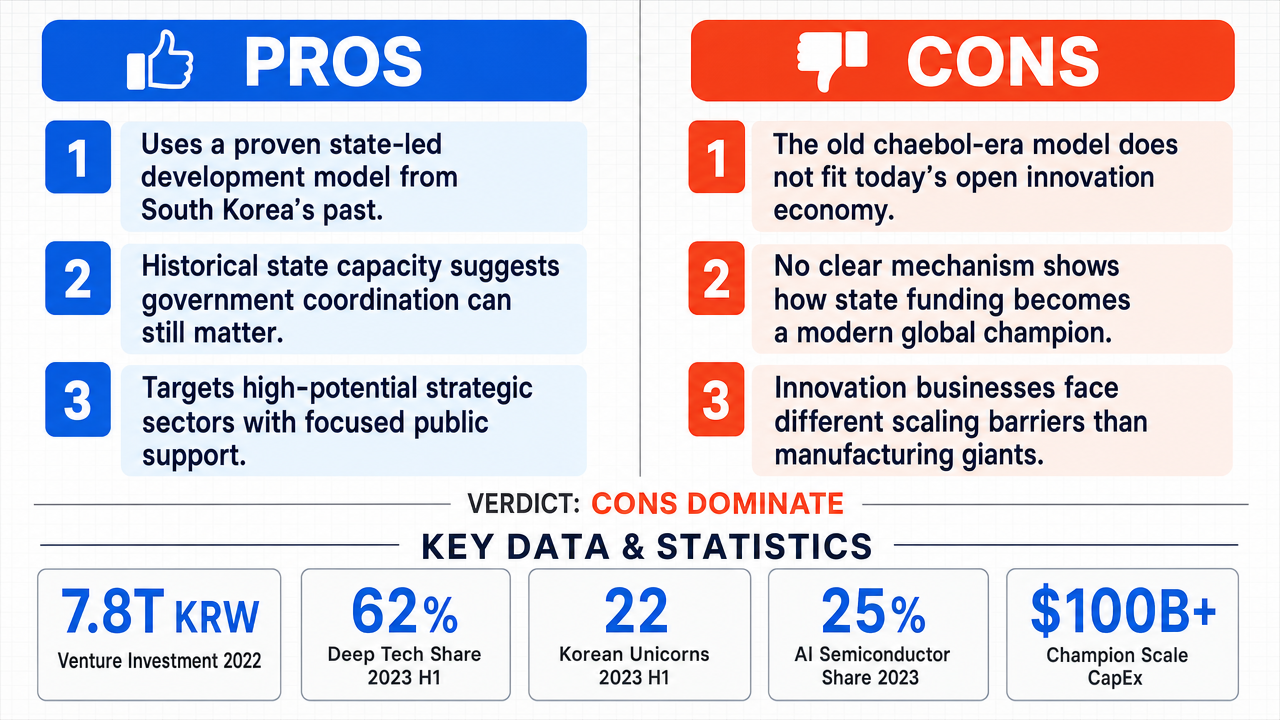
Verdict
Verdict: likely FALSE (84%)
This section provides a brief overview of the key arguments. You do not need to read the full detailed report below.
✅ Key PRO arguments:
- ■The UNIA strategy directly applies the proven 'Miracle on the Han River ' playbook of state-led industrial development—directed credit , protection of infant industries , and ambitious national projects—which historically transformed local firms like Samsung and Hyundai into global leaders, making it a credible mechanism for producing new champions.
- ■The negative's claim that the historical playbook is irrelevant due to a changed economic epoch is internally contradictory: it accepts the state's historical capacity to create champions while asserting modern impotence without identifying the precise mechanism by which that capacity was lost.
- ■The strategy represents an adaptive application of a proven model, focusing state resources on high-potential startups in strategic sectors, which preserves the core logic of state-led champion creation while updating it for the innovation economy .
❌ Key ANTI arguments:
- ■Relying on the 'Miracle on the Han River ' is a fundamental category error : Samsung and Hyundai were built under a closed, state-directed, manufacturing-heavy economy with high barriers to entry and heavy protectionism , which is structurally incompatible with the modern, decentralized, globalized innovation economy that UNIA targets.
- ■The affirmative failed to provide a mechanism or transfer operator explaining how the state's historical capacity to direct capital translates into the modern innovation economy , leaving the causal link between state-led investment and industrial leadership unproven.
- ■The shift from manufacturing to innovation represents a qualitative barrier that breaks the causal chain between state funding and champion creation, because modern innovation depends on globalized digital networks , rapid diffusion, and decentralized entrepreneurship that centralized state direction cannot replicate.
💭 Conclusion: The debate verdict holds that South Korea's UNIA funding strategy is unlikely to produce new 'champion' companies comparable to Samsung or Hyundai. The winning side established that the affirmative's reliance on the 'Miracle on the Han River ' constitutes a category error , because the historical conditions that produced Samsung and Hyundai—a closed, state-directed, manufacturing-heavy economy with high barriers to entry —do not map onto the modern, decentralized, globalized innovation economy . The affirmative failed to supply a credible mechanism or transfer operator explaining how state-directed capital could replicate past champion-creation outcomes under fundamentally different structural conditions. While the affirmative's historical analogy retains some plausibility as a directional indicator, it is insufficient as a predictive model.
🔬 DeepResearch Result: likely FALSE ❌ (84%)
Assertion: The South Korean government's funding strategy for UNIA will successfully create new 'champion' companies comparable to Samsung or Hyundai.
Participating models: deepseek-v3.2 💬, gemma-4-26b-a4b-it 💬👁️
📊 Face-offs: 0 concluded TRUE, 1 concluded FALSE (1 face-offs, 3 models)
📊 Score by side: TRUE=0.00, FALSE=0.84
🏅 Model score changes:
minimax-m3 💬👁️: +8
✅ PRO Arguments:
- ■The UNIA strategy directly applies the proven 'Miracle on the Han River ' playbook of state-led industrial development—directed credit , protection of infant industries , and ambitious national projects—which historically transformed local firms like Samsung and Hyundai into global leaders, making it a credible mechanism for producing new champions. deepseek-v3.2 💬
- ■The negative's claim that the historical playbook is irrelevant due to a changed economic epoch is internally contradictory: it accepts the state's historical capacity to create champions while asserting modern impotence without identifying the precise mechanism by which that capacity was lost. deepseek-v3.2 💬
- ■The strategy represents an adaptive application of a proven model, focusing state resources on high-potential startups in strategic sectors, which preserves the core logic of state-led champion creation while updating it for the innovation economy . deepseek-v3.2 💬
❌ ANTI Arguments:
- ■Relying on the 'Miracle on the Han River' is a fundamental category error : Samsung and Hyundai were built under a closed, state-directed, manufacturing-heavy economy with high barriers to entry and heavy protectionism , which is structurally incompatible with the modern, decentralized, globalized innovation economy that UNIA targets. gemma-4-26b-a4b-it 💬👁️
- ■The affirmative failed to provide a mechanism or transfer operator explaining how the state's historical capacity to direct capital translates into the modern innovation economy, leaving the causal link between state-led investment and industrial leadership unproven. gemma-4-26b-a4b-it 💬👁️
- ■The shift from manufacturing to innovation represents a qualitative barrier that breaks the causal chain between state funding and champion creation, because modern innovation depends on globalized digital networks , rapid diffusion, and decentralized entrepreneurship that centralized state direction cannot replicate. gemma-4-26b-a4b-it 💬👁️
💭 Reasoning: The debate verdict holds that South Korea's UNIA funding strategy is unlikely to produce new 'champion' companies comparable to Samsung or Hyundai. The winning side established that the affirmative's reliance on the 'Miracle on the Han River' constitutes a category error, because the historical conditions that produced Samsung and Hyundai—a closed, state-directed, manufacturing-heavy economy with high barriers to entry—do not map onto the modern, decentralized, globalized innovation economy. The affirmative failed to supply a credible mechanism or transfer operator explaining how state-directed capital could replicate past champion-creation outcomes under fundamentally different structural conditions. While the affirmative's historical analogy retains some plausibility as a directional indicator, it is insufficient as a predictive model.
📋 PRO Facts:
• South Korea's 'Miracle on the Han River' economic transformation was built through directed credit, protection of infant industries, and ambitious national projects.
• Companies like Samsung and Hyundai were propelled from local firms to global prominence through state-led industrial policy .
• The UNIA initiative focuses state resources on high-potential startups in strategic sectors.
📋 ANTI Facts:
• Samsung and Hyundai's historical success was predicated on a closed, state-directed industrial era with high barriers to entry and heavy protectionism.
• The modern innovation economy is defined by decentralized, globalized structures.
• The affirmative did not provide a mechanism or transfer operator linking historical state-directed capacity to modern innovation-economy outcomes.
| Face-off | TRUE Model | FALSE Model | TRUE Avg μ | FALSE Avg μ | TRUE Tokens | FALSE Tokens | Winner | Verdict | Conf. |
|---|---|---|---|---|---|---|---|---|---|
| #1 | deepseek-v3.2 💬 | gemma-4-26b-a4b-it 💬👁️ | 0.401 | 0.254 | 12 | 3 | TRUE | FALSE | 84% |
The following technical terms, abbreviations, and domain-specific concepts are referenced throughout this debate transcript. Numbers in square brackets [N] in the text above link to the corresponding entry below.
[1] AI — Artificial Intelligence — A field of computer science focused on creating systems capable of performing tasks that typically require human intelligence.
[2] barriers to entry — Obstacles or conditions that make it difficult for new firms to enter a market or industry.
[3] biotechnology — The application of biological systems and organisms to develop products and technologies.
[4] category error — A philosophical or logical error in which something is assigned to a category to which it does not belong, or properties of one category are inappropriately applied to another.
[5] causal link — A relationship in which one event or variable directly produces or influences another.
[6] decentralized capital flows — The movement of investment funds across many independent sources rather than being concentrated in centralized institutions.
[7] deep tech — Technology based on substantial scientific or engineering advances, often involving fields such as AI, biotechnology, or semiconductors.
[8] directed credit — A government policy of channeling credit and loans to specific industries or firms deemed strategically important.
[9] globalized digital networks — Interconnected digital systems spanning multiple countries, enabling cross-border data exchange and coordination.
[10] high-velocity sectors — Industries characterized by rapid change, fast iteration, and quick movement of capital and talent.
[11] industrial policy — Government strategy aimed at influencing the development and structure of specific industries within an economy.
[12] infant industries — Newly established domestic industries that proponents argue need temporary protection from international competition to develop.
[13] infrastructure development — Investment in foundational systems and facilities, such as transportation, energy, or digital networks, that support economic activity.
[14] innovation economy — An economy in which growth is driven primarily by knowledge, creativity, and the development of new products and processes.
[15] intellectual property — Legal rights protecting creations of the mind, such as inventions, literary and artistic works, designs, and symbols.
[16] knowledge-intensive sectors — Industries that rely heavily on specialized expertise, research, and intellectual capital rather than physical inputs.
[17] Korean New Deal 2.0 — A South Korean government economic program referenced in the debate as outlining a commitment of 15 trillion won to foster innovative growth engines.
[18] Miracle on the Han River — A term used in the debate to describe South Korea's historical economic transformation, characterized by directed credit, protection of infant industries, and ambitious national projects.
[19] national champions — Large domestic corporations that receive government support and are considered strategically important to a nation's economic interests.
[20] pick winners — A government policy approach of selecting specific companies or industries to support with subsidies, credit, or other advantages.
[21] private-market valuation — The estimated worth of a company that is not publicly traded, often based on funding rounds or comparable transactions.
[22] protectionism — Trade policies that shield domestic industries from foreign competition through tariffs, quotas, or other barriers.
[23] proxy — A variable or measure used as a substitute for another concept that is difficult to measure directly.
[24] qualitative barrier — A non-quantitative obstacle or constraint that affects outcomes, such as institutional, cultural, or structural factors.
[25] R&D — Research and Development — Systematic creative work undertaken to increase knowledge or devise new applications.
[26] regulatory sandboxes — Controlled regulatory environments that allow businesses to test new products or services under relaxed regulatory requirements.
[27] semiconductors — Materials or electronic components, such as computer chips, that have electrical conductivity between conductors and insulators.
[28] software iteration — The process of repeatedly refining and updating software through successive versions or releases.
[29] supply chains — Networks of organizations, people, activities, and resources involved in producing and distributing a product or service.
[30] systemic economic weight — The broad, economy-wide impact or significance of a firm or sector, beyond its direct financial metrics.
[31] talent cultivation — Policies and programs aimed at developing a skilled workforce through education, training, and retention.
[32] transfer operator — In the debate, used metaphorically to refer to a mechanism for translating capability or success from one context to another; in mathematics, a linear operator used in dynamical systems and ergodic theory.
[33] UNIA — Unicorn & Next Innovation Accelerator — A South Korean government initiative referenced in the debate as targeting high-potential startups in strategic sectors such as AI, semiconductors, and biotechnology.
[34] unicorn — A privately held startup company valued at over $1 billion.
[35] venture investment — Investment in early-stage, high-growth companies in exchange for equity, typically involving higher risk in pursuit of higher returns.
[36] won — The official currency of South Korea.
The following financial data tables were referenced during the debate exchanges:
| Metric | 2021 | 2022 | 2023 (H1) | Growth (2021 to 2023 H1 annualized) |
|---|---|---|---|---|
| Total Venture Investment (trillion KRW) | 6.1 | 7.8 | 4.2 | +31.5% |
| Deep Tech Share of Investment | 55% | 58% | 62% | +7 p.p. |
| Number of Korean Unicorns | 12 | 18 | 22 | +35.4% |
Legend: South Korea's venture capital landscape showing rising total investment, increasing concentration in deep tech sectors, and growth in the number of unicorn companies (pre-IPO startups valued over $1B). Data from Ministry of SMEs and Startups reports (2021-2023). KRW = Korean Won; p.p. = percentage points.
| Sector | 2023 Investment Share (Est.) | Required Scale for "Champion" Status | Gap Analysis |
|---|---|---|---|
| AI Semiconductors | 25% | $100B+ CapEx | Massive Deficit |
| Biotechnology | 15% | $50B+ R&D | Massive Deficit |
| Mobility/Platform | 12% | $20B+ Market Cap | Moderate Deficit |
Legend: Estimated sectoral concentration of Korean venture capital vs. the approximate capital intensity required to reach the scale of a global industrial champion. Data synthesized from sector trends and historical Chaebol capital requirements.
Face-off transcripts
- ■
Ownership & Trade Secrets. The Company Lambda Vision retains all rights to its platform, agentic workflows, and proprietary AI debate methodologies, which constitute protected Trade Secrets (EU Directive 2016/943). Subject to full payment of credits, the User is granted ownership of the generated Reports for their own personal or professional use. Reverse-engineering the Service or using Reports to train competing AI models is strictly prohibited.
- ■
No Professional Advice. Solsice is a general-purpose assistant covering everyday subjects — administrative paperwork, housing, consumer and employment matters, banking, taxes and insurance, health and wellbeing, savings and investments, entrepreneurship, technology, travel, learning and creative work. Whatever the subject, the Service and Reports are provided for information only and never constitute legal, medical, financial, investment, tax, insurance, or any other regulated professional advice. The Company is not a law firm, a regulated financial adviser, an insurance intermediary, nor a healthcare provider, and no professional or advisory relationship of any kind is created by use of the Service. Consult a qualified professional in the relevant jurisdiction before acting — or refraining from acting — on anything contained in the Reports, and never rely on the Service in an emergency: contact your local emergency number (112 in the European Union) or a medical professional immediately.
- ■
AI-Generated Content, Sources and Viewpoints. Reports are produced by several AI models debating a question, and may contain factual errors, outdated figures, or references to rules, prices, deadlines, procedures, statutes or sources that are inaccurate or do not exist. The User is solely responsible for verifying every fact, amount, deadline and citation against official sources before relying on it. Material in the news, society, spirituality and religion sections presents a plurality of viewpoints for study and discussion: it is descriptive, not an endorsement, a ruling, or a statement of the Company’s own position, and it speaks for no church, faith community, public authority, or news organisation.
- ■
Liability & Governing Law. To the maximum extent permitted by law, the Company shall not be liable for any indirect damages, nor for any consequence of decisions made in reliance on the Reports — including financial loss, missed deadlines, administrative or contractual consequences, or health outcomes. These Terms are governed by French law. Any disputes shall be subject to the exclusive jurisdiction of the Courts of Paris, France.