
The 'Son of a Dungeon' subscription price increase for new subscribers will effectively maintain the independence and motivation of its creators.
AI debate verdict and arguments
⚠️ AI-generated information only; not professional advice
Completed October 8, 2026
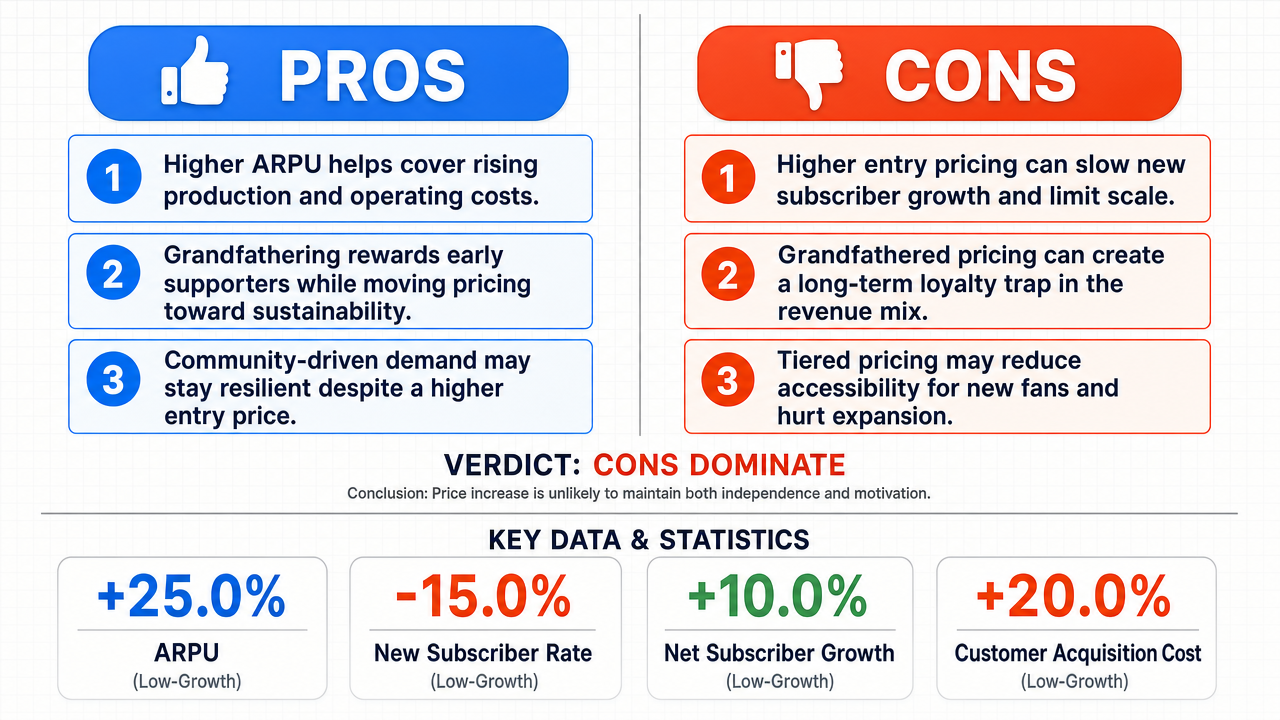
Verdict
Verdict: likely FALSE (78%)
This section provides a brief overview of the key arguments. You do not need to read the full detailed report below.
✅ Key PRO arguments:
- ■A price increase for new subscribers directly augments average revenue per user (ARPU ), which is critical for covering rising operational costs (equipment, software licenses, guest talent fees) without seeking external investors or advertisers, thereby preserving creator independence.
- ■The grandfathering strategy is a tactful balance that rewards early supporters while progressively shifting the revenue base toward a sustainable market rate , protecting community loyalty alongside financial growth.
- ■Demand for established, community-driven projects like 'Son of a Dungeon' is relatively inelastic because the subscription is not a commodity but a relationship-based support for unique, non-fungible content, so price hikes will not meaningfully suppress acquisition.
❌ Key ANTI arguments:
- ■Increasing prices for new subscribers creates a 'barrier to entry ' that can stifle the growth needed to achieve the scale required for independence; if the price exceeds perceived marginal value , new-member acquisition will stagnate or shrink.
- ■The grandfathering strategy creates a 'loyalty trap ' for existing subscribers: as the proportion of grandfathered members grows relative to new entrants, the project becomes increasingly dependent on a shrinking pool of high-ARPU new subscribers to subsidize a massive, low-margin legacy base , undermining long-term financial independence.
- ■The tiered pricing model creates a 'prestige/accessibility barrier' for new subscribers, where higher entry costs stifle the growth required to achieve scale, threatening both independence and creator motivation.
💭 Conclusion: False. The price increase for new subscribers will not effectively maintain both independence and motivation of the 'Son of a Dungeon' creators. The FALSE side demonstrated that the grandfathering strategy creates a structural 'loyalty trap ,' in which a growing low-margin legacy base must be subsidized by a shrinking pool of high-ARPU new subscribers, eroding long-term financial stability rather than securing it. The FALSE side further established that higher entry prices create a prestige/accessibility barrier that suppresses the new-subscriber acquisition needed to reach the scale that independence requires. Because the claim is compound (independence AND motivation), and the motivation sub-claim was only indirectly addressed by either side, confidence in the FALSE verdict is moderated rather than reported higher. The structural risks identified by the FALSE side outweigh the ARPU gains emphasized by the TRUE side, because the projected Low-Growth Scenario shows a -15.0% new-subscriber acquisition rate and -10.0% net subscriber growth alongside only a +25.0% ARPU gain, meaning the subscriber base itself contracts even as per-user revenue rises.
🔬 DeepResearch Result: likely FALSE ❌ (78%)
Assertion: The 'Son of a Dungeon' subscription price increase for new subscribers will effectively maintain the independence and motivation of its creators.
Participating models: deepseek-v3.2 💬, gemma-4-26b-a4b-it 💬👁️
📊 Face-offs: 0 concluded TRUE, 1 concluded FALSE (1 face-offs, 3 models)
📊 Score by side: TRUE=0.00, FALSE=0.78
🏅 Model score changes:
minimax-m3 💬👁️: +8
✅ PRO Arguments:
- ■A price increase for new subscribers directly augments average revenue per user (ARPU ), which is critical for covering rising operational costs (equipment, software licenses, guest talent fees) without seeking external investors or advertisers, thereby preserving creator independence. deepseek-v3.2 💬
- ■The grandfathering strategy is a tactful balance that rewards early supporters while progressively shifting the revenue base toward a sustainable market rate , protecting community loyalty alongside financial growth. deepseek-v3.2 💬
- ■Demand for established, community-driven projects like 'Son of a Dungeon' is relatively inelastic because the subscription is not a commodity but a relationship-based support for unique, non-fungible content, so price hikes will not meaningfully suppress acquisition. deepseek-v3.2 💬
- ■Sustainable revenue is the foundational entrepreneurial enabler of creator independence, and price is a direct lever for financial health in a single-revenue-stream subscription model. deepseek-v3.2 💬
- ■Higher ARPU provides the financial cushion that allows creators to make content decisions based purely on artistic vision rather than commercial pressure. deepseek-v3.2 💬
❌ ANTI Arguments:
- ■Increasing prices for new subscribers creates a 'barrier to entry ' that can stifle the growth needed to achieve the scale required for independence; if the price exceeds perceived marginal value , new-member acquisition will stagnate or shrink. gemma-4-26b-a4b-it 💬👁️
- ■The grandfathering strategy creates a 'loyalty trap ' for existing subscribers: as the proportion of grandfathered members grows relative to new entrants, the project becomes increasingly dependent on a shrinking pool of high-ARPU new subscribers to subsidize a massive, low-margin legacy base , undermining long-term financial independence. gemma-4-26b-a4b-it 💬👁️
- ■The tiered pricing model creates a 'prestige/accessibility barrier' for new subscribers, where higher entry costs stifle the growth required to achieve scale, threatening both independence and creator motivation. gemma-4-26b-a4b-it 💬👁️
- ■The structural instability affects both segments simultaneously: legacy subscribers face a growing revenue gap while new entrants face higher costs, producing a dual-threat to long-term independence rather than a balanced trade-off. gemma-4-26b-a4b-it 💬👁️
- ■Reliance on projected revenue growth is fundamentally flawed because it ignores price elasticity of demand within niche creator communities, where small subscriber pools amplify the impact of any acquisition slowdown. gemma-4-26b-a4b-it 💬👁️
💭 Reasoning: False. The price increase for new subscribers will not effectively maintain both independence and motivation of the 'Son of a Dungeon' creators. The FALSE side demonstrated that the grandfathering strategy creates a structural 'loyalty trap,' in which a growing low-margin legacy base must be subsidized by a shrinking pool of high-ARPU new subscribers, eroding long-term financial stability rather than securing it. The FALSE side further established that higher entry prices create a prestige/accessibility barrier that suppresses the new-subscriber acquisition needed to reach the scale that independence requires. Because the claim is compound (independence AND motivation), and the motivation sub-claim was only indirectly addressed by either side, confidence in the FALSE verdict is moderated rather than reported higher. The structural risks identified by the FALSE side outweigh the ARPU gains emphasized by the TRUE side, because the projected Low-Growth Scenario shows a -15.0% new-subscriber acquisition rate and -10.0% net subscriber growth alongside only a +25.0% ARPU gain, meaning the subscriber base itself contracts even as per-user revenue rises.
📋 PRO Facts:
• A price increase directly raises average revenue per user (ARPU) in a subscription model.
• Operational costs for creator-owned media projects are rising and must be covered by sustainable revenue.
• Grandfathering preserves the existing subscription price for current members while raising it for new entrants.
📋 ANTI Facts:
• Price elasticity of demand in niche creator communities can cause new-subscriber acquisition to drop when prices rise.
• A tiered pricing model creates a growing revenue gap between grandfathered subscribers and new subscribers paying the higher rate.
• Higher entry prices can function as a barrier to entry that suppresses the subscriber-base growth required for scale.
• A shrinking pool of high-ARPU new subscribers must subsidize a growing low-margin legacy base under grandfathering, creating structural revenue instability.
| Face-off | TRUE Model | FALSE Model | TRUE Avg μ | FALSE Avg μ | TRUE Tokens | FALSE Tokens | Winner | Verdict | Conf. |
|---|---|---|---|---|---|---|---|---|---|
| #1 | deepseek-v3.2 💬 | gemma-4-26b-a4b-it 💬👁️ | 0.396 | 0.229 | 12 | 3 | TRUE | FALSE | 78% |
The following technical terms, abbreviations, and domain-specific concepts are referenced throughout this debate transcript. Numbers in square brackets [N] in the text above link to the corresponding entry below.
[1] actual-play — A format of entertainment content where participants play tabletop role-playing games for an audience, often streamed or recorded.
[2] ARPU — Average Revenue Per User — A metric that measures the average revenue generated per user or subscriber, commonly used in subscription-based businesses to assess financial performance.
[3] barrier to entry — An economic concept referring to obstacles such as high prices that prevent new customers from accessing a product or new competitors from entering a market.
[4] CAC — Customer Acquisition Cost — The cost associated with acquiring a new customer or subscriber, including marketing and sales expenses.
[5] churn — The rate at which customers or subscribers discontinue their subscriptions or stop doing business with a company.
[6] commodity — An economic term for goods or services that are interchangeable with others of the same type and valued primarily by price rather than unique characteristics.
[7] creator economy — The economic ecosystem consisting of independent content creators, their audiences, and the platforms and tools that enable them to produce and monetize content.
[8] creator-owned — A business structure where creators retain ownership and control over their content and intellectual property, rather than working for a studio or publisher.
[9] grandfathering — A pricing strategy where existing subscribers or customers are allowed to continue paying the old (lower) price after a price increase is applied to new subscribers.
[10] inelastic demand — An economic concept describing a situation where demand for a product or service changes relatively little in response to price changes.
[11] legacy base — In the context of this debate, refers to the existing subscriber base that remains locked into older pricing terms through a grandfathering strategy.
[12] low-margin — A business descriptor indicating that a customer segment or product generates relatively little profit per unit of revenue.
[13] loyalty trap — A concept raised in the debate referring to a situation where grandfathering existing subscribers at lower prices creates a growing revenue gap that undermines financial stability. The affirmative disputes this characterization.
[14] marginal value — The additional value or benefit a consumer receives from consuming one more unit of a good or service.
[15] market rate — The prevailing price for a good or service in a competitive market at a given time.
[16] niche markets — Specialized segments of a market focused on a specific audience or product category with relatively limited size and distinct preferences.
[17] non-fungible — An economic term describing items or content that are unique and not interchangeable with others of the same type.
[18] operational autonomy — The ability of an organization or creator to make decisions and operate independently without external control or influence from investors, sponsors, or other parties.
[19] prestige trap — A concept raised in the debate referring to a situation where price increases create a perception of declining prestige or exclusivity that harms the brand. The affirmative disputes this characterization.
[20] price elasticity of demand — An economic measure of how sensitive the quantity demanded of a good or service is to a change in its price.
[21] price sensitivity — The degree to which the price of a product or service influences consumer purchasing decisions.
[22] price-sensitive — An economic descriptor for consumers or market segments whose purchasing decisions are strongly influenced by price changes.
[23] revenue stream — A source of income or revenue for a business or individual, such as subscriptions, advertising, or product sales.
[24] runway — In business and finance, the amount of time a company or project can continue operating before exhausting its available cash, given its current burn rate.
[25] structural vulnerability — A weakness in the fundamental structure of a business model that creates risk or instability, often arising from dependencies or imbalances in revenue composition.
[26] subscriber-based economies — Business models where revenue is generated primarily through recurring subscriptions from customers rather than one-time purchases.
[27] tiered exclusivity — A pricing strategy where different levels of access or content are offered at different price points, with higher tiers offering exclusive benefits not available to lower tiers.
[28] tiered pricing model — A pricing strategy where products or services are offered at multiple price points, typically with different features, benefits, or levels of access at each tier.
[29] TTRPG — Table-Top Role Playing Game — A type of game where players assume the roles of characters and collaboratively create narratives, typically using dice, rulebooks, and a game master.
[30] willingness to pay — The maximum price a consumer is willing to pay for a good or service, reflecting their perceived value of the offering.
The following financial data tables were referenced during the debate exchanges:
| Metric | Low-Growth Scenario | High-Growth Scenario (Affirmative) | Impact on Independence |
|---|---|---|---|
| New Subscriber Acquisition Rate | -15.0% | +5.0% | Negative |
| Average Revenue Per User (ARPU) | +25.0% | +25.0% | Positive |
| Net Subscriber Growth | -10.0% | +10.0% | Variable |
| Customer Acquisition Cost (CAC) | +20.0% | +5.0% | Negative |
Legend: Comparative projection of subscriber dynamics following a 25% price increase. "Low-Growth" assumes high price elasticity; "High-Growth" assumes the affirmative's model. All values represent projected change relative to current baseline.
Face-off transcripts
- ■
Ownership & Trade Secrets. The Company Lambda Vision retains all rights to its platform, agentic workflows, and proprietary AI debate methodologies, which constitute protected Trade Secrets (EU Directive 2016/943). Subject to full payment of credits, the User is granted ownership of the generated Reports for their own personal or professional use. Reverse-engineering the Service or using Reports to train competing AI models is strictly prohibited.
- ■
No Professional Advice. Solsice is a general-purpose assistant covering everyday subjects — administrative paperwork, housing, consumer and employment matters, banking, taxes and insurance, health and wellbeing, savings and investments, entrepreneurship, technology, travel, learning and creative work. Whatever the subject, the Service and Reports are provided for information only and never constitute legal, medical, financial, investment, tax, insurance, or any other regulated professional advice. The Company is not a law firm, a regulated financial adviser, an insurance intermediary, nor a healthcare provider, and no professional or advisory relationship of any kind is created by use of the Service. Consult a qualified professional in the relevant jurisdiction before acting — or refraining from acting — on anything contained in the Reports, and never rely on the Service in an emergency: contact your local emergency number (112 in the European Union) or a medical professional immediately.
- ■
AI-Generated Content, Sources and Viewpoints. Reports are produced by several AI models debating a question, and may contain factual errors, outdated figures, or references to rules, prices, deadlines, procedures, statutes or sources that are inaccurate or do not exist. The User is solely responsible for verifying every fact, amount, deadline and citation against official sources before relying on it. Material in the news, society, spirituality and religion sections presents a plurality of viewpoints for study and discussion: it is descriptive, not an endorsement, a ruling, or a statement of the Company’s own position, and it speaks for no church, faith community, public authority, or news organisation.
- ■
Liability & Governing Law. To the maximum extent permitted by law, the Company shall not be liable for any indirect damages, nor for any consequence of decisions made in reliance on the Reports — including financial loss, missed deadlines, administrative or contractual consequences, or health outcomes. These Terms are governed by French law. Any disputes shall be subject to the exclusive jurisdiction of the Courts of Paris, France.