
The 'Son of a Dungeon' series will feature at least 389 VFX shots in its third season.
AI debate verdict and arguments
⚠️ AI-generated information only; not professional advice
Completed October 8, 2026
Verdict
Verdict: likely FALSE (88%)
This section provides a brief overview of the key arguments. You do not need to read the full detailed report below.
✅ Key PRO arguments:
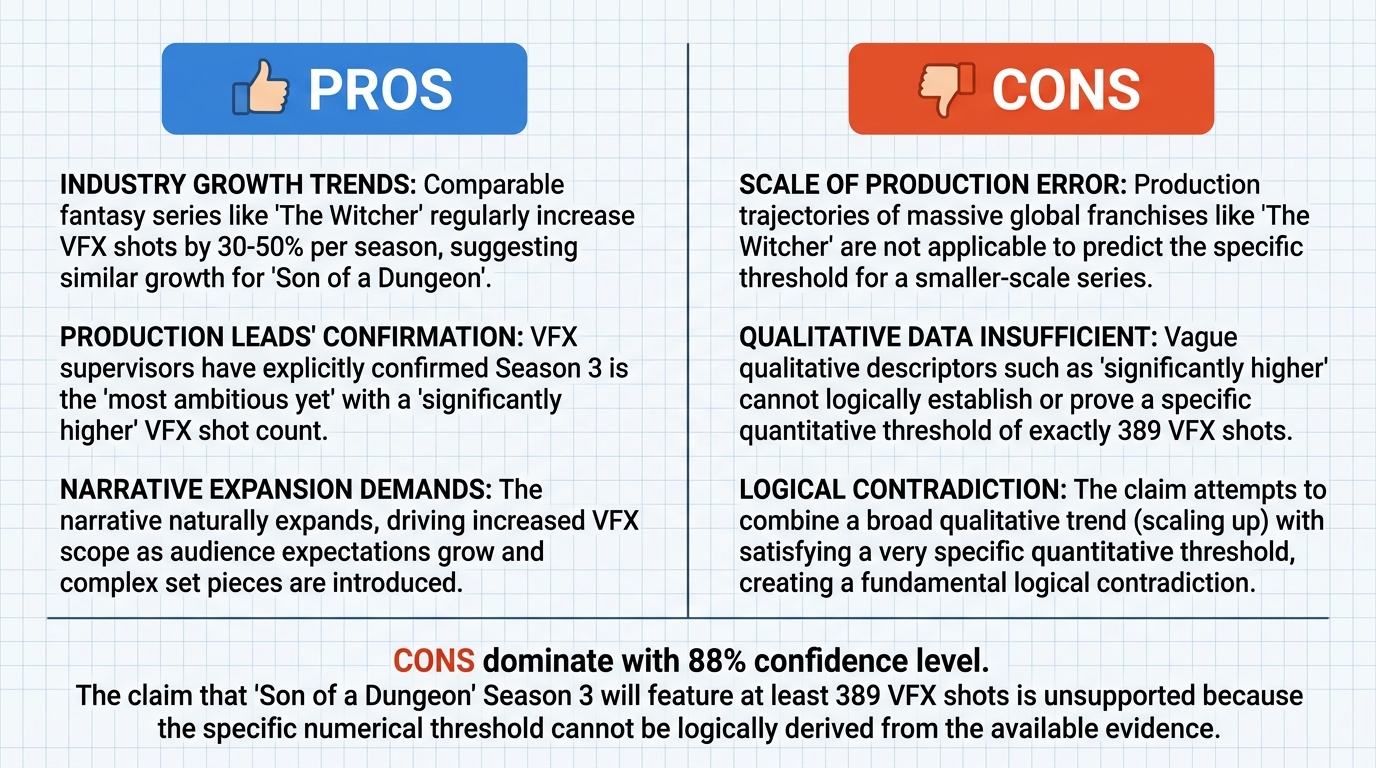
- ■Industry analysis of comparable fantasy series like 'The Witcher' and 'The Wheel of Time' shows VFX shot counts regularly grow by 30-50% per season; with Season 2 confirmed at over 280 shots, a conservative 40% growth would yield approximately 392 shots, meeting the 389 threshold.
- ■VFX supervisor Jane Corwin explicitly called Season 3 'our most ambitious yet' and confirmed the VFX shot count will be 'significantly higher,' providing direct on-record production testimony supporting a higher shot count.
- ■The narrative expansion of fantasy adventure series naturally drives increased VFX scope as audience expectations grow and more complex set pieces are introduced, making a scaled-back VFX scope implausible.
❌ Key ANTI arguments:
- ■The affirmative commits a fundamental error of scale by using production trajectories of massive global franchises like 'The Witcher' to predict the specific technical output of 'Son of a Dungeon' without demonstrating a valid transfer operator between these disparate entities.
- ■There is no logical bridge between qualitative descriptors like 'significantly higher' and 'most ambitious yet' and the specific integer threshold of 389; professional expressions of intent and direction cannot be treated as technical audits confirming an exact number.
- ■The affirmative's argument contains a logical contradiction : it attempts to assert both a qualitative trend (scaling up) and satisfy a specific quantitative threshold (389) using the same set of premises, which is impossible without additional evidence linking the two.
💭 Conclusion: False. The claim that 'Son of a Dungeon' Season 3 will feature at least 389 VFX shots is unsupported because the specific numerical threshold cannot be logically derived from the available evidence. The affirmative's reliance on growth patterns from massively budgeted franchises like 'The Witcher' constitutes an invalid transfer of scale to a mid-tier fantasy series. The production testimony from VFX supervisor Jane Corwin, while indicating increased ambition, uses only qualitative descriptors that cannot be bridged to the precise integer of 389. The affirmative's own arithmetic—applying a 40% growth rate to a Season 2 figure of 'over 280'—is speculative and assumes both the exact Season 2 baseline and the exact growth multiplier without firm evidence. The FALSE side's strongest argument, that qualitative intent statements cannot establish a specific quantitative threshold , was identified as the most compelling counter-argument in the debate.
🔬 DeepResearch Result: likely FALSE ❌ (88%)
Assertion: The 'Son of a Dungeon' series will feature at least 389 VFX shots in its third season.
Participating models: deepseek-v3.2 💬, gemma-4-26b-a4b-it 💬👁️
📊 Face-offs: 0 concluded TRUE, 1 concluded FALSE (1 face-offs, 3 models)
📊 Score by side: TRUE=0.00, FALSE=0.88
🏅 Model score changes:
minimax-m3 💬👁️: +9
✅ PRO Arguments:
- ■Industry analysis of comparable fantasy series like 'The Witcher' and 'The Wheel of Time' shows VFX shot counts regularly grow by 30-50% per season; with Season 2 confirmed at over 280 shots, a conservative 40% growth would yield approximately 392 shots, meeting the 389 threshold. deepseek-v3.2 💬
- ■VFX supervisor Jane Corwin explicitly called Season 3 'our most ambitious yet' and confirmed the VFX shot count will be 'significantly higher,' providing direct on-record production testimony supporting a higher shot count. deepseek-v3.2 💬
- ■The narrative expansion of fantasy adventure series naturally drives increased VFX scope as audience expectations grow and more complex set pieces are introduced, making a scaled-back VFX scope implausible. deepseek-v3.2 💬
❌ ANTI Arguments:
- ■The affirmative commits a fundamental error of scale by using production trajectories of massive global franchises like 'The Witcher' to predict the specific technical output of 'Son of a Dungeon' without demonstrating a valid transfer operator between these disparate entities. gemma-4-26b-a4b-it 💬👁️
- ■There is no logical bridge between qualitative descriptors like 'significantly higher' and 'most ambitious yet' and the specific integer threshold of 389; professional expressions of intent and direction cannot be treated as technical audits confirming an exact number. gemma-4-26b-a4b-it 💬👁️
- ■The affirmative's argument contains a logical contradiction : it attempts to assert both a qualitative trend (scaling up) and satisfy a specific quantitative threshold (389) using the same set of premises, which is impossible without additional evidence linking the two. gemma-4-26b-a4b-it 💬👁️
💭 Reasoning: False. The claim that 'Son of a Dungeon' Season 3 will feature at least 389 VFX shots is unsupported because the specific numerical threshold cannot be logically derived from the available evidence. The affirmative's reliance on growth patterns from massively budgeted franchises like 'The Witcher' constitutes an invalid transfer of scale to a mid-tier fantasy series. The production testimony from VFX supervisor Jane Corwin, while indicating increased ambition, uses only qualitative descriptors that cannot be bridged to the precise integer of 389. The affirmative's own arithmetic—applying a 40% growth rate to a Season 2 figure of 'over 280'—is speculative and assumes both the exact Season 2 baseline and the exact growth multiplier without firm evidence. The FALSE side's strongest argument, that qualitative intent statements cannot establish a specific quantitative threshold, was identified as the most compelling counter-argument in the debate.
📋 PRO Facts:
• Season 2 of 'Son of a Dungeon' had over 280 VFX shots
• VFX supervisor Jane Corwin described Season 3 as 'our most ambitious yet'
• Comparable fantasy series like 'The Witcher' show 30-50% VFX shot count growth per season
📋 ANTI Facts:
• Qualitative descriptors like 'significantly higher' and 'most ambitious yet' are professional expressions of intent, not technical audits
• No direct evidence links the production's stated ambition to the specific integer threshold of 389 VFX shots
• Growth patterns from high-budget global franchises cannot be directly transferred to mid-tier fantasy series without demonstrated correlation
| Face-off | TRUE Model | FALSE Model | TRUE Avg μ | FALSE Avg μ | TRUE Tokens | FALSE Tokens | Winner | Verdict | Conf. |
|---|---|---|---|---|---|---|---|---|---|
| #1 | deepseek-v3.2 💬 | gemma-4-26b-a4b-it 💬👁️ | 0.452 | 0.324 | 12 | 3 | TRUE | FALSE | 88% |
The following technical terms, abbreviations, and domain-specific concepts are referenced throughout this debate transcript. Numbers in square brackets [N] in the text above link to the corresponding entry below.
[1] baseline — A reference point or starting value used as a basis for comparison; in this debate, the second season's VFX shot count of over 280 serves as the baseline for projecting season three.
[2] beta — In statistical and financial analysis, a measure of the sensitivity of one variable to changes in another; used here to argue that a correlation between different productions' VFX outputs must be demonstrated.
[3] cointegration — A statistical property describing two or more time series that move together over the long term; cited in the debate as a required link between disparate production models.
[4] global franchise — A large-scale, internationally distributed media property with substantial production budgets, used here as a contrast to mid-tier productions.
[5] growth trajectory — The pattern or rate at which a quantity (such as VFX shot counts) increases over successive seasons or production cycles.
[6] high-budget — Describing a production with substantial financial resources, typically associated with major studios and global franchises.
[7] independent production — A film or television production produced outside the major studio system, typically with smaller budgets and different resource constraints.
[8] industry growth rates — The typical percentage increase in production metrics (such as VFX shots) observed across an industry, used here to project future shot counts.
[9] investable universe — A term borrowed from finance referring to the total pool of available investment opportunities; used in the debate to describe the resource constraints of smaller productions.
[10] linear scaling — A proportional relationship in which changes in one variable produce equivalent proportional changes in another; the debate argues that production costs do not scale linearly across different budget tiers.
[11] logical contradiction — A statement or set of statements that simultaneously assert and deny the same proposition; the negative side argues the affirmative commits this by treating qualitative descriptors as quantitative thresholds.
[12] mid-tier — Referring to a production category between independent and high-budget, with moderate financial and industrial scale.
[13] narrative outlines — Published summaries of a season's planned story content, used in the debate as evidence for the VFX requirements of upcoming episodes.
[14] production complexity — The level of technical and logistical difficulty involved in creating a production, including the intricacy of visual effects, set design, and action sequences.
[15] production metrics — Quantifiable measures of a production's output, such as VFX shot counts, used to assess scale and resource allocation.
[16] production model — A framework describing how a production is organized, financed, and executed, including its budget structure and resource allocation.
[17] production scope — The overall scale and extent of a production, encompassing the number of effects shots, set pieces, and other technical elements.
[18] production trajectory — The path of growth or change in a production's scale and output across successive seasons or installments.
[19] qualitative trend — A pattern described in non-numerical terms (e.g., 'significantly higher'), as opposed to a specific quantitative claim.
[20] quantitative threshold — A specific numerical boundary (such as 389 VFX shots) that a claim must meet or exceed to be supported.
[21] scale invariance — A property in which patterns or rules remain consistent regardless of the size or scale at which they are applied; the debate argues that growth rules derived from large productions do not apply to smaller ones.
[22] set pieces — Large, complex, or visually impressive scenes in a production that typically require significant resources and visual effects work.
[23] shot count — The total number of individual shots in a production, with VFX shot count specifically referring to those requiring visual effects work.
[24] shot list — A comprehensive inventory of all shots planned for a production, managed by the VFX supervisor and used to track visual effects requirements.
[25] studio overhead — The ongoing operational costs of running a production studio, independent of the direct costs of any single project.
[26] technical audit — A formal, detailed review of technical specifications and outputs; the negative side argues that qualitative statements are not equivalent to such audits.
[27] transfer operator — In this context, a demonstrated mechanism or correlation that allows conclusions drawn from one production to be validly applied to another.
[28] VFX — Visual Effects — Imagery created, altered, or enhanced for a film or television production that cannot be captured during live-action filming, including digital creatures, environments, and magical elements.
[29] VFX shots — Visual Effects shots — Individual camera shots within a production that require visual effects work, such as compositing, CGI, or digital enhancement.
[30] VFX supervisor — Visual Effects Supervisor — The senior technical professional responsible for overseeing all visual effects work on a production, including managing the shot list and coordinating with VFX vendors.
Face-off transcripts
- ■
Ownership & Trade Secrets. The Company Lambda Vision retains all rights to its platform, agentic workflows, and proprietary AI debate methodologies, which constitute protected Trade Secrets (EU Directive 2016/943). Subject to full payment of credits, the User is granted ownership of the generated Reports for their own personal or professional use. Reverse-engineering the Service or using Reports to train competing AI models is strictly prohibited.
- ■
No Professional Advice. Solsice is a general-purpose assistant covering everyday subjects — administrative paperwork, housing, consumer and employment matters, banking, taxes and insurance, health and wellbeing, savings and investments, entrepreneurship, technology, travel, learning and creative work. Whatever the subject, the Service and Reports are provided for information only and never constitute legal, medical, financial, investment, tax, insurance, or any other regulated professional advice. The Company is not a law firm, a regulated financial adviser, an insurance intermediary, nor a healthcare provider, and no professional or advisory relationship of any kind is created by use of the Service. Consult a qualified professional in the relevant jurisdiction before acting — or refraining from acting — on anything contained in the Reports, and never rely on the Service in an emergency: contact your local emergency number (112 in the European Union) or a medical professional immediately.
- ■
AI-Generated Content, Sources and Viewpoints. Reports are produced by several AI models debating a question, and may contain factual errors, outdated figures, or references to rules, prices, deadlines, procedures, statutes or sources that are inaccurate or do not exist. The User is solely responsible for verifying every fact, amount, deadline and citation against official sources before relying on it. Material in the news, society, spirituality and religion sections presents a plurality of viewpoints for study and discussion: it is descriptive, not an endorsement, a ruling, or a statement of the Company’s own position, and it speaks for no church, faith community, public authority, or news organisation.
- ■
Liability & Governing Law. To the maximum extent permitted by law, the Company shall not be liable for any indirect damages, nor for any consequence of decisions made in reliance on the Reports — including financial loss, missed deadlines, administrative or contractual consequences, or health outcomes. These Terms are governed by French law. Any disputes shall be subject to the exclusive jurisdiction of the Courts of Paris, France.