
The Social Health Authority (SHA) in Kenya, with its regressive payment structure for emergency care, is unaffordable for the majority of Kenyans in the informal sector.
AI debate verdict and arguments
⚠️ AI-generated information only; not professional advice
Completed October 11, 2026
Verdict
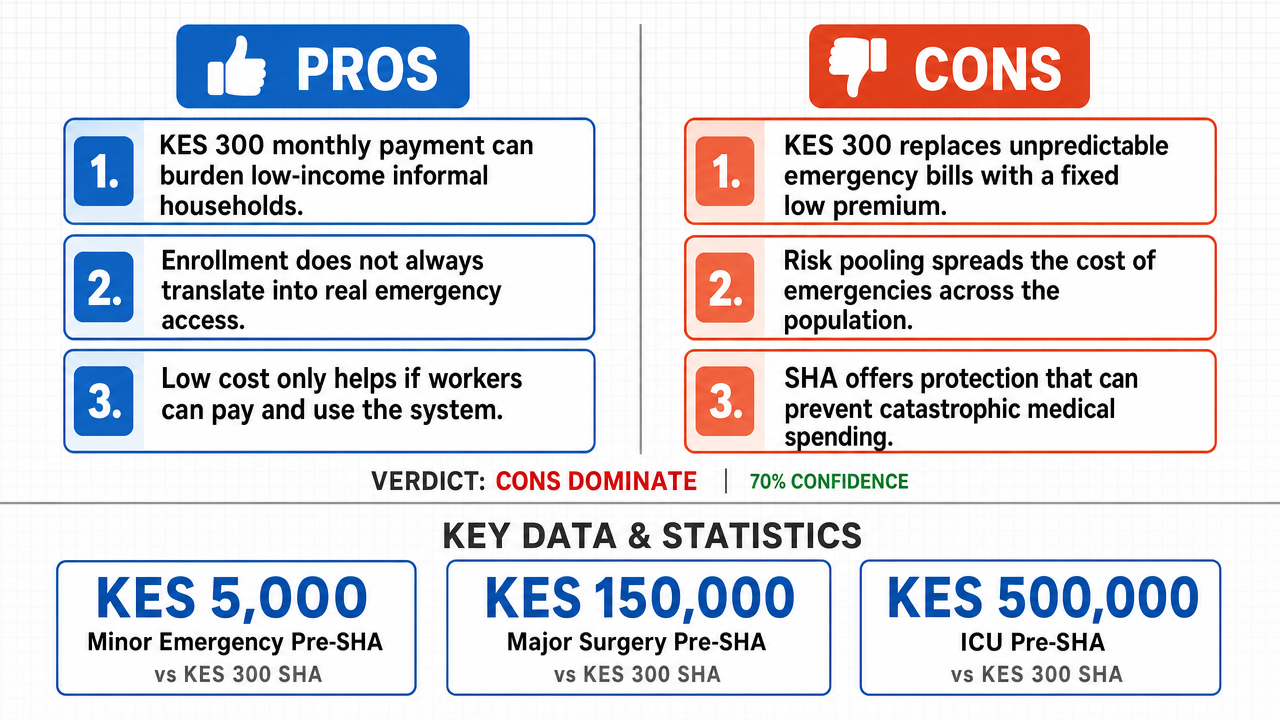
Verdict: likely FALSE (70%)
This section provides a brief overview of the key arguments. You do not need to read the full detailed report below.
✅ Key PRO arguments:
- ■The mandatory KES 300 monthly household contribution is inherently regressive, disproportionately burdening low-income informal sector workers who constitute over 80% of Kenya's workforce, as this fixed cost consumes a larger share of their irregular and meager incomes.
- ■Even with contributions, SHA 's emergency care remains largely inaccessible due to a persistent gap between formal enrollment and actual utilization, as demonstrated by NHIF data showing the poorest quintiles underutilized inpatient services despite enrollment.
- ■The premise that a low monthly premium translates into realized access assumes informal workers can both afford the KES 300 contribution and navigate the system to receive promised coverage, which evidence from low-income contexts contradicts.
❌ Key ANTI arguments:
- ■The SHA 's structured contribution model is designed to replace unpredictable, high-magnitude out-of-pocket emergency costs with a predictable, low-cost premium , providing catastrophic cost protection that the previous out-of-pocket model lacked.
- ■By pooling risks across the entire population, the SHA ensures that the financial impact of an emergency is distributed broadly, transforming potentially household-destroying expenses into manageable contributions.
- ■The opponent's use of NHIF utilization data is a flawed substitution of variables —measuring one entity (the previous NHIF regime) and concluding it represents behavior of a different entity (the new SHA regime) without establishing the specific policy or administrative transfer operators linking the two.
💭 Conclusion: False. The SHA framework, despite featuring a flat-rate contribution that exhibits regressive characteristics, provides essential financial protection through risk pooling and the replacement of catastrophic out-of-pocket emergency costs with predictable premiums. The anti side successfully argued that historical NHIF utilization data cannot be directly applied to predict SHA outcomes without establishing specific policy transfer mechanisms between the two regimes. The catastrophic cost protection offered by social insurance outweighs the regressive nature of the fixed contribution for most informal sector workers facing emergency health events. However, the regressive nature of the payment structure remains a partially valid concern that was not fully refuted, particularly regarding utilization gaps and indirect costs . The compound nature of the claim—combining regressive structure with unaffordability—means the verdict is only as strong as its weakest sub-claim.
🔬 DeepResearch Result: likely FALSE ❌ (70%)
Assertion: The Social Health Authority (SHA ) in Kenya, with its regressive payment structure for emergency care, is unaffordable for the majority of Kenyans in the informal sector .
Participating models: deepseek-v3.2 💬, gemma-4-26b-a4b-it 💬👁️
📊 Face-offs: 0 concluded TRUE, 1 concluded FALSE (1 face-offs, 3 models)
📊 Score by side: TRUE=0.00, FALSE=0.70
🏅 Model score changes:
minimax-m3 💬👁️: +7
✅ PRO Arguments:
- ■The mandatory KES 300 monthly household contribution is inherently regressive, disproportionately burdening low-income informal sector workers who constitute over 80% of Kenya's workforce, as this fixed cost consumes a larger share of their irregular and meager incomes. deepseek-v3.2 💬
- ■Even with contributions, SHA's emergency care remains largely inaccessible due to a persistent gap between formal enrollment and actual utilization, as demonstrated by NHIF data showing the poorest quintiles underutilized inpatient services despite enrollment. deepseek-v3.2 💬
- ■The premise that a low monthly premium translates into realized access assumes informal workers can both afford the KES 300 contribution and navigate the system to receive promised coverage, which evidence from low-income contexts contradicts. deepseek-v3.2 💬
- ■Out-of-pocket costs such as co-payments and indirect expenses create a utilization gap that prevents the most vulnerable from actually accessing the services they have paid for, undermining the affordability claim. deepseek-v3.2 💬
❌ ANTI Arguments:
- ■The SHA's structured contribution model is designed to replace unpredictable, high-magnitude out-of-pocket emergency costs with a predictable, low-cost premium, providing catastrophic cost protection that the previous out-of-pocket model lacked. gemma-4-26b-a4b-it 💬👁️
- ■By pooling risks across the entire population, the SHA ensures that the financial impact of an emergency is distributed broadly, transforming potentially household-destroying expenses into manageable contributions. gemma-4-26b-a4b-it 💬👁️
- ■The opponent's use of NHIF utilization data is a flawed substitution of variables —measuring one entity (the previous NHIF regime) and concluding it represents behavior of a different entity (the new SHA regime) without establishing the specific policy or administrative transfer operators linking the two. gemma-4-26b-a4b-it 💬👁️
- ■The transition from out-of-pocket models to a social insurance model fundamentally changes the financial calculus for informal sector workers, who previously faced immediate large-scale cash payments that could deplete entire household savings during emergencies. gemma-4-26b-a4b-it 💬👁️
💭 Reasoning: False. The SHA framework, despite featuring a flat-rate contribution that exhibits regressive characteristics, provides essential financial protection through risk pooling and the replacement of catastrophic out-of-pocket emergency costs with predictable premiums. The anti side successfully argued that historical NHIF utilization data cannot be directly applied to predict SHA outcomes without establishing specific policy transfer mechanisms between the two regimes. The catastrophic cost protection offered by social insurance outweighs the regressive nature of the fixed contribution for most informal sector workers facing emergency health events. However, the regressive nature of the payment structure remains a partially valid concern that was not fully refuted, particularly regarding utilization gaps and indirect costs . The compound nature of the claim—combining regressive structure with unaffordability—means the verdict is only as strong as its weakest sub-claim.
📋 PRO Facts:
• Proposed mandatory monthly contribution to SHA is KES 300 per household
• A large majority of Kenya's workforce is in the informal sector
• NHIF historical data showed enrollment-utilization gap for poorest quintiles in inpatient services
📋 ANTI Facts:
• SHA structured contribution model replaces unpredictable high-magnitude out-of-pocket costs with predictable premiums
• Risk pooling distributes financial impact of emergencies across the entire population
• Previous emergency care regimes required immediate large-scale cash payments that could deplete household savings
| Face-off | TRUE Model | FALSE Model | TRUE Avg μ | FALSE Avg μ | TRUE Tokens | FALSE Tokens | Winner | Verdict | Conf. |
|---|---|---|---|---|---|---|---|---|---|
| #1 | deepseek-v3.2 💬 | gemma-4-26b-a4b-it 💬👁️ | 0.547 | 0.286 | 12 | 3 | TRUE | FALSE | 70% |
The following technical terms, abbreviations, and domain-specific concepts are referenced throughout this debate transcript. Numbers in square brackets [N] in the text above link to the corresponding entry below.
[1] administrative barriers — Procedural or bureaucratic obstacles that prevent individuals from accessing a service or benefit, even when they are formally eligible. In the debate, these are cited as factors that can reduce actual utilization of health insurance coverage.
[2] catastrophic cost protection — A feature of health insurance design that shields households from medical expenses large enough to push them into poverty. The debate disputes whether the SHA delivers this protection in practice.
[3] co-payments — Fixed amounts that an insured person must pay out of pocket at the point of receiving a covered health service, in addition to any premium already paid.
[4] deductibles — Amounts that an insured individual must pay out of pocket before the insurer begins to cover costs. Mentioned in the debate as a source of out-of-pocket spending that can limit access to care.
[5] digital integration — The linking of a public system with digital platforms (such as mobile money) to facilitate payments, enrollment, or service delivery. The debate cites this as a structural change introduced by the SHA.
[6] disposable income — Income remaining after taxes and mandatory deductions, available for spending or saving. Used in the debate to argue that a fixed contribution consumes a larger share of this income for low earners.
[7] enrollment — Formal registration of individuals in an insurance or social program. The debate distinguishes between enrollment and actual utilization of services.
[8] financial resilience — The capacity of a household to absorb financial shocks without falling into hardship. The debate argues the SHA is intended to increase this capacity for informal sector workers.
[9] fixed-rate contribution — A flat monetary amount that every contributor must pay regardless of income. The debate characterizes the SHA's KES 300 monthly household contribution as such a payment.
[10] hidden premise — An unstated assumption underlying an argument. In the debate, the negative side accuses the affirmative of treating the claim that the SHA is merely a rebranding of the NHIF as a hidden premise.
[11] hospitalization rate — The frequency with which a population is admitted to hospital over a given period. Used in the debate as a measure of whether insurance enrollment translates into actual service use.
[12] income quintile — A statistical grouping that divides a population into five equal segments ranked by income (e.g., poorest 20%, richest 20%). Used in the debate to compare enrollment and utilization outcomes.
[13] indirect costs — Non-medical expenses associated with obtaining care, such as transport to a facility or wages lost while seeking treatment. Cited in the debate as a barrier to utilization.
[14] informal sector — Economic activity that occurs outside formal employment relationships, typically characterized by irregular income, lack of contracts, and absence of employer-provided benefits. The debate notes this sector accounts for over 80% of Kenya's employment.
[15] inpatient services — Health services requiring a patient to be admitted to a hospital or facility overnight or longer. Referenced in the debate as a category of care whose utilization remained stagnant for the poorest quintile under the NHIF.
[16] KES — Kenyan Shilling — The official currency of Kenya, used in the debate to denote the SHA's proposed mandatory monthly household contribution of KES 300.
[17] KNBS — Kenya National Bureau of Statistics — The Kenyan government agency responsible for collecting and publishing official economic and social statistics, cited in the debate as the source of the Economic Survey 2023.
[18] mandatory monthly contribution — A compulsory periodic payment required of households under the SHA. The debate centers on whether this fixed amount is affordable for informal sector workers.
[19] maximum individual liability — The upper limit on what a single insured person is required to pay for covered services. The debate argues the SHA caps this liability to spread the cost of emergencies across the population.
[20] mobile money — A digital payment service allowing users to store and transfer funds via mobile phones. Cited in the debate as a platform the SHA integrates with to facilitate contributions.
[21] NHIF — National Hospital Insurance Fund — Kenya's predecessor statutory health insurance scheme, referenced in the debate for evidence on the gap between enrollment and actual service utilization.
[22] nominal contribution — The stated monetary amount of a payment, as opposed to its real value relative to income. The debate distinguishes between the nominal contribution and its effective burden on low earners.
[23] non-compliance — Failure to meet a legal or contractual obligation, such as making required insurance contributions. Cited in the debate as a challenge the SHA's digital integration is intended to address.
[24] out-of-pocket — Payments made directly by a patient at the point of receiving care, rather than covered by insurance. The debate argues these costs persist under the SHA and undermine financial protection.
[25] poorest quintile — The bottom 20% of a population ranked by income. The debate cites evidence that NHIF enrollment increases did not raise hospitalization rates for this group.
[26] premium — The periodic payment made to maintain insurance coverage. The debate frames the SHA's contribution as a predictable, low-cost premium replacing unpredictable emergency expenses.
[27] progressive in benefit — A characteristic of a system where the value of benefits received is greater for lower-income participants than for higher-income ones, even if contributions are flat. The debate disputes whether the SHA meets this criterion.
[28] regressive payment structure — A payment design in which lower-income contributors bear a higher proportion of their income than higher-income contributors. The debate characterizes the SHA's flat-rate contribution as regressive.
[29] risk-pooling — An insurance mechanism that combines contributions from many participants so that the cost of any individual's claim is shared across the group. The debate cites this as a key feature of the SHA.
[30] SHA — Social Health Authority — The Kenyan statutory health insurance body established under the Social Health Insurance Act, 2023, which mandates household contributions and organizes emergency care coverage.
[31] social insurance model — A system of mandatory contributions that entitles participants to defined benefits, typically run by the state. The debate contrasts this with out-of-pocket payment for emergency care.
[32] structural mismatch — An incompatibility between the design of a policy and the economic conditions of its target population. The debate uses this term to describe the gap between fixed SHA contributions and irregular informal-sector incomes.
[33] substitution of variables — A logical error in which a measure relating to one entity is used as evidence about a different entity. The debate accuses the affirmative of applying NHIF utilization data to the SHA without justification.
[34] transfer operator — In argumentation, the specific mechanism or policy change that links evidence from one case to conclusions about another. The debate argues this link is missing when NHIF data is used to assess the SHA.
[35] utilization gap — The difference between being enrolled in a program and actually using its services. The debate cites this gap as evidence that SHA contributions may not translate into realized access to emergency care.
The following financial data tables were referenced during the debate exchanges:
| Medical Event Type | Estimated Out-of-Pocket Cost (Pre-SHA) | Estimated SHA Contribution Equivalent | Savings Factor |
|---|---|---|---|
| Minor Emergency | KES 5,000 | KES 300 | 16.6x |
| Major Surgery/Trauma | KES 150,000 | KES 300 | 500.0x |
| Critical Care (ICU) | KES 500,000 | KES 300 | 1666.6x |
Legend: Comparison of estimated out-of-pocket costs for common emergency scenarios versus the proposed monthly contribution. Values are illustrative of the protection ratio provided by the social insurance model. Source: Comparative analysis based on Kenyan private hospital rate averages and SHA Act 2023.
| Income Quintile | NHIF Enrollment Increase (2013-2019) | Change in Hospitalization Rate |
|---|---|---|
| Poorest 20% | +12% | +0.8% |
| Richest 20% | +5% | +3.1% |
Legend: Impact of enrollment increases on actual health service utilization in Kenya, showing a utilization gap for the poorest despite coverage. Source: "Utilization of health insurance among the urban poor in Kenya" (Health Policy and Planning, 2021).
Face-off transcripts
- ■
Ownership & Trade Secrets. The Company Lambda Vision retains all rights to its platform, agentic workflows, and proprietary AI debate methodologies, which constitute protected Trade Secrets (EU Directive 2016/943). Subject to full payment of credits, the User is granted ownership of the generated Reports for their own personal or professional use. Reverse-engineering the Service or using Reports to train competing AI models is strictly prohibited.
- ■
No Professional Advice. Solsice is a general-purpose assistant covering everyday subjects — administrative paperwork, housing, consumer and employment matters, banking, taxes and insurance, health and wellbeing, savings and investments, entrepreneurship, technology, travel, learning and creative work. Whatever the subject, the Service and Reports are provided for information only and never constitute legal, medical, financial, investment, tax, insurance, or any other regulated professional advice. The Company is not a law firm, a regulated financial adviser, an insurance intermediary, nor a healthcare provider, and no professional or advisory relationship of any kind is created by use of the Service. Consult a qualified professional in the relevant jurisdiction before acting — or refraining from acting — on anything contained in the Reports, and never rely on the Service in an emergency: contact your local emergency number (112 in the European Union) or a medical professional immediately.
- ■
AI-Generated Content, Sources and Viewpoints. Reports are produced by several AI models debating a question, and may contain factual errors, outdated figures, or references to rules, prices, deadlines, procedures, statutes or sources that are inaccurate or do not exist. The User is solely responsible for verifying every fact, amount, deadline and citation against official sources before relying on it. Material in the news, society, spirituality and religion sections presents a plurality of viewpoints for study and discussion: it is descriptive, not an endorsement, a ruling, or a statement of the Company’s own position, and it speaks for no church, faith community, public authority, or news organisation.
- ■
Liability & Governing Law. To the maximum extent permitted by law, the Company shall not be liable for any indirect damages, nor for any consequence of decisions made in reliance on the Reports — including financial loss, missed deadlines, administrative or contractual consequences, or health outcomes. These Terms are governed by French law. Any disputes shall be subject to the exclusive jurisdiction of the Courts of Paris, France.