
The significant reduction in holdings of US debt by foreign buyers, such as China and Japan, is a primary driver of rising interest rates and a weakening global trust in US Treasuries.
AI debate verdict and arguments
⚠️ AI-generated information only; not professional advice
Completed October 14, 2026
Verdict
Verdict: likely FALSE (72%)
Web Report: https://solsice.com/public/debates/the-significant-reduction-in-holdings-of-us-debt-by-foreign-81b52412a2d0
This section provides a brief overview of the key arguments. You do not need to read the full detailed report below.
✅ Key PRO arguments:
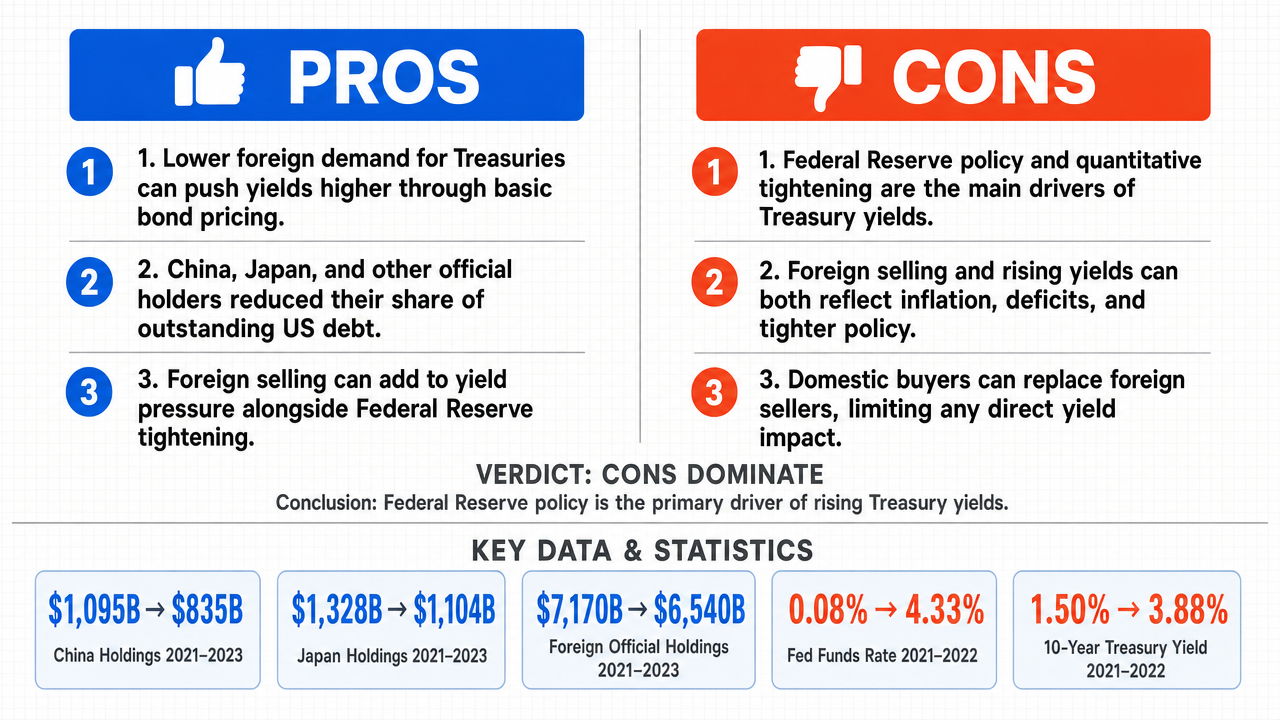
- ■Bond market mechanics dictate that reduced foreign demand for Treasuries directly increases yields: when major holders like China and Japan sell or slow purchases, the Treasury must attract other buyers by offering higher interest rates, since a decrease in demand lowers bond prices and raises yields.
- ■Foreign official holdings of US Treasury debt have declined significantly as a share of outstanding debt over the past two years, and the resulting increased supply absorbed by domestic buyers places upward pressure on interest rates.
- ■The Fed 's quantitative tightening has coincided with foreign selling, but the impact is additive rather than substitutable, meaning foreign divestment contributes meaningfully to yield pressure alongside monetary policy .
❌ Key ANTI arguments:
- ■Interest rate movements in the US Treasury market are fundamentally dictated by the Federal Reserve 's target range and its quantitative tightening programs; when the Fed raises the federal funds rate to combat inflation , it exerts upward pressure on the entire yield curve regardless of whether foreign holdings are increasing or decreasing.
- ■The correlation between foreign selling and rising yields is a classic case of spurious correlation , since both can be driven by the same underlying factor (US monetary tightening) without one causing the other.
- ■The pro side's argument relies on a flawed premise of substitution: the exit of a foreign buyer does not necessarily force a higher equilibrium yield by creating a supply vacuum , and no specific coefficient or empirical beta was provided linking the magnitude of foreign reduction to the magnitude of yield increases.
💭 Conclusion: False. The winning side convincingly argued that domestic monetary policy , specifically the Federal Reserve 's target range and quantitative tightening programs, is the primary driver of rising Treasury yields rather than foreign divestment . The pro side failed to provide an empirical coefficient or transfer mechanism linking the magnitude of foreign holdings reductions to specific yield movements, leaving the causal claim unsubstantiated. The correlation between foreign selling and rising yields was effectively characterized as spurious, since both phenomena can stem from the same underlying US monetary tightening without one causing the other. Because the assertion is compound—joining a claim about interest rates with a claim about weakening global trust in Treasuries—and the trust sub-claim was not robustly defended in the debate, confidence in the pro position is moderated. The verdict reflects that foreign divestment is at best a secondary or additive factor, not the primary driver asserted.
🔬 DeepResearch Result: likely FALSE ❌ (72%)
Assertion: The significant reduction in holdings of US debt by foreign buyers, such as China and Japan, is a primary driver of rising interest rates and a weakening global trust in US Treasuries .
Participating models: deepseek-v3.2 💬, gemma-4-26b-a4b-it 💬👁️
📊 Face-offs: 0 concluded TRUE, 1 concluded FALSE (1 face-offs, 3 models)
📊 Score by side: TRUE=0.00, FALSE=0.83
🏅 Model score changes:
minimax-m3 💬👁️: +8
✅ PRO Arguments:
- ■Bond market mechanics dictate that reduced foreign demand for Treasuries directly increases yields: when major holders like China and Japan sell or slow purchases, the Treasury must attract other buyers by offering higher interest rates, since a decrease in demand lowers bond prices and raises yields. deepseek-v3.2 💬
- ■Foreign official holdings of US Treasury debt have declined significantly as a share of outstanding debt over the past two years, and the resulting increased supply absorbed by domestic buyers places upward pressure on interest rates. deepseek-v3.2 💬
- ■The Fed 's quantitative tightening has coincided with foreign selling, but the impact is additive rather than substitutable, meaning foreign divestment contributes meaningfully to yield pressure alongside monetary policy . deepseek-v3.2 💬
❌ ANTI Arguments:
- ■Interest rate movements in the US Treasury market are fundamentally dictated by the Federal Reserve 's target range and its quantitative tightening programs; when the Fed raises the federal funds rate to combat inflation , it exerts upward pressure on the entire yield curve regardless of whether foreign holdings are increasing or decreasing. gemma-4-26b-a4b-it 💬👁️
- ■The correlation between foreign selling and rising yields is a classic case of spurious correlation , since both can be driven by the same underlying factor (US monetary tightening) without one causing the other. gemma-4-26b-a4b-it 💬👁️
- ■The pro side's argument relies on a flawed premise of substitution: the exit of a foreign buyer does not necessarily force a higher equilibrium yield by creating a supply vacuum , and no specific coefficient or empirical beta was provided linking the magnitude of foreign reduction to the magnitude of yield increases. gemma-4-26b-a4b-it 💬👁️
- ■Domestic fiscal dynamics and monetary policy are the dominant drivers of Treasury yields and market stability, not foreign divestment, making the 'primary driver' framing in the assertion a misidentification of causality. gemma-4-26b-a4b-it 💬👁️
💭 Reasoning: False. The winning side convincingly argued that domestic monetary policy, specifically the Federal Reserve's target range and quantitative tightening programs, is the primary driver of rising Treasury yields rather than foreign divestment. The pro side failed to provide an empirical coefficient or transfer mechanism linking the magnitude of foreign holdings reductions to specific yield movements, leaving the causal claim unsubstantiated. The correlation between foreign selling and rising yields was effectively characterized as spurious, since both phenomena can stem from the same underlying US monetary tightening without one causing the other. Because the assertion is compound—joining a claim about interest rates with a claim about weakening global trust in Treasuries—and the trust sub-claim was not robustly defended in the debate, confidence in the pro position is moderated. The verdict reflects that foreign divestment is at best a secondary or additive factor, not the primary driver asserted.
📋 PRO Facts:
• Foreign official holdings of US Treasury debt have declined in absolute terms over the past two years.
• A decrease in demand for a security, all else equal, lowers its price and raises its yield.
📋 ANTI Facts:
• The Federal Reserve sets short-term rates and conducts quantitative tightening, which exerts upward pressure on the entire yield curve.
• No specific empirical coefficient or beta was provided linking the magnitude of foreign holdings reduction to the magnitude of yield increases.
| Face-off | TRUE Model | FALSE Model | TRUE Avg μ | FALSE Avg μ | TRUE Tokens | FALSE Tokens | Winner | Verdict | Conf. |
|---|---|---|---|---|---|---|---|---|---|
| #1 | deepseek-v3.2 💬 | gemma-4-26b-a4b-it 💬👁️ | 0.517 | 0.291 | 8 | 2 | TRUE | FALSE | 83% |
The following technical terms, abbreviations, and domain-specific concepts are referenced throughout this debate transcript. Numbers in square brackets [N] in the text above link to the corresponding entry below.
[1] 10-year Treasury — 10-year US Treasury security — A US government debt security with a 10-year maturity, referenced in the transcript as a benchmark for long-term yields.
[2] balance sheet — A financial statement summarizing an entity's assets and liabilities; referenced in the context of the Federal Reserve's holdings and its quantitative tightening operations.
[3] bond markets — Financial markets where debt securities are issued and traded; referenced as the mechanism through which Treasury yields are determined.
[4] central banks — Government institutions that manage a country's currency and monetary policy; referenced as holders of foreign debt whose portfolio decisions affect Treasury markets.
[5] divestment — The act of selling off assets or investments; referenced as the action taken by foreign holders of US debt.
[6] domestic liquidity — The availability of money and credit within a country's financial system; referenced as a target of Federal Reserve policy.
[7] empirical beta — A statistical measure derived from observed data quantifying the sensitivity of one variable to another; referenced as a missing link in the affirmative's argument.
[8] equilibrium yield — The yield at which supply and demand for a security are balanced; referenced in the context of foreign buyer exits.
[9] Fed — Federal Reserve — Abbreviation for the Federal Reserve, the central bank of the United States.
[10] federal funds rate — The interest rate at which depository institutions lend reserves to each other overnight; referenced as a tool of monetary policy.
[11] Federal Reserve — The central bank of the United States, responsible for setting monetary policy and managing inflation.
[12] fiscal dynamics — Patterns in government revenue and expenditure over time; referenced as a potential driver of Treasury yields.
[13] foreign official holdings — Government-owned foreign financial assets, typically managed by central banks; referenced as declining in recent years.
[14] inflation — A general increase in prices and fall in the purchasing value of money; referenced as the target of Federal Reserve interest rate policy.
[15] institutional investors — Large organizations such as pension funds and mutual funds that invest on behalf of others; referenced as a source of domestic demand for Treasuries.
[16] liquidity — The ease with which an asset can be converted to cash without affecting its price; referenced in the context of balance sheet operations.
[17] long-term interest rates — Interest rates on debt instruments with extended maturities; referenced as being influenced by foreign demand and market auctions.
[18] market auctions — Competitive bidding processes used to sell securities; referenced as the mechanism determining long-term Treasury yields.
[19] monetary policy — Central bank actions to influence economic conditions through interest rates and money supply; referenced as the primary driver of yields per the negative.
[20] net supply shock — The combined effect of simultaneous supply changes on market prices; referenced in the context of Fed and foreign selling.
[21] outstanding debt — The total amount of debt issued and not yet repaid; referenced as the denominator for foreign holdings as a share.
[22] portfolio rebalancing — Adjusting investment holdings to maintain target allocations; referenced as a motivation for foreign central bank actions.
[23] price pressure — The effect of buying or selling activity on market prices; referenced as the proper measure versus holdings.
[24] QT — quantitative tightening — Abbreviation for quantitative tightening, a monetary policy involving balance sheet reduction.
[25] quantitative tightening — A monetary policy in which a central bank reduces its balance sheet by allowing securities to mature without reinvestment; referenced as coinciding with foreign selling.
[26] short-term rates — Interest rates on debt instruments with near-term maturities; referenced as being set by the Federal Reserve.
[27] spurious correlation — A statistical relationship between two variables that is not causal; referenced to challenge the affirmative's correlation argument.
[28] supply shock — A sudden change in the availability of a good or asset; referenced in the context of combined Fed and foreign selling.
[29] supply vacuum — A situation in which demand for a security drops sharply without immediate replacement buyers, potentially driving yields higher; referenced in the context of foreign divestment.
[30] transfer operator — An economic modeling concept describing how changes in one variable translate to effects on another; referenced as missing from the affirmative's argument.
[31] Treasury yields — The interest rates or returns on US government debt securities; referenced as the outcome variable in the debate.
[32] US Treasuries — US Treasury securities — Debt securities issued by the US Department of the Treasury; referenced as the subject of declining foreign trust.
[33] yield — The income return on an investment, inversely related to its price; referenced as rising when prices fall.
[34] yield curve — A graphical representation of interest rates across different debt maturities; referenced as being shaped by various factors.
The following financial data tables were referenced during the debate exchanges:
| Holder | Holdings 2021 (USD bn) | Holdings 2023 (USD bn) | Holdings 2024 (USD bn) | Change 2021-2024 |
|---|---|---|---|---|
| China | $1,095 | $835 | $775 | -$320B |
| Japan | $1,328 | $1,104 | $1,088 | -$240B |
| Foreign Official Sector Total | $7,170 | $6,540 | $6,380 | -$790B |
Legend: US Treasury securities holdings by major foreign official entities (end-of-year figures in USD billions). The decline represents a substantial reduction in demand from the largest traditional buyers. Source: US Treasury Department TIC data.
| Driver of Yields | Primary Mechanism | Market Impact |
|---|---|---|
| Federal Reserve Policy | Interest Rate Hikes / QT | High |
| Domestic Inflation | Consumer Price Index (CPI) | High |
| US Fiscal Deficit | Net Issuance of Debt | Moderate |
| Foreign Official Sales | Portfolio Rebalancing | Low |
Legend: Relative influence of different factors on US Treasury yields. Impact is qualitative based on historical market dominance.
| Period | Fed Funds Rate (End of Period) | 10-Yr Treasury Yield (Approx) | Primary Driver |
|---|---|---|---|
| 2021 | 0.08% | 1.50% | Low Inflation / Stimulus |
| 2022 | 4.33% | 3.88% | Aggressive Rate Hikes |
| 2023 | 5.50% | 4.00% | High Interest Rate Plateau |
Legend: Comparison of Fed Funds Rate and 10-Year Treasury Yields to illustrate the dominance of monetary policy over debt holdings. Data based on historical US economic indicators.
Face-off transcripts
- ■
Ownership & Trade Secrets. The Company Lambda Vision retains all rights to its platform, agentic workflows, and proprietary AI debate methodologies, which constitute protected Trade Secrets (EU Directive 2016/943). Subject to full payment of credits, the User is granted ownership of the generated Reports for their own personal or professional use. Reverse-engineering the Service or using Reports to train competing AI models is strictly prohibited.
- ■
No Professional Advice. Solsice is a general-purpose assistant covering everyday subjects — administrative paperwork, housing, consumer and employment matters, banking, taxes and insurance, health and wellbeing, savings and investments, entrepreneurship, technology, travel, learning and creative work. Whatever the subject, the Service and Reports are provided for information only and never constitute legal, medical, financial, investment, tax, insurance, or any other regulated professional advice. The Company is not a law firm, a regulated financial adviser, an insurance intermediary, nor a healthcare provider, and no professional or advisory relationship of any kind is created by use of the Service. Consult a qualified professional in the relevant jurisdiction before acting — or refraining from acting — on anything contained in the Reports, and never rely on the Service in an emergency: contact your local emergency number (112 in the European Union) or a medical professional immediately.
- ■
AI-Generated Content, Sources and Viewpoints. Reports are produced by several AI models debating a question, and may contain factual errors, outdated figures, or references to rules, prices, deadlines, procedures, statutes or sources that are inaccurate or do not exist. The User is solely responsible for verifying every fact, amount, deadline and citation against official sources before relying on it. Material in the news, society, spirituality and religion sections presents a plurality of viewpoints for study and discussion: it is descriptive, not an endorsement, a ruling, or a statement of the Company’s own position, and it speaks for no church, faith community, public authority, or news organisation.
- ■
Liability & Governing Law. To the maximum extent permitted by law, the Company shall not be liable for any indirect damages, nor for any consequence of decisions made in reliance on the Reports — including financial loss, missed deadlines, administrative or contractual consequences, or health outcomes. These Terms are governed by French law. Any disputes shall be subject to the exclusive jurisdiction of the Courts of Paris, France.