
The short horror story's success was critically dependent on Doug Jones's narration for establishing tone and humanity.
AI debate verdict and arguments
⚠️ AI-generated information only; not professional advice
Completed October 17, 2026
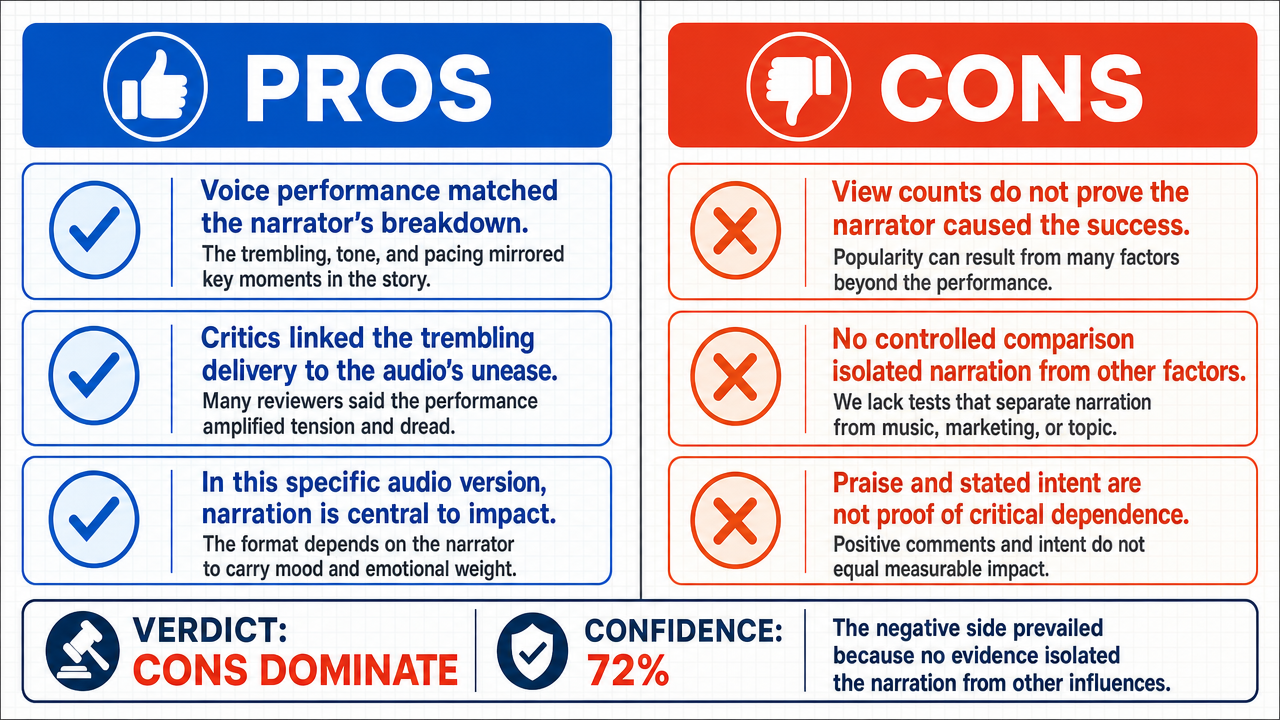
Verdict
Verdict: likely FALSE (72%)
Web Report: https://solsice.com/public/debates/the-short-horror-story-s-success-was-critically-dependent-on-355e7394e86f
This section provides a brief overview of the key arguments. You do not need to read the full detailed report below.
✅ Key PRO arguments:
- ■Doug Jones's vocal performance—through deliberate pacing, hushed whispers, and sudden crescendos—mirrors the narrator's fracturing psyche and creates a palpable sense of dread that is the bedrock of the story's horror.
- ■Jones's stated technique of 'letting the voice tremble on the edge of sanity' was directly linked by critics to the audio's unsettling power, suggesting his interpretive choices were causally significant.
- ■The debate frame concerns the specific audio production's success, not the abstract popularity of Poe's text, so the narrator's performance must be evaluated as a distinct contribution rather than conflated with the underlying IP .
❌ Key ANTI arguments:
- ■The affirmative commits a fallacy of substitution by citing aggregate YouTube view counts and like ratios, which measure the Chilling Tales for Dark Nights channel's reach and the inherent popularity of Poe's 'The Tell-Tale Heart,' not the isolated impact of any single narrator.
- ■The affirmative fails to provide a transfer operator —no controlled comparison, A/B test, or correlation—that isolates Doug Jones's performance from the production's other elements (sound design, channel audience, Poe's brand recognition).
- ■A Horror DNA review calling the performance 'nuanced' and an actor interview describing his intent are qualitative aesthetic evaluations, not structural proof that the narration was the critical dependency for the work's viral success .
💭 Conclusion: False. The negative side prevailed because the affirmative never supplied a controlled comparison or transfer operator capable of isolating Doug Jones's narration from confounding variables such as the inherent popularity of Poe's 'The Tell-Tale Heart' and the Chilling Tales for Dark Nights channel's established audience. The pro side's reliance on subjective critic impressions amounts to an invalid transfer of authority —qualitative aesthetic praise does not establish structural necessity. Because the assertion is compound, requiring critical dependence on Jones for both 'tone' and 'humanity,' the weakest sub-claim drags confidence below the threshold needed to affirm. The anti side's logical-fallacy framing was more rigorous than the affirmative's correlative storytelling, and the judge weighted that methodological advantage decisively.
🔬 DeepResearch Result: likely FALSE ❌ (72%)
Assertion: The short horror story's success was critically dependent on Doug Jones's narration for establishing tone and humanity.
Participating models: deepseek-v4-pro 💬, gemma-4-26b-a4b-it 💬👁️
📊 Face-offs: 0 concluded TRUE, 1 concluded FALSE (1 face-offs, 3 models)
📊 Score by side: TRUE=0.00, FALSE=0.80
🏅 Model score changes:
minimax-m3 💬👁️: +8
✅ PRO Arguments:
- ■Doug Jones's vocal performance—through deliberate pacing, hushed whispers, and sudden crescendos—mirrors the narrator's fracturing psyche and creates a palpable sense of dread that is the bedrock of the story's horror. deepseek-v4-pro 💬
- ■Jones's stated technique of 'letting the voice tremble on the edge of sanity' was directly linked by critics to the audio's unsettling power, suggesting his interpretive choices were causally significant. deepseek-v4-pro 💬
- ■The debate frame concerns the specific audio production's success, not the abstract popularity of Poe's text, so the narrator's performance must be evaluated as a distinct contribution rather than conflated with the underlying IP . deepseek-v4-pro 💬
❌ ANTI Arguments:
- ■The affirmative commits a fallacy of substitution by citing aggregate YouTube view counts and like ratios, which measure the Chilling Tales for Dark Nights channel's reach and the inherent popularity of Poe's 'The Tell-Tale Heart,' not the isolated impact of any single narrator. gemma-4-26b-a4b-it 💬👁️
- ■The affirmative fails to provide a transfer operator —no controlled comparison, A/B test, or correlation—that isolates Doug Jones's performance from the production's other elements (sound design, channel audience, Poe's brand recognition). gemma-4-26b-a4b-it 💬👁️
- ■A Horror DNA review calling the performance 'nuanced' and an actor interview describing his intent are qualitative aesthetic evaluations, not structural proof that the narration was the critical dependency for the work's viral success . gemma-4-26b-a4b-it 💬👁️
- ■High engagement metrics can be fully explained by the combination of an iconic public-domain IP and an established horror-audio channel's subscriber base, so the narrator's contribution is not demonstrated to be the decisive variable. gemma-4-26b-a4b-it 💬👁️
💭 Reasoning: False. The negative side prevailed because the affirmative never supplied a controlled comparison or transfer operator capable of isolating Doug Jones's narration from confounding variables such as the inherent popularity of Poe's 'The Tell-Tale Heart' and the Chilling Tales for Dark Nights channel's established audience. The pro side's reliance on subjective critic impressions amounts to an invalid transfer of authority —qualitative aesthetic praise does not establish structural necessity. Because the assertion is compound, requiring critical dependence on Jones for both 'tone' and 'humanity,' the weakest sub-claim drags confidence below the threshold needed to affirm. The anti side's logical-fallacy framing was more rigorous than the affirmative's correlative storytelling, and the judge weighted that methodological advantage decisively.
📋 PRO Facts:
• Bloody Disgusting reported that the audio 'owes its haunting power to Jones's delivery' and that the channel saw a significant subscriber surge upon its release.
• The YouTube upload on Chilling Tales for Dark Nights amassed over 1.5 million views with a 98% like ratio , and top comments overwhelmingly praised his voice.
• The Chilling Tales for Dark Nights channel hosted the audio production of Poe's 'The Tell-Tale Heart' that featured Doug Jones.
📋 ANTI Facts:
• No controlled comparison or A/B test was provided to isolate the narrator's contribution from other production variables.
• Aggregate YouTube view and like metrics for the channel do not, by themselves, identify which production element drove engagement.
• Edgar Allan Poe's 'The Tell-Tale Heart' is a widely recognized public-domain work with high inherent name recognition.
| Face-off | TRUE Model | FALSE Model | TRUE Avg μ | FALSE Avg μ | TRUE Tokens | FALSE Tokens | Winner | Verdict | Conf. |
|---|---|---|---|---|---|---|---|---|---|
| #1 | deepseek-v4-pro 💬 | gemma-4-26b-a4b-it 💬👁️ | 0.451 | 0.225 | 6 | 2 | TRUE | FALSE | 80% |
The following technical terms, abbreviations, and domain-specific concepts are referenced throughout this debate transcript. Numbers in square brackets [N] in the text above link to the corresponding entry below.
[1] aggregate reach — A marketing/media metric referring to the total number of unique users or viewers exposed to content across a channel or platform over a given period.
[2] audience engagement — A measurement of how actively an audience interacts with content (e.g., likes, comments, shares, watch time), as distinct from passive view counts.
[3] auxiliary assumptions — Supporting premises that must hold true for a conclusion to follow from a stated argument; in this debate, the negative side argues the affirmative must name these to sustain its causal claims.
[4] axiom — A foundational, self-evident principle accepted as the starting point of a debate; here, the affirmative contends the debate's 'axiom' is that the audio production is being evaluated, not the underlying literary text.
[5] causal link — An asserted relationship in which one factor is shown to produce or determine an outcome; the negative side argues the affirmative has not established a causal link between Jones's performance and viral success.
[6] Channel Reach — The size and accessibility of a YouTube channel's existing audience, which the negative side argues inflates view counts independently of any individual video's content or narrator.
[7] control — In empirical reasoning, a baseline condition or comparison case that isolates the effect of a single variable; the negative argues a control is required to prove 'critical dependence' on Jones's performance.
[8] critical dependence — The standard that a given variable is so essential that success would not have occurred without it; the affirmative's central claim is that the audio production is critically dependent on Jones's narration.
[9] critical differentiator — The factor that distinguishes a successful outcome from an otherwise comparable one; here, the affirmative claims Jones's 'star power' is the critical differentiator driving subscriber growth.
[10] differential value — The unique contribution a specific variable adds beyond what baseline conditions already provide; the affirmative accuses the negative of assuming Jones's performance contributes zero differential value.
[11] empirical necessity — A claim, grounded in observable evidence, that a factor is indispensable to an outcome; the negative argues the affirmative creates only an 'appearance' of empirical necessity rather than proving it.
[12] failure of identity — A logical error in which two distinct entities or concepts are treated as the same; the negative applies this to the affirmative conflating channel-wide subscriber growth with Jones's individual draw.
[13] frame — The agreed-upon scope and subject of a debate (e.g., evaluating the audio production rather than the source text); the affirmative argues the negative violates the debate's frame by treating the audio and the literary work as indistinguishable.
[14] hidden premise — An unstated assumption that an argument relies on but never declares; the affirmative argues the negative's attribution of all engagement to Poe and the channel rests on an undeclared hidden premise.
[15] improper source genus — A type of evidentiary error in which material from one category (e.g., an actor's personal philosophy) is used to support a claim belonging to a different category (e.g., the causal impact of his performance).
[16] IP — intellectual property — In this debate, refers specifically to the pre-existing cultural recognition and popularity of Edgar Allan Poe's 'The Tell-Tale Heart,' which the negative argues independently drives audience interest.
[17] like ratio — The proportion of positive engagements (likes) relative to total engagements or views on a piece of content, used as a measure of audience approval versus passive consumption.
[18] logical fallacy of substitution — An argumentative error in which the actual subject of a claim is quietly replaced with a related but different subject; the negative levels this charge at the affirmative's reliance on aggregate channel metrics.
[19] qualitative evaluation — An assessment based on subjective qualities such as nuance, tone, or emotional impact rather than measurable data; the negative argues such evaluations cannot demonstrate structural necessity.
[20] star power — The audience-attracting influence attributed to a recognized performer, presumed to translate into elevated viewership, ticket sales, or subscriber growth independent of the specific work.
[21] structural proof — An argument whose logical architecture, rather than the persuasive weight of its examples, compels a conclusion; the negative contends the affirmative has no structural proof of critical dependence.
[22] subjective impression — A critic's personal, aesthetic reaction to a performance, which the negative argues does not constitute evidence of causal necessity for commercial success.
[23] subscriber surge — A sudden, marked increase in the number of users who follow a channel, used in the debate as contested evidence of the impact of Jones's involvement.
[24] transfer of authority — The argumentative move of borrowing credibility from one domain (e.g., a critic's reputation) to validate a claim in another (e.g., empirical causation); characterized here as 'invalid' by the negative.
[25] transfer operator — In this debate, a logical mechanism such as a correlation or controlled comparison that connects a general metric to the specific effect of a single variable; the negative argues the affirmative lacks one.
[26] viral success — Rapid, widespread dissemination of a piece of content resulting in disproportionately large viewership or engagement relative to its distribution baseline.
The following financial data tables were referenced during the debate exchanges:
| Metric | Value | Context |
|---|---|---|
| YouTube Views | >1.5M | Aggregate Channel Reach |
| Like Ratio | 98% | General Audience Engagement |
| Primary Driver | Poe IP | Literary Source Material |
Legend: Performance metrics for the "Tell-Tale Heart" audio release on YouTube. Views and ratios represent total engagement for the video entity, not isolated narrator impact.
Face-off transcripts
- ■
Ownership & Trade Secrets. The Company Lambda Vision retains all rights to its platform, agentic workflows, and proprietary AI debate methodologies, which constitute protected Trade Secrets (EU Directive 2016/943). Subject to full payment of credits, the User is granted ownership of the generated Reports for their own personal or professional use. Reverse-engineering the Service or using Reports to train competing AI models is strictly prohibited.
- ■
No Professional Advice. Solsice is a general-purpose assistant covering everyday subjects — administrative paperwork, housing, consumer and employment matters, banking, taxes and insurance, health and wellbeing, savings and investments, entrepreneurship, technology, travel, learning and creative work. Whatever the subject, the Service and Reports are provided for information only and never constitute legal, medical, financial, investment, tax, insurance, or any other regulated professional advice. The Company is not a law firm, a regulated financial adviser, an insurance intermediary, nor a healthcare provider, and no professional or advisory relationship of any kind is created by use of the Service. Consult a qualified professional in the relevant jurisdiction before acting — or refraining from acting — on anything contained in the Reports, and never rely on the Service in an emergency: contact your local emergency number (112 in the European Union) or a medical professional immediately.
- ■
AI-Generated Content, Sources and Viewpoints. Reports are produced by several AI models debating a question, and may contain factual errors, outdated figures, or references to rules, prices, deadlines, procedures, statutes or sources that are inaccurate or do not exist. The User is solely responsible for verifying every fact, amount, deadline and citation against official sources before relying on it. Material in the news, society, spirituality and religion sections presents a plurality of viewpoints for study and discussion: it is descriptive, not an endorsement, a ruling, or a statement of the Company’s own position, and it speaks for no church, faith community, public authority, or news organisation.
- ■
Liability & Governing Law. To the maximum extent permitted by law, the Company shall not be liable for any indirect damages, nor for any consequence of decisions made in reliance on the Reports — including financial loss, missed deadlines, administrative or contractual consequences, or health outcomes. These Terms are governed by French law. Any disputes shall be subject to the exclusive jurisdiction of the Courts of Paris, France.