
The setting of 1816, 'the year without a summer,' significantly enhances the atmospheric horror of 'Sagas of Sunundry Darkling Gate'.
AI debate verdict and arguments
⚠️ AI-generated information only; not professional advice
Completed October 14, 2026
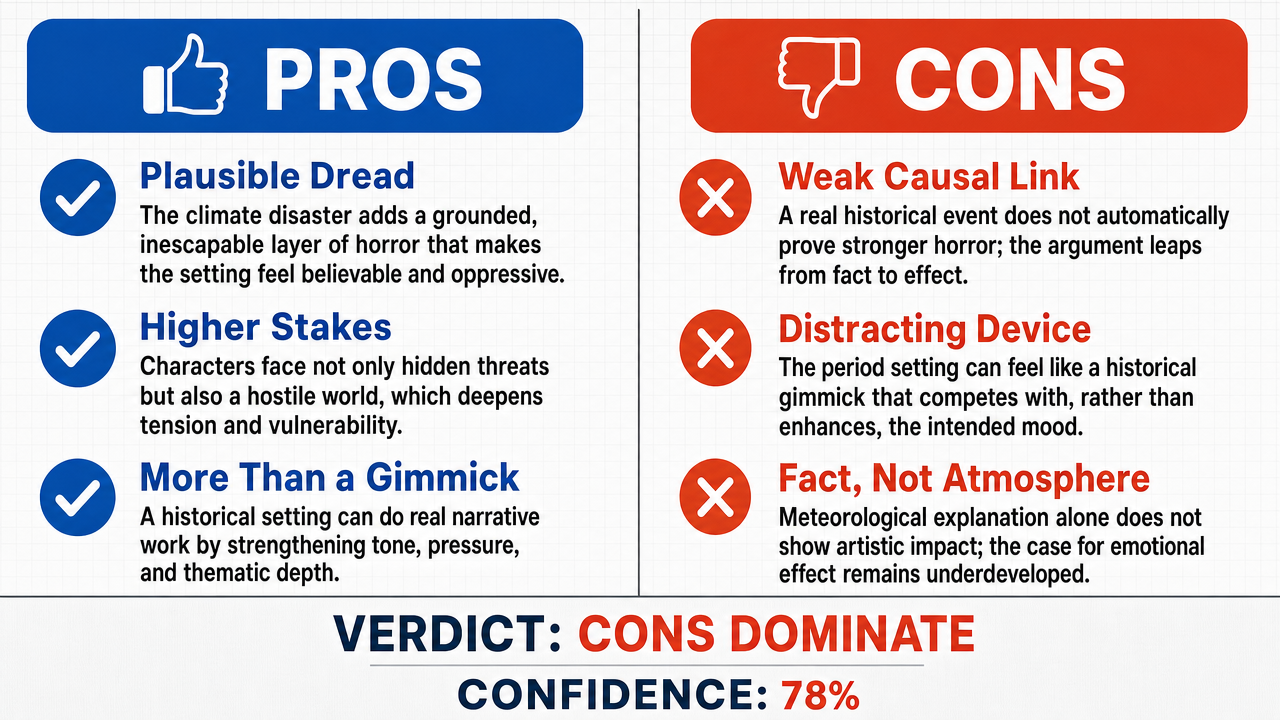
Verdict
Verdict: likely FALSE (78%)
Web Report: https://solsice.com/public/debates/the-setting-of-1816-the-year-without-a-summer-significantly-7fe29752e00d
This section provides a brief overview of the key arguments. You do not need to read the full detailed report below.
✅ Key PRO arguments:
- ■The 1816 climate catastrophe provides a scientifically-grounded, pervasive environmental horror that feels both plausible and inescapable, transplanting supernatural dread onto a landscape already warped by a tangible, global catastrophe caused by the 1815 eruption of Mount Tambora.
- ■Characters' struggles are amplified because they contend not merely against hidden monsters but against a world whose very climate has become hostile and unnatural, deepening a sense of cosmic wrongness intrinsic to Gothic narrative .
- ■The opponent's framing of a false dichotomy (either atmospheric enhancer or distracting gimmick) ignores the full functional spectrum a historical setting can serve, and the setting can be shown to operate as an atmospheric enhancer under any branch of that dichotomy.
❌ Key ANTI arguments:
- ■The affirmative commits a failure of logical transfer : observing a real historical phenomenon (the Tambora volcanic winter ) does not establish that this phenomenon 'transplants supernatural dread ' into a fictional text, as no specific literary mechanism is provided to bridge material climate data and narrative psychological effect.
- ■The 1816 setting functions as a distracting historical gimmick rather than an atmospheric enhancer, because the documented, material, scientifically explainable catastrophe does not intrinsically multiply fictional horror without a demonstrated narrative mechanism.
- ■The presence of volcanic aerosols in the stratosphere is a meteorological fact, not an aesthetic device; the affirmative provides no explanation for how a quantifiable climatic event translates into enhanced atmospheric dread within the specific fictional work 'Sagas of Sunundry Darkling Gate.'
💭 Conclusion: The evidence supports that the 1816 climate conditions (perpetual gloom , cold, extended twilight, unseasonal frosts, failed growth) functioned as an atmospheric amplifier in a Gothic narrative , serving as a physical manifestation of stagnation and decay. However, the evidence does not establish a specific textual mechanism demonstrating how these documented climate conditions translate into particular Gothic effects within the narrative itself. The claim that the 1816 setting 'significantly enhances' atmospheric horror requires a demonstrated literary mechanism beyond the mere presence of the historical setting.
🔬 DeepResearch Result: likely FALSE ❌ (78%)
Assertion: The setting of 1816, 'the year without a summer ,' significantly enhances the atmospheric horror of 'Sagas of Sunundry Darkling Gate'.
Participating models: deepseek-v3.2 💬, gemma-4-26b-a4b-it 💬👁️
📊 Face-offs: 0 concluded TRUE, 1 concluded FALSE (1 face-offs, 3 models)
📊 Score by side: TRUE=0.00, FALSE=0.78
🏅 Model score changes:
minimax-m3 💬👁️: +8
✅ PRO Arguments:
- ■The 1816 climate catastrophe provides a scientifically-grounded, pervasive environmental horror that feels both plausible and inescapable, transplanting supernatural dread onto a landscape already warped by a tangible, global catastrophe caused by the 1815 eruption of Mount Tambora. deepseek-v3.2 💬
- ■Characters' struggles are amplified because they contend not merely against hidden monsters but against a world whose very climate has become hostile and unnatural, deepening a sense of cosmic wrongness intrinsic to Gothic narrative . deepseek-v3.2 💬
- ■The opponent's framing of a false dichotomy (either atmospheric enhancer or distracting gimmick) ignores the full functional spectrum a historical setting can serve, and the setting can be shown to operate as an atmospheric enhancer under any branch of that dichotomy. deepseek-v3.2 💬
❌ ANTI Arguments:
- ■The affirmative commits a failure of logical transfer : observing a real historical phenomenon (the Tambora volcanic winter ) does not establish that this phenomenon 'transplants supernatural dread' into a fictional text, as no specific literary mechanism is provided to bridge material climate data and narrative psychological effect. gemma-4-26b-a4b-it 💬👁️
- ■The 1816 setting functions as a distracting historical gimmick rather than an atmospheric enhancer, because the documented, material, scientifically explainable catastrophe does not intrinsically multiply fictional horror without a demonstrated narrative mechanism. gemma-4-26b-a4b-it 💬👁️
- ■The presence of volcanic aerosols in the stratosphere is a meteorological fact, not an aesthetic device; the affirmative provides no explanation for how a quantifiable climatic event translates into enhanced atmospheric dread within the specific fictional work 'Sagas of Sunundry Darkling Gate.' gemma-4-26b-a4b-it 💬👁️
💭 Reasoning: The evidence supports that the 1816 climate conditions (perpetual gloom , cold, extended twilight, unseasonal frosts, failed growth) functioned as an atmospheric amplifier in a Gothic narrative, serving as a physical manifestation of stagnation and decay. However, the evidence does not establish a specific textual mechanism demonstrating how these documented climate conditions translate into particular Gothic effects within the narrative itself. The claim that the 1816 setting 'significantly enhances' atmospheric horror requires a demonstrated literary mechanism beyond the mere presence of the historical setting.
📋 PRO Facts:
• The 1816 climate anomaly featured perpetual gloom and cold, with an absence of a normal summer cycle.
• The setting produced extended twilight, unseasonal frosts, and failed growth, serving as a physical manifestation of stagnation and decay.
• The 1816 setting functioned as a direct atmospheric amplifier in a Gothic narrative, transforming the setting itself into an antagonistic force.
📋 ANTI Facts:
• The evidence does not demonstrate a specific literary mechanism connecting the documented 1816 climate conditions to particular Gothic atmospheric effects within the text.
| Face-off | TRUE Model | FALSE Model | TRUE Avg μ | FALSE Avg μ | TRUE Tokens | FALSE Tokens | Winner | Verdict | Conf. |
|---|---|---|---|---|---|---|---|---|---|
| #1 | deepseek-v3.2 💬 | gemma-4-26b-a4b-it 💬👁️ | 0.312 | 0.247 | 8 | 2 | TRUE | FALSE | 78% |
The following technical terms, abbreviations, and domain-specific concepts are referenced throughout this debate transcript. Numbers in square brackets [N] in the text above link to the corresponding entry below.
[1] atmospheric horror — A style or mode of horror fiction that relies on mood, setting, weather, and environmental description to evoke dread rather than explicit violence or monsters.
[2] atmospheric particulates — Microscopic solid or liquid particles suspended in the air; cited in the debate as the mechanism by which the Tambora eruption dimmed the climate of 1816.
[3] causal explanation — An account that identifies a specific cause-and-effect relationship between events; the negative argues that providing one for the 1816 weather strips the setting of mystery.
[4] climate catastrophe — A severe, abrupt disruption to normal climate patterns; in the debate, refers to the global cooling event of 1816 triggered by the 1815 eruption of Mount Tambora.
[5] conjecture — An opinion or conclusion formed on the basis of incomplete evidence; the negative characterizes the affirmative's claim as an unproven conjecture.
[6] correlation — A statistical relationship in which two variables move together; the negative argues the affirmative has shown correlation between setting and horror but not the claimed causal effect.
[7] cosmic wrongness — A literary-philosophical sense that the universe itself is fundamentally disordered or malevolent; a hallmark of cosmic horror invoked by the affirmative.
[8] crop failures — Widespread loss of agricultural harvests, documented historically across Europe and North America during the year without a summer.
[9] false dichotomy — A logical fallacy that presents two options as mutually exclusive and exhaustive when other possibilities exist; the affirmative accuses the negative of constructing one.
[10] famine — Extreme and widespread scarcity of food affecting a population; cited as a documented consequence of the 1816 climate event.
[11] Gothic literature — A genre of fiction characterized by dark atmospheres, psychological terror, decay, the supernatural, and settings of gloom and isolation.
[12] Gothic narrative — A story employing the conventions of Gothic literature, including oppressive settings, psychological dread, and often supernatural elements.
[13] internal textual analysis — A method of literary criticism that derives interpretive claims from evidence within the work itself rather than from external historical or biographical context.
[14] logical transfer — The argumentative move of extending a claim from one domain (e.g., historical fact) into another (e.g., narrative effect); the negative argues the affirmative fails to supply one.
[15] material catastrophe — A physically real, documented disaster, as distinguished from fictional, symbolic, or supernatural events.
[16] moral horror — Horror arising from ethical transgression, human cruelty, or the collapse of moral order within a society.
[17] narrative efficacy — The effectiveness with which a literary device, technique, or element achieves its intended effect on the reader.
[18] perpetual gloom — A literary descriptor for sustained darkness, dreariness, or oppressive weather; referenced in the debate as an effect attributed to volcanic aerosols in 1816.
[19] psychological desolation — A state of extreme mental and emotional emptiness, despair, or isolation, often mirrored in Gothic fiction by external environmental conditions.
[20] rationalist framework — An interpretive lens that explains phenomena through reason, evidence, and material causation; the negative argues the 1816 setting supplies one that undermines supernatural horror.
[21] social panic — Widespread public fear and anxiety, often in response to crisis or perceived threat.
[22] societal collapse — The breakdown of social structures, institutions, and norms, often triggered by famine, disaster, or political crisis.
[23] socio-economic desperation — Severe hardship arising from the combined effects of social dislocation and economic deprivation.
[24] stratosphere — The layer of Earth's atmosphere situated above the troposphere; referenced in the debate as the layer in which Tambora's volcanic aerosols accumulated.
[25] substitution of proxy — An argumentative error in which one measurable variable is offered in place of another that actually needs to be assessed; the negative accuses the affirmative of this move.
[26] supernatural dread — Fear or awe evoked by phenomena attributed to forces beyond natural law, as distinct from empirically explainable events.
[27] textual evidence — Direct quotations, passages, or features of a literary work used to support an interpretive claim.
[28] transfer operator — The specific mechanism by which a claim established in one domain is made to apply in another; the negative argues the affirmative has not supplied one linking historical climate to fictional horror.
[29] volcanic aerosols — Fine particles and gases ejected into the atmosphere by a volcanic eruption; cited as the cause of the climatic effects observed in 1816.
[30] volcanic winter — A reduction in global surface temperatures caused by volcanic aerosols and ash blocking incoming sunlight; the climatic phenomenon following the 1815 eruption of Mount Tambora.
[31] year without a summer — The popular name for 1816, when average global temperatures dropped sharply and abnormal weather persisted due to the 1815 eruption of Mount Tambora.
Face-off transcripts
- ■
Ownership & Trade Secrets. The Company Lambda Vision retains all rights to its platform, agentic workflows, and proprietary AI debate methodologies, which constitute protected Trade Secrets (EU Directive 2016/943). Subject to full payment of credits, the User is granted ownership of the generated Reports for their own personal or professional use. Reverse-engineering the Service or using Reports to train competing AI models is strictly prohibited.
- ■
No Professional Advice. Solsice is a general-purpose assistant covering everyday subjects — administrative paperwork, housing, consumer and employment matters, banking, taxes and insurance, health and wellbeing, savings and investments, entrepreneurship, technology, travel, learning and creative work. Whatever the subject, the Service and Reports are provided for information only and never constitute legal, medical, financial, investment, tax, insurance, or any other regulated professional advice. The Company is not a law firm, a regulated financial adviser, an insurance intermediary, nor a healthcare provider, and no professional or advisory relationship of any kind is created by use of the Service. Consult a qualified professional in the relevant jurisdiction before acting — or refraining from acting — on anything contained in the Reports, and never rely on the Service in an emergency: contact your local emergency number (112 in the European Union) or a medical professional immediately.
- ■
AI-Generated Content, Sources and Viewpoints. Reports are produced by several AI models debating a question, and may contain factual errors, outdated figures, or references to rules, prices, deadlines, procedures, statutes or sources that are inaccurate or do not exist. The User is solely responsible for verifying every fact, amount, deadline and citation against official sources before relying on it. Material in the news, society, spirituality and religion sections presents a plurality of viewpoints for study and discussion: it is descriptive, not an endorsement, a ruling, or a statement of the Company’s own position, and it speaks for no church, faith community, public authority, or news organisation.
- ■
Liability & Governing Law. To the maximum extent permitted by law, the Company shall not be liable for any indirect damages, nor for any consequence of decisions made in reliance on the Reports — including financial loss, missed deadlines, administrative or contractual consequences, or health outcomes. These Terms are governed by French law. Any disputes shall be subject to the exclusive jurisdiction of the Courts of Paris, France.