
The 'Sagas of Sunundry Darkling Gate' series successfully blends Jane Austen-style social drama with cosmic horror elements in its narrative.
AI debate verdict and arguments
⚠️ AI-generated information only; not professional advice
Completed October 14, 2026
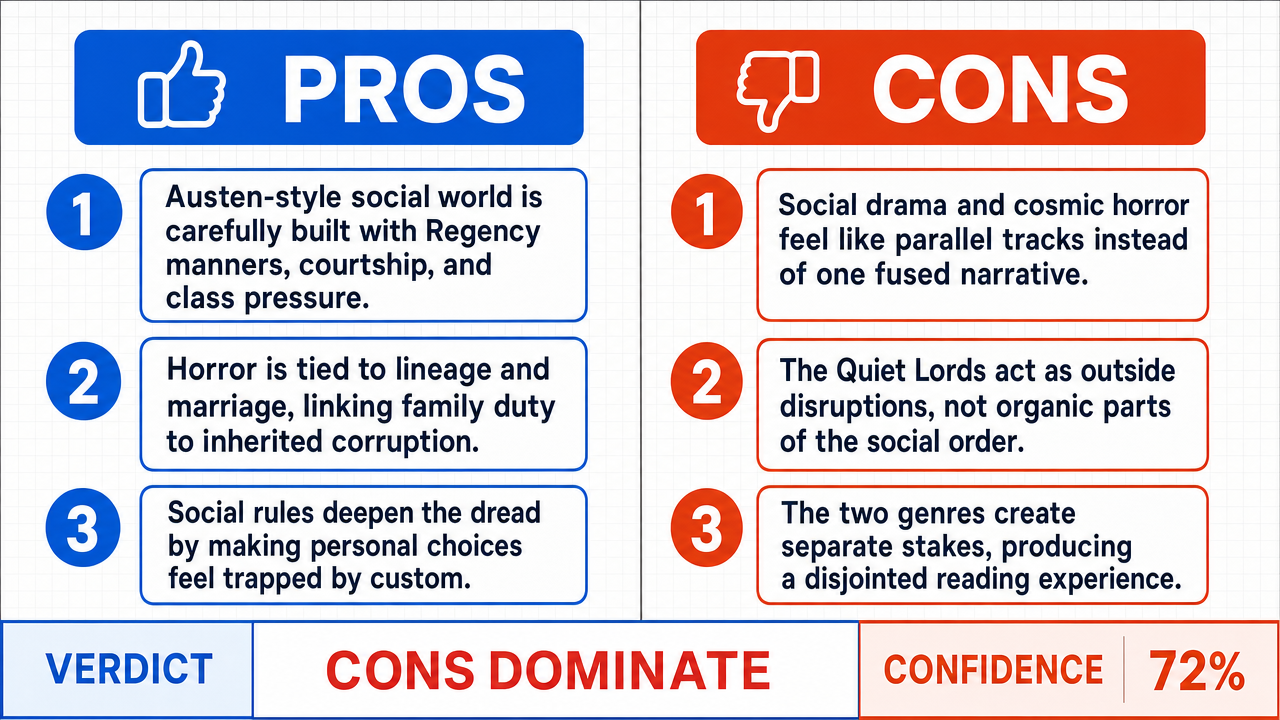
Verdict
Verdict: likely FALSE (72%)
Web Report: https://solsice.com/public/debates/the-sagas-of-sunundry-darkling-gate-series-successfully-blen-60976d9091fd
This section provides a brief overview of the key arguments. You do not need to read the full detailed report below.
✅ Key PRO arguments:
- ■The series explicitly constructs its social world using Austen's narrative techniques, featuring a meticulously rendered Regency-era setting, marriage-market maneuvers, and free indirect discourse that mirrors Austen's style in exploring characters' internal social calculations and reputation anxieties.
- ■The cosmic horror elements are structurally entangled with the social order through the mechanism of lineage and marriage, where bloodline corruption serves as a thematic fusion of the social and the cosmic rather than a mere juxtaposition.
❌ Key ANTI arguments:
- ■The narrative functions through a jarring juxtaposition where social drama and cosmic horror operate as parallel, non-interacting tracks; the social drama is confined to interpersonal politics of the landed gentry while cosmic horror is relegated to external, catastrophic events that disrupt rather than inhabit the social fabric .
- ■The cosmic horror elements—specifically the influence of the Quiet Lords—function as external, disruptive forces that act upon the social structure from the outside rather than being intrinsic to it; the 'corruption' of a bloodline is a mechanical imposition of a supernatural variable into a social equation, not a genuine thematic fusion .
- ■The bifurcated reading experience means the stakes of one genre do not meaningfully inform the mechanics of the other, resulting in a disjointed narrative rather than a successful blend.
💭 Conclusion: The judge determined that the series fails to achieve a genuine synthesis of Austenian social drama and cosmic horror . The cosmic horror elements function as external disruptive forces imposed upon the social structure rather than being intrinsically woven into it, serving as a 'deus ex machina' that bypasses character development. In Austen's work, social resolution results from internal moral and intellectual growth, whereas in the Sagas, conflicts are resolved through the sudden intervention of cosmic phenomena. The anti side's argument that the genres operate as parallel, non-interacting layers was more persuasive in demonstrating the absence of genuine integration.
🔬 DeepResearch Result: likely FALSE ❌ (72%)
Assertion: The 'Sagas of Sunundry Darkling Gate' series successfully blends Jane Austen-style social drama with cosmic horror elements in its narrative.
Participating models: deepseek-v3.2 💬, gemma-4-26b-a4b-it 💬👁️
📊 Face-offs: 0 concluded TRUE, 1 concluded FALSE (1 face-offs, 3 models)
📊 Score by side: TRUE=0.00, FALSE=0.72
🏅 Model score changes:
minimax-m3 💬👁️: +7
✅ PRO Arguments:
- ■The series explicitly constructs its social world using Austen's narrative techniques, featuring a meticulously rendered Regency-era setting, marriage-market maneuvers, and free indirect discourse that mirrors Austen's style in exploring characters' internal social calculations and reputation anxieties. deepseek-v3.2 💬
- ■The cosmic horror elements are structurally entangled with the social order through the mechanism of lineage and marriage, where bloodline corruption serves as a thematic fusion of the social and the cosmic rather than a mere juxtaposition. deepseek-v3.2 💬
❌ ANTI Arguments:
- ■The narrative functions through a jarring juxtaposition where social drama and cosmic horror operate as parallel, non-interacting tracks; the social drama is confined to interpersonal politics of the landed gentry while cosmic horror is relegated to external, catastrophic events that disrupt rather than inhabit the social fabric . gemma-4-26b-a4b-it 💬👁️
- ■The cosmic horror elements—specifically the influence of the Quiet Lords—function as external, disruptive forces that act upon the social structure from the outside rather than being intrinsic to it; the 'corruption' of a bloodline is a mechanical imposition of a supernatural variable into a social equation, not a genuine thematic fusion. gemma-4-26b-a4b-it 💬👁️
- ■The bifurcated reading experience means the stakes of one genre do not meaningfully inform the mechanics of the other, resulting in a disjointed narrative rather than a successful blend. gemma-4-26b-a4b-it 💬👁️
💭 Reasoning: The judge determined that the series fails to achieve a genuine synthesis of Austenian social drama and cosmic horror. The cosmic horror elements function as external disruptive forces imposed upon the social structure rather than being intrinsically woven into it, serving as a 'deus ex machina' that bypasses character development. In Austen's work, social resolution results from internal moral and intellectual growth, whereas in the Sagas, conflicts are resolved through the sudden intervention of cosmic phenomena. The anti side's argument that the genres operate as parallel, non-interacting layers was more persuasive in demonstrating the absence of genuine integration.
📋 PRO Facts:
• The series features a Regency-era setting with marriage-market maneuvers and status anxieties characteristic of Austen's social world.
• The prose employs free indirect discourse to explore characters' internal social calculations and reputation awareness.
• Critical analysis has noted the cosmic horror is directly entangled with social order through lineage and marriage mechanics.
📋 ANTI Facts:
• The cosmic horror elements function as external, disruptive forces acting upon the social structure from outside rather than being intrinsic to it.
• The narrative operates through a bifurcated structure where social drama and cosmic horror are parallel, non-interacting tracks.
• The stakes of one genre do not meaningfully inform the mechanics of the other, resulting in a disjointed reading experience.
| Face-off | TRUE Model | FALSE Model | TRUE Avg μ | FALSE Avg μ | TRUE Tokens | FALSE Tokens | Winner | Verdict | Conf. |
|---|---|---|---|---|---|---|---|---|---|
| #1 | deepseek-v3.2 💬 | gemma-4-26b-a4b-it 💬👁️ | 0.461 | 0.463 | 8 | 2 | FALSE | FALSE | 72% |
The following technical terms, abbreviations, and domain-specific concepts are referenced throughout this debate transcript. Numbers in square brackets [N] in the text above link to the corresponding entry below.
[1] Austenian — of or relating to Jane Austen — Pertaining to the narrative style, social themes, and prose techniques characteristic of Jane Austen's novels, such as free indirect discourse, irony, and focus on marriage and social standing.
[2] bifurcated reading experience — split reading experience — A critical term describing a narrative that divides into two distinct, non-interpreting tracks, forcing the reader to engage with separate genre modes rather than a unified whole.
[3] cosmic horror — cosmic horror (genre) — A literary genre emphasizing the incomprehensibility of the universe and humanity's insignificance, often featuring ancient, indifferent supernatural entities that provoke existential dread.
[4] exhaustive possibilities — exhaustive possibilities (logical dichotomy) — A logical structure in which the cases under consideration are mutually exclusive and collectively cover all options, leaving no third alternative.
[5] existential dread — A profound anxiety arising from the awareness of human meaninglessness or the presence of forces beyond human comprehension, a hallmark theme of cosmic horror.
[6] familial duty — The social obligation, central to Regency-era drama, for individuals to act in ways that preserve or advance their family's reputation, lineage, and standing.
[7] free indirect discourse — A third-person narrative technique that blends the author's voice with a character's internal thoughts, famously used by Jane Austen to convey social calculation and irony.
[8] genre hybridity — The blending of two or more distinct literary genres into a single, integrated work, as opposed to their mere juxtaposition.
[9] genre integration — The structural and thematic merging of multiple genres so that their conventions inform one another, rather than operating as parallel layers.
[10] landed gentry — A social class of landowners, below the aristocracy but above yeomen, whose income and status derive from renting agricultural land; the typical milieu of Regency-era social drama.
[11] lineage as a vector — lineage as a vector for cosmic corruption — An interpretive concept in which family bloodlines serve as the transmission mechanism by which supernatural or cosmic corruption spreads through the social order.
[12] marriage-market — A sociological and literary concept treating marriage as a transactional system in which individuals (especially women) are evaluated for social, economic, and reproductive advantage.
[13] mechanical imposition — In narrative analysis, the introduction of an external plot element (such as a supernatural variable) that acts upon existing social rules without being shaped by them.
[14] narrative layers — Distinct structural strata within a text, such as separate genre, thematic, or plot tracks that may or may not interact.
[15] narrative structure — The formal organization of a story, including its plot architecture, pacing, and the arrangement of events and revelations.
[16] Regency-era — Regency era — The period in British history roughly spanning 1811–1820 (and used more loosely for the early 19th century), the setting of Jane Austen's novels and a frequent backdrop for Austenian social drama.
[17] reputation — reputation (social) — In Regency-era social contexts, the public estimation of a family or individual's moral standing, propriety, and wealth, which governs their eligibility for advantageous matches and social acceptance.
[18] social fabric — The interlocking network of relationships, norms, and institutions that constitute a society, often invoked in literary analysis to describe the integrated whole that genre elements may inhabit or disrupt.
[19] social order — The hierarchical arrangement of classes, ranks, and institutions in a society, which in the debate is treated as a structure that cosmic horror may either inhabit or merely disrupt.
[20] structural bifurcation — A narrative condition in which a text splits into two structurally separate and non-communicating branches, preventing unified interpretation.
[21] structural interdependence — A narrative property in which two elements (e.g., social drama and cosmic horror) require and shape one another such that neither functions fully without the other.
[22] textual evidence — Direct quotations or specific passages from a work used in literary argument to support an interpretive claim.
[23] thematic fusion — The merging of two or more thematic concerns into a single, unified idea within a narrative, as opposed to their parallel presentation.
[24] thematic synthesis — The combination of disparate themes into a coherent whole, regarded in the debate as a criterion for successful genre blending.
[25] tonal whiplash — A jarring shift in mood, register, or genre atmosphere that disrupts reader immersion, here cited as evidence of failed genre integration.
[26] vector — vector (analytical sense) — In literary analysis, a carrier or conduit through which a quality (such as corruption) is transmitted, rather than the literal mathematical or biological meaning.
Face-off transcripts
- ■
Ownership & Trade Secrets. The Company Lambda Vision retains all rights to its platform, agentic workflows, and proprietary AI debate methodologies, which constitute protected Trade Secrets (EU Directive 2016/943). Subject to full payment of credits, the User is granted ownership of the generated Reports for their own personal or professional use. Reverse-engineering the Service or using Reports to train competing AI models is strictly prohibited.
- ■
No Professional Advice. Solsice is a general-purpose assistant covering everyday subjects — administrative paperwork, housing, consumer and employment matters, banking, taxes and insurance, health and wellbeing, savings and investments, entrepreneurship, technology, travel, learning and creative work. Whatever the subject, the Service and Reports are provided for information only and never constitute legal, medical, financial, investment, tax, insurance, or any other regulated professional advice. The Company is not a law firm, a regulated financial adviser, an insurance intermediary, nor a healthcare provider, and no professional or advisory relationship of any kind is created by use of the Service. Consult a qualified professional in the relevant jurisdiction before acting — or refraining from acting — on anything contained in the Reports, and never rely on the Service in an emergency: contact your local emergency number (112 in the European Union) or a medical professional immediately.
- ■
AI-Generated Content, Sources and Viewpoints. Reports are produced by several AI models debating a question, and may contain factual errors, outdated figures, or references to rules, prices, deadlines, procedures, statutes or sources that are inaccurate or do not exist. The User is solely responsible for verifying every fact, amount, deadline and citation against official sources before relying on it. Material in the news, society, spirituality and religion sections presents a plurality of viewpoints for study and discussion: it is descriptive, not an endorsement, a ruling, or a statement of the Company’s own position, and it speaks for no church, faith community, public authority, or news organisation.
- ■
Liability & Governing Law. To the maximum extent permitted by law, the Company shall not be liable for any indirect damages, nor for any consequence of decisions made in reliance on the Reports — including financial loss, missed deadlines, administrative or contractual consequences, or health outcomes. These Terms are governed by French law. Any disputes shall be subject to the exclusive jurisdiction of the Courts of Paris, France.