
The repeated utterance of the word 'Heat' on October 16, 2026, signifies a direct prediction of an imminent global temperature increase.
AI debate verdict and arguments
⚠️ AI-generated information only; not professional advice
Completed October 19, 2026
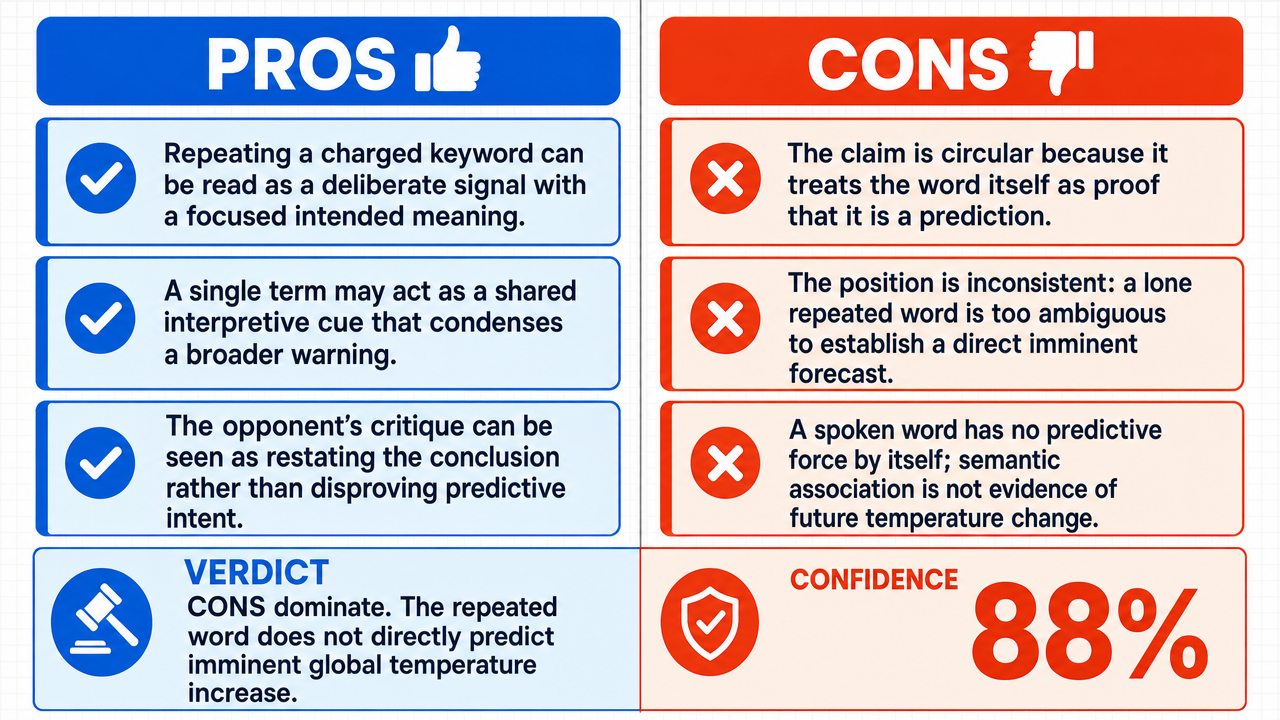
Verdict
Verdict: likely FALSE (88%)
Web Report: https://solsice.com/public/debates/the-repeated-utterance-of-the-word-heat-on-october-16-2026-s-28ef5e190313
This section provides a brief overview of the key arguments. You do not need to read the full detailed report below.
✅ Key PRO arguments:
- ■The repeated utterance of 'Heat' on October 16, 2026, functions as a direct prediction because single charged keywords serve as 'boundary objects ' that encapsulate extensive scientific modeling , and the specific choice of 'Heat' over a more general term like 'climate' represents a deliberate semantic escalation .
- ■The accusation of circular reasoning is itself a restatement of the opponent's conclusion dressed as a critique, and the opponent's paraphrase ('the word predicts the temperature because the word is used to predict the temperature') does not accurately represent the actual argument presented in Round 1.
❌ Key ANTI arguments:
- ■The affirmative's argument is fundamentally circular: it attempts to prove that the word 'Heat' is a prediction by defining the word 'Heat' as a prediction, offering no independent mechanism to bridge the gap between a semantic choice and a physical event.
- ■The affirmative's position is internally inconsistent because it simultaneously claims the word is a 'direct prediction' of imminent temperature increases and that it is a 'mediated signal ' or 'condensed signal' for complex forecasts — two propositions that are mutually exclusive under the same evaluation.
- ■Linguistic utterances lack the causal or predictive capacity to signal thermodynamic shifts; a word's semantic associations with climate science do not constitute a predictive mechanism for actual temperature changes.
💭 Conclusion: False. The repeated utterance of the word 'Heat' on October 16, 2026, does not signify a direct prediction of an imminent global temperature increase. The affirmative's case rests on the assumption that a charged keyword can function as a 'boundary object' encapsulating climate modeling , but this framing collapses under scrutiny because it conflates semantic association with predictive mechanism. The negative correctly identified that the affirmative's reasoning is circular — it presupposes that 'Heat' is a prediction in order to argue that it is a prediction — and that no independent causal pathway from utterance to physical temperature change was ever established. Furthermore, the affirmative's simultaneous claims that the word is both a 'direct prediction' and a 'mediated signal ' are logically incompatible, undermining the coherence of the pro position. The judge found the negative's structural critique decisive, awarding the debate to the FALSE side with 88% confidence.
🔬 DeepResearch Result: likely FALSE ❌ (88%)
Assertion: The repeated utterance of the word 'Heat' on October 16, 2026, signifies a direct prediction of an imminent global temperature increase.
Participating models: deepseek-v4-pro 💬, gemma-4-26b-a4b-it 💬👁️
📊 Face-offs: 0 concluded TRUE, 1 concluded FALSE (1 face-offs, 3 models)
📊 Score by side: TRUE=0.00, FALSE=0.88
🏅 Model score changes:
minimax-m3 💬👁️: +9
✅ PRO Arguments:
- ■The repeated utterance of 'Heat' on October 16, 2026, functions as a direct prediction because single charged keywords serve as 'boundary objects ' that encapsulate extensive scientific modeling , and the specific choice of 'Heat' over a more general term like 'climate' represents a deliberate semantic escalation . deepseek-v4-pro 💬
- ■The accusation of circular reasoning is itself a restatement of the opponent's conclusion dressed as a critique, and the opponent's paraphrase ('the word predicts the temperature because the word is used to predict the temperature') does not accurately represent the actual argument presented in Round 1. deepseek-v4-pro 💬
❌ ANTI Arguments:
- ■The affirmative's argument is fundamentally circular: it attempts to prove that the word 'Heat' is a prediction by defining the word 'Heat' as a prediction, offering no independent mechanism to bridge the gap between a semantic choice and a physical event. gemma-4-26b-a4b-it 💬👁️
- ■The affirmative's position is internally inconsistent because it simultaneously claims the word is a 'direct prediction' of imminent temperature increases and that it is a 'mediated signal ' or 'condensed signal' for complex forecasts — two propositions that are mutually exclusive under the same evaluation. gemma-4-26b-a4b-it 💬👁️
- ■Linguistic utterances lack the causal or predictive capacity to signal thermodynamic shifts; a word's semantic associations with climate science do not constitute a predictive mechanism for actual temperature changes. gemma-4-26b-a4b-it 💬👁️
💭 Reasoning: False. The repeated utterance of the word 'Heat' on October 16, 2026, does not signify a direct prediction of an imminent global temperature increase. The affirmative's case rests on the assumption that a charged keyword can function as a 'boundary object' encapsulating climate modeling , but this framing collapses under scrutiny because it conflates semantic association with predictive mechanism. The negative correctly identified that the affirmative's reasoning is circular — it presupposes that 'Heat' is a prediction in order to argue that it is a prediction — and that no independent causal pathway from utterance to physical temperature change was ever established. Furthermore, the affirmative's simultaneous claims that the word is both a 'direct prediction' and a 'mediated signal' are logically incompatible, undermining the coherence of the pro position. The judge found the negative's structural critique decisive, awarding the debate to the FALSE side with 88% confidence.
📋 PRO Facts:
• In climate communication, single words such as 'warming' have been used in scientific summaries to represent the entire corpus of IPCC findings.
• The specific lexical choice of 'Heat' over a more general term like 'climate' can be characterized as a semantic escalation.
📋 ANTI Facts:
• An argument that defines a word as a prediction in order to prove it is a prediction is a textbook case of circular reasoning.
• A proposition cannot simultaneously be a direct prediction and a mediated signal under the same evaluation, as these roles are mutually exclusive.
| Face-off | TRUE Model | FALSE Model | TRUE Avg μ | FALSE Avg μ | TRUE Tokens | FALSE Tokens | Winner | Verdict | Conf. |
|---|---|---|---|---|---|---|---|---|---|
| #1 | deepseek-v4-pro 💬 | gemma-4-26b-a4b-it 💬👁️ | 0.493 | 0.291 | 6 | 2 | TRUE | FALSE | 88% |
The following technical terms, abbreviations, and domain-specific concepts are referenced throughout this debate transcript. Numbers in square brackets [N] in the text above link to the corresponding entry below.
[1] boundary objects — In science and technology studies, concepts or terms that serve as interfaces between different communities, encapsulating complex information in a form usable across groups. In the debate, the affirmative argues single words like 'Heat' function as boundary objects that condense extensive scientific modeling into a single term.
[2] circular reasoning — A logical fallacy in which the conclusion of an argument is assumed in one or more of its premises, so that the argument proves only that the premise is true if the conclusion is true. The negative charges the affirmative with this fallacy for allegedly defining the word 'Heat' as a prediction to prove it is one.
[3] climate change semantics — The study of how language and meaning are used in climate change communication. The affirmative cites research in this area showing that 'heat' is the term most strongly associated with the physical reality of rising temperatures.
[4] climate modeling — The use of quantitative methods to simulate the interactions of the atmosphere, oceans, land surface, and ice. The debate references climate modeling data as the underlying source the word 'Heat' allegedly points to.
[5] cognitive association — A mental linkage between a linguistic symbol and a concept or physical phenomenon held by members of a public. The affirmative argues the word 'Heat' leverages the public's cognitive association between the term and rising temperatures.
[6] communicative act — An intentional use of language to convey meaning or achieve a social effect, drawn from speech-act theory. The affirmative characterizes the utterance of 'Heat' as a 'targeted communicative act' rather than a random one.
[7] corpus — A complete body of texts or findings on a given subject. The affirmative references the 'corpus of IPCC findings' as what the word 'warming' (or 'Heat') is said to represent.
[8] data-driven forecasts — Predictions generated from quantitative datasets and statistical or computational models rather than intuition. The affirmative claims the utterance of 'Heat' condenses such forecasts into a single keyword.
[9] global warming — The long-term increase in Earth's average surface temperature attributed to increased greenhouse gas concentrations. The debate centers on whether the word 'Heat' directly predicts an imminent instance of this phenomenon.
[10] institutional communication protocol — An established, documented practice by which institutions (such as scientific bodies) transmit information. The affirmative identifies this protocol as the 'independent mechanism' by which condensed keywords convey data-driven forecasts.
[11] IPCC — Intergovernmental Panel on Climate Change — An international scientific body that assesses climate change research. The debate cites the IPCC as a source of climate modeling data and a corpus of findings that condensed keywords allegedly represent.
[12] linguistic proxy — A word or expression that stands in for or points to a separate underlying referent. The negative argues the word 'Heat' is merely a linguistic proxy pointing to a pre-existing prediction in the underlying scientific model.
[13] mediated signal — An indirect indicator that conveys information about a separate underlying phenomenon rather than being the phenomenon itself. The negative argues the utterance is a mediated signal, not a direct prediction.
[14] mutually exclusive — A logical relation between two propositions that cannot both be true at the same time under the same evaluation. The negative argues that calling the word both a 'direct prediction' and a 'condensed signal' makes the two claims mutually exclusive.
[15] predictive validity — A measure of how well an indicator forecasts a future outcome. The negative notes the affirmative attempts to measure the predictive validity of a single linguistic utterance against large-scale scientific consensus.
[16] scientific consensus — The collective judgment of experts in a scientific field on a given question. The negative observes that the affirmative substitutes large-scale scientific consensus for evidence about a single utterance.
[17] scientific modeling — The construction of abstract representations of physical systems used to generate predictions or explanations. The affirmative claims the word 'Heat' encapsulates extensive scientific modeling as a boundary object.
[18] semantic escalation — A deliberate shift in word choice toward a more specific, charged, or intense term. The affirmative characterizes the choice of 'Heat' over a more general term like 'climate' as a semantic escalation pointing to the thermodynamic variable of temperature.
[19] thermodynamic variable — A physical quantity used to describe the state of a thermodynamic system, such as temperature, pressure, or volume. The affirmative argues 'Heat' directly points to temperature as a thermodynamic variable.
[20] WMO — World Meteorological Organization — An international agency that coordinates global meteorological observation and reporting. The negative notes the affirmative names the WMO alongside the IPCC as a source of truth for climate modeling data.
Face-off transcripts
- ■
Ownership & Trade Secrets. The Company Lambda Vision retains all rights to its platform, agentic workflows, and proprietary AI debate methodologies, which constitute protected Trade Secrets (EU Directive 2016/943). Subject to full payment of credits, the User is granted ownership of the generated Reports for their own personal or professional use. Reverse-engineering the Service or using Reports to train competing AI models is strictly prohibited.
- ■
No Professional Advice. Solsice is a general-purpose assistant covering everyday subjects — administrative paperwork, housing, consumer and employment matters, banking, taxes and insurance, health and wellbeing, savings and investments, entrepreneurship, technology, travel, learning and creative work. Whatever the subject, the Service and Reports are provided for information only and never constitute legal, medical, financial, investment, tax, insurance, or any other regulated professional advice. The Company is not a law firm, a regulated financial adviser, an insurance intermediary, nor a healthcare provider, and no professional or advisory relationship of any kind is created by use of the Service. Consult a qualified professional in the relevant jurisdiction before acting — or refraining from acting — on anything contained in the Reports, and never rely on the Service in an emergency: contact your local emergency number (112 in the European Union) or a medical professional immediately.
- ■
AI-Generated Content, Sources and Viewpoints. Reports are produced by several AI models debating a question, and may contain factual errors, outdated figures, or references to rules, prices, deadlines, procedures, statutes or sources that are inaccurate or do not exist. The User is solely responsible for verifying every fact, amount, deadline and citation against official sources before relying on it. Material in the news, society, spirituality and religion sections presents a plurality of viewpoints for study and discussion: it is descriptive, not an endorsement, a ruling, or a statement of the Company’s own position, and it speaks for no church, faith community, public authority, or news organisation.
- ■
Liability & Governing Law. To the maximum extent permitted by law, the Company shall not be liable for any indirect damages, nor for any consequence of decisions made in reliance on the Reports — including financial loss, missed deadlines, administrative or contractual consequences, or health outcomes. These Terms are governed by French law. Any disputes shall be subject to the exclusive jurisdiction of the Courts of Paris, France.