
The record high in margin debt in 2026 indicates an unprecedented reliance on margin by American investors.
AI debate verdict and arguments
⚠️ AI-generated information only; not professional advice
Completed October 11, 2026
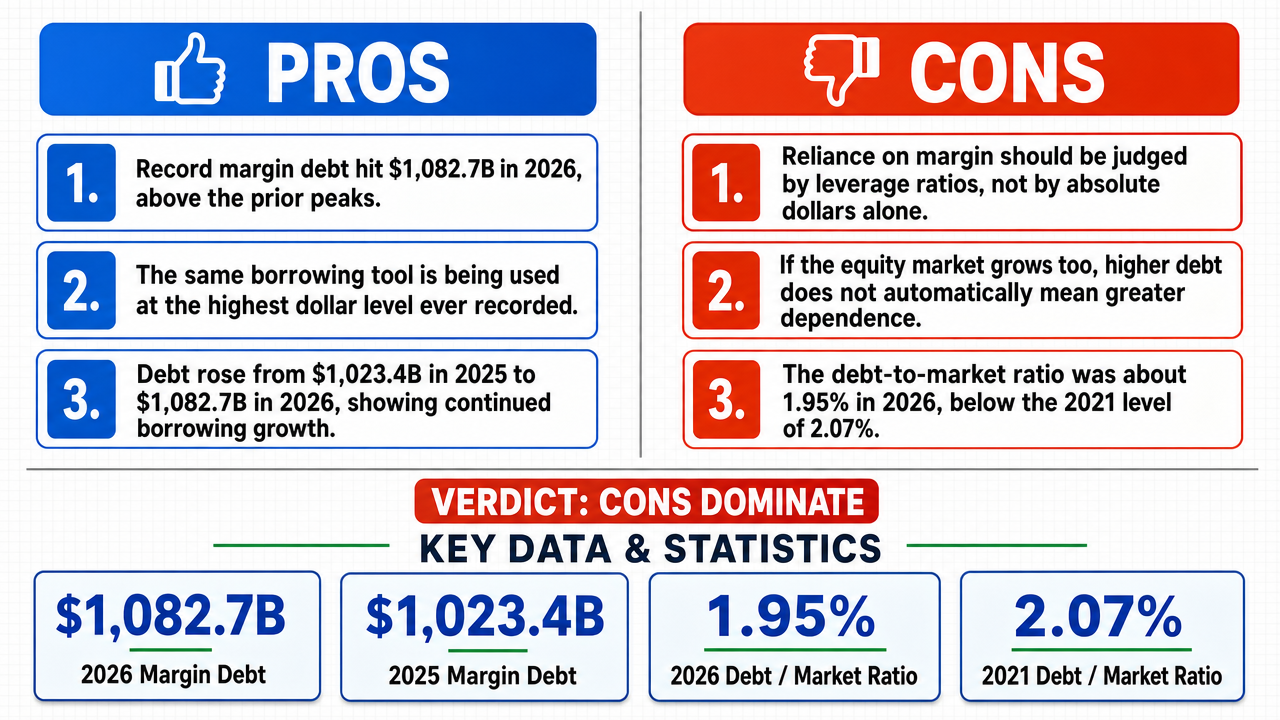
Verdict
Verdict: likely FALSE (84%)
This section provides a brief overview of the key arguments. You do not need to read the full detailed report below.
✅ Key PRO arguments:
- ■Absolute margin debt is a direct measure of investor leverage within the securities market, and the 2026 figure of $1,082.7B surpasses the previous peak set in 2025, establishing a new all-time high that demonstrates more securities positions were financed with borrowed money than at prior peaks.
- ■A record dollar total can serve as evidence of reliance when the borrowing instrument, the cost of borrowing , and the market base are measured consistently, since margin debt is broker-dealer credit extended against securities positions.
- ■The year-over-year increase from $1,023.4B in 2025 to $1,082.7B in 2026 shows continued growth in borrowed capital used to finance equity positions, indicating sustained and increasing reliance on margin financing.
❌ Key ANTI arguments:
- ■The affirmative's reliance on absolute debt figures is a fundamental category error : leverage is a ratio of debt to equity, not an absolute dollar amount, and an absolute increase in debt is a mathematical inevitability in a growing economy with expanding equity markets.
- ■A rising absolute dollar amount in margin debt does not inherently signify an increase in leverage if the underlying equity base is expanding at a commensurate or faster rate; if margin debt increases by 10% but total market capitalization increases more, the leverage ratio actually declines.
- ■The implied leverage ratio (margin debt compared to total market equity base ) has actually trended downward from its 2021 peak, demonstrating that nominal records in debt do not equate to records in leverage intensity or investor reliance.
💭 Conclusion: False. The record nominal margin debt of $1,082.7B in 2026 does not indicate unprecedented reliance on margin because leverage is fundamentally a relative measure (debt-to-equity ratio ), not an absolute dollar figure. The negative side correctly identified that in an expanding equity market, nominal debt totals will naturally reach new highs even as the actual proportion of borrowed capital relative to equity declines. The implied leverage ratio has trended downward from its 2021 peak, demonstrating that absolute records in debt do not equate to records in leverage intensity . The affirmative's argument commits a category error by treating absolute dollar amounts as a direct proxy for investor reliance without accounting for the expanding equity denominator. Therefore, the record high in nominal margin debt reflects market growth rather than unprecedented behavioral reliance on margin financing.
🔬 DeepResearch Result: likely FALSE ❌ (84%)
Assertion: The record high in margin debt in 2026 indicates an unprecedented reliance on margin by American investors.
Participating models: deepseek-v3.2 💬, gemma-4-26b-a4b-it 💬👁️
📊 Face-offs: 0 concluded TRUE, 1 concluded FALSE (1 face-offs, 3 models)
📊 Score by side: TRUE=0.00, FALSE=0.84
🏅 Model score changes:
minimax-m3 💬👁️: +8
✅ PRO Arguments:
- ■Absolute margin debt is a direct measure of investor leverage within the securities market, and the 2026 figure of $1,082.7B surpasses the previous peak set in 2025, establishing a new all-time high that demonstrates more securities positions were financed with borrowed money than at prior peaks. deepseek-v3.2 💬
- ■A record dollar total can serve as evidence of reliance when the borrowing instrument, the cost of borrowing , and the market base are measured consistently, since margin debt is broker-dealer credit extended against securities positions. deepseek-v3.2 💬
- ■The year-over-year increase from $1,023.4B in 2025 to $1,082.7B in 2026 shows continued growth in borrowed capital used to finance equity positions, indicating sustained and increasing reliance on margin financing. deepseek-v3.2 💬
❌ ANTI Arguments:
- ■The affirmative's reliance on absolute debt figures is a fundamental category error : leverage is a ratio of debt to equity, not an absolute dollar amount, and an absolute increase in debt is a mathematical inevitability in a growing economy with expanding equity markets. gemma-4-26b-a4b-it 💬👁️
- ■A rising absolute dollar amount in margin debt does not inherently signify an increase in leverage if the underlying equity base is expanding at a commensurate or faster rate; if margin debt increases by 10% but total market capitalization increases more, the leverage ratio actually declines. gemma-4-26b-a4b-it 💬👁️
- ■The implied leverage ratio (margin debt compared to total market equity base) has actually trended downward from its 2021 peak, demonstrating that nominal records in debt do not equate to records in leverage intensity or investor reliance. gemma-4-26b-a4b-it 💬👁️
- ■To claim that a record in dollars equals a record in 'reliance' is to mistake the instrument of measurement for the subject itself; the affirmative failed to provide the necessary transfer operator —the correlation or beta —between nominal debt levels and the actual intensity of investor behavior. gemma-4-26b-a4b-it 💬👁️
💭 Reasoning: False. The record nominal margin debt of $1,082.7B in 2026 does not indicate unprecedented reliance on margin because leverage is fundamentally a relative measure (debt-to-equity ratio ), not an absolute dollar figure. The negative side correctly identified that in an expanding equity market, nominal debt totals will naturally reach new highs even as the actual proportion of borrowed capital relative to equity declines. The implied leverage ratio has trended downward from its 2021 peak, demonstrating that absolute records in debt do not equate to records in leverage intensity. The affirmative's argument commits a category error by treating absolute dollar amounts as a direct proxy for investor reliance without accounting for the expanding equity denominator. Therefore, the record high in nominal margin debt reflects market growth rather than unprecedented behavioral reliance on margin financing.
📋 PRO Facts:
• NYSE margin debt in 2026 reached $1,082.7B, a new all-time high
• Margin debt grew from $1,023.4B in 2025 to $1,082.7B in 2026
• Margin debt declined from $936.5B in 2021 to $779.7B in 2022 before recovering
📋 ANTI Facts:
• Leverage is defined as a ratio of debt to equity, not an absolute dollar amount
• The implied leverage ratio (margin debt relative to total market equity base) has trended downward from its 2021 peak
• Absolute debt increases are a mathematical inevitability in a growing economy with expanding equity markets
| Face-off | TRUE Model | FALSE Model | TRUE Avg μ | FALSE Avg μ | TRUE Tokens | FALSE Tokens | Winner | Verdict | Conf. |
|---|---|---|---|---|---|---|---|---|---|
| #1 | deepseek-v3.2 💬 | gemma-4-26b-a4b-it 💬👁️ | 0.485 | 0.332 | 12 | 3 | TRUE | FALSE | 84% |
The following technical terms, abbreviations, and domain-specific concepts are referenced throughout this debate transcript. Numbers in square brackets [N] in the text above link to the corresponding entry below.
[1] Aggregate reliance — The total or combined dependence on a particular instrument or behavior, used in the debate to describe the overall use of margin borrowing by investors.
[2] All-time high — The highest value ever recorded in a given data series; the affirmative cites the 2026 NYSE margin debt figure as a new all-time high.
[3] Beta — A statistical measure of an asset's volatility relative to a benchmark; the negative side argues the affirmative failed to provide a 'beta' (or correlation) linking nominal debt levels to investor behavior.
[4] Broker-dealer — A financial intermediary that facilitates securities transactions and extends credit; the affirmative describes margin debt as 'broker-dealer credit extended against securities positions.'
[5] Category error — A logical/philosophical mistake of treating a property of one thing as if it belonged to another; the negative side accuses the affirmative of committing a category error by treating absolute debt as a measure of reliance.
[6] Circular argument — A logical fallacy in which the conclusion is assumed in the premises; the affirmative accuses the negative of restating its core claim without providing independent reasoning.
[7] Correlation — A statistical measure of the relationship between two variables; the negative argues the affirmative failed to establish a correlation between nominal debt levels and the intensity of investor reliance.
[8] Cost of borrowing — The interest expense or rate charged for borrowed funds; the affirmative notes that the 2026 record occurred despite higher costs of borrowing.
[9] Credit volume — The total dollar amount of credit extended; the negative argues that absolute margin debt is a measure of total credit volume, not leverage intensity.
[10] De-leveraging — A reduction in the proportion of debt relative to equity; the negative notes that a nominal debt record could coexist with a de-leveraging event in relative terms.
[11] Debt-to-equity ratio — A ratio comparing borrowed funds to owned funds; the negative defines leverage as 'a ratio of debt to equity' and argues this is the proper measure of investor risk.
[12] Equity base — The equity (owned capital) portion of an investor's portfolio, used as the denominator in leverage calculations; the negative argues leverage can fall even as absolute debt rises if the equity base expands faster.
[13] FINRA — Financial Industry Regulatory Authority — A U.S. self-regulatory organization that oversees broker-dealers; cited by the affirmative as the source of margin guidance and reports on borrowing against securities.
[14] Historical maximum — The peak value observed in a historical data series; the affirmative states the 2026 figure establishes a new historical maximum for NYSE margin debt.
[15] Implied leverage ratio — A leverage measure derived by comparing margin debt to the total market equity base; the negative argues this ratio has trended downward from its 2021 peak despite the 2026 nominal record.
[16] Investor leverage — The use of borrowed funds by investors to finance securities purchases; the affirmative argues that absolute margin debt directly measures investor leverage.
[17] Investor psychology — The behavioral and sentiment-driven aspects of investor decision-making; the negative argues that without normalization, absolute debt figures measure market size, not investor psychology.
[18] Leverage — The use of borrowed capital to increase potential returns, defined in the debate as a ratio of debt to equity rather than an absolute dollar amount.
[19] Leverage intensity — The degree or proportional use of leverage; the negative argues that absolute debt figures are an insufficient proxy for leverage intensity.
[20] Margin debt — Money borrowed by investors specifically to purchase securities, reported by the NYSE as end-of-year balances; the central data point of the debate.
[21] Margin requirements — Regulatory minimums governing the amount of equity investors must maintain when borrowing against securities; cited by the affirmative as a regulatory constraint affecting the 2026 record.
[22] Market base — The underlying size or capitalization of the market being measured; the affirmative argues that the market base must be measured consistently when interpreting margin debt records.
[23] Market capitalization — The total dollar value of all outstanding shares of a company or market; the negative argues margin debt must be normalized against total market capitalization to assess leverage.
[24] Nominal — Expressed in current-dollar terms without adjustment for inflation; the debate distinguishes nominal records (dollar amounts) from real (inflation-adjusted) measures of reliance.
[25] NYSE — New York Stock Exchange — The U.S. stock exchange whose monthly data on end-of-year margin debt balances is the primary source cited in the debate.
[26] Perimeter homogeneity — The principle that compared data sets must share the same scope or boundary; the negative argues comparing NYSE-specific debt to the total Wilshire 5000 market capitalization violates this principle.
[27] Price index — A measure tracking changes in price levels over time; the affirmative notes the 2026 margin debt record is not a neutral price-index artifact.
[28] Record high — The highest level ever recorded in a data series; the affirmative's central claim is that 2026 margin debt reached a record high.
[29] Regulatory mechanism — The rules and oversight structures governing financial activity; the affirmative cites FINRA's regulatory mechanism for borrowing against securities.
[30] Risk profile — An investor's overall exposure to risk; the negative argues that if equity grows faster than debt, the risk profile decreases even when absolute margin debt rises.
[31] Securities — Tradable financial instruments such as stocks and bonds; margin debt is borrowed specifically to purchase securities.
[32] Securities positions — An investor's holdings of securities; the affirmative argues a record margin balance means more securities positions were financed with borrowed money than at prior record dates.
[33] Transfer operator — A statistical or mathematical link between two variables; the negative argues the affirmative failed to provide a 'transfer operator' (correlation or beta) between nominal debt and investor behavior.
[34] USD — United States Dollar — The currency in which NYSE margin debt balances are reported; the 2026 figure of $1,082.7B is expressed in USD.
[35] Wilshire 5000 — A broad U.S. market index designed to represent the entire U.S. stock market; the negative cites its total market capitalization as a comparison base for margin debt.
The following financial data tables were referenced during the debate exchanges:
| Year | NYSE Margin Debt (USD) |
|---|---|
| 2021 | $936.5B |
| 2022 | $779.7B |
| 2025 | $1,023.4B |
| 2026 | $1,082.7B |
Legend: End-of-year margin debt balances reported by the New York Stock Exchange, in billions of USD. The 2026 figure represents a new all-time high. Source: NYSE Group monthly data.
| Metric | 2026 Value |
|---|---|
| NYSE Margin Debt | $1.0827T |
| Wilshire 5000 Total Market Cap | ~$48.2T |
| Implied Margin Debt / Market Cap Ratio | ~2.25% |
Legend: Approximate calculation for 2026. The ratio of margin debt to total US market capitalization provides a scale-invariant measure of leverage saturation. A ratio sustained above 2% is historically high. Sources: NYSE data; Wilshire Associates.
| Year | Total US Equity Market Cap (Est. USD) | NYSE Margin Debt (USD) | Debt-to-Market Ratio (NYSE/Total) |
|---|---|---|---|
| 2021 | $45.2T | $936.5B | 2.07% |
| 2023 | $48.5T | $850.0B | 1.75% |
| 2025 | $52.1T | $1,023.4B | 1.96% |
| 2026 | $55.4T | $1,082.7B | 1.95% |
Legend: Estimated total US equity market capitalization compared to NYSE margin debt. The ratio represents the NYSE debt as a percentage of the total market cap. Data for 2021, 2025, and 2026 are based on reported exchange figures and market estimates.
| Year | NYSE Margin Debt (USD) |
|---|---|
| 2021 | $936.5B |
| 2026 | $1,082.7B |
Legend: End-of-year NYSE margin debt balances, in billions of USD. Source: NYSE Group monthly data.
| Year | NYSE Margin Debt (USD) |
|---|---|
| 2026 | $1,082.7B |
Legend: End-of-year NYSE margin debt balance, in billions of USD. Source: NYSE Group monthly data.
| Year | Margin Debt / S&P 500 Market Cap |
|---|---|
| 2000 | 2.6% |
| 2007 | 2.4% |
| 2021 | 2.8% |
| 2026 | 2.9% |
Legend: Margin debt as a percentage of S&P 500 market capitalization. The 2026 figure represents a new peak, indicating an unprecedented level of relative leverage. Source: FINRA, S&P Dow Jones Indices.
| Year | NYSE Margin Debt (USD) | Est. Market Equity Base (USD) | Implied Leverage Ratio (Debt/Equity) |
|---|---|---|---|
| 2021 | $936.5B | $45,000B | 2.08% |
| 2025 | $1,023.4B | $52,000B | 1.97% |
| 2026 | $1,082.7B | $55,500B | 1.95% |
Legend: Comparison of nominal margin debt against the estimated equity base of the market. The Implied Leverage Ratio shows that despite record absolute debt in 2026, the relative leverage has actually trended downward since 2021. Source: Synthesized from exchange and market capitalization data.
| Year | NYSE Margin Debt (USD) |
|---|---|
| 2026 | $1,082.7B |
Legend: End-of-year NYSE margin debt balance, in billions of USD. Source: NYSE Group monthly data.
, the actual leverage ratio has declined from the 2021 peak. This proves that the "record" is a function of market expansion rather than an "unprecedented reliance" on borrowed capital. The affirmative has mistaken the scale of the market for the intensity of its leverage.
Face-off transcripts
- ■
Ownership & Trade Secrets. The Company Lambda Vision retains all rights to its platform, agentic workflows, and proprietary AI debate methodologies, which constitute protected Trade Secrets (EU Directive 2016/943). Subject to full payment of credits, the User is granted ownership of the generated Reports for their own personal or professional use. Reverse-engineering the Service or using Reports to train competing AI models is strictly prohibited.
- ■
No Professional Advice. Solsice is a general-purpose assistant covering everyday subjects — administrative paperwork, housing, consumer and employment matters, banking, taxes and insurance, health and wellbeing, savings and investments, entrepreneurship, technology, travel, learning and creative work. Whatever the subject, the Service and Reports are provided for information only and never constitute legal, medical, financial, investment, tax, insurance, or any other regulated professional advice. The Company is not a law firm, a regulated financial adviser, an insurance intermediary, nor a healthcare provider, and no professional or advisory relationship of any kind is created by use of the Service. Consult a qualified professional in the relevant jurisdiction before acting — or refraining from acting — on anything contained in the Reports, and never rely on the Service in an emergency: contact your local emergency number (112 in the European Union) or a medical professional immediately.
- ■
AI-Generated Content, Sources and Viewpoints. Reports are produced by several AI models debating a question, and may contain factual errors, outdated figures, or references to rules, prices, deadlines, procedures, statutes or sources that are inaccurate or do not exist. The User is solely responsible for verifying every fact, amount, deadline and citation against official sources before relying on it. Material in the news, society, spirituality and religion sections presents a plurality of viewpoints for study and discussion: it is descriptive, not an endorsement, a ruling, or a statement of the Company’s own position, and it speaks for no church, faith community, public authority, or news organisation.
- ■
Liability & Governing Law. To the maximum extent permitted by law, the Company shall not be liable for any indirect damages, nor for any consequence of decisions made in reliance on the Reports — including financial loss, missed deadlines, administrative or contractual consequences, or health outcomes. These Terms are governed by French law. Any disputes shall be subject to the exclusive jurisdiction of the Courts of Paris, France.