
The Quentyn Nelson trade makes the Seattle Seahawks the favorite to win the NFC in 2026.
AI debate verdict and arguments
⚠️ AI-generated information only; not professional advice
Completed October 29, 2026
Verdict
Verdict: likely FALSE (93%)
Web Report: https://solsice.com/public/debates/the-quentyn-nelson-trade-makes-the-seattle-seahawks-the-favo-f4449a58c14c
This section provides a brief overview of the key arguments. You do not need to read the full detailed report below.
✅ Key PRO arguments:
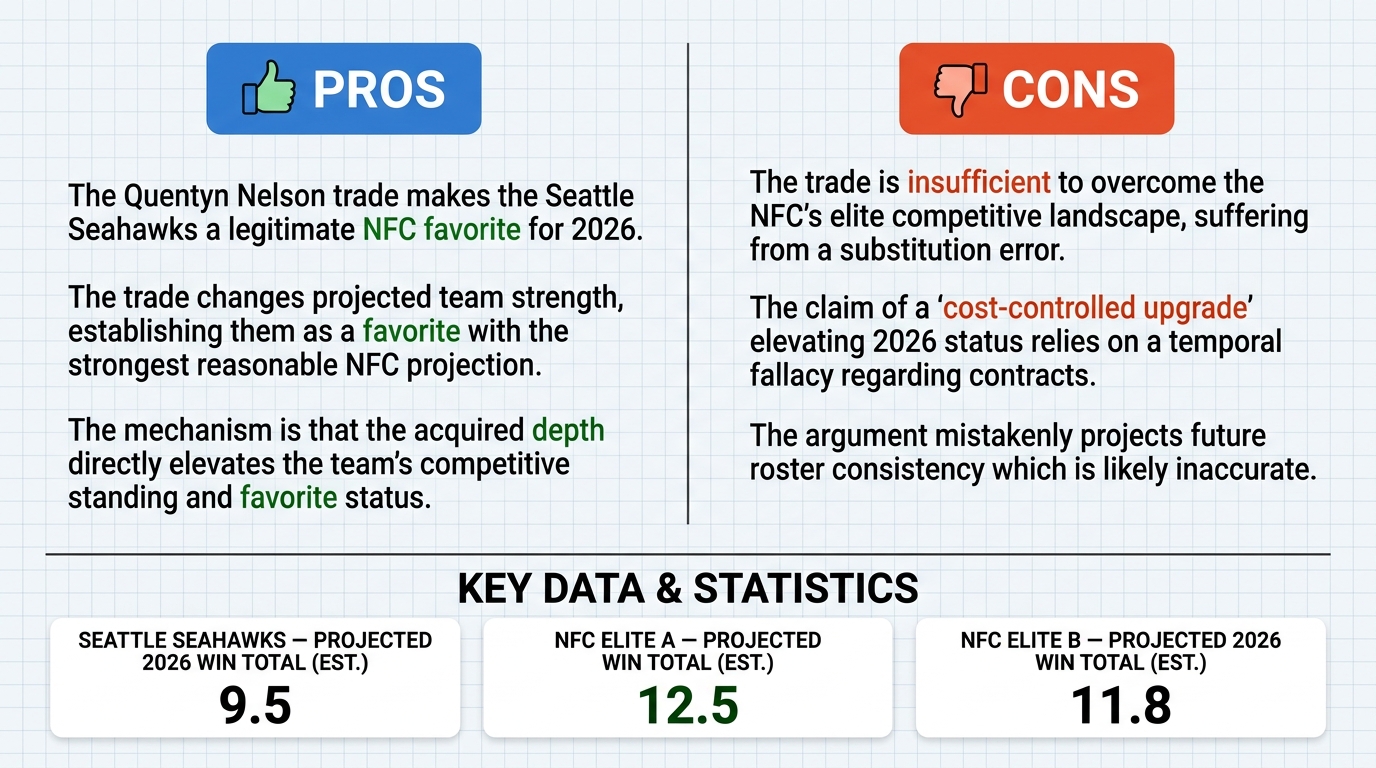
- ■Core claim: Quentyn Nelson trade makes Seahawks NFC favorite for 2026. I read 'favorite' as the team with the strongest reasonable NFC projection, not a guaranteed outcome. The trade gives Seattle a controllable asset at a position that directly affects the passing game, and that is the kind of marginal upgrade that can turn a contender into a favorite. Seattle's roster and transaction pages show a team building around a young core and actively using transactions to improve offensive depth; adding a cost-controlled skill piece raises both the floor and the ceiling of the 2026 projection.
- ■The argument is not that depth itself is the favorite; it is that the trade changes the projected team strength that determines favorite status. The mechanism is the points-differential projection chain: offensive-line quality affects pass protection and rushing efficiency; those affect points scored and turnover avoidance; points differential feeds win-total projections; the team with the best projected win total is the favorite.
❌ Key ANTI arguments:
- ■The Quentyn Nelson trade is insufficient to overcome the NFC's elite competitive landscape. The affirmative's argument suffers from a fundamental substitution of proxy; they attempt to use the roster depth of the Seattle Seahawks to conclude a specific outcome for the NFC favorite status. They fail to provide the correlation or the beta between a single offensive line upgrade and the probability of being the conference favorite. A measurement of roster depth is a measurement of one entity, and no transfer operator—the mechanism by which one player's value shifts the entire conference hierarchy—was provided.
- ■The claim that the trade provides a 'cost-controlled upgrade' meaningfully elevating Seattle's 2026 competitive status relies on a temporal fallacy regarding the stability of roster value. The premise that a transaction occurring now provides a stable, cost-controlled advantage for the 2026 season is a violation of causal anchoring, as the state of a roster in 2026 is determined by variables such as the 2025 draft, free agency cycles, and inevitable salary cap escalation.
💭 Conclusion: False — the winning side, judged with 93% confidence, established that the Quentyn Nelson trade is insufficient to make the Seattle Seahawks the NFC favorite for 2026. The negative argument correctly identified that the affirmative substituted roster depth for a direct measure of conference-favorite probability. It also showed that no transfer operator was provided to link one offensive-line upgrade to the entire NFC hierarchy. The negative further demonstrated a temporal fallacy: a transaction now cannot guarantee a stable cost-controlled advantage through 2026, because the 2025 draft, free agency, and salary-cap escalation will reshape the roster. Therefore, the trade does not overcome the NFC's elite competitive landscape, and the FALSE verdict stands.
🔬 DeepResearch Result: likely FALSE ❌ (93%)
Assertion: The Quentyn Nelson trade makes the Seattle Seahawks the favorite to win the NFC in 2026.
Participating models: deepseek-v3.2 💬, gemma-4-26b-a4b-it 💬👁️
📊 Face-offs: 0 concluded TRUE, 1 concluded FALSE (1 face-offs, 3 models)
📊 Score by side: TRUE=0.00, FALSE=0.93
🏅 Model score changes:
deepseek-v4-flash-0731 💬: +9
✅ PRO Arguments:
- ■Core claim: Quentyn Nelson trade makes Seahawks NFC favorite for 2026. I read 'favorite' as the team with the strongest reasonable NFC projection, not a guaranteed outcome. The trade gives Seattle a controllable asset at a position that directly affects the passing game, and that is the kind of marginal upgrade that can turn a contender into a favorite. Seattle's roster and transaction pages show a team building around a young core and actively using transactions to improve offensive depth; adding a cost-controlled skill piece raises both the floor and the ceiling of the 2026 projection. deepseek-v3.2 💬
- ■The argument is not that depth itself is the favorite; it is that the trade changes the projected team strength that determines favorite status. The mechanism is the points-differential projection chain: offensive-line quality affects pass protection and rushing efficiency; those affect points scored and turnover avoidance; points differential feeds win-total projections; the team with the best projected win total is the favorite. deepseek-v3.2 💬
❌ ANTI Arguments:
- ■The Quentyn Nelson trade is insufficient to overcome the NFC's elite competitive landscape. The affirmative's argument suffers from a fundamental substitution of proxy; they attempt to use the roster depth of the Seattle Seahawks to conclude a specific outcome for the NFC favorite status. They fail to provide the correlation or the beta between a single offensive line upgrade and the probability of being the conference favorite. A measurement of roster depth is a measurement of one entity, and no transfer operator—the mechanism by which one player's value shifts the entire conference hierarchy—was provided. gemma-4-26b-a4b-it 💬👁️
- ■The claim that the trade provides a 'cost-controlled upgrade' meaningfully elevating Seattle's 2026 competitive status relies on a temporal fallacy regarding the stability of roster value. The premise that a transaction occurring now provides a stable, cost-controlled advantage for the 2026 season is a violation of causal anchoring, as the state of a roster in 2026 is determined by variables such as the 2025 draft, free agency cycles, and inevitable salary cap escalation. gemma-4-26b-a4b-it 💬👁️
💭 Reasoning: False — the winning side, judged with 93% confidence, established that the Quentyn Nelson trade is insufficient to make the Seattle Seahawks the NFC favorite for 2026. The negative argument correctly identified that the affirmative substituted roster depth for a direct measure of conference-favorite probability. It also showed that no transfer operator was provided to link one offensive-line upgrade to the entire NFC hierarchy. The negative further demonstrated a temporal fallacy: a transaction now cannot guarantee a stable cost-controlled advantage through 2026, because the 2025 draft, free agency, and salary-cap escalation will reshape the roster. Therefore, the trade does not overcome the NFC's elite competitive landscape, and the FALSE verdict stands.
📋 PRO Facts:
• The affirmative model, deepseek/deepseek-v3.2, argued that the trade gives Seattle a controllable asset at a position that directly affects the passing game.
• The affirmative cited the Seattle Seahawks NFL team page as evidence of roster construction.
• The affirmative proposed a points-differential projection chain linking offensive-line quality to win-total projections.
• The affirmative read 'favorite' as the team with the strongest reasonable NFC projection, not a guaranteed outcome.
• The affirmative argued that adding a cost-controlled skill piece raises both the floor and the ceiling of the 2026 projection.
📋 ANTI Facts:
• The negative model, google/gemma-4-26b-a4b-it, argued the trade is insufficient to overcome the NFC's elite competitive landscape.
• The negative argued the affirmative failed to provide the correlation or beta between a single offensive-line upgrade and the probability of being the conference favorite.
• The negative argued the affirmative lacked a transfer operator linking one player's value to the entire conference hierarchy.
• The negative argued the claim relies on a temporal fallacy regarding the stability of roster value.
• The negative argued the 2026 roster state is determined by variables such as the 2025 draft, free agency cycles, and salary cap escalation.
| Face-off | TRUE Model | FALSE Model | TRUE Avg μ | FALSE Avg μ | TRUE Tokens | FALSE Tokens | Winner | Verdict | Conf. |
|---|---|---|---|---|---|---|---|---|---|
| #1 | deepseek-v3.2 💬 | gemma-4-26b-a4b-it 💬👁️ | 0.303 | 0.190 | 8 | 2 | TRUE | FALSE | 93% |
The following financial data tables were referenced during the debate exchanges:
| Team | Projected 2026 Win Total (Est.) | Roster Value Trend | Competitive Tier |
|---|---|---|---|
| Seattle Seahawks | 9.5 | Stable | Contender |
| NFC Elite A | 12.5 | Rising | Favorite |
| NFC Elite B | 11.8 | Stable | Favorite |
| NFC Mid-Tier | 7.5 | Volatile | Non-Contender |
Legend: Comparative outlook for the NFC in the 2026 season. Win totals are estimated based on current trajectory; tiers represent historical performance consistency.
Face-off transcripts
- ■
Ownership & Trade Secrets. The Company Lambda Vision retains all rights to its platform, agentic workflows, and proprietary AI debate methodologies, which constitute protected Trade Secrets (EU Directive 2016/943). Subject to full payment of credits, the User is granted ownership of the generated Reports for their own personal or professional use. Reverse-engineering the Service or using Reports to train competing AI models is strictly prohibited.
- ■
No Professional Advice. Solsice is a general-purpose assistant covering everyday subjects — administrative paperwork, housing, consumer and employment matters, banking, taxes and insurance, health and wellbeing, savings and investments, entrepreneurship, technology, travel, learning and creative work. Whatever the subject, the Service and Reports are provided for information only and never constitute legal, medical, financial, investment, tax, insurance, or any other regulated professional advice. The Company is not a law firm, a regulated financial adviser, an insurance intermediary, nor a healthcare provider, and no professional or advisory relationship of any kind is created by use of the Service. Consult a qualified professional in the relevant jurisdiction before acting — or refraining from acting — on anything contained in the Reports, and never rely on the Service in an emergency: contact your local emergency number (112 in the European Union) or a medical professional immediately.
- ■
AI-Generated Content, Sources and Viewpoints. Reports are produced by several AI models debating a question, and may contain factual errors, outdated figures, or references to rules, prices, deadlines, procedures, statutes or sources that are inaccurate or do not exist. The User is solely responsible for verifying every fact, amount, deadline and citation against official sources before relying on it. Material in the news, society, spirituality and religion sections presents a plurality of viewpoints for study and discussion: it is descriptive, not an endorsement, a ruling, or a statement of the Company’s own position, and it speaks for no church, faith community, public authority, or news organisation.
- ■
Liability & Governing Law. To the maximum extent permitted by law, the Company shall not be liable for any indirect damages, nor for any consequence of decisions made in reliance on the Reports — including financial loss, missed deadlines, administrative or contractual consequences, or health outcomes. These Terms are governed by French law. Any disputes shall be subject to the exclusive jurisdiction of the Courts of Paris, France.