
The proportion of American wealth held in the stock market will decrease from its current record high of 33% by the end of 2027.
AI debate verdict and arguments
⚠️ AI-generated information only; not professional advice
Completed October 25, 2026
Verdict
Verdict: likely FALSE (69%)
Web Report: https://solsice.com/public/debates/the-proportion-of-american-wealth-held-in-the-stock-market-w-fdbbd4dd1e7b
This section provides a brief overview of the key arguments. You do not need to read the full detailed report below.
✅ Key PRO arguments:
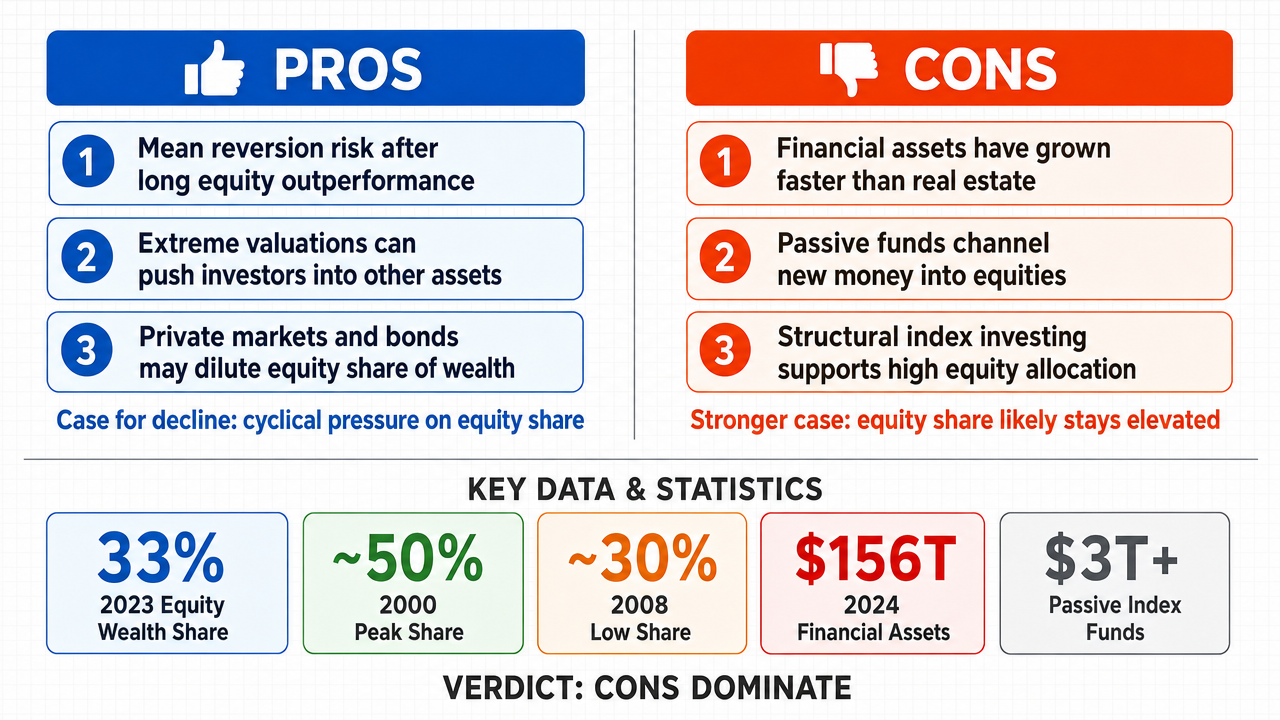
- ■The current concentration of wealth in equities is subject to significant mean reversion pressures, as periods of extreme equity outperformance are historically followed by cycles of stagnation or contraction in market capitalization relative to total national wealth.
- ■As valuations reach historical extremes, the risk-adjusted return for equities diminishes, prompting institutional and retail investors to rotate capital into other asset classes such as fixed income or private credit to capture yield , naturally reducing the equity share of total wealth.
- ■The rapid expansion of non-equity asset classes further dilutes the proportional share of equities in total American wealth.
❌ Key ANTI arguments:
- ■Federal Reserve data indicates that Household Financial Assets , predominantly composed of equities and mutual funds , have grown significantly faster than Household Real Estate over the past decade, suggesting that as total wealth expands, capital allocated to public equities increases at a rate that prevents dilution of their proportional share.
- ■The explosion of passive investing , with index funds holding over $3 trillion in assets, mechanically allocates the vast majority of new capital into equities and directly counteracts any argument for a decrease in the stock market's share of wealth.
- ■The structural shift toward passive index investing creates a persistent upward pressure on equity allocations that overwhelms cyclical mean reversion pressures.
💭 Conclusion: The stock market's proportion of American wealth is unlikely to decrease from its current level of approximately 33% by the end of 2027. The structural shift toward passive investing , with index funds holding over $3 trillion in assets, mechanically channels new capital into equities and creates persistent upward pressure on equity allocations. Data shows that Household Financial Assets have grown significantly faster than Household Real Estate between 2018 and 2024 (+62.5% vs +50.0%), indicating that equities capture a growing share of expanding total wealth. While the PRO side correctly notes that mean reversion and historical precedents like the 2008 crisis demonstrate the possibility of equity contractions, these cyclical events are counterbalanced by powerful secular trends favoring equity accumulation. This verdict reflects moderate but not overwhelming certainty given the inherent unpredictability of multi-year market trajectories.
🔬 DeepResearch Result: likely FALSE ❌ (69%)
Assertion: The proportion of American wealth held in the stock market will decrease from its current level of 33% by the end of 2027.
Participating models: gemma-4-26b-a4b-it 💬👁️, glm-4.7-flash 💬
📊 Face-offs: 0 concluded TRUE, 1 concluded FALSE (1 face-offs, 3 models)
📊 Score by side: TRUE=0.00, FALSE=0.69
🏅 Model score changes:
minimax-m3 💬👁️: +7
✅ PRO Arguments:
- ■The current concentration of wealth in equities is subject to significant mean reversion pressures, as periods of extreme equity outperformance are historically followed by cycles of stagnation or contraction in market capitalization relative to total national wealth. gemma-4-26b-a4b-it 💬👁️
- ■As valuations reach historical extremes, the risk-adjusted return for equities diminishes, prompting institutional and retail investors to rotate capital into other asset classes such as fixed income or private credit to capture yield , naturally reducing the equity share of total wealth. gemma-4-26b-a4b-it 💬👁️
- ■The rapid expansion of non-equity asset classes further dilutes the proportional share of equities in total American wealth. gemma-4-26b-a4b-it 💬👁️
- ■The 2008 financial crisis demonstrated that the proportion of American household wealth held in equities can undergo a massive and rapid contraction as equity valuations plummet and capital is reallocated to safer, non-equity assets. gemma-4-26b-a4b-it 💬👁️
❌ ANTI Arguments:
- ■Federal Reserve data indicates that Household Financial Assets , predominantly composed of equities and mutual funds , have grown significantly faster than Household Real Estate over the past decade, suggesting that as total wealth expands, capital allocated to public equities increases at a rate that prevents dilution of their proportional share. glm-4.7-flash 💬
- ■The explosion of passive investing , with index funds holding over $3 trillion in assets, mechanically allocates the vast majority of new capital into equities and directly counteracts any argument for a decrease in the stock market's share of wealth. glm-4.7-flash 💬
- ■The structural shift toward passive index investing creates a persistent upward pressure on equity allocations that overwhelms cyclical mean reversion pressures. glm-4.7-flash 💬
💭 Reasoning: The stock market's proportion of American wealth is unlikely to decrease from its current level of approximately 33% by the end of 2027. The structural shift toward passive investing, with index funds holding over $3 trillion in assets, mechanically channels new capital into equities and creates persistent upward pressure on equity allocations. Data shows that Household Financial Assets have grown significantly faster than Household Real Estate between 2018 and 2024 (+62.5% vs +50.0%), indicating that equities capture a growing share of expanding total wealth. While the PRO side correctly notes that mean reversion and historical precedents like the 2008 crisis demonstrate the possibility of equity contractions, these cyclical events are counterbalanced by powerful secular trends favoring equity accumulation. This verdict reflects moderate but not overwhelming certainty given the inherent unpredictability of multi-year market trajectories.
📋 PRO Facts:
• The current proportion of American wealth held in the stock market is approximately 33%, representing a recovery from the 2008 lows.
• During the 2008 financial crisis, the proportion of American household wealth held in equities underwent a massive and rapid contraction.
📋 ANTI Facts:
• Index funds hold over $3 trillion in assets, mechanically allocating the vast majority of new capital into equities.
• Household Financial Assets have grown significantly faster than Household Real Estate between 2018 and 2024 (+62.5% vs +50.0%).
| Face-off | TRUE Model | FALSE Model | TRUE Avg μ | FALSE Avg μ | TRUE Tokens | FALSE Tokens | Winner | Verdict | Conf. |
|---|---|---|---|---|---|---|---|---|---|
| #1 | gemma-4-26b-a4b-it 💬👁️ | glm-4.7-flash 💬 | 0.227 | 0.448 | 4 | 4 | FALSE | FALSE | 69% |
The following technical terms, abbreviations, and domain-specific concepts are referenced throughout this debate transcript. Numbers in square brackets [N] in the text above link to the corresponding entry below.
[1] asset classes — Categories of investments with similar characteristics and market behavior, such as equities, fixed income, real estate, and private markets.
[2] asset reallocation — The process of shifting investment capital from one asset class to another, often in response to changing market conditions or return expectations.
[3] capital allocation — The deployment of financial resources across different investment opportunities or asset categories.
[4] dilution — In this context, the reduction of one asset class's proportional share of total wealth as other asset classes grow at a faster rate.
[5] economic cycle — The recurring pattern of expansion and contraction in economic activity over time.
[6] equities — Shares of ownership in a company, representing a claim on its earnings and assets.
[7] equity dominance — The condition in which equities constitute the largest or most influential portion of total wealth or investment portfolios.
[8] equity ownership — Holding shares in publicly traded or private companies as a form of investment.
[9] equity share — The proportion of total wealth or assets held in the form of equities.
[10] equity valuations — The assessed market price or worth of equity securities, often relative to earnings or book value.
[11] Federal Reserve — The central banking system of the United States, referenced in the debate as a source of data on household financial assets.
[12] financial assets — Non-physical assets such as stocks, bonds, mutual funds, and bank deposits, as distinguished from physical or tangible assets.
[13] fixed income — A category of investments, primarily bonds, that provide returns in the form of regular, predetermined payments.
[14] Household Financial Assets — The total value of financial holdings (such as equities and mutual funds) owned by American households, as tracked by the Federal Reserve.
[15] Household Real Estate — The total value of real estate property owned by American households.
[16] index funds — Investment funds that track a specific market index and passively hold the same securities as that index.
[17] market capitalization — The total market value of a company's outstanding shares, calculated as share price multiplied by shares outstanding.
[18] mean reversion — The financial theory that asset prices, valuations, or returns tend to move back toward their long-term average over time.
[19] monotonic — Describing a relationship that consistently moves in one direction without reversing; the debate disputes whether equity dominance follows such a pattern.
[20] mutual funds — Pooled investment vehicles that collect capital from many investors to purchase a diversified portfolio of securities.
[21] non-financial assets — Tangible or physical assets such as real estate, as distinguished from financial assets like stocks and bonds.
[22] passive investing — An investment strategy that seeks to match market returns rather than outperform them, typically through index funds.
[23] private credit — Debt financing provided by non-bank lenders directly to companies or projects, outside of traditional public bond markets.
[24] private equity — Investment capital provided to private companies or used to take public companies private, typically through specialized funds.
[25] productivity gains — Increases in output per unit of input, cited in the debate as a driver of equity outperformance over other asset classes.
[26] public equities — Shares of companies that are traded on public stock exchanges and available for purchase by any investor.
[27] risk-adjusted return — A measure of investment performance that accounts for the level of risk taken to achieve that return.
[28] S&P 500 — Standard & Poor's 500 — A stock market index tracking the performance of 500 large-cap companies listed on U.S. exchanges.
[29] structural realignment — A fundamental, lasting shift in the composition or distribution of wealth or investment portfolios.
[30] systemic collapse — A widespread failure across the financial system, referenced in the debate in the context of the 2008 financial crisis.
[31] trough — The lowest point in a market cycle, following a period of decline.
[32] venture capital — A form of private equity financing provided to early-stage, high-growth-potential companies.
[33] yield — The income return on an investment, typically expressed as a percentage of its price or face value.
The following financial data tables were referenced during the debate exchanges:
| Asset Class | Estimated Wealth Share Trend (2024-2027) | Primary Driver |
|---|---|---|
| Public Equities | Decreasing | Valuation Mean Reversion |
| Private Markets | Increasing | Institutional Allocation |
| Fixed Income | Increasing | Yield Normalization |
| Real Estate | Stable/Increasing | Supply Constraints |
Legend: Projected directional shift in wealth composition. Trends are based on historical cyclicality and current capital flow data.
| Asset Category | 2018 Value | 2024 Value | 6-Year Growth |
|---|---|---|---|
| Household Financial Assets | $96T | $156T | +62.5% |
| Household Real Estate | $30T | $45T | +50.0% |
Legend: Comparison of household wealth composition (2018 Q4 vs 2024 Q2). Source: Federal Reserve Flow of Funds.
| Year | Stock Market Wealth Share | Context |
|---|---|---|
| 2000 | ~50% | Dot-com Peak |
| 2008 | ~30% | Financial Crisis Low |
| 2023 | 33% | Recovery to Dominance |
Legend: Estimated percentage of U.S. household net worth held in equities over the last two decades. Source: Federal Reserve Financial Accounts of the United States.
Face-off transcripts
- ■
Ownership & Trade Secrets. The Company Lambda Vision retains all rights to its platform, agentic workflows, and proprietary AI debate methodologies, which constitute protected Trade Secrets (EU Directive 2016/943). Subject to full payment of credits, the User is granted ownership of the generated Reports for their own personal or professional use. Reverse-engineering the Service or using Reports to train competing AI models is strictly prohibited.
- ■
No Professional Advice. Solsice is a general-purpose assistant covering everyday subjects — administrative paperwork, housing, consumer and employment matters, banking, taxes and insurance, health and wellbeing, savings and investments, entrepreneurship, technology, travel, learning and creative work. Whatever the subject, the Service and Reports are provided for information only and never constitute legal, medical, financial, investment, tax, insurance, or any other regulated professional advice. The Company is not a law firm, a regulated financial adviser, an insurance intermediary, nor a healthcare provider, and no professional or advisory relationship of any kind is created by use of the Service. Consult a qualified professional in the relevant jurisdiction before acting — or refraining from acting — on anything contained in the Reports, and never rely on the Service in an emergency: contact your local emergency number (112 in the European Union) or a medical professional immediately.
- ■
AI-Generated Content, Sources and Viewpoints. Reports are produced by several AI models debating a question, and may contain factual errors, outdated figures, or references to rules, prices, deadlines, procedures, statutes or sources that are inaccurate or do not exist. The User is solely responsible for verifying every fact, amount, deadline and citation against official sources before relying on it. Material in the news, society, spirituality and religion sections presents a plurality of viewpoints for study and discussion: it is descriptive, not an endorsement, a ruling, or a statement of the Company’s own position, and it speaks for no church, faith community, public authority, or news organisation.
- ■
Liability & Governing Law. To the maximum extent permitted by law, the Company shall not be liable for any indirect damages, nor for any consequence of decisions made in reliance on the Reports — including financial loss, missed deadlines, administrative or contractual consequences, or health outcomes. These Terms are governed by French law. Any disputes shall be subject to the exclusive jurisdiction of the Courts of Paris, France.