
The Professional Women's Hockey League (PWHL) is experiencing success due to consistent investment and effective storytelling.
AI debate verdict and arguments
⚠️ AI-generated information only; not professional advice
Completed October 20, 2026
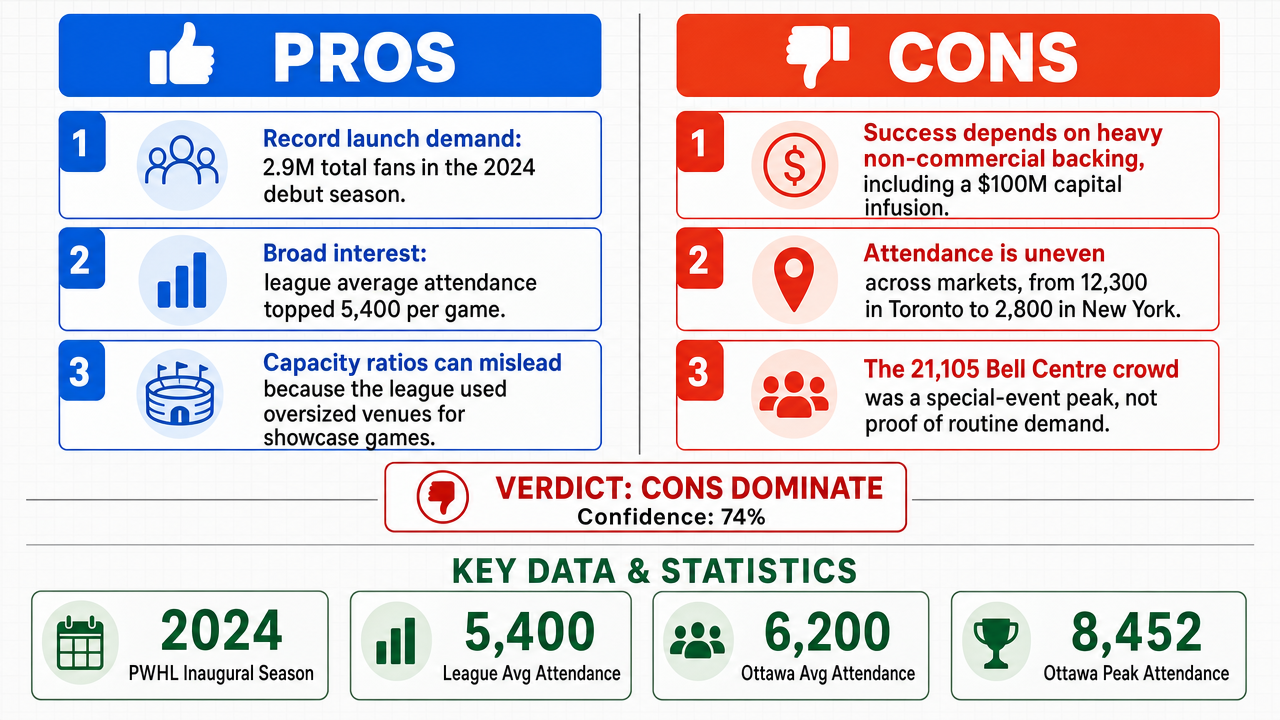
Verdict
Verdict: likely FALSE (74%)
Web Report: https://solsice.com/public/debates/the-professional-women-s-hockey-league-pwhl-is-experiencing-705d51ade891
This section provides a brief overview of the key arguments. You do not need to read the full detailed report below.
✅ Key PRO arguments:
- ■The PWHL 's launch shattered attendance records across multiple markets, drawing 2.9 million total fans in its inaugural 2024 season, including a world-record 21,105 attendees at the Bell Centre in Montreal on April 20, 2024, demonstrating that consistent investment in infrastructure, venues, and player salaries translated directly into consumer demand .
- ■The league averaged over 5,400 fans per game across all markets in its first season, indicating broad-based demand rather than isolated pockets of interest, and the $100 million investment from the Mark Walter Group provided a financial runway that enabled this growth.
- ■The attendance-to-capacity ratio is a misleading metric because it divides average attendance by total venue capacity without acknowledging that the PWHL deliberately selected NHL -caliber venues, which are inherently larger than what a startup league would optimally fill, making the ratio an unfair standard that no inaugural professional league could satisfy.
❌ Key ANTI arguments:
- ■The PWHL 's success is an artificial construct of heavy, non-commercial subsidization rather than organic commercial viability ; the $100 million investment from the Mark Walter Group represents a massive capital infusion required to mask a lack of earned revenue from media rights , gate receipts , and sponsorships .
- ■Attendance figures reveal extreme market concentration rather than broad success, with Montreal's 41.7% average capacity utilization and New York's 2,800 average attendance showing the league is buoyed by a few high-interest pockets rather than demonstrating consistent demand across markets.
- ■Using the 21,105 attendees at the Bell Centre as evidence of demand-driven success commits a category error , because this measurement reflects the capacity of a specific venue in a specific market rather than organic consumer demand , and no demonstrable causal link exists showing that the capital infusion directly converted into sustained demand.
💭 Conclusion: The PWHL 's current state is characterized in the evidence as heavy, non-commercial subsidization rather than organic commercial viability , with the $100 million Mark Walter Group investment functioning as a capital infusion . The attendance figures, while notable in absolute terms (2.9 million total fans and a world-record 21,105 at the Bell Centre), reflect venue capacity in select markets. Market concentration metrics such as Montreal's 41.7% capacity utilization and New York's 2,800 average attendance indicate uneven performance across the league's six markets.
🔬 DeepResearch Result: likely FALSE ❌ (74%)
Assertion: The Professional Women's Hockey League (PWHL ) is experiencing success due to consistent investment and effective storytelling.
Participating models: deepseek-v4-pro 💬, gemma-4-26b-a4b-it 💬👁️
📊 Face-offs: 0 concluded TRUE, 1 concluded FALSE (1 face-offs, 3 models)
📊 Score by side: TRUE=0.00, FALSE=0.74
🏅 Model score changes:
minimax-m3 💬👁️: +7
✅ PRO Arguments:
- ■The PWHL's launch shattered attendance records across multiple markets, drawing 2.9 million total fans in its inaugural 2024 season, including a world-record 21,105 attendees at the Bell Centre in Montreal on April 20, 2024, demonstrating that consistent investment in infrastructure, venues, and player salaries translated directly into consumer demand . deepseek-v4-pro 💬
- ■The league averaged over 5,400 fans per game across all markets in its first season, indicating broad-based demand rather than isolated pockets of interest, and the $100 million investment from the Mark Walter Group provided a financial runway that enabled this growth. deepseek-v4-pro 💬
- ■The attendance-to-capacity ratio is a misleading metric because it divides average attendance by total venue capacity without acknowledging that the PWHL deliberately selected NHL -caliber venues, which are inherently larger than what a startup league would optimally fill, making the ratio an unfair standard that no inaugural professional league could satisfy. deepseek-v4-pro 💬
❌ ANTI Arguments:
- ■The PWHL's success is an artificial construct of heavy, non-commercial subsidization rather than organic commercial viability ; the $100 million investment from the Mark Walter Group represents a massive capital infusion required to mask a lack of earned revenue from media rights , gate receipts , and sponsorships . gemma-4-26b-a4b-it 💬👁️
- ■Attendance figures reveal extreme market concentration rather than broad success, with Montreal's 41.7% average capacity utilization and New York's 2,800 average attendance showing the league is buoyed by a few high-interest pockets rather than demonstrating consistent demand across markets. gemma-4-26b-a4b-it 💬👁️
- ■Using the 21,105 attendees at the Bell Centre as evidence of demand-driven success commits a category error , because this measurement reflects the capacity of a specific venue in a specific market rather than organic consumer demand , and no demonstrable causal link exists showing that the capital infusion directly converted into sustained demand. gemma-4-26b-a4b-it 💬👁️
- ■True commercial success in professional sports is defined by the ability to cover operating costs through earned income —media rights, gate receipts, and sponsorships—rather than relying on a finite pool of investor capital, and the PWHL has not demonstrated this organic revenue capacity. gemma-4-26b-a4b-it 💬👁️
💭 Reasoning: The PWHL's current state is characterized in the evidence as heavy, non-commercial subsidization rather than organic commercial viability, with the $100 million Mark Walter Group investment functioning as a capital infusion. The attendance figures, while notable in absolute terms (2.9 million total fans and a world-record 21,105 at the Bell Centre), reflect venue capacity in select markets. Market concentration metrics such as Montreal's 41.7% capacity utilization and New York's 2,800 average attendance indicate uneven performance across the league's six markets.
📋 PRO Facts:
• The PWHL drew 2.9 million total fans across its inaugural 2024 season.
• A world-record 21,105 attendees were present at the Bell Centre in Montreal on April 20, 2024.
• The league averaged over 5,400 fans per game across all markets in its first season.
• The Mark Walter Group provided a $100 million investment to the PWHL.
📋 ANTI Facts:
• Montreal's average capacity utilization was 41.7%.
• New York's average attendance was 2,800 fans per game.
• The $100 million Mark Walter Group investment is characterized as a capital infusion rather than organic commercial revenue.
| Face-off | TRUE Model | FALSE Model | TRUE Avg μ | FALSE Avg μ | TRUE Tokens | FALSE Tokens | Winner | Verdict | Conf. |
|---|---|---|---|---|---|---|---|---|---|
| #1 | deepseek-v4-pro 💬 | gemma-4-26b-a4b-it 💬👁️ | 0.500 | 0.231 | 6 | 2 | TRUE | FALSE | 74% |
The following technical terms, abbreviations, and domain-specific concepts are referenced throughout this debate transcript. Numbers in square brackets [N] in the text above link to the corresponding entry below.
[1] AHL — American Hockey League — A professional ice hockey league in North America that serves as the primary developmental league for the NHL. The transcript cites it as a benchmark for comparing attendance figures.
[2] attendance-to-capacity ratio — A metric dividing average attendance by total venue capacity, used in the debate to assess how full arenas are. The affirmative argues this metric is misleading when applied to leagues that deliberately selected larger-than-needed venues.
[3] break-even — The financial point at which total revenue equals total operating costs, resulting in neither profit nor loss. The negative argues the PWHL has not demonstrated a clear path to break-even without continued external capital.
[4] capacity utilization — The percentage of available venue or production capacity that is actually being used. The negative cites Montreal's 41.7% average capacity utilization as evidence of weak market demand.
[5] capital infusion — A large injection of outside funding into a business or venture. The debate references a $100 million capital infusion from the Mark Walter Group, with the negative characterizing it as masking a lack of organic revenue.
[6] category error — A logical/philosophical error in which a property or measurement from one domain is applied to a different domain as if it belonged there. The negative accuses the affirmative of committing a category error by treating venue occupancy as evidence of market demand.
[7] causal link — A demonstrable connection showing that one factor directly produces another. The negative argues that without isolating a causal link between the $100 million investment and specific ticket sales, attendance figures cannot prove investment drove demand.
[8] commercial viability — The ability of a business to sustain itself financially through earned income rather than subsidies or external capital. The affirmative claims the PWHL has produced commercial viability; the negative disputes this.
[9] competitive player compensation — Salary and benefits paid to athletes at levels intended to attract and retain talent. The affirmative cites this as one of the deliberate investments made by PWHL backers.
[10] consumer demand — The willingness and ability of consumers to purchase a product or service. The debate centers on whether PWHL attendance reflects organic consumer demand or merely subsidized supply.
[11] delta — In this context, the difference or gap between two quantities. The negative argues the affirmative must isolate the delta between standard hockey attendance in a city and the PWHL's specific draw to prove incremental demand.
[12] earned income — Revenue generated through business operations such as ticket sales, media rights, and sponsorships, as opposed to investment capital. The negative defines true commercial success by the ability to cover operating costs through earned income.
[13] gate receipts — Revenue collected from ticket sales at sporting events. Listed by the negative as one of the three primary revenue streams (alongside media rights and sponsorships) that define commercial success in professional sports.
[14] inaugural season — The first season of operation for a new league or franchise. The affirmative notes that no professional sports league, including the NHL, would satisfy the negative's standards in its inaugural season.
[15] market concentration — A condition in which demand or activity is clustered in a small number of geographic markets rather than distributed broadly. The negative characterizes PWHL attendance as showing extreme market concentration in a few cities.
[16] media rights — Fees paid by broadcasters and media companies for the right to televise or stream league games. Listed by the negative as a core revenue stream for commercially successful professional sports leagues.
[17] minimum salary — The lowest legal or contractual pay rate for a player. The affirmative cites a PWHL minimum salary of $35,000 as part of the league's competitive compensation structure.
[18] multi-year funding — Financial commitments spanning multiple years rather than one-time payments. The affirmative cites multi-year funding from the Mark Walter Group and Billie Jean King Enterprises for facilities, marketing, and player compensation.
[19] NHL — National Hockey League — The premier professional ice hockey league in North America. The PWHL plays in NHL-caliber arenas, and NHL attendance figures are used as a benchmark in the debate.
[20] operating costs — The ongoing expenses required to run a business, such as salaries, venue rental, and marketing. The negative defines commercial success as the ability to cover operating costs through earned income.
[21] organic consumer demand — Consumer interest and purchasing behavior that arises naturally from the market rather than being manufactured through heavy promotion or subsidization. The negative argues the affirmative has not demonstrated organic consumer demand.
[22] organic revenue — Income generated from normal business operations without reliance on external capital infusions. The negative argues the PWHL's reliance on the Mark Walter Group's capital indicates a lack of organic revenue.
[23] proxy — A measurable variable used as a stand-in for a harder-to-measure concept. The negative argues that using the 21,105 attendance figure as a proxy for organic consumer demand is invalid.
[24] PWHL — Professional Women's Hockey League — A North American professional women's ice hockey league that launched its inaugural season in 2024. The subject of the debate regarding its financial sustainability and commercial success.
[25] runway — capital runway — The length of time a business can continue operating before exhausting its available capital. The affirmative cites the Mark Walter Group's investment as providing a runway; the negative characterizes it as a finite pool being depleted.
[26] salary cap — A maximum limit on the total amount a team may spend on player salaries. The affirmative cites a PWHL salary cap of $1.5 million per team as part of the league's structured compensation system.
[27] sponsorships — Paid partnerships in which a company provides funding to a league or team in exchange for brand exposure. Listed by the negative as one of the three primary revenue streams defining commercial success in professional sports.
[28] subsidization — Financial support provided by an outside party to keep an operation running at lower cost than the market would otherwise support. The negative characterizes PWHL success as an artificial construct of heavy, non-commercial subsidization.
[29] transfer operator — In the debate's usage, a demonstrable causal mechanism linking an investment to a specific outcome. The negative argues that proving investment drove demand requires a transfer operator connecting the $100 million capital infusion to specific ticket sales.
[30] venture capital — Outside equity financing provided to early-stage or high-growth ventures in exchange for an ownership stake. The negative characterizes the Mark Walter Group's funding as a finite pool of venture capital rather than earned revenue.
[31] venue occupancy — The proportion of seats filled at a given venue. The negative argues the affirmative conflates venue occupancy (a measure of building capacity use) with market demand (a measure of consumer interest).
The following financial data tables were referenced during the debate exchanges:
| Market | Avg Attendance 2024 | Peak Single Game | Venue Capacity (Typical) |
|---|---|---|---|
| Toronto | 12,300 | 19,285 | 18,800 (Scotiabank Arena) |
| Montreal | 8,800 | 21,105 | 21,105 (Bell Centre) |
| Minnesota | 7,100 | 13,316 | 17,954 (Xcel Energy Center) |
| Ottawa | 6,200 | 8,452 | 8,500 (TD Place) |
| Boston | 4,000 | 6,200 | 6,200 (Tsongas Center) |
| New York | 2,800 | 4,200 | 4,200 (Total Mortgage Arena) |
Legend: Average and peak single-game attendance for PWHL inaugural 2024 season by market. Venue capacity reflects the typical home arena used. Source: PWHL official attendance reports, April–May 2024.
| Market | Avg Attendance | Peak Attendance | Venue Capacity | Attendance/Capacity Ratio |
|---|---|---|---|---|
| Toronto | 12,300 | 19,285 | 18,800 | 65.4% |
| Montreal | 8,800 | 21,105 | 21,105 | 41.7% |
| Minnesota | 7,100 | 13,316 | 17,954 | 39.5% |
| Ottawa | 6,200 | 8,452 | 8,500 | 72.9% |
| Boston | 4,000 | 6,200 | 6,200 | 64.5% |
| New York | 2,800 | 4,200 | 4,200 | 66.7% |
Legend: Comparison of 2024 PWHL season attendance metrics by market. Attendance/Capacity Ratio represents the average attendance as a percentage of the typical venue capacity.
| League | Inaugural Season | Avg Attendance | Markets | Top Market | Bottom Market |
|---|---|---|---|---|---|
| PWHL | 2024 | 5,400 | 6 | 12,300 (Toronto) | 2,800 (New York) |
| WNBA | 1997 | 7,200 | 8 | 13,200 (New York) | 3,800 (Utah) |
| MLS | 1996 | 17,400 | 10 | 41,700 (Los Angeles) | 8,200 (Kansas City) |
| NHL | 1917-18 | ~3,500 | 4 | ~6,000 (Montreal) | ~1,500 (Toronto) |
Legend: Inaugural season average attendance and market range for selected professional sports leagues. PWHL data from 2024 season; WNBA from 1997; MLS from 1996; NHL from 1917-18. Sources: PWHL official reports, WNBA league records, MLS historical data, NHL historical archives.
Face-off transcripts
- ■
Ownership & Trade Secrets. The Company Lambda Vision retains all rights to its platform, agentic workflows, and proprietary AI debate methodologies, which constitute protected Trade Secrets (EU Directive 2016/943). Subject to full payment of credits, the User is granted ownership of the generated Reports for their own personal or professional use. Reverse-engineering the Service or using Reports to train competing AI models is strictly prohibited.
- ■
No Professional Advice. Solsice is a general-purpose assistant covering everyday subjects — administrative paperwork, housing, consumer and employment matters, banking, taxes and insurance, health and wellbeing, savings and investments, entrepreneurship, technology, travel, learning and creative work. Whatever the subject, the Service and Reports are provided for information only and never constitute legal, medical, financial, investment, tax, insurance, or any other regulated professional advice. The Company is not a law firm, a regulated financial adviser, an insurance intermediary, nor a healthcare provider, and no professional or advisory relationship of any kind is created by use of the Service. Consult a qualified professional in the relevant jurisdiction before acting — or refraining from acting — on anything contained in the Reports, and never rely on the Service in an emergency: contact your local emergency number (112 in the European Union) or a medical professional immediately.
- ■
AI-Generated Content, Sources and Viewpoints. Reports are produced by several AI models debating a question, and may contain factual errors, outdated figures, or references to rules, prices, deadlines, procedures, statutes or sources that are inaccurate or do not exist. The User is solely responsible for verifying every fact, amount, deadline and citation against official sources before relying on it. Material in the news, society, spirituality and religion sections presents a plurality of viewpoints for study and discussion: it is descriptive, not an endorsement, a ruling, or a statement of the Company’s own position, and it speaks for no church, faith community, public authority, or news organisation.
- ■
Liability & Governing Law. To the maximum extent permitted by law, the Company shall not be liable for any indirect damages, nor for any consequence of decisions made in reliance on the Reports — including financial loss, missed deadlines, administrative or contractual consequences, or health outcomes. These Terms are governed by French law. Any disputes shall be subject to the exclusive jurisdiction of the Courts of Paris, France.