
The primary reason many content creators fail is that they abandon their efforts prematurely, failing to commit to the long game.
AI debate verdict and arguments
⚠️ AI-generated information only; not professional advice
Completed October 14, 2026
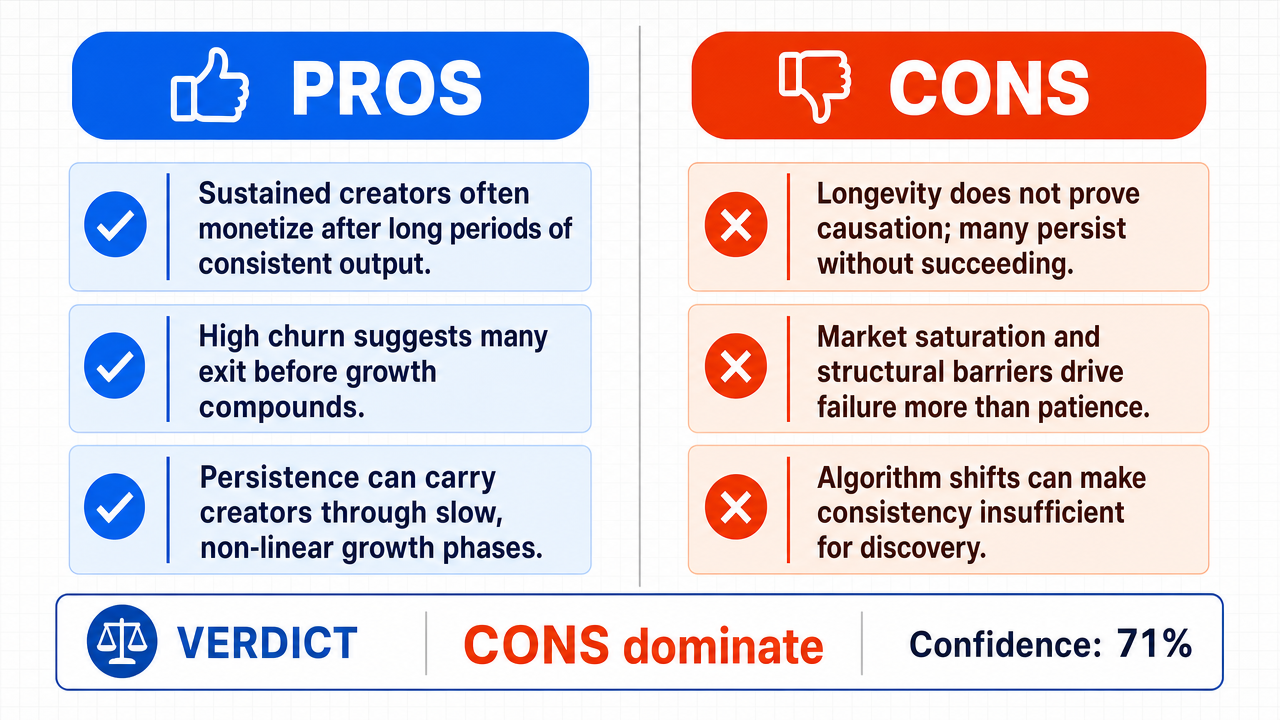
Verdict
Verdict: likely FALSE (71%)
Web Report: https://solsice.com/public/debates/the-primary-reason-many-content-creators-fail-is-that-they-a-c86eb8fb52a3
This section provides a brief overview of the key arguments. You do not need to read the full detailed report below.
✅ Key PRO arguments:
- ■Empirical platform data shows that creators who achieve meaningful monetization maintain consistent output for 18-24 months, indicating that survivorship bias —where persisters succeed and quitters fail—is the dominant factor in creator outcomes.
- ■Market saturation is itself a product of premature exits: the high creator density reflects low entry barriers and high churn rather than a static structural barrier , so quitting—not saturation—drives failure.
- ■Persistence helps overcome the invisible, non-linear growth phase where effort yields little visible return, so stamina rather than initial quality or strategy is the binding constraint.
❌ Key ANTI arguments:
- ■The affirmative commits a correlation/causation fallacy: long tenure correlates with success because successful creators remain, but many creators persist for years without monetization , so duration alone does not cause success.
- ■Market saturation and structural barriers—low creator success rates driven by high creator density —are the primary drivers of failure, not a lack of commitment by individual creators.
- ■Algorithmic volatility and the 'discovery-to-saturation' cycle act as structural barriers that can render consistency irrelevant, because frequent algorithmic updates erode accumulated watch time and subscriber metrics.
💭 Conclusion: False. The negative persuasively demonstrated that the affirmative's central claim commits a correlation/causation error: the affirmative measures the duration of successful creators and then concludes longevity causes success, without supplying the causal mechanism or statistical correlation that links mere duration to outcomes. The evidence shows that monetization rates remain very low across major content segments, indicating many creators persist for extended periods without achieving monetization, so longevity alone does not guarantee success. The negative further established that structural barriers—including market saturation and algorithmic volatility —operate independently of individual commitment: the data tables show high volatility in reach/visibility from algorithmic shifts and constant decline from market saturation, both of which can defeat even highly persistent creators. The affirmative's argument that platforms structurally reward consistency by prioritizing cumulative metrics fails to account for this algorithmic instability and competitive density, which independently erode the returns to persistence.
🔬 DeepResearch Result: likely FALSE ❌ (71%)
Assertion: The primary reason many content creators fail is that they abandon their efforts prematurely, failing to commit to the long game.
Participating models: deepseek-v3.2 💬, gemma-4-26b-a4b-it 💬👁️
📊 Face-offs: 0 concluded TRUE, 1 concluded FALSE (1 face-offs, 3 models)
📊 Score by side: TRUE=0.00, FALSE=0.71
🏅 Model score changes:
minimax-m3 💬👁️: +7
✅ PRO Arguments:
- ■Empirical platform data shows that creators who achieve meaningful monetization maintain consistent output for 18-24 months, indicating that survivorship bias —where persisters succeed and quitters fail—is the dominant factor in creator outcomes. deepseek-v3.2 💬
- ■Market saturation is itself a product of premature exits: the high creator density reflects low entry barriers and high churn rather than a static structural barrier , so quitting—not saturation—drives failure. deepseek-v3.2 💬
- ■Persistence helps overcome the invisible, non-linear growth phase where effort yields little visible return, so stamina rather than initial quality or strategy is the binding constraint. deepseek-v3.2 💬
❌ ANTI Arguments:
- ■The affirmative commits a correlation/causation fallacy: long tenure correlates with success because successful creators remain, but many creators persist for years without monetization, so duration alone does not cause success. gemma-4-26b-a4b-it 💬👁️
- ■Market saturation and structural barriers—low creator success rates driven by high creator density—are the primary drivers of failure, not a lack of commitment by individual creators. gemma-4-26b-a4b-it 💬👁️
- ■Algorithmic volatility and the 'discovery-to-saturation' cycle act as structural barriers that can render consistency irrelevant, because frequent algorithmic updates erode accumulated watch time and subscriber metrics. gemma-4-26b-a4b-it 💬👁️
💭 Reasoning: False. The negative persuasively demonstrated that the affirmative's central claim commits a correlation/causation error: the affirmative measures the duration of successful creators and then concludes longevity causes success, without supplying the causal mechanism or statistical correlation that links mere duration to outcomes. The evidence shows that monetization rates remain very low across major content segments, indicating many creators persist for extended periods without achieving monetization, so longevity alone does not guarantee success. The negative further established that structural barriers—including market saturation and algorithmic volatility—operate independently of individual commitment: the data tables show high volatility in reach/visibility from algorithmic shifts and constant decline from market saturation, both of which can defeat even highly persistent creators. The affirmative's argument that platforms structurally reward consistency by prioritizing cumulative metrics fails to account for this algorithmic instability and competitive density, which independently erode the returns to persistence.
📋 PRO Facts:
• The vast majority of successful creators who achieve meaningful monetization maintain consistent output for at least 18-24 months on major platforms.
• Initial-phase attrition rates for content creators are reported as extremely high on platforms like YouTube.
📋 ANTI Facts:
• Many creators persist for extended periods without ever achieving monetization or audience growth , as reflected in very low segment success rates (e.g., Gaming 0.8%, Lifestyle/Vlog 1.2%, Education 3.5%, Tech/Review 2.1%), undermining duration as a causal driver of success.
• Platforms frequently update recommendation algorithms, producing high volatility in reach and visibility that can diminish prior cumulative metrics such as watch time and subscriber counts .
| Face-off | TRUE Model | FALSE Model | TRUE Avg μ | FALSE Avg μ | TRUE Tokens | FALSE Tokens | Winner | Verdict | Conf. |
|---|---|---|---|---|---|---|---|---|---|
| #1 | deepseek-v3.2 💬 | gemma-4-26b-a4b-it 💬👁️ | 0.322 | 0.243 | 8 | 2 | TRUE | FALSE | 71% |
The following technical terms, abbreviations, and domain-specific concepts are referenced throughout this debate transcript. Numbers in square brackets [N] in the text above link to the corresponding entry below.
[1] algorithmic decay — A concept referenced in the debate referring to the diminishing distribution or visibility of content over time as platforms shift recommendation weights, potentially deprioritizing older content libraries built on previous engagement signals.
[2] algorithmic volatility — In the context of the debate, refers to the instability and unpredictability of platform recommendation algorithms, which are subject to frequent updates that change which creator behaviors are rewarded.
[3] attrition rate — The rate at which participants (in this debate, content creators) discontinue their activity over a given period; used in the affirmative's argument to describe the high dropout rate among creators in early stages.
[4] audience growth — The increase in the number or engagement of followers, viewers, or listeners of a content creator over time; identified in the debate as a key metric of creator success.
[5] barrier to entry — An economics concept referring to the costs or obstacles that prevent new competitors from entering a market; the affirmative argues the barrier to sustained participation is high even when the barrier to initial entry is low.
[6] churn — In business contexts, the rate at which customers or participants leave or stop using a service; the affirmative uses the related concept of 'churn' of creators giving up to argue against market saturation as a static barrier.
[7] confusion of correlation with causation — A logical/epistemological error identified by the negative, where observing that successful creators have long tenures is used to conclude that duration itself causes success, without ruling out other explanations.
[8] creator density — Used in the debate to refer to the concentration or volume of content creators within a given niche or platform; the negative cites it as evidence of market saturation.
[9] creator economy — The economic ecosystem encompassing independent content creators, platforms, monetization tools, and supporting services; the negative characterizes it as having winner-take-all dynamics.
[10] cumulative watch time — The total aggregate duration that viewers spend watching a creator's content across their body of work; identified in the debate as a metric platforms use to prioritize recommendations.
[11] discovery-to-saturation cycle — A platform-level pattern referenced in the debate in which a content type or niche moves from being newly discoverable to becoming oversaturated, potentially undermining the value of consistency.
[12] engagement signals — Behavioral data points (such as likes, comments, shares, watch duration) that platforms use as inputs to their recommendation algorithms; the debate notes these can be redefined by platform updates.
[13] incumbents — Established participants within a market who already hold dominant positions; the affirmative argues that if saturation were the primary barrier, entrenched incumbents would stably block newcomers, which the debate contests.
[14] marginal utility — An economics concept referring to the additional value or benefit gained from one more unit of consumption or production; the negative invokes it to argue each additional piece of creator content yields less audience value.
[15] market saturation — A market condition in which supply (here, creators or content) has grown to the point of diminishing returns for new entrants; the negative attributes creator failure primarily to this, while the affirmative contests this framing.
[16] monetization — The process by which a content creator converts audience and content activity into revenue, typically via advertising, sponsorships, subscriptions, or platform revenue-sharing programs.
[17] recommendation engines — Algorithmic systems used by platforms to rank and surface content to users based on predicted relevance or engagement; the negative notes these are subject to frequent updates that shift their weighting.
[18] session start — A platform engagement metric cited in the debate referring to a user beginning a viewing session on a platform, referenced as one of the newer signals platforms may prioritize over cumulative watch time.
[19] short-form engagement — User interaction with brief video or content formats (such as short vertical videos); referenced in the debate as a newer engagement signal that platforms may weigh more heavily after algorithm updates.
[20] statistical correlation — A quantitative measure of the degree to which two variables move together; the negative argues the affirmative lacks this to link mere duration of effort to creator success.
[21] structural barrier — A persistent, system-level obstacle (such as platform design or market structure) that impedes entry or success regardless of individual effort; the negative attributes creator failure to such barriers.
[22] subscriber counts — The number of users who have formally followed or subscribed to a creator's channel or profile; identified in the debate as a cumulative metric that platforms may use for content prioritization.
[23] survivorship bias — A statistical/logical error in which analysis focuses on entities that 'survived' a selection process while overlooking those that did not, leading to skewed conclusions about what causes success.
[24] transfer operator — Originally a mathematical operator used in dynamical systems and functional analysis; in this debate it is used figuratively by the negative to denote a missing causal mechanism or statistical link between duration and success.
[25] user retention — A product/platform metric measuring the degree to which users continue to engage with a platform or creator's content over time; cited as a key signal that platform algorithms prioritize.
[26] watch time — The total duration viewers spend watching a specific piece of content or a creator's body of work; identified in the debate as a primary metric rewarded by recommendation algorithms on major video platforms.
[27] winner-take-all dynamics — A market structure in which a small number of top participants capture a disproportionate share of rewards or attention; the negative argues the creator economy exhibits this extreme concentration.
The following financial data tables were referenced during the debate exchanges:
| Market Segment | Estimated Creator Density (per 1M users) | Estimated Success Rate (Monetization) |
|---|---|---|
| Gaming | 450 | 0.8% |
| Lifestyle/Vlog | 380 | 1.2% |
| Education | 120 | 3.5% |
| Tech/Review | 150 | 2.1% |
Legend: Estimated density and success rates across major content niches. Success is defined by reaching top-tier monetization thresholds. Data represents industry-wide approximations.
| Metric | Impact of Algorithmic Shift | Impact of Market Saturation |
|---|---|---|
| Reach/Visibility | High Volatility | Constant Decline |
| Revenue Stability | Low (Ad-rate fluctuations) | Low (Competition for CPM) |
| Barrier to Entry | Variable (Feature-dependent) | High (Volume-dependent) |
Legend: Qualitative assessment of how platform mechanics affect creator stability.
Face-off transcripts
- ■
Ownership & Trade Secrets. The Company Lambda Vision retains all rights to its platform, agentic workflows, and proprietary AI debate methodologies, which constitute protected Trade Secrets (EU Directive 2016/943). Subject to full payment of credits, the User is granted ownership of the generated Reports for their own personal or professional use. Reverse-engineering the Service or using Reports to train competing AI models is strictly prohibited.
- ■
No Professional Advice. Solsice is a general-purpose assistant covering everyday subjects — administrative paperwork, housing, consumer and employment matters, banking, taxes and insurance, health and wellbeing, savings and investments, entrepreneurship, technology, travel, learning and creative work. Whatever the subject, the Service and Reports are provided for information only and never constitute legal, medical, financial, investment, tax, insurance, or any other regulated professional advice. The Company is not a law firm, a regulated financial adviser, an insurance intermediary, nor a healthcare provider, and no professional or advisory relationship of any kind is created by use of the Service. Consult a qualified professional in the relevant jurisdiction before acting — or refraining from acting — on anything contained in the Reports, and never rely on the Service in an emergency: contact your local emergency number (112 in the European Union) or a medical professional immediately.
- ■
AI-Generated Content, Sources and Viewpoints. Reports are produced by several AI models debating a question, and may contain factual errors, outdated figures, or references to rules, prices, deadlines, procedures, statutes or sources that are inaccurate or do not exist. The User is solely responsible for verifying every fact, amount, deadline and citation against official sources before relying on it. Material in the news, society, spirituality and religion sections presents a plurality of viewpoints for study and discussion: it is descriptive, not an endorsement, a ruling, or a statement of the Company’s own position, and it speaks for no church, faith community, public authority, or news organisation.
- ■
Liability & Governing Law. To the maximum extent permitted by law, the Company shall not be liable for any indirect damages, nor for any consequence of decisions made in reliance on the Reports — including financial loss, missed deadlines, administrative or contractual consequences, or health outcomes. These Terms are governed by French law. Any disputes shall be subject to the exclusive jurisdiction of the Courts of Paris, France.