
The primary reason for the failure of a unified Arab state was the solidification of national institutions and vested interests within existing sovereign states.
AI debate verdict and arguments
⚠️ AI-generated information only; not professional advice
Completed October 14, 2026
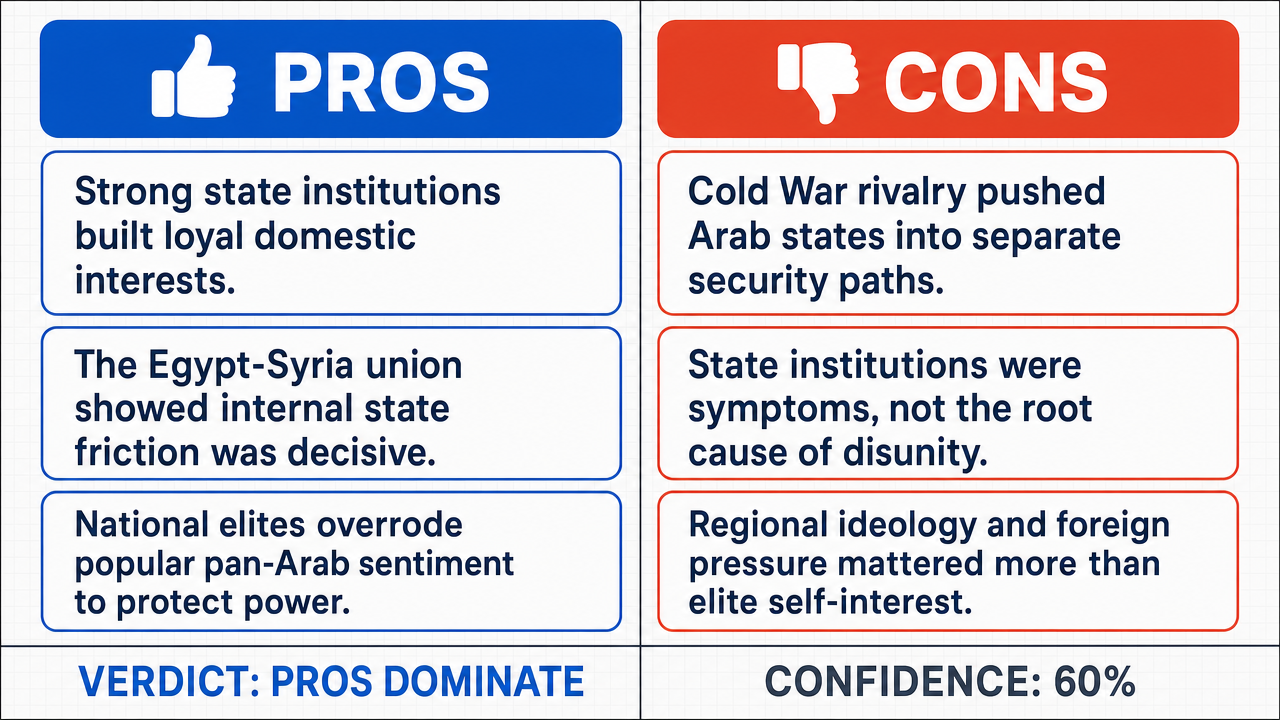
Verdict
Verdict: likely TRUE (60%)
Web Report: https://solsice.com/public/debates/the-primary-reason-for-the-failure-of-a-unified-arab-state-w-fb006f1b43b5
This section provides a brief overview of the key arguments. You do not need to read the full detailed report below.
✅ Key PRO arguments:
- ■Post-colonial Arab states developed robust administrative, military, and legal apparatuses that created powerful domestic constituencies —civil servants, military officers, and state-aligned business elites —whose careers, status, and wealth became dependent on the survival of the individual nation-state, making any supranational union a direct threat to their interests.
- ■The historical record of the United Arab Republic (UAR ), which was formed and sustained for three years between Egypt and Syria, demonstrates that the friction of artificial colonial borders could be overcome when political will driven by pan-Arab sentiment aligned with institutional cooperation, undermining the claim that borders alone made unity impossible.
- ■Pan-Arab sentiment was real and widespread, but it was systematically overridden by the entrenched self-interest of national elites who controlled state resources and used institutional patronage to maintain regime legitimacy, transforming potential unity movements into instruments of individual state power.
❌ Key ANTI arguments:
- ■The failure of Arab unification was primarily a consequence of external geopolitical fragmentation : Cold War bipolarity forced Arab states into divergent security architectures, and any move toward a unified Arab bloc would have been perceived as a shift in the global balance of power, prompting external interventions to maintain fragmentation.
- ■The pro position is internally contradictory because it relies on the very institutional framework of sovereign statehood that it identifies as the obstacle to unity—using the existence of sovereign diplomatic and military establishments as evidence against unity while those establishments are themselves the expression of the statehood the argument presupposes.
💭 Conclusion: True, the evidence supports the assertion that the solidification of national institutions and vested interests within existing sovereign states was the primary reason for the failure of a unified Arab state. The pro side effectively demonstrated that post-colonial Arab states developed entrenched bureaucracies , militaries, and elite networks whose survival depended on the continuation of individual nation-states, creating structural resistance to supranational integration . The counterexample of the UAR showed that unity was achievable when political will aligned with institutional cooperation, weakening the claim that external or structural factors alone were decisive. While the anti side raised valid points about Cold War interference and logical tensions in the pro argument, these were treated as secondary or reinforcing factors rather than primary causes. The moderate 60% confidence reflects that external geopolitical pressures and ideological divergences also played meaningful roles, preventing a stronger verdict. Overall, the entrenchment of domestic institutional interests emerges as the most consistent and proximate explanation for the persistence of fragmentation.
🔬 DeepResearch Result: likely TRUE ✅ (60%)
Assertion: The primary reason for the failure of a unified Arab state was the solidification of national institutions and vested interests within existing sovereign states.
Participating models: deepseek-v3.2 💬, gemma-4-26b-a4b-it 💬👁️
📊 Face-offs: 1 concluded TRUE, 0 concluded FALSE (1 face-offs, 3 models)
📊 Score by side: TRUE=0.60, FALSE=0.00
🏅 Model score changes:
minimax-m3 💬👁️: +6
✅ PRO Arguments:
- ■Post-colonial Arab states developed robust administrative, military, and legal apparatuses that created powerful domestic constituencies —civil servants, military officers, and state-aligned business elites —whose careers, status, and wealth became dependent on the survival of the individual nation-state, making any supranational union a direct threat to their interests. deepseek-v3.2 💬
- ■The historical record of the United Arab Republic (UAR ), which was formed and sustained for three years between Egypt and Syria, demonstrates that the friction of artificial colonial borders could be overcome when political will driven by pan-Arab sentiment aligned with institutional cooperation, undermining the claim that borders alone made unity impossible. deepseek-v3.2 💬
- ■Pan-Arab sentiment was real and widespread, but it was systematically overridden by the entrenched self-interest of national elites who controlled state resources and used institutional patronage to maintain regime legitimacy, transforming potential unity movements into instruments of individual state power. deepseek-v3.2 💬
❌ ANTI Arguments:
- ■The failure of Arab unification was primarily a consequence of external geopolitical fragmentation : Cold War bipolarity forced Arab states into divergent security architectures, and any move toward a unified Arab bloc would have been perceived as a shift in the global balance of power, prompting external interventions to maintain fragmentation. gemma-4-26b-a4b-it 💬👁️
- ■The pro position is internally contradictory because it relies on the very institutional framework of sovereign statehood that it identifies as the obstacle to unity—using the existence of sovereign diplomatic and military establishments as evidence against unity while those establishments are themselves the expression of the statehood the argument presupposes. gemma-4-26b-a4b-it 💬👁️
💭 Reasoning: True, the evidence supports the assertion that the solidification of national institutions and vested interests within existing sovereign states was the primary reason for the failure of a unified Arab state. The pro side effectively demonstrated that post-colonial Arab states developed entrenched bureaucracies , militaries, and elite networks whose survival depended on the continuation of individual nation-states, creating structural resistance to supranational integration . The counterexample of the UAR showed that unity was achievable when political will aligned with institutional cooperation, weakening the claim that external or structural factors alone were decisive. While the anti side raised valid points about Cold War interference and logical tensions in the pro argument, these were treated as secondary or reinforcing factors rather than primary causes. The moderate 60% confidence reflects that external geopolitical pressures and ideological divergences also played meaningful roles, preventing a stronger verdict. Overall, the entrenchment of domestic institutional interests emerges as the most consistent and proximate explanation for the persistence of fragmentation.
📋 PRO Facts:
• The United Arab Republic (UAR) was formed and sustained for three years between Egypt and Syria, demonstrating that integration was achievable under certain political conditions.
• Post-colonial Arab states developed robust administrative, military, and legal apparatuses following independence.
• Domestic constituencies including civil servants, military officers, and state-aligned business elites had careers and wealth tied to individual nation-states.
📋 ANTI Facts:
• Cold War bipolarity between the United States and Soviet Union forced Arab states into divergent security architectures.
• The Arab League 's charter explicitly commits to the independence and sovereignty of its member states.
• External interventions were deployed to maintain regional fragmentation during the Cold War era.
| Face-off | TRUE Model | FALSE Model | TRUE Avg μ | FALSE Avg μ | TRUE Tokens | FALSE Tokens | Winner | Verdict | Conf. |
|---|---|---|---|---|---|---|---|---|---|
| #1 | deepseek-v3.2 💬 | gemma-4-26b-a4b-it 💬👁️ | 0.370 | 0.196 | 8 | 2 | TRUE | TRUE | 60% |
The following technical terms, abbreviations, and domain-specific concepts are referenced throughout this debate transcript. Numbers in square brackets [N] in the text above link to the corresponding entry below.
[1] Arab League — League of Arab States — A regional organization of Arab states founded in 1945, whose charter commits member states to cooperation while respecting their independence and sovereignty.
[2] bipolarity — Cold War bipolarity — The global geopolitical structure characterized by two dominant superpowers (the United States and the Soviet Union) competing for influence during the Cold War.
[3] bureaucracies — bureaucratic institutions — Administrative systems of government composed of hierarchical offices and career civil servants that implement state policy.
[4] centralized administration — centralized governmental authority — A system of governance in which decision-making power and resources are concentrated in a single central authority rather than distributed regionally.
[5] Cold War — The period of geopolitical tension between the United States and the Soviet Union and their respective allies from roughly 1947 to 1991.
[6] colonial borders — colonial-era borders — National boundaries drawn by European colonial powers, often without regard for ethnic, tribal, or economic realities on the ground.
[7] diplomatic establishments — diplomatic institutions — The foreign affairs ministries and associated institutions through which a state conducts its external relations and foreign policy.
[8] domestic constituencies — domestic political constituencies — Groups within a country whose members share common interests and can mobilize to influence political outcomes.
[9] ethnic cohesion — The degree of unity, shared identity, and social integration among different ethnic groups within a political entity.
[10] geopolitical fragmentation — The division of a region into separate, often competing political units driven by external strategic interests.
[11] integration — political/economic integration — The process of unifying separate political entities into a larger common framework, involving shared institutions, policies, or sovereignty.
[12] mandate-era — Mandate era — The period following World War I when former Ottoman territories in the Middle East were administered as League of Nations mandates by European powers.
[13] national institutions — The governing structures of a sovereign state, including its bureaucracy, military, legal system, and security apparatus.
[14] pan-Arabism — A political ideology advocating the unity and solidarity of Arab peoples and states, often across existing national borders.
[15] political will — The commitment of political leaders and populations to pursue a particular policy goal despite obstacles.
[16] post-colonial — Referring to the period and conditions following the end of colonial rule, including the political structures inherited from colonial powers.
[17] proxy conflicts — Wars in which external powers support opposing sides rather than directly fighting each other, using local forces to advance their strategic interests.
[18] regional cohesion — The degree of political, economic, and social unity among states within a geographic region.
[19] regional stability — The maintenance of peace and the absence of major conflict within a geographic region.
[20] security apparatus — The military, intelligence, and law enforcement organizations through which a state maintains internal order and external defense.
[21] security architecture — The framework of alliances, treaties, and military arrangements that define security relationships among states.
[22] socio-economic cohesion — The degree of shared social identity and integrated economic relations among populations within a political entity.
[23] sovereignty — state sovereignty — The supreme authority of a state to govern itself within its territory without external interference.
[24] state-aligned business elites — Wealthy individuals and business leaders whose economic fortunes are closely tied to the survival and patronage of the ruling regime.
[25] strategic relationships — Alliances or partnerships between states based on mutual security, economic, or geopolitical interests.
[26] supranational — Referring to authority, institutions, or governance that transcend the sovereignty of individual nation-states.
[27] supranational consensus — Agreement among multiple states to cede or share aspects of their sovereignty with a higher-level collective authority.
[28] UAR — United Arab Republic — A political union between Egypt and Syria formed in 1958 that dissolved in 1961, cited in the debate as a key example of attempted Arab unification.
[29] unification — political unification — The process of merging separate political entities into a single unified state or political structure.
[30] vested interests — Personal or group stakes in maintaining an existing arrangement, where change would threaten one's status, wealth, or power.
[31] zero-sum — A situation in which one participant's gain is exactly balanced by another's loss, leaving the total unchanged.
Face-off transcripts
- ■
Ownership & Trade Secrets. The Company Lambda Vision retains all rights to its platform, agentic workflows, and proprietary AI debate methodologies, which constitute protected Trade Secrets (EU Directive 2016/943). Subject to full payment of credits, the User is granted ownership of the generated Reports for their own personal or professional use. Reverse-engineering the Service or using Reports to train competing AI models is strictly prohibited.
- ■
No Professional Advice. Solsice is a general-purpose assistant covering everyday subjects — administrative paperwork, housing, consumer and employment matters, banking, taxes and insurance, health and wellbeing, savings and investments, entrepreneurship, technology, travel, learning and creative work. Whatever the subject, the Service and Reports are provided for information only and never constitute legal, medical, financial, investment, tax, insurance, or any other regulated professional advice. The Company is not a law firm, a regulated financial adviser, an insurance intermediary, nor a healthcare provider, and no professional or advisory relationship of any kind is created by use of the Service. Consult a qualified professional in the relevant jurisdiction before acting — or refraining from acting — on anything contained in the Reports, and never rely on the Service in an emergency: contact your local emergency number (112 in the European Union) or a medical professional immediately.
- ■
AI-Generated Content, Sources and Viewpoints. Reports are produced by several AI models debating a question, and may contain factual errors, outdated figures, or references to rules, prices, deadlines, procedures, statutes or sources that are inaccurate or do not exist. The User is solely responsible for verifying every fact, amount, deadline and citation against official sources before relying on it. Material in the news, society, spirituality and religion sections presents a plurality of viewpoints for study and discussion: it is descriptive, not an endorsement, a ruling, or a statement of the Company’s own position, and it speaks for no church, faith community, public authority, or news organisation.
- ■
Liability & Governing Law. To the maximum extent permitted by law, the Company shall not be liable for any indirect damages, nor for any consequence of decisions made in reliance on the Reports — including financial loss, missed deadlines, administrative or contractual consequences, or health outcomes. These Terms are governed by French law. Any disputes shall be subject to the exclusive jurisdiction of the Courts of Paris, France.