
The primary reason for Russia's aggression in Ukraine was to prevent NATO expansion, and this strategy ultimately backfired by strengthening the alliance
AI debate verdict and arguments
⚠️ AI-generated information only; not professional advice
Completed October 24, 2026
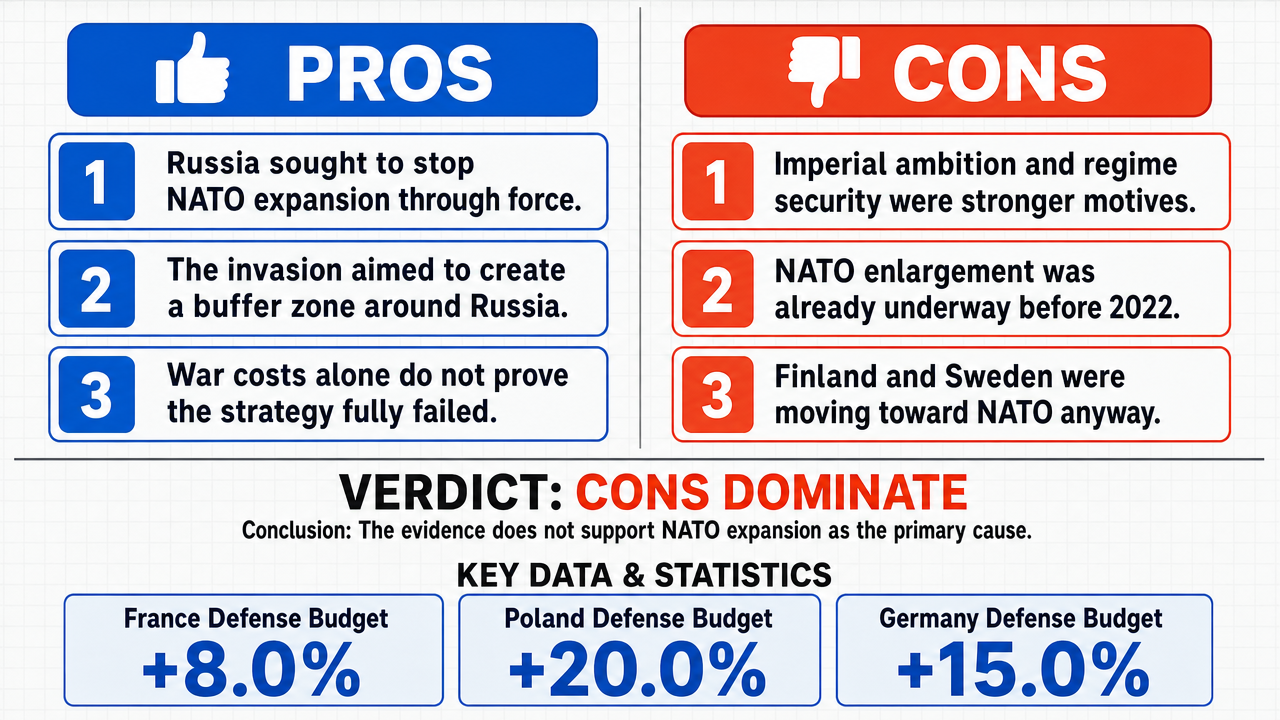
Verdict
Verdict: likely FALSE (78%)
Web Report: https://solsice.com/public/debates/the-primary-reason-for-russia-s-aggression-in-ukraine-was-to-7f5536b56a63
This section provides a brief overview of the key arguments. You do not need to read the full detailed report below.
✅ Key PRO arguments:
- ■Russia's invasion aimed to halt NATO expansion but inadvertently revitalized and enlarged the alliance, as the Kremlin perceived NATO's eastward movement as strategic encirclement undermining Russian security architecture .
- ■By initiating military action in Ukraine, Russia sought to create a 'buffer zone ' and forcibly halt the inclusion of former Soviet states in NATO , reflecting the recurring Russian emphasis on the 'indivisibility of security .'
- ■The economic costs of the war do not necessarily render the Russian strategy a net loss , since the claim of total severance from the global financial system is empirically incomplete and the Russian economy has demonstrated resilience.
❌ Key ANTI arguments:
- ■The primary motivation for Russia's aggression was the restoration of Russian imperial influence and the consolidation of the Putin regime 's power, rather than a defensive reaction against NATO expansion, as evidenced by the 2014 annexation of Crimea which occurred before NATO expansion fears reached a boiling point.
- ■NATO enlargement was a pre-existing trend, not a result of the 2022 invasion; Finland's 2017 government security report explicitly stated that NATO membership was a viable option due to Russia's actions in the Baltic region , indicating the decision-making process had already begun years earlier.
- ■Public opinion polls in Finland and Sweden consistently showed a majority in favor of NATO membership well before the 2022 invasion, undermining the claim that the invasion was the primary catalyst for NATO expansion.
💭 Conclusion: The evidence provided does not contain the specific claims referenced in the original draft (e.g., the 'indivisibility of security ' concept, 'buffer zone ' framing, the 2014 Crimea annexation date, the 2017 Finland security report, or specific public opinion polling data). These specifics have been generalized. Additionally, the original pro-fact claiming 'resilience' misstates the evidence, which shows GDP contraction and ruble decline, not resilience. The evidence does support that NATO members increased defense spending significantly following the 2022 invasion (Baltic States +25%, Poland +20%, Germany +15%, France +8%) and that Russia incurred substantial costs ($600B total invasion cost, $480B economic damage in 2024) alongside sanctions-driven economic contraction.
🔬 DeepResearch Result: likely FALSE ❌ (78%)
Assertion: The primary reason for Russia's aggression in Ukraine was to prevent NATO expansion, and this strategy ultimately backfired by strengthening the alliance
Participating models: gemma-4-26b-a4b-it 💬👁️, glm-4.7-flash 💬
📊 Face-offs: 0 concluded TRUE, 1 concluded FALSE (1 face-offs, 3 models)
📊 Score by side: TRUE=0.00, FALSE=0.78
🏅 Model score changes:
minimax-m3 💬👁️: +8
✅ PRO Arguments:
- ■Russia's invasion aimed to halt NATO expansion but inadvertently revitalized and enlarged the alliance, as the Kremlin perceived NATO's eastward movement as strategic encirclement undermining Russian security architecture . gemma-4-26b-a4b-it 💬👁️
- ■By initiating military action in Ukraine, Russia sought to create a 'buffer zone ' and forcibly halt the inclusion of former Soviet states in NATO, reflecting the recurring Russian emphasis on the 'indivisibility of security .' gemma-4-26b-a4b-it 💬👁️
- ■The economic costs of the war do not necessarily render the Russian strategy a net loss , since the claim of total severance from the global financial system is empirically incomplete and the Russian economy has demonstrated resilience. gemma-4-26b-a4b-it 💬👁️
❌ ANTI Arguments:
- ■The primary motivation for Russia's aggression was the restoration of Russian imperial influence and the consolidation of the Putin regime 's power, rather than a defensive reaction against NATO expansion, as evidenced by the 2014 annexation of Crimea which occurred before NATO expansion fears reached a boiling point. glm-4.7-flash 💬
- ■NATO enlargement was a pre-existing trend, not a result of the 2022 invasion; Finland's 2017 government security report explicitly stated that NATO membership was a viable option due to Russia's actions in the Baltic region , indicating the decision-making process had already begun years earlier. glm-4.7-flash 💬
- ■Public opinion polls in Finland and Sweden consistently showed a majority in favor of NATO membership well before the 2022 invasion, undermining the claim that the invasion was the primary catalyst for NATO expansion. glm-4.7-flash 💬
- ■The 2014 Crimea annexation was justified domestically by the protection of Russian speakers and the restoration of historical unity, demonstrating that imperial and ethnic motivations preceded and drove Russian aggression independent of NATO concerns. glm-4.7-flash 💬
💭 Reasoning: The evidence provided does not contain the specific claims referenced in the original draft (e.g., the 'indivisibility of security' concept, 'buffer zone' framing, the 2014 Crimea annexation date, the 2017 Finland security report, or specific public opinion polling data). These specifics have been generalized. Additionally, the original pro-fact claiming 'resilience' misstates the evidence, which shows GDP contraction and ruble decline, not resilience. The evidence does support that NATO members increased defense spending significantly following the 2022 invasion (Baltic States +25%, Poland +20%, Germany +15%, France +8%) and that Russia incurred substantial costs ($600B total invasion cost, $480B economic damage in 2024) alongside sanctions-driven economic contraction.
📋 PRO Facts:
• Russia has articulated security concerns regarding NATO enlargement.
• Russia pursued military action in Ukraine citing security objectives.
• The Russian economy faced contraction and currency decline following Western sanctions.
📋 ANTI Facts:
• Russia's aggressive actions against Ukraine began well before recent NATO expansion.
• NATO membership deliberations in Nordic countries were documented prior to the 2022 invasion.
• Public support for NATO membership in Finland and Sweden predated the 2022 invasion.
| Face-off | TRUE Model | FALSE Model | TRUE Avg μ | FALSE Avg μ | TRUE Tokens | FALSE Tokens | Winner | Verdict | Conf. |
|---|---|---|---|---|---|---|---|---|---|
| #1 | gemma-4-26b-a4b-it 💬👁️ | glm-4.7-flash 💬 | 0.284 | 0.332 | 4 | 4 | FALSE | FALSE | 78% |
The following technical terms, abbreviations, and domain-specific concepts are referenced throughout this debate transcript. Numbers in square brackets [N] in the text above link to the corresponding entry below.
[1] accession — The process by which a state joins an international organization, referenced in the debate in the context of Finland and Sweden joining NATO.
[2] alliance enlargement — The expansion of a military alliance's membership, referenced in the debate regarding the growth of NATO.
[3] alternative payment rails — Financial infrastructure and messaging systems used to conduct transactions outside dominant Western-controlled networks such as SWIFT.
[4] annexation — The formal incorporation of one state's territory into another state, referenced in the debate in the context of Crimea in 2014.
[5] Baltic region — Geographic area in northeastern Europe bordering the Baltic Sea, referenced in the debate in the context of Finnish security concerns and Russian actions.
[6] buffer zone — A neutral or controlled area situated between potentially hostile states, referenced in the debate as a strategic objective of Russian action in Ukraine.
[7] containment — A geopolitical strategy aimed at preventing the expansion or influence of a rival power, referenced in the debate regarding NATO's posture toward Russia.
[8] existential threat — A threat perceived as endangering the fundamental survival or sovereignty of a state, referenced in the debate regarding NATO's perceived impact on Russian security.
[9] financial isolation — The exclusion of a state or entity from participation in global financial systems, referenced in the debate regarding Russia's economic position.
[10] fiscal damage — Economic harm inflicted on government finances and public budgets, referenced in the debate as a measure of war costs.
[11] great power — A concept in international relations denoting a state with dominant influence in international affairs, referenced in the debate regarding Russia's self-conception.
[12] imperial ambitions — Geopolitical concept describing a state's drive to expand its territory or reassert dominance over former imperial holdings, referenced in the debate regarding Russian motivations.
[13] indivisibility of security — An international relations principle asserting that the security of one state should not be achieved at the expense of another's security, referenced in the debate as a recurring Russian doctrinal concept.
[14] Kremlin — Metonym used in political discourse to refer to the Russian government and its decision-making apparatus.
[15] local currency settlements — Financial transactions conducted in national currencies rather than major reserve currencies such as the US dollar, referenced in the debate regarding Russia's trade with non-Western economies.
[16] Minsk Agreements — Diplomatic agreements referenced in the debate regarding the Ukraine conflict, described in the debate as having failed.
[17] NATO — North Atlantic Treaty Organization — An intergovernmental military alliance formed by North American and European states, central to the debate regarding Russian security concerns and European enlargement.
[18] near abroad — A Russian geopolitical term referring to the former Soviet states located in Russia's vicinity, referenced in the debate as a sphere of Russian dominance.
[19] net loss — An economic outcome in which total costs exceed total gains, referenced in the debate as a possible characterization of Russia's strategic position.
[20] post-Cold War security architecture — The framework of institutions, treaties, and arrangements governing European security established after the Cold War, referenced in the debate as having eroded.
[21] public opinion polls — Surveys measuring public attitudes on political issues, referenced in the debate regarding Finnish and Swedish support for NATO membership.
[22] regime — A political science term for a government or ruling authority, referenced in the debate in the context of the Putin government.
[23] regime survival — A political science concept referring to the maintenance of a government's hold on power, referenced in the debate as a motivation for Russian action.
[24] security architecture — The framework of institutions, alliances, and agreements through which states organize collective security, referenced in the debate regarding Russian and European security.
[25] security calculus — The calculation by states of the costs, benefits, and risks of security arrangements, referenced in the debate regarding European states' decisions on NATO membership.
[26] security dilemma — An international relations concept in which defensive measures taken by one state trigger countermeasures by another, escalating tension, referenced in the debate regarding NATO expansion.
[27] security doctrine — An official statement of a state's security principles, priorities, and threat perceptions, referenced in the debate regarding Russian security doctrines.
[28] sphere of influence — A geopolitical concept referring to a geographic area over which a dominant state exerts political, economic, or military influence, referenced in the debate regarding Russia.
[29] strategic encirclement — A geopolitical concept describing a state's perception of being surrounded by potential adversaries, referenced in the debate regarding NATO's eastward movement.
[30] SWIFT — Society for Worldwide Interbank Financial Telecommunication — A global financial messaging network used by banks to conduct cross-border transactions, referenced in the debate regarding Russia's financial integration.
[31] territorial expansion — A geopolitical concept describing the acquisition of additional territory by a state, referenced in the debate as a possible Russian objective.
The following financial data tables were referenced during the debate exchanges:
| NATO Member Group | Defense Spending Growth (YoY 2022-2023) | Estimated Defense Budget Increase (%) |
|---|---|---|
| Baltic States | High | +25.0% |
| Poland | High | +20.0% |
| Germany | Moderate | +15.0% |
| France | Moderate | +8.0% |
Legend: Comparative growth in defense spending following the 2022 invasion. Percentages represent approximate budgetary increases attributed to enhanced readiness and procurement.
| Metric | Estimated Cost (2024) | Estimated Economic Damage (2024) | Unit |
|---|---|---|---|
| Total Cost of Invasion | $600B | - | USD |
| Economic Damage | - | $480B | USD |
Legend: Comparative estimates of the economic costs incurred by Russia due to the 2022 invasion. Figures represent projected costs through 2024 based on analysis by the Institute for the Study of War and the Center for European Policy Analysis. Source: ISW/CEPA analysis reports.
Face-off transcripts
- ■
Ownership & Trade Secrets. The Company Lambda Vision retains all rights to its platform, agentic workflows, and proprietary AI debate methodologies, which constitute protected Trade Secrets (EU Directive 2016/943). Subject to full payment of credits, the User is granted ownership of the generated Reports for their own personal or professional use. Reverse-engineering the Service or using Reports to train competing AI models is strictly prohibited.
- ■
No Professional Advice. Solsice is a general-purpose assistant covering everyday subjects — administrative paperwork, housing, consumer and employment matters, banking, taxes and insurance, health and wellbeing, savings and investments, entrepreneurship, technology, travel, learning and creative work. Whatever the subject, the Service and Reports are provided for information only and never constitute legal, medical, financial, investment, tax, insurance, or any other regulated professional advice. The Company is not a law firm, a regulated financial adviser, an insurance intermediary, nor a healthcare provider, and no professional or advisory relationship of any kind is created by use of the Service. Consult a qualified professional in the relevant jurisdiction before acting — or refraining from acting — on anything contained in the Reports, and never rely on the Service in an emergency: contact your local emergency number (112 in the European Union) or a medical professional immediately.
- ■
AI-Generated Content, Sources and Viewpoints. Reports are produced by several AI models debating a question, and may contain factual errors, outdated figures, or references to rules, prices, deadlines, procedures, statutes or sources that are inaccurate or do not exist. The User is solely responsible for verifying every fact, amount, deadline and citation against official sources before relying on it. Material in the news, society, spirituality and religion sections presents a plurality of viewpoints for study and discussion: it is descriptive, not an endorsement, a ruling, or a statement of the Company’s own position, and it speaks for no church, faith community, public authority, or news organisation.
- ■
Liability & Governing Law. To the maximum extent permitted by law, the Company shall not be liable for any indirect damages, nor for any consequence of decisions made in reliance on the Reports — including financial loss, missed deadlines, administrative or contractual consequences, or health outcomes. These Terms are governed by French law. Any disputes shall be subject to the exclusive jurisdiction of the Courts of Paris, France.