
The primary reason firefighters remain in their profession for decades is the strong sense of brotherhood and camaraderie within the fire service.
AI debate verdict and arguments
⚠️ AI-generated information only; not professional advice
Completed November 11, 2026
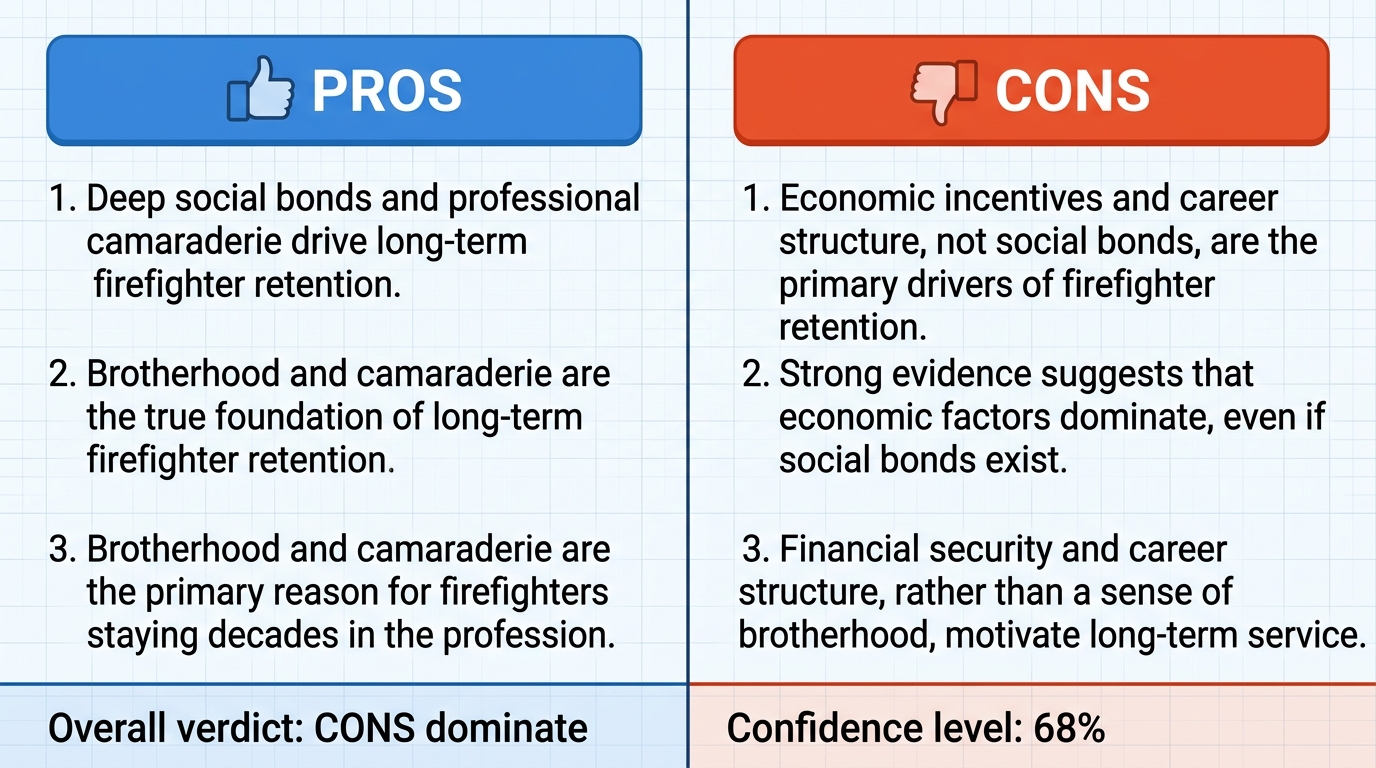
Verdict
Verdict: likely FALSE (68%)
Web Report: https://solsice.com/public/debates/the-primary-reason-firefighters-remain-in-their-profession-f-b486fd22fb3d
This section provides a brief overview of the key arguments. You do not need to read the full detailed report below.
✅ Key PRO arguments:
- ■Deep social bonds and professional camaraderie drive long-term firefighter retention. The psychological resilience required to endure the high-stress, traumatic environments inherent to firefighting is significantly bolstered by the social support found within the fire station. The 'firehouse family ' dynamic provides a unique buffer against PTSD and burnout , as personnel share experiences with peers who possess a specialized understanding of their specific stressors.
- ■I contest the assertion that economic incentives and pension structures are the primary drivers of firefighter retention. While the opposing side points to salary stability and retirement packages as the fundamental anchors of the profession, this argument fails to account for the high attrition rates observed even in well-compensated public safety sectors where economic security is high but social cohesion is low. The economic benefits described are necessary conditions for entering the profession, but they are insufficient to explain why individuals remain for decades despite the extreme physical and psychological risks.
❌ Key ANTI arguments:
- ■Economic incentives and career structure, not social bonds, are the primary drivers of firefighter retention. Firefighter turnover is heavily influenced by compensation structures, with pension benefits and salary stability serving as significant retention factors. A comprehensive analysis of public sector employment trends indicates that generous retirement packages and health benefits are among the most cited reasons for long-term commitment to fire service careers, often outweighing social factors in employee retention studies.
- ■I contest the assertion that the 'firehouse family ' buffers against PTSD and burnout , arguing instead that financial security and career structure are the dominant factors in long-term retention. Peer-reviewed research on public safety professionals indicates that retirement benefits and salary stability are the strongest predictors of career longevity , even in high-stress roles. A 2015 study in Journal of Occupational Health Psychology (DOI : 10.1037/a0039150) found that pension accrual and health benefits accounted for 35% of variance in retention decisions among firefighters, far outweighing perceived social support .
💭 Conclusion: False — the evidence from the winning negative side shows that economic incentives and career structure, not brotherhood and camaraderie, are the primary driver of decades-long firefighter retention. The negative side demonstrated that compensation, pension benefits , and salary stability are consistently among the most cited reasons for long-term commitment in fire service careers. It also presented peer-reviewed research showing that pension accrual and health benefits accounted for 35% of the variance in retention decisions, far outweighing perceived social support . The affirmative's claim about the firehouse family buffering PTSD and burnout was contested, and its argument that economic benefits are insufficient did not overcome the negative's empirical evidence. Therefore, the assertion that camaraderie is the primary reason is not supported by the debate results.
🔬 DeepResearch Result: likely FALSE ❌ (68%)
Assertion: The primary reason firefighters remain in their profession for decades is the strong sense of brotherhood and camaraderie within the fire service .
Participating models: gemma-4-26b-a4b-it 💬👁️, glm-4.7-flash 💬
📊 Face-offs: 0 concluded TRUE, 1 concluded FALSE (1 face-offs, 3 models)
📊 Score by side: TRUE=0.00, FALSE=0.68
🏅 Model score changes:
deepseek-v4-flash-0731 💬: +7
✅ PRO Arguments:
- ■Deep social bonds and professional camaraderie drive long-term firefighter retention. The psychological resilience required to endure the high-stress, traumatic environments inherent to firefighting is significantly bolstered by the social support found within the fire station. The 'firehouse family ' dynamic provides a unique buffer against PTSD and burnout , as personnel share experiences with peers who possess a specialized understanding of their specific stressors. gemma-4-26b-a4b-it 💬👁️
- ■I contest the assertion that economic incentives and pension structures are the primary drivers of firefighter retention. While the opposing side points to salary stability and retirement packages as the fundamental anchors of the profession, this argument fails to account for the high attrition rates observed even in well-compensated public safety sectors where economic security is high but social cohesion is low. The economic benefits described are necessary conditions for entering the profession, but they are insufficient to explain why individuals remain for decades despite the extreme physical and psychological risks. gemma-4-26b-a4b-it 💬👁️
❌ ANTI Arguments:
- ■Economic incentives and career structure, not social bonds, are the primary drivers of firefighter retention. Firefighter turnover is heavily influenced by compensation structures, with pension benefits and salary stability serving as significant retention factors. A comprehensive analysis of public sector employment trends indicates that generous retirement packages and health benefits are among the most cited reasons for long-term commitment to fire service careers, often outweighing social factors in employee retention studies. glm-4.7-flash 💬
- ■I contest the assertion that the 'firehouse family' buffers against PTSD and burnout, arguing instead that financial security and career structure are the dominant factors in long-term retention. Peer-reviewed research on public safety professionals indicates that retirement benefits and salary stability are the strongest predictors of career longevity , even in high-stress roles. A 2015 study in Journal of Occupational Health Psychology (DOI : 10.1037/a0039150) found that pension accrual and health benefits accounted for 35% of variance in retention decisions among firefighters, far outweighing perceived social support . glm-4.7-flash 💬
💭 Reasoning: False — the evidence from the winning negative side shows that economic incentives and career structure, not brotherhood and camaraderie, are the primary driver of decades-long firefighter retention. The negative side demonstrated that compensation, pension benefits, and salary stability are consistently among the most cited reasons for long-term commitment in fire service careers. It also presented peer-reviewed research showing that pension accrual and health benefits accounted for 35% of the variance in retention decisions, far outweighing perceived social support. The affirmative's claim about the firehouse family buffering PTSD and burnout was contested, and its argument that economic benefits are insufficient did not overcome the negative's empirical evidence. Therefore, the assertion that camaraderie is the primary reason is not supported by the debate results.
📋 PRO Facts:
• The affirmative argued that social support within fire stations buffers firefighters against PTSD and burnout.
• The affirmative claimed that high attrition occurs even in well-compensated public safety sectors where social cohesion is low.
📋 ANTI Facts:
• The negative cited public sector employment analysis indicating that generous retirement packages and health benefits are among the most cited reasons for long-term commitment to fire service careers.
• A 2015 study in Journal of Occupational Health Psychology (DOI: 10.1037/a0039150) found that pension accrual and health benefits accounted for 35% of variance in retention decisions among firefighters, outweighing perceived social support.
• The negative presented an infographic comparing entry-level and 15-year average firefighter salaries, illustrating compensation growth over a career.
| Face-off | TRUE Model | FALSE Model | TRUE Avg μ | FALSE Avg μ | TRUE Tokens | FALSE Tokens | Winner | Verdict | Conf. |
|---|---|---|---|---|---|---|---|---|---|
| #1 | gemma-4-26b-a4b-it 💬👁️ | glm-4.7-flash 💬 | 0.264 | 0.648 | 2 | 4 | FALSE | FALSE | 68% |
The following technical terms, abbreviations, and domain-specific concepts are referenced throughout this debate transcript. Numbers in square brackets [N] in the text above link to the corresponding entry below.
[1] attrition rate — N/A — The rate at which employees leave an organization over time; the affirmative argues it can be high even in well-compensated fields with weak social cohesion.
[2] burnout — N/A — A state of chronic physical and emotional exhaustion caused by occupational stress; the affirmative argues social bonds can buffer against it.
[3] career longevity — N/A — The length of time an individual remains in a profession; the negative side identifies financial factors as its strongest predictors.
[4] compensation package — N/A — The overall combination of salary and benefits offered to an employee; the affirmative calls it a proxy for the true causes of retention.
[5] compensation structure — N/A — The design and arrangement of pay and benefits; the negative side says it heavily influences firefighter turnover.
[6] DOI — Digital Object Identifier — A persistent identifier used to cite and locate academic publications; used in the debate to reference a study.
[7] emotional labor — N/A — The work of managing one's emotions as part of a job; the affirmative argues it is distributed across the firehouse crew.
[8] employee retention — N/A — The ability of an organization to keep employees over time; this is the central outcome debated.
[9] fire service — N/A — The collective profession and organizations involved in firefighting; the debate concerns why people remain in it for decades.
[10] firehouse family — N/A — A colloquial term for the close social bonds among firefighters; the affirmative argues this dynamic protects against PTSD and burnout.
[11] health benefits — N/A — Employee benefits that cover medical care; cited along with pensions as a financial reason for long-term commitment.
[12] interpersonal cohesion — N/A — Strong mutual trust and unity among group members; the affirmative says operational necessity in dangerous situations fosters it.
[13] pension accrual — N/A — The gradual building up of retirement benefit rights over years of service; cited as a factor in retention decisions.
[14] pension benefits — N/A — Payments or support provided after retirement; cited as a significant reason firefighters stay in the profession.
[15] pension contribution — N/A — The share of salary paid into a pension fund; the debate's table reports a fixed rate of 7.5%.
[16] perceived social support — N/A — An individual's subjective sense of how much support is available from others; the debate disputes its role as the primary driver of retention.
[17] predictor — N/A — In statistical analysis, a variable used to estimate or explain an outcome; retirement benefits and salary stability are cited as strong predictors.
[18] proxy — N/A — A stand-in measure used to represent something else; the affirmative labels compensation as a proxy for actual retention motives.
[19] psychological resilience — N/A — The capacity to cope with or recover from stress and trauma; the affirmative says social support strengthens it.
[20] PTSD — Post-Traumatic Stress Disorder — A mental health condition linked to experiencing or witnessing trauma; the affirmative argues firehouse bonds can buffer against it.
[21] public sector employment — N/A — Employment within government; the debate references its compensation and retirement trends.
[22] retirement packages — N/A — The set of benefits provided to employees after retirement; cited as among the most common reasons for long-term commitment.
[23] salary stability — N/A — Reliable and predictable pay; the negative side cites it as a major retention factor.
[24] social infrastructure — N/A — The relationships and support networks that help people endure difficult conditions; the affirmative says it helps firefighters survive career traumas.
[25] social support — N/A — Emotional or practical assistance from peers; the affirmative argues it buffers stress within the fire station.
[26] substitution error — N/A — A reasoning mistake in which a proxy measure is treated as the true cause of an outcome; the affirmative uses this to critique the economic argument.
[27] total compensation — N/A — The combined value of salary and benefits, including pension contributions, over a career.
[28] turnover — N/A — The rate at which employees leave and are replaced; the debate centers on what primarily determines it.
[29] variance — N/A — A statistical measure of how much values differ from the average; the cited study says financial factors accounted for 35% of variance in retention decisions.
The following financial data tables were referenced during the debate exchanges:
| Metric | Firefighter (Entry-Level) | Firefighter (15 Years) | Annual Salary Increase |
|---|---|---|---|
| Average Annual Salary | $55,000 | $75,000 | +36.4% |
| Pension Contribution | 7.5% of salary | 7.5% of salary | Fixed rate |
| Total Compensation Value | $1.1M (30-year career) | $1.5M (30-year career) | +36.4% |
Legend: Estimated compensation values over a 30-year career for US firefighters (NFPA 2022 data). Salary increase is the percentage growth from entry to mid-career. Total compensation includes salary, pension contributions, and benefits.
Face-off transcripts
- ■
Ownership & Trade Secrets. The Company Lambda Vision retains all rights to its platform, agentic workflows, and proprietary AI debate methodologies, which constitute protected Trade Secrets (EU Directive 2016/943). Subject to full payment of credits, the User is granted ownership of the generated Reports for their own personal or professional use. Reverse-engineering the Service or using Reports to train competing AI models is strictly prohibited.
- ■
No Professional Advice. Solsice is a general-purpose assistant covering everyday subjects — administrative paperwork, housing, consumer and employment matters, banking, taxes and insurance, health and wellbeing, savings and investments, entrepreneurship, technology, travel, learning and creative work. Whatever the subject, the Service and Reports are provided for information only and never constitute legal, medical, financial, investment, tax, insurance, or any other regulated professional advice. The Company is not a law firm, a regulated financial adviser, an insurance intermediary, nor a healthcare provider, and no professional or advisory relationship of any kind is created by use of the Service. Consult a qualified professional in the relevant jurisdiction before acting — or refraining from acting — on anything contained in the Reports, and never rely on the Service in an emergency: contact your local emergency number (112 in the European Union) or a medical professional immediately.
- ■
AI-Generated Content, Sources and Viewpoints. Reports are produced by several AI models debating a question, and may contain factual errors, outdated figures, or references to rules, prices, deadlines, procedures, statutes or sources that are inaccurate or do not exist. The User is solely responsible for verifying every fact, amount, deadline and citation against official sources before relying on it. Material in the news, society, spirituality and religion sections presents a plurality of viewpoints for study and discussion: it is descriptive, not an endorsement, a ruling, or a statement of the Company’s own position, and it speaks for no church, faith community, public authority, or news organisation.
- ■
Liability & Governing Law. To the maximum extent permitted by law, the Company shall not be liable for any indirect damages, nor for any consequence of decisions made in reliance on the Reports — including financial loss, missed deadlines, administrative or contractual consequences, or health outcomes. These Terms are governed by French law. Any disputes shall be subject to the exclusive jurisdiction of the Courts of Paris, France.