
The primary reason content creators fail is their motivation for fame rather than genuine audience service.
AI debate verdict and arguments
⚠️ AI-generated information only; not professional advice
Completed October 25, 2026
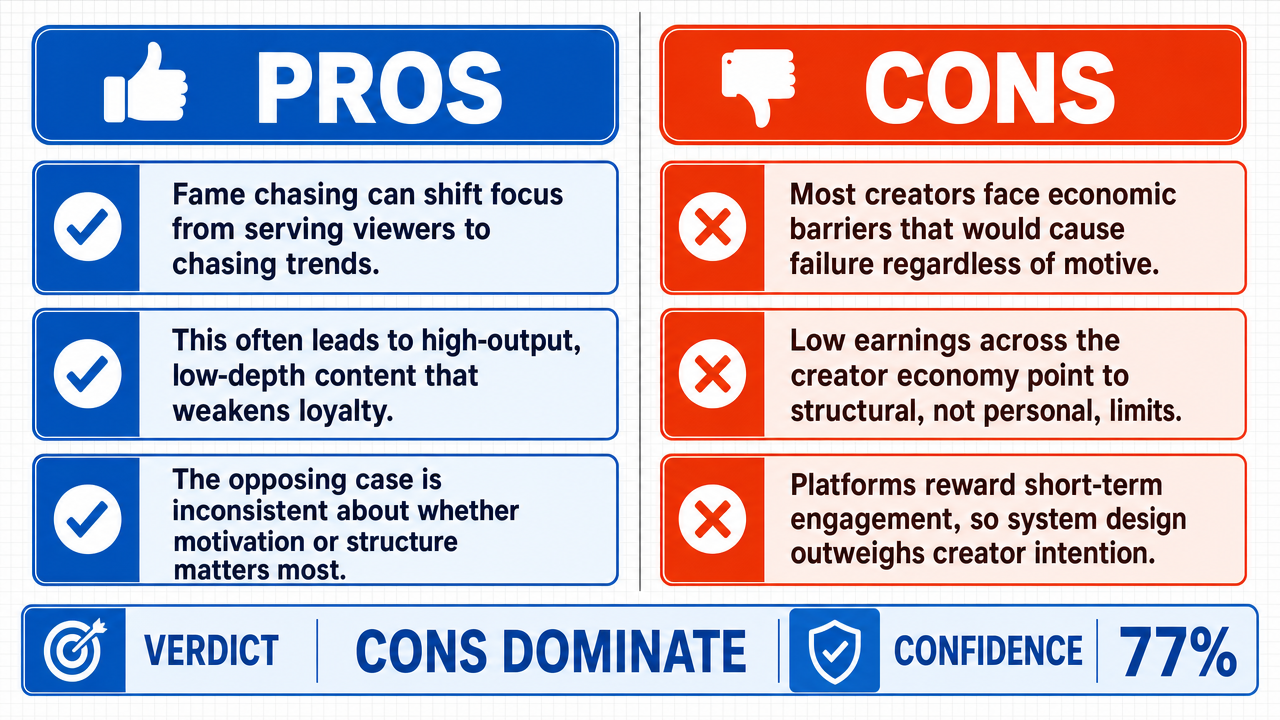
Verdict
Verdict: likely FALSE (77%)
Web Report: https://solsice.com/public/debates/the-primary-reason-content-creators-fail-is-their-motivation-a4a99c2c3783
This section provides a brief overview of the key arguments. You do not need to read the full detailed report below.
✅ Key PRO arguments:
- ■Fame-seeking motivations push creators to prioritize algorithmic volatility and sensationalism over consistent value delivery, turning them into slaves to recommendation engines rather than stewards of audience interests.
- ■This misalignment produces 'content churn ' — high-volume, low-substance material designed to capture fleeting attention rather than build deep, resilient audience loyalty needed to survive platform shifts.
- ■The opponent's position is internally contradictory, simultaneously asserting that financial/technical constraints are the primary drivers while also claiming they are not, which collapses the logical coherence of the negative case.
❌ Key ANTI arguments:
- ■The economic structure of the creator economy imposes a survival threshold that most participants fail to clear regardless of motivational intent, making systemic financial constraints the primary barrier to longevity rather than internal motivations.
- ■Statista data on the creator economy indicates that the vast majority of creators earn less than the median income , suggesting low conversion rates and financial constraints are the dominant failure drivers rather than fame-seeking.
- ■Platform architecture is designed to prioritize short-term engagement metrics over deep value delivery, meaning structural factors — not creator motivation — determine who survives.
💭 Conclusion: False. The assertion that fame-seeking motivation is the primary cause of content creator failure is not supported by the strongest arguments in this debate. The negative side successfully demonstrated that the creator economy 's economic structure imposes survival thresholds that most participants cannot clear regardless of their internal motivations. The affirmative's claim that fame-seeking inherently undermines sustainability was undermined by the negative's evidence that fame-driven channels like brand sponsorships and ad revenue provide viable monetization independent of trust-based community models. The affirmative's strongest counter — pointing to logical inconsistencies in the negative's framing — was not sufficient to overcome the structural and economic evidence presented. Overall, the debate indicates that financial constraints and platform architecture, rather than motivational orientation, are the more dominant drivers of creator failure.
🔬 DeepResearch Result: likely FALSE ❌ (77%)
Assertion: The primary reason content creators fail is their motivation for fame rather than genuine audience service.
Participating models: gemma-4-26b-a4b-it 💬👁️, glm-4.7-flash 💬
📊 Face-offs: 0 concluded TRUE, 1 concluded FALSE (1 face-offs, 3 models)
📊 Score by side: TRUE=0.00, FALSE=0.77
🏅 Model score changes:
minimax-m3 💬👁️: +8
✅ PRO Arguments:
- ■Fame-seeking motivations push creators to prioritize algorithmic volatility and sensationalism over consistent value delivery, turning them into slaves to recommendation engines rather than stewards of audience interests. gemma-4-26b-a4b-it 💬👁️
- ■This misalignment produces 'content churn ' — high-volume, low-substance material designed to capture fleeting attention rather than build deep, resilient audience loyalty needed to survive platform shifts. gemma-4-26b-a4b-it 💬👁️
- ■The opponent's position is internally contradictory, simultaneously asserting that financial/technical constraints are the primary drivers while also claiming they are not, which collapses the logical coherence of the negative case. gemma-4-26b-a4b-it 💬👁️
❌ ANTI Arguments:
- ■The economic structure of the creator economy imposes a survival threshold that most participants fail to clear regardless of motivational intent, making systemic financial constraints the primary barrier to longevity rather than internal motivations. glm-4.7-flash 💬
- ■Statista data on the creator economy indicates that the vast majority of creators earn less than the median income , suggesting low conversion rates and financial constraints are the dominant failure drivers rather than fame-seeking. glm-4.7-flash 💬
- ■Platform architecture is designed to prioritize short-term engagement metrics over deep value delivery, meaning structural factors — not creator motivation — determine who survives. glm-4.7-flash 💬
- ■Fame-driven monetization channels such as brand sponsorships and ad revenue represent substantial economic pathways that do not depend on trust-based community building , undermining the claim that fame-seeking inherently prevents sustainability. glm-4.7-flash 💬
💭 Reasoning: False. The assertion that fame-seeking motivation is the primary cause of content creator failure is not supported by the strongest arguments in this debate. The negative side successfully demonstrated that the creator economy's economic structure imposes survival thresholds that most participants cannot clear regardless of their internal motivations. The affirmative's claim that fame-seeking inherently undermines sustainability was undermined by the negative's evidence that fame-driven channels like brand sponsorships and ad revenue provide viable monetization independent of trust-based community models. The affirmative's strongest counter — pointing to logical inconsistencies in the negative's framing — was not sufficient to overcome the structural and economic evidence presented. Overall, the debate indicates that financial constraints and platform architecture, rather than motivational orientation, are the more dominant drivers of creator failure.
📋 PRO Facts:
• Creators who view their audience as a means to an end rather than as a stakeholder to be served often fail to develop diversified revenue streams such as memberships, products, or deep sponsorships.
• Technical competence and business strategy are the most reliable predictors of creator success, often outweighing the specific motivation behind a creator's work.
📋 ANTI Facts:
• Fame-driven monetization channels such as brand sponsorships and ad revenue generate substantial revenue independent of trust-based community building.
| Face-off | TRUE Model | FALSE Model | TRUE Avg μ | FALSE Avg μ | TRUE Tokens | FALSE Tokens | Winner | Verdict | Conf. |
|---|---|---|---|---|---|---|---|---|---|
| #1 | gemma-4-26b-a4b-it 💬👁️ | glm-4.7-flash 💬 | 0.276 | 0.444 | 4 | 4 | FALSE | FALSE | 77% |
The following technical terms, abbreviations, and domain-specific concepts are referenced throughout this debate transcript. Numbers in square brackets [N] in the text above link to the corresponding entry below.
[1] ad revenue — advertising revenue — Income generated by creators from advertisements placed on or alongside their content, typically paid by advertisers based on impressions, clicks, or views.
[2] algorithm updates — platform algorithm updates — Changes made by social media platforms to the rules governing how content is ranked, recommended, or surfaced to users, which can dramatically affect a creator's visibility.
[3] algorithmic volatility — The instability or unpredictability of platform recommendation algorithms, which can cause rapid shifts in content reach and creator visibility.
[4] audience-centric — An approach in which a creator prioritizes the needs, interests, and value delivery to their specific audience over other goals such as reach or fame.
[5] brand sponsorships — Paid partnerships in which a brand compensates a creator to promote its products or services, often tied to the creator's reach and visibility.
[6] clout-chasing — The behavior of pursuing social media attention, recognition, or controversy in order to gain visibility or status, often at the expense of substantive content.
[7] content churn — The practice of producing high volumes of low-substance content, often to capture fleeting attention rather than deliver lasting value to an audience.
[8] content ecosystems — The interconnected networks of creators, platforms, audiences, and monetization channels that together shape how content is produced, distributed, and consumed.
[9] conversion rates — The percentage of audience members who take a desired action (such as a purchase, subscription, or click), used as a metric of how effectively content drives outcomes.
[10] creator economy — The economic ecosystem encompassing independent content creators, the platforms that host them, and the tools and monetization channels that support their work.
[11] creator failure — The inability of a content creator to sustain their activity over time, whether due to financial, motivational, algorithmic, or skill-related reasons.
[12] deprioritized — algorithmically deprioritized — Reduced in visibility or ranking by a platform's recommendation algorithm, often because the content does not meet the platform's engagement criteria.
[13] direct monetization — The conversion of audience attention into revenue through channels such as ad revenue, sponsorships, or paid partnerships, without relying on long-term community trust.
[14] diversified revenue streams — Multiple distinct sources of income (e.g., ads, sponsorships, merchandise, subscriptions) that reduce a creator's dependence on any single channel.
[15] economic sustainability — The ability of a creator to maintain their content activity over the long term through sufficient and stable income.
[16] engagement metrics — Quantitative measures of how audiences interact with content, including likes, comments, shares, watch time, and click-through rates.
[17] fame-driven monetization — Revenue generation strategies that rely primarily on a creator's reach, visibility, and public recognition rather than on trust-based community relationships.
[18] influencer economy — The segment of the creator economy focused on individuals who monetize their reach and audience influence, often through brand partnerships and sponsorships.
[19] logical inconsistency — A flaw in reasoning in which a set of claims contains contradictions, such as asserting both a proposition and its negation under the same evaluation.
[20] median income — The income level at which half of earners make more and half make less, used as a benchmark for comparing creator earnings.
[21] monetization — The process of converting content, audience attention, or influence into revenue.
[22] platform trends — Shifts in user behavior, content formats, or algorithmic preferences on social media platforms that affect which creators succeed.
[23] reach — The size of the audience exposed to a creator's content, often used as a metric of visibility and monetization potential.
[24] recommendation engine — The algorithmic system used by social media platforms to select and surface content to users based on predicted engagement or relevance.
[25] service-oriented — A creator mindset focused on delivering genuine value, help, or entertainment to an audience rather than pursuing personal recognition.
[26] structural instability — A weakness in the foundational setup of a creator's strategy or ecosystem that makes long-term success difficult to sustain.
[27] survival threshold — The minimum level of income or audience engagement required for a creator to continue producing content as a viable activity.
[28] systemic financial constraints — Structural economic barriers embedded in the creator economy that limit most creators' ability to earn a sustainable income, regardless of their individual motivations.
[29] trust-based community building — A strategy in which a creator develops long-term loyalty and revenue by cultivating genuine trust with their audience rather than chasing reach.
[30] virality — The rapid and widespread spread of content across audiences, often driven by algorithmic amplification of high-engagement material.
Face-off transcripts
- ■
Ownership & Trade Secrets. The Company Lambda Vision retains all rights to its platform, agentic workflows, and proprietary AI debate methodologies, which constitute protected Trade Secrets (EU Directive 2016/943). Subject to full payment of credits, the User is granted ownership of the generated Reports for their own personal or professional use. Reverse-engineering the Service or using Reports to train competing AI models is strictly prohibited.
- ■
No Professional Advice. Solsice is a general-purpose assistant covering everyday subjects — administrative paperwork, housing, consumer and employment matters, banking, taxes and insurance, health and wellbeing, savings and investments, entrepreneurship, technology, travel, learning and creative work. Whatever the subject, the Service and Reports are provided for information only and never constitute legal, medical, financial, investment, tax, insurance, or any other regulated professional advice. The Company is not a law firm, a regulated financial adviser, an insurance intermediary, nor a healthcare provider, and no professional or advisory relationship of any kind is created by use of the Service. Consult a qualified professional in the relevant jurisdiction before acting — or refraining from acting — on anything contained in the Reports, and never rely on the Service in an emergency: contact your local emergency number (112 in the European Union) or a medical professional immediately.
- ■
AI-Generated Content, Sources and Viewpoints. Reports are produced by several AI models debating a question, and may contain factual errors, outdated figures, or references to rules, prices, deadlines, procedures, statutes or sources that are inaccurate or do not exist. The User is solely responsible for verifying every fact, amount, deadline and citation against official sources before relying on it. Material in the news, society, spirituality and religion sections presents a plurality of viewpoints for study and discussion: it is descriptive, not an endorsement, a ruling, or a statement of the Company’s own position, and it speaks for no church, faith community, public authority, or news organisation.
- ■
Liability & Governing Law. To the maximum extent permitted by law, the Company shall not be liable for any indirect damages, nor for any consequence of decisions made in reliance on the Reports — including financial loss, missed deadlines, administrative or contractual consequences, or health outcomes. These Terms are governed by French law. Any disputes shall be subject to the exclusive jurisdiction of the Courts of Paris, France.