
The primary goal of Neuralink's 2026 human trials is to augment human cognitive capabilities with AI, rather than solely to address severe medical conditions.
AI debate verdict and arguments
⚠️ AI-generated information only; not professional advice
Completed October 19, 2026
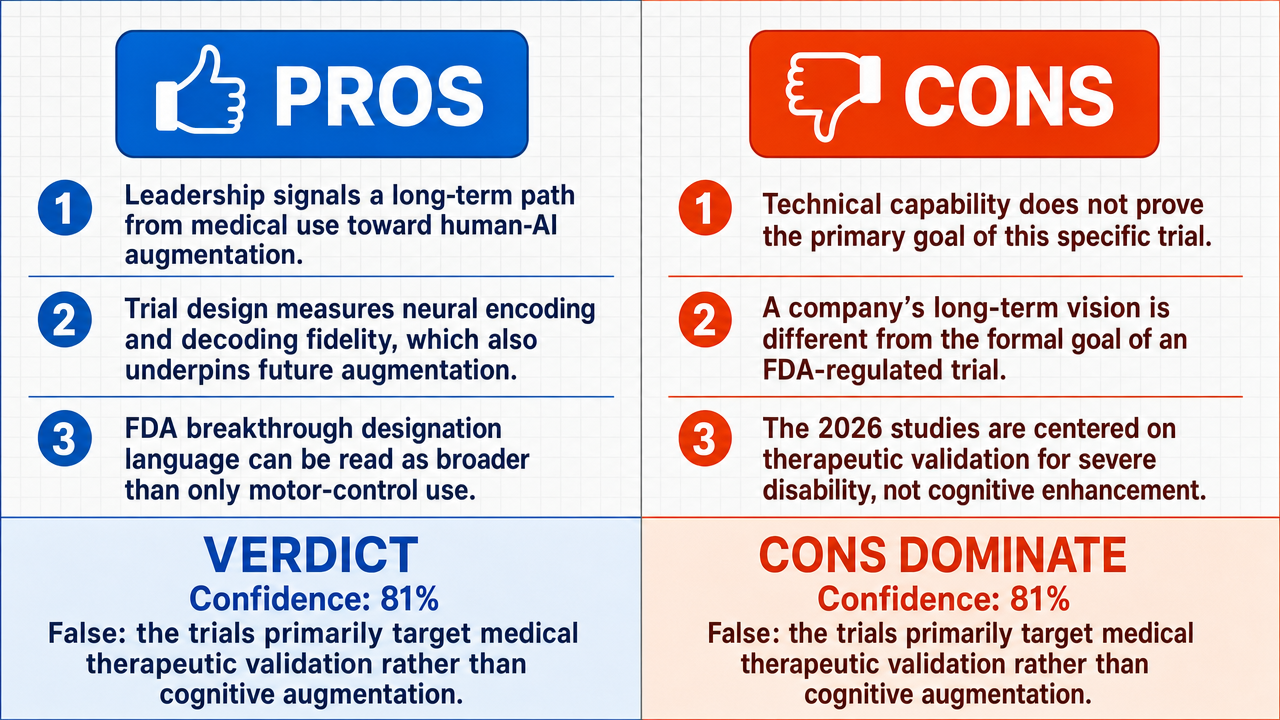
Verdict
Verdict: likely FALSE (81%)
Web Report: https://solsice.com/public/debates/the-primary-goal-of-neuralink-s-2026-human-trials-is-to-augm-36a705dc2711
This section provides a brief overview of the key arguments. You do not need to read the full detailed report below.
✅ Key PRO arguments:
- ■Neuralink's strategic trajectory, as articulated by its leadership, reveals that medical applications are a necessary regulatory stepping stone toward the ultimate goal of human-AI symbiosis, with Elon Musk framing the brain-machine interface as a defense against AI surpassing human intellect.
- ■The 2026 trial protocols are explicitly structured to gather data on neural encoding and decoding fidelity —the foundational metrics for AI -augmented cognition—not merely to validate safety for motor restoration .
- ■The FDA 's breakthrough device designation for Neuralink's 'Telepathy ' system, granted in May 2023, is not limited to motor control , and FDA documentation describes the device as a 'brain-computer interface' with broader applications.
❌ Key ANTI arguments:
- ■The affirmative argument suffers from a fundamental failure to distinguish between technical capability and primary intent; high electrode density and bidirectional potential are necessary conditions for future augmentation but are not sufficient to establish it as the primary goal of the 2026 trials.
- ■The 'purpose' of a corporation's long-term vision is not the 'goal' of a specific, FDA -regulated clinical trial; the entity being measured (the 2026 trial protocol ) is not the same as the entity being measured (the company's aspirational mission).
- ■The 2026 trials focus on medical therapeutic validation for patients with severe conditions such as quadriplegia , with cognitive augmentation being a speculative future state disconnected from the current trial's primary regulatory and engineering objective.
💭 Conclusion: False. The debate verdict is FALSE with 81% judge confidence, indicating that Neuralink's 2026 human trials are primarily focused on medical therapeutic validation rather than cognitive augmentation . The winning side successfully argued that the affirmative conflated long-term corporate vision with the immediate, legally binding objectives of FDA -regulated clinical trials. The technical capabilities of the N1 implant , while enabling future augmentation, do not establish cognitive enhancement as the primary goal of the 2026 protocols, which remain centered on addressing severe medical conditions. The affirmative's reliance on Musk's aspirational rhetoric about human-AI symbiosis was correctly identified as a substitution of proxy rather than evidence of trial intent. The confidence is set at 81% reflecting the single-judge determination, with the compound claim's weakest sub-claim (that augmentation is the 'primary' rather than a secondary goal) being the most contested element.
🔬 DeepResearch Result: likely FALSE ❌ (81%)
Assertion: The primary goal of Neuralink's 2026 human trials is to augment human cognitive capabilities with AI , rather than solely to address severe medical conditions.
Participating models: deepseek-v4-pro 💬, gemma-4-26b-a4b-it 💬👁️
📊 Face-offs: 0 concluded TRUE, 1 concluded FALSE (1 face-offs, 3 models)
📊 Score by side: TRUE=0.00, FALSE=0.81
🏅 Model score changes:
minimax-m3 💬👁️: +8
✅ PRO Arguments:
- ■Neuralink's strategic trajectory, as articulated by its leadership, reveals that medical applications are a necessary regulatory stepping stone toward the ultimate goal of human-AI symbiosis , with Elon Musk framing the brain-machine interface as a defense against AI surpassing human intellect. deepseek-v4-pro 💬
- ■The 2026 trial protocols are explicitly structured to gather data on neural encoding and decoding fidelity —the foundational metrics for AI-augmented cognition—not merely to validate safety for motor restoration . deepseek-v4-pro 💬
- ■The FDA 's breakthrough device designation for Neuralink's 'Telepathy ' system, granted in May 2023, is not limited to motor control , and FDA documentation describes the device as a 'brain-computer interface' with broader applications. deepseek-v4-pro 💬
- ■The bidirectional high-bandwidth architecture of the N1 implant demonstrates that cognitive augmentation is embedded in the engineering design, not a speculative future state. deepseek-v4-pro 💬
❌ ANTI Arguments:
- ■The affirmative argument suffers from a fundamental failure to distinguish between technical capability and primary intent; high electrode density and bidirectional potential are necessary conditions for future augmentation but are not sufficient to establish it as the primary goal of the 2026 trials. gemma-4-26b-a4b-it 💬👁️
- ■The 'purpose' of a corporation's long-term vision is not the 'goal' of a specific, FDA-regulated clinical trial; the entity being measured (the 2026 trial protocol ) is not the same as the entity being measured (the company's aspirational mission). gemma-4-26b-a4b-it 💬👁️
- ■The 2026 trials focus on medical therapeutic validation for patients with severe conditions such as quadriplegia , with cognitive augmentation being a speculative future state disconnected from the current trial's primary regulatory and engineering objective. gemma-4-26b-a4b-it 💬👁️
- ■Using Elon Musk's long-term, aspirational rhetoric to define the immediate, legally binding objectives of clinical research is a logical error of substitution; corporate vision statements do not override specific FDA-approved trial protocols. gemma-4-26b-a4b-it 💬👁️
💭 Reasoning: False. The debate verdict is FALSE with 81% judge confidence, indicating that Neuralink's 2026 human trials are primarily focused on medical therapeutic validation rather than cognitive augmentation. The winning side successfully argued that the affirmative conflated long-term corporate vision with the immediate, legally binding objectives of FDA-regulated clinical trials. The technical capabilities of the N1 implant, while enabling future augmentation, do not establish cognitive enhancement as the primary goal of the 2026 protocols, which remain centered on addressing severe medical conditions. The affirmative's reliance on Musk's aspirational rhetoric about human-AI symbiosis was correctly identified as a substitution of proxy rather than evidence of trial intent. The confidence is set at 81% reflecting the single-judge determination, with the compound claim's weakest sub-claim (that augmentation is the 'primary' rather than a secondary goal) being the most contested element.
📋 PRO Facts:
• Elon Musk has publicly stated that achieving 'symbiosis with artificial intelligence' is Neuralink's fundamental purpose.
• The FDA granted breakthrough device designation for Neuralink's 'Telepathy' system in May 2023.
• The N1 implant features bidirectional high-bandwidth architecture with high electrode density.
• The PRIME Study targets patients with quadriplegia as the initial FDA-approved human trial.
📋 ANTI Facts:
• FDA-regulated clinical trials have specific, legally binding objectives distinct from corporate vision statements.
• The 2026 trial protocols are designed to validate safety and efficacy for medical applications in patients with severe conditions.
• Technical capability of a device does not equate to the primary regulatory goal of a specific clinical trial.
• Corporate long-term vision and specific trial protocols are distinct entities that should not be conflated.
| Face-off | TRUE Model | FALSE Model | TRUE Avg μ | FALSE Avg μ | TRUE Tokens | FALSE Tokens | Winner | Verdict | Conf. |
|---|---|---|---|---|---|---|---|---|---|
| #1 | deepseek-v4-pro 💬 | gemma-4-26b-a4b-it 💬👁️ | 0.403 | 0.286 | 6 | 2 | TRUE | FALSE | 81% |
The following technical terms, abbreviations, and domain-specific concepts are referenced throughout this debate transcript. Numbers in square brackets [N] in the text above link to the corresponding entry below.
[1] AI — Artificial Intelligence — Computer systems designed to perform tasks that typically require human intelligence, such as reasoning, learning, and decision-making. In the debate, it is referenced as a potential cognitive partner or competitor to human intellect.
[2] BCI — Brain-Computer Interface — A direct communication pathway between the brain's electrical activity and an external device, allowing signals to be translated into commands without using the body's normal neuromuscular pathways.
[3] bidirectional high-bandwidth architecture — A technical design in a neural implant that supports two-way (input and output) data flow at high data rates, enabling both reading neural activity and stimulating the brain.
[4] bits per second — bps — A unit measuring the rate of data transmission, used in the debate as a metric for information transfer rate in brain-computer interfaces.
[5] BMI — Brain-Machine Interface — A technology that creates a direct connection between the brain and an external machine, often used interchangeably with brain-computer interface.
[6] breakthrough device designation — An FDA program intended to expedite the development and review of devices that provide more effective treatment for irreversibly debilitating conditions. The transcript notes Neuralink's 'Telepathy' system received this designation in May 2023.
[7] cognitive augmentation — The enhancement of human cognitive abilities (such as memory, processing speed, or intelligence) beyond baseline levels, as opposed to restoring lost function.
[8] decoding fidelity — The accuracy and reliability with which neural signals are interpreted and translated into meaningful commands or data by a brain-computer interface.
[9] elective indication — A medical use of a device that is not for treating a serious or life-threatening condition, but rather for enhancement or non-essential purposes. The debate notes no regulatory filing for such an indication exists for the 2026 trials.
[10] electrode density — The number of electrodes packed into a given area of a neural implant, which determines the resolution and amount of neural data that can be recorded or stimulated.
[11] existential risk — A risk that threatens the survival of humanity or the collapse of human civilization, referenced in the debate as the danger of AI surpassing human intellect.
[12] fallacy of misplaced priority — A logical error in which a necessary condition or capability is incorrectly treated as the defining primary purpose of an entity or action.
[13] FDA — Food and Drug Administration — The U.S. federal agency responsible for regulating medical devices, drugs, and clinical trials. The debate notes it mandates that primary trial endpoints be clinical and safety-oriented.
[14] human-AI symbiosis — A conceptual merging or close integration of human cognition with artificial intelligence, described in the debate as Neuralink's stated long-term purpose.
[15] information transfer rate — ITR — A metric measuring the speed at which information is communicated through a brain-computer interface, typically expressed in bits per second.
[16] motor control — The regulation of voluntary movement of the body, which is the focus of Neuralink's initial FDA-approved applications for patients with paralysis.
[17] motor restoration — The recovery or rehabilitation of lost voluntary movement, cited in the debate as the medical focus of Neuralink's early trials.
[18] N1 implant — Neuralink's first-generation brain implant device, referenced in the debate as the hardware being tested in human trials.
[19] neural decoding — The process of interpreting recorded neural activity to determine the intention, perception, or cognitive state of a user.
[20] neural encoding — The process of representing information (such as sensory input or commands) in patterns of neural activity, the inverse of neural decoding.
[21] pathologies — Diseases or abnormal physiological conditions, referenced in the debate as the targets the FDA requires clinical trials to address.
[22] primary endpoints — The main pre-specified outcomes used to judge whether a clinical trial has succeeded, which the debate notes the FDA requires to be clinical and safety-oriented.
[23] PRIME Study — Neuralink's initial FDA-approved human clinical trial referenced in the debate, designed for patients with quadriplegia to validate safety and basic functionality of the N1 implant.
[24] quadriplegia — Paralysis affecting all four limbs and typically the torso, resulting from spinal cord injury or neurological disease. The debate cites it as the patient population for Neuralink's PRIME Study.
[25] regulatory filings — Official documents submitted to regulatory agencies such as the FDA, used in the debate as evidence of a trial's stated objectives.
[26] secondary endpoints — Additional pre-specified outcomes measured in a clinical trial that provide supporting evidence beyond the primary endpoints, such as information transfer rate and decoding accuracy.
[27] substitution of proxy — A logical error in which evidence about one entity (e.g., a founder's rhetoric) is used to draw conclusions about a different entity (e.g., a regulated trial protocol).
[28] Telepathy — The name Neuralink uses for its brain-computer interface system, which received FDA breakthrough device designation in May 2023 according to the debate.
[29] tertiary layer — A concept referenced in the debate describing an added digital layer of cognition beyond the brain's biological functions, framed as a goal for healthy individuals.
[30] trial protocol — The detailed, legally binding plan governing how a clinical trial is conducted, including its endpoints, eligibility criteria, and procedures.
The following financial data tables were referenced during the debate exchanges:
| Metric | Clinical Trial Focus (2026) | Augmentation Focus (Speculative) |
|---|---|---|
| Primary Endpoint | Safety and Efficacy in Pathology | Cognitive Performance Enhancement |
| Regulatory Pathway | FDA Premarket Approval (PMA) | Not Currently Defined/Permitted |
| Target Population | Patients with Severe Impairments | Healthy Individuals |
| Objective | Medical Restoration | Capability Expansion |
Legend: Comparison between the established regulatory objectives of Neuralink's current clinical trajectory and the speculative goals of cognitive augmentation.
Face-off transcripts
- ■
Ownership & Trade Secrets. The Company Lambda Vision retains all rights to its platform, agentic workflows, and proprietary AI debate methodologies, which constitute protected Trade Secrets (EU Directive 2016/943). Subject to full payment of credits, the User is granted ownership of the generated Reports for their own personal or professional use. Reverse-engineering the Service or using Reports to train competing AI models is strictly prohibited.
- ■
No Professional Advice. Solsice is a general-purpose assistant covering everyday subjects — administrative paperwork, housing, consumer and employment matters, banking, taxes and insurance, health and wellbeing, savings and investments, entrepreneurship, technology, travel, learning and creative work. Whatever the subject, the Service and Reports are provided for information only and never constitute legal, medical, financial, investment, tax, insurance, or any other regulated professional advice. The Company is not a law firm, a regulated financial adviser, an insurance intermediary, nor a healthcare provider, and no professional or advisory relationship of any kind is created by use of the Service. Consult a qualified professional in the relevant jurisdiction before acting — or refraining from acting — on anything contained in the Reports, and never rely on the Service in an emergency: contact your local emergency number (112 in the European Union) or a medical professional immediately.
- ■
AI-Generated Content, Sources and Viewpoints. Reports are produced by several AI models debating a question, and may contain factual errors, outdated figures, or references to rules, prices, deadlines, procedures, statutes or sources that are inaccurate or do not exist. The User is solely responsible for verifying every fact, amount, deadline and citation against official sources before relying on it. Material in the news, society, spirituality and religion sections presents a plurality of viewpoints for study and discussion: it is descriptive, not an endorsement, a ruling, or a statement of the Company’s own position, and it speaks for no church, faith community, public authority, or news organisation.
- ■
Liability & Governing Law. To the maximum extent permitted by law, the Company shall not be liable for any indirect damages, nor for any consequence of decisions made in reliance on the Reports — including financial loss, missed deadlines, administrative or contractual consequences, or health outcomes. These Terms are governed by French law. Any disputes shall be subject to the exclusive jurisdiction of the Courts of Paris, France.