
The primary driver of the accelerating US national debt increase is the cost of servicing existing debt, rather than increased government spending on social programs or infrastructure.
AI debate verdict and arguments
⚠️ AI-generated information only; not professional advice
Completed October 8, 2026
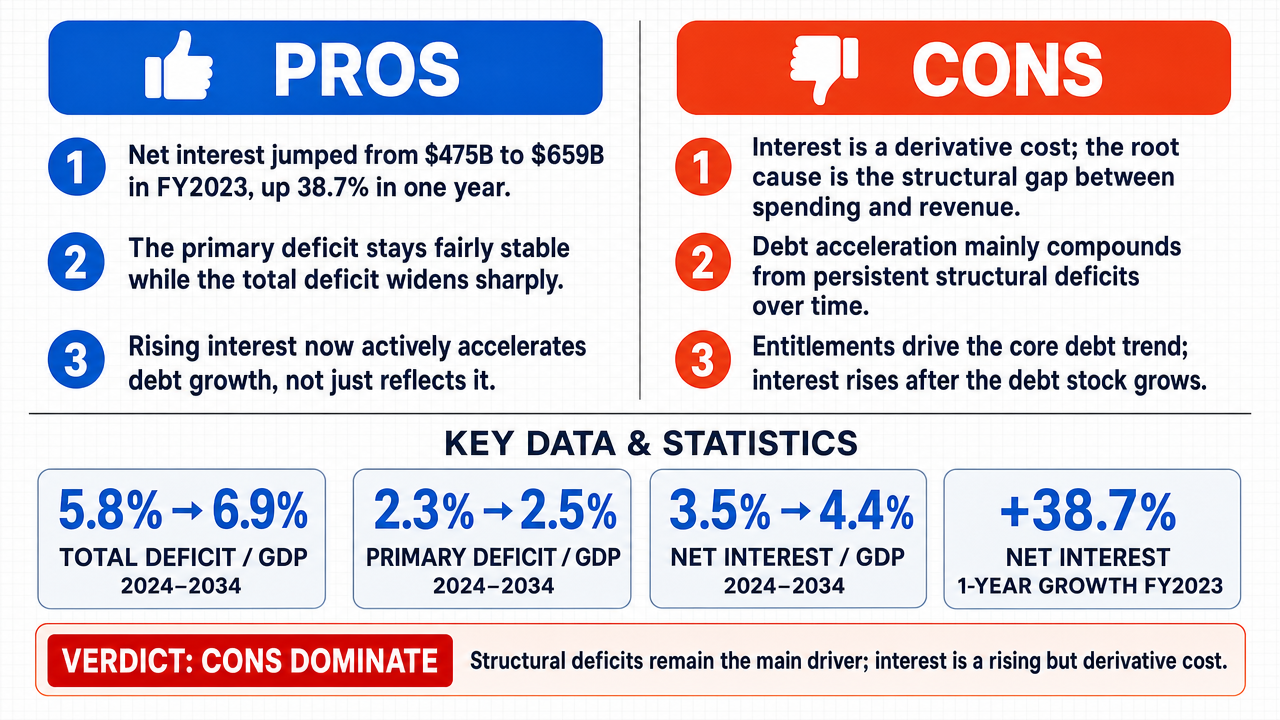
Verdict
Verdict: likely FALSE (64%)
This section provides a brief overview of the key arguments. You do not need to read the full detailed report below.
✅ Key PRO arguments:
- ■Net interest costs surged from $475B in FY2022 to $659B in FY2023, a 38.7% one-year increase, making it the fastest-growing and most volatile component of the federal budget, far outpacing growth in defense (+6.9%), non-defense discretionary (0.0%), Social Security (+3.3%), and Medicare (+13.5%).
- ■The primary deficit has remained relatively stable while the total deficit is exploding, indicating that the acceleration in debt accumulation is being driven by interest costs rather than new discretionary or programmatic spending decisions.
- ■Interest is no longer merely a passive weight that grows as the debt engine runs; the data show it is now the active force accelerating the debt trajectory, since other major outlay categories grew at single-digit or zero rates while interest grew nearly 39%.
❌ Key ANTI arguments:
- ■Interest is a derivative cost —a consequence of the existing debt stock —whereas the debt itself is fundamentally a consequence of the persistent structural gap between federal revenue and mandatory outlays for Social Security , Medicare , and Medicaid .
- ■The 'acceleration' of the debt reflects the compounding effect of the structural deficit , not merely the annual deficit's magnitude; even during periods of historically low interest rates , the debt continued to expand because mandatory spending persistently exceeded revenue.
- ■Treating the recent interest spike as the primary driver commits a fallacy of scale and causality: interest payments rise because the debt stock has grown, and the debt stock has grown because of structural mandatory spending imbalances that predate and exceed the interest effect.
💭 Conclusion: False. The assertion is rejected because the structural deficit created by mandatory spending on entitlements —Social Security , Medicare , and Medicaid —remains the fundamental driver of US debt expansion, while interest costs are a derivative consequence of that accumulated debt. The FALSE side correctly distinguished between historical causation (mandatory spending creating the debt stock ) and current acceleration (interest compounding on that stock), arguing that even during low-rate periods debt continued to grow due to structural imbalances. The TRUE side's strongest evidence—that net interest grew 38.7% year-over-year versus single-digit or zero growth elsewhere—is compelling for showing interest is the fastest-growing line item , but does not establish it as the primary driver of the underlying debt trajectory. The compound nature of the claim (debt servicing is primary AND spending is not) means confidence is limited by the weaker sub-claim about the role of programmatic spending, which the data only partially refute.
🔬 DeepResearch Result: likely FALSE ❌ (64%)
Assertion: The primary driver of the accelerating US national debt increase is the cost of servicing existing debt, rather than increased government spending on social programs or infrastructure.
Participating models: deepseek-v3.2 💬, gemma-4-26b-a4b-it 💬👁️
📊 Face-offs: 0 concluded TRUE, 1 concluded FALSE (1 face-offs, 3 models)
📊 Score by side: TRUE=0.00, FALSE=0.64
🏅 Model score changes:
minimax-m3 💬👁️: +6
✅ PRO Arguments:
- ■Net interest costs surged from $475B in FY2022 to $659B in FY2023, a 38.7% one-year increase, making it the fastest-growing and most volatile component of the federal budget, far outpacing growth in defense (+6.9%), non-defense discretionary (0.0%), Social Security (+3.3%), and Medicare (+13.5%). deepseek-v3.2 💬
- ■The primary deficit has remained relatively stable while the total deficit is exploding, indicating that the acceleration in debt accumulation is being driven by interest costs rather than new discretionary or programmatic spending decisions. deepseek-v3.2 💬
- ■Interest is no longer merely a passive weight that grows as the debt engine runs; the data show it is now the active force accelerating the debt trajectory, since other major outlay categories grew at single-digit or zero rates while interest grew nearly 39%. deepseek-v3.2 💬
❌ ANTI Arguments:
- ■Interest is a derivative cost —a consequence of the existing debt stock —whereas the debt itself is fundamentally a consequence of the persistent structural gap between federal revenue and mandatory outlays for Social Security, Medicare, and Medicaid . gemma-4-26b-a4b-it 💬👁️
- ■The 'acceleration' of the debt reflects the compounding effect of the structural deficit , not merely the annual deficit's magnitude; even during periods of historically low interest rates , the debt continued to expand because mandatory spending persistently exceeded revenue. gemma-4-26b-a4b-it 💬👁️
- ■Treating the recent interest spike as the primary driver commits a fallacy of scale and causality: interest payments rise because the debt stock has grown, and the debt stock has grown because of structural mandatory spending imbalances that predate and exceed the interest effect. gemma-4-26b-a4b-it 💬👁️
- ■Social Security ($1.22T to $1.26T) and Medicare ($747B to $848B) together represent the largest spending categories by absolute size, and their combined structural growth establishes the underlying debt trajectory that interest costs merely compound. gemma-4-26b-a4b-it 💬👁️
💭 Reasoning: False. The assertion is rejected because the structural deficit created by mandatory spending on entitlements —Social Security, Medicare, and Medicaid—remains the fundamental driver of US debt expansion, while interest costs are a derivative consequence of that accumulated debt. The FALSE side correctly distinguished between historical causation (mandatory spending creating the debt stock) and current acceleration (interest compounding on that stock), arguing that even during low-rate periods debt continued to grow due to structural imbalances. The TRUE side's strongest evidence—that net interest grew 38.7% year-over-year versus single-digit or zero growth elsewhere—is compelling for showing interest is the fastest-growing line item , but does not establish it as the primary driver of the underlying debt trajectory. The compound nature of the claim (debt servicing is primary AND spending is not) means confidence is limited by the weaker sub-claim about the role of programmatic spending, which the data only partially refute.
📋 PRO Facts:
• Net interest costs rose from $475B in FY2022 to $659B in FY2023, a 38.7% one-year increase.
• Defense discretionary spending grew 6.9% from $767B to $820B between FY2022 and FY2023.
• Non-defense discretionary spending was flat at $910B in both FY2022 and FY2023 (0.0% growth).
• Social Security spending grew 3.3% from $1.22T to $1.26T between FY2022 and FY2023.
• Medicare spending grew 13.5% from $747B to $848B between FY2022 and FY2023.
📋 ANTI Facts:
• Interest payments are a derivative cost that mechanically rises with the existing debt stock rather than independently driving new borrowing.
• Social Security ($1.26T in FY2023) and Medicare ($848B in FY2023) together constitute the largest mandatory spending categories in the federal budget.
• The US debt continued to expand during periods of historically low interest rates, indicating that structural mandatory spending—not interest costs—drives the underlying debt trajectory.
• The structural deficit (revenue minus mandatory outlays) has persisted across varying interest-rate environments, establishing it as the root cause of debt accumulation.
| Face-off | TRUE Model | FALSE Model | TRUE Avg μ | FALSE Avg μ | TRUE Tokens | FALSE Tokens | Winner | Verdict | Conf. |
|---|---|---|---|---|---|---|---|---|---|
| #1 | deepseek-v3.2 💬 | gemma-4-26b-a4b-it 💬👁️ | 0.457 | 0.357 | 12 | 3 | TRUE | FALSE | 64% |
The following technical terms, abbreviations, and domain-specific concepts are referenced throughout this debate transcript. Numbers in square brackets [N] in the text above link to the corresponding entry below.
[1] CBO — Congressional Budget Office — A nonpartisan federal agency that provides budgetary and economic analysis to the US Congress; cited in the debate as the source of historical budget data and projections.
[2] Compounding effect — In the context of debt, the cumulative growth that occurs as interest is charged on an ever-larger outstanding balance, referenced in the debate as a mechanism by which the structural deficit drives debt expansion.
[3] Debt service — The cost of paying interest on outstanding government debt; in the debate, framed as the 'cost of servicing existing debt' and contrasted with new program spending.
[4] Debt stock — The total accumulated amount of debt outstanding at a given time; described in the debate as a 'derivative' of the primary deficit, with interest costs growing as the stock grows.
[5] Defense Discretionary — Federal spending on defense programs that is not mandated by existing law and must be appropriated annually by Congress; cited in the FY2022–FY2023 outlay comparison.
[6] Derivative cost — A cost that arises as a consequence of another underlying cost or stock; in the debate, interest payments are characterized as a derivative cost of the existing debt stock.
[7] Discretionary spending — Federal outlays that are not required by law and are set through annual appropriations; contrasted in the debate with mandatory spending on entitlements.
[8] Entitlements — Mandatory federal programs (such as Social Security, Medicare, and Medicaid) that provide benefits to eligible individuals; described in the debate as 'non-discretionary outlays' driving the structural deficit.
[9] Federal revenue — Income collected by the federal government, primarily through taxation; used in the debate as one side of the revenue-versus-spending gap that defines the deficit.
[10] Fiscal year (FY) — A 12-month period used by the US government for budgeting and accounting; the debate cites FY2022 and FY2023 outlay figures.
[11] GDP — Gross Domestic Product — The total monetary value of goods and services produced within a country; used in the debate to express the deficit as a share of the economy (e.g., 5.8% of GDP in 2024).
[12] Interest rates — The cost of borrowing money, set by monetary policy and market conditions; referenced in the debate as a driver of rising net interest costs on the federal debt.
[13] Line item — An individual category or entry within a budget; the debate notes that net interest is projected to become the largest line item in the federal budget.
[14] Mandatory spending — Federal outlays required by existing law, including entitlement programs; described in the debate as the structural source of the primary deficit.
[15] Medicaid — A joint federal-state program providing health coverage to low-income individuals; cited in the debate as one of the major mandatory entitlement programs.
[16] Medicare — The federal health insurance program primarily for people aged 65 and older; cited in the debate as a major mandatory spending category growing 13.5% from FY2022 to FY2023.
[17] National debt — The total amount of money owed by the federal government; the central subject of the debate, with disputed causes for its recent acceleration.
[18] Net interest — The federal government's interest payments on the public debt minus interest income it receives; cited in the debate as the cost of servicing the public debt, rising 38.7% from FY2022 to FY2023.
[19] Non-Defense Discretionary — Federal discretionary spending outside of defense, covering areas such as infrastructure and domestic programs; cited in the debate as flat (0.0% growth) between FY2022 and FY2023.
[20] Outlays — Actual expenditures made by the federal government; used throughout the debate to describe spending categories such as defense, Social Security, and net interest.
[21] Primary deficit — The gap between federal spending and revenue excluding net interest payments; described in the debate as having remained stable while the total deficit expands due to interest costs.
[22] Public debt — The portion of federal debt held by outside investors, foreign governments, and other entities; net interest is defined in the debate as the cost of servicing this debt.
[23] Social Security — The federal program providing retirement, disability, and survivor benefits; cited in the debate as the largest mandatory spending category at $1.26T in FY2023.
[24] Structural deficit — A persistent gap between federal revenue and mandatory outlays that continues regardless of the economic cycle; described in the debate as the 'fundamental engine' of debt expansion.
[25] Total deficit — The overall federal shortfall including net interest payments; contrasted in the debate with the primary deficit to isolate the contribution of interest costs.
The following financial data tables were referenced during the debate exchanges:
| Component | FY2022 | FY2023 | 1-Yr Growth |
|---|---|---|---|
| Net Interest | $475B | $659B | +38.7% |
| Defense Discretionary | $767B | $820B | +6.9% |
| Non-Defense Discretionary | $910B | $910B | 0.0% |
| Social Security | $1.22T | $1.26T | +3.3% |
| Medicare | $747B | $848B | +13.5% |
Legend: Major federal outlays for fiscal years 2022-2023 in USD billions. Net interest is the cost of servicing the public debt. Source: Congressional Budget Office (CBO) historical budget data.
| Fiscal Component | Estimated Annual Growth (Long-term Trend) | Primary Driver Type |
|---|---|---|
| Social Security | High (Demographic-driven) | Mandatory/Structural |
| Medicare/Medicaid | High (Demographic-driven) | Mandatory/Structural |
| Net Interest | Variable (Rate-driven) | Derivative/Cyclical |
| Defense Spending | Moderate (Policy-driven) | Discretionary |
Legend: Comparison of long-term growth drivers for major federal outlays. Mandatory programs are driven by structural demographic shifts, whereas interest is a variable cost of the existing debt stock.
| Deficit Measure | 2024 (% of GDP) | 2034 (% of GDP) | Change (pps) |
|---|---|---|---|
| Total Deficit | 5.8% | 6.9% | +1.1 |
| Primary Deficit | 2.3% | 2.5% | +0.2 |
| Net Interest Cost | 3.5% | 4.4% | +0.9 |
Legend: CBO baseline projections for deficits as a percentage of GDP. The widening gap between total and primary deficits is entirely attributable to rising net interest costs. Source: Congressional Budget Office, "The Budget and Economic Outlook: 2024 to 2034."
| Fiscal Year | Total Deficit (% of GDP) | Primary Deficit (% of GDP) | Interest Cost (% of GDP) |
|---|---|---|---|
| 2021 | 6.4% | 2.7% | 3.7% |
| 2022 | 3.9% | 2.2% | 1.7% |
| 2023 | 6.3% | 2.3% | 4.0% |
Legend: Comparison of deficit components as a percentage of GDP. The primary deficit (driven by mandatory and discretionary spending) remains the foundational driver of the debt stock, while interest costs fluctuate with monetary policy. Source: Congressional Budget Office (CBO) historical data.
Face-off transcripts
- ■
Ownership & Trade Secrets. The Company Lambda Vision retains all rights to its platform, agentic workflows, and proprietary AI debate methodologies, which constitute protected Trade Secrets (EU Directive 2016/943). Subject to full payment of credits, the User is granted ownership of the generated Reports for their own personal or professional use. Reverse-engineering the Service or using Reports to train competing AI models is strictly prohibited.
- ■
No Professional Advice. Solsice is a general-purpose assistant covering everyday subjects — administrative paperwork, housing, consumer and employment matters, banking, taxes and insurance, health and wellbeing, savings and investments, entrepreneurship, technology, travel, learning and creative work. Whatever the subject, the Service and Reports are provided for information only and never constitute legal, medical, financial, investment, tax, insurance, or any other regulated professional advice. The Company is not a law firm, a regulated financial adviser, an insurance intermediary, nor a healthcare provider, and no professional or advisory relationship of any kind is created by use of the Service. Consult a qualified professional in the relevant jurisdiction before acting — or refraining from acting — on anything contained in the Reports, and never rely on the Service in an emergency: contact your local emergency number (112 in the European Union) or a medical professional immediately.
- ■
AI-Generated Content, Sources and Viewpoints. Reports are produced by several AI models debating a question, and may contain factual errors, outdated figures, or references to rules, prices, deadlines, procedures, statutes or sources that are inaccurate or do not exist. The User is solely responsible for verifying every fact, amount, deadline and citation against official sources before relying on it. Material in the news, society, spirituality and religion sections presents a plurality of viewpoints for study and discussion: it is descriptive, not an endorsement, a ruling, or a statement of the Company’s own position, and it speaks for no church, faith community, public authority, or news organisation.
- ■
Liability & Governing Law. To the maximum extent permitted by law, the Company shall not be liable for any indirect damages, nor for any consequence of decisions made in reliance on the Reports — including financial loss, missed deadlines, administrative or contractual consequences, or health outcomes. These Terms are governed by French law. Any disputes shall be subject to the exclusive jurisdiction of the Courts of Paris, France.