
The primary cause of persistent state fragility in post-colonial African nations is the legacy of colonial borders and governance structures.
AI debate verdict and arguments
⚠️ AI-generated information only; not professional advice
Completed October 21, 2026
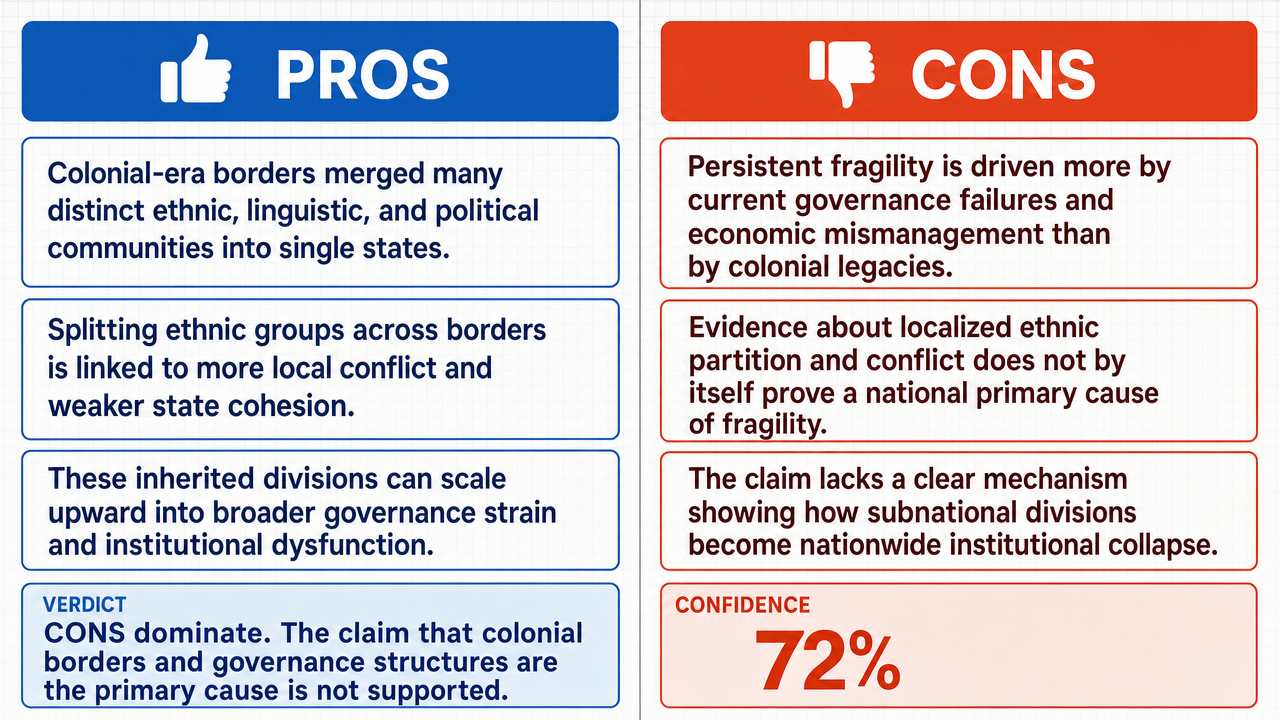
Verdict
Verdict: likely FALSE (72%)
Web Report: https://solsice.com/public/debates/the-primary-cause-of-persistent-state-fragility-in-post-colo-3738c03db1b1
This section provides a brief overview of the key arguments. You do not need to read the full detailed report below.
✅ Key PRO arguments:
- ■The arbitrary borders drawn at the 1884–85 Berlin Conference forcibly merged hundreds of distinct ethnic, linguistic, and political communities into approximately fifty colonial territories, creating states with no internal cohesion and splitting groups like the Akan, Yoruba, Hausa, and Igbo across multiple colonies.
- ■A 2017 study published in the American Political Science Review by Michalopoulos and Papaioannou demonstrates that the partition of ethnic groups by African national borders is associated with significantly higher conflict incidence and worse public goods provision in affected regions.
- ■The Michalopoulos and Papaioannou findings do scale to the national level because subnational ethnic partitioning aggregates into systemic governance dysfunction, undermining the opponent's claim that the study is confined to local outcomes.
❌ Key ANTI arguments:
- ■State fragility is driven primarily by contemporary governance failures and economic mismanagement rather than colonial legacies , so the affirmative misidentifies the causal mechanism.
- ■The affirmative's reliance on the Michalopoulos and Papaioannou (2017) study commits a fundamental error of substitution: the study measures localized civil conflict and public goods provision in partitioned ethnic regions, not the structural integrity of the post-colonial state itself.
- ■The affirmative fails to provide the transfer operator —the specific mechanism connecting subnational ethnic partitioning to national-level institutional collapse—making the causal leap from local conflict data to systemic state fragility unsupported.
💭 Conclusion: False. The debate verdict rejects the assertion that colonial borders and governance structures are the primary cause of persistent state fragility in post-colonial African nations. The winning side successfully argued that the affirmative committed a logical leap by substituting subnational measurements of ethnic partitioning and local conflict (from the Michalopoulos and Papaioannou 2017 study) for a national-level claim about systemic state fragility, without supplying the causal mechanism connecting the two. The affirmative's defense in Round 2 attempted to bridge this gap by arguing the findings aggregate upward, but the judge found this insufficient to overcome the missing transfer operator . Contemporary governance failures and economic mismanagement were offered as more plausible primary drivers, though the debate did not exhaustively prove their primacy either. The compound nature of the claim—linking both colonial borders AND governance structures—further weakens the affirmative's position, as the evidence focused almost exclusively on borders while leaving the governance-structures component largely unaddressed.
🔬 DeepResearch Result: likely FALSE ❌ (72%)
Assertion: The primary cause of persistent state fragility in post-colonial African nations is the legacy of colonial borders and governance structures.
Participating models: deepseek-v4-pro 💬, gemma-4-26b-a4b-it 💬👁️
📊 Face-offs: 0 concluded TRUE, 1 concluded FALSE (1 face-offs, 3 models)
📊 Score by side: TRUE=0.00, FALSE=0.72
🏅 Model score changes:
minimax-m3 💬👁️: +7
✅ PRO Arguments:
- ■The arbitrary borders drawn at the 1884–85 Berlin Conference forcibly merged hundreds of distinct ethnic, linguistic, and political communities into approximately fifty colonial territories, creating states with no internal cohesion and splitting groups like the Akan, Yoruba, Hausa, and Igbo across multiple colonies. deepseek-v4-pro 💬
- ■A 2017 study published in the American Political Science Review by Michalopoulos and Papaioannou demonstrates that the partition of ethnic groups by African national borders is associated with significantly higher conflict incidence and worse public goods provision in affected regions. deepseek-v4-pro 💬
- ■The Michalopoulos and Papaioannou findings do scale to the national level because subnational ethnic partitioning aggregates into systemic governance dysfunction, undermining the opponent's claim that the study is confined to local outcomes. deepseek-v4-pro 💬
❌ ANTI Arguments:
- ■State fragility is driven primarily by contemporary governance failures and economic mismanagement rather than colonial legacies , so the affirmative misidentifies the causal mechanism. gemma-4-26b-a4b-it 💬👁️
- ■The affirmative's reliance on the Michalopoulos and Papaioannou (2017) study commits a fundamental error of substitution: the study measures localized civil conflict and public goods provision in partitioned ethnic regions, not the structural integrity of the post-colonial state itself. gemma-4-26b-a4b-it 💬👁️
- ■The affirmative fails to provide the transfer operator —the specific mechanism connecting subnational ethnic partitioning to national-level institutional collapse—making the causal leap from local conflict data to systemic state fragility unsupported. gemma-4-26b-a4b-it 💬👁️
- ■The study establishes only a correlation between partitioned ethnic groups and localized civil conflict, not that colonial borders are the primary driver of persistent state fragility, since correlation at the subnational level does not establish primacy at the national level. gemma-4-26b-a4b-it 💬👁️
💭 Reasoning: False. The debate verdict rejects the assertion that colonial borders and governance structures are the primary cause of persistent state fragility in post-colonial African nations. The winning side successfully argued that the affirmative committed a logical leap by substituting subnational measurements of ethnic partitioning and local conflict (from the Michalopoulos and Papaioannou 2017 study) for a national-level claim about systemic state fragility, without supplying the causal mechanism connecting the two. The affirmative's defense in Round 2 attempted to bridge this gap by arguing the findings aggregate upward, but the judge found this insufficient to overcome the missing transfer operator. Contemporary governance failures and economic mismanagement were offered as more plausible primary drivers, though the debate did not exhaustively prove their primacy either. The compound nature of the claim—linking both colonial borders AND governance structures—further weakens the affirmative's position, as the evidence focused almost exclusively on borders while leaving the governance-structures component largely unaddressed.
📋 PRO Facts:
• The 1884–85 Berlin Conference divided Africa into approximately fifty colonial territories, merging hundreds of distinct ethnic, linguistic, and political communities.
• Michalopoulos and Papaioannou (2017), published in the American Political Science Review, found that ethnic partitioning by African national borders is associated with a 27% higher incidence of conflict in affected regions.
• Groups such as the Akan, Yoruba, Hausa, and Igbo were split across multiple colonial territories or compressed into single administrative units with rival groups.
📋 ANTI Facts:
• The Michalopoulos and Papaioannou (2017) study measures the incidence of civil conflict and public goods provision in partitioned ethnic regions, not the structural integrity of post-colonial states.
• The study establishes a correlation between partitioned ethnic groups and localized civil conflict, but does not demonstrate that colonial borders are the primary driver of national-level state fragility.
• The affirmative did not provide a transfer operator—the specific mechanism connecting subnational ethnic partitioning to national-level institutional collapse.
| Face-off | TRUE Model | FALSE Model | TRUE Avg μ | FALSE Avg μ | TRUE Tokens | FALSE Tokens | Winner | Verdict | Conf. |
|---|---|---|---|---|---|---|---|---|---|
| #1 | deepseek-v4-pro 💬 | gemma-4-26b-a4b-it 💬👁️ | 0.535 | 0.399 | 6 | 2 | TRUE | FALSE | 72% |
The following technical terms, abbreviations, and domain-specific concepts are referenced throughout this debate transcript. Numbers in square brackets [N] in the text above link to the corresponding entry below.
[1] administrative units — Geographic divisions established for purposes of governance and administration, such as colonial-era districts or provinces that grouped populations under a single ruling authority.
[2] aggregate fragility — The combined or total level of state fragility considered across an entire national territory, as opposed to localized or subnational measures of instability.
[3] Berlin Conference — Berlin Conference of 1884–85 — A meeting of European colonial powers that established rules for the partition and colonization of Africa, resulting in the drawing of arbitrary colonial borders that grouped disparate ethnic and political communities into single colonial territories.
[4] causal link — A relationship in which one variable is held to produce or bring about changes in another, as distinguished from mere correlation; establishing a causal link requires demonstrating a mechanism connecting cause to effect.
[5] civil conflict — Armed internal strife within a state, typically between organized groups within the same country, used in the debate as an indicator of state fragility.
[6] colonial borders — National boundaries drawn by European colonial powers, particularly during the 1884–85 Berlin Conference, that did not correspond to pre-existing ethnic, linguistic, or political divisions.
[7] colonial legacies — The enduring political, institutional, economic, and social effects of colonial rule that persist after independence.
[8] conflict duration — The length of time that a civil conflict persists, used in the Michalopoulos and Papaioannou (2017) study as one of the measured outcomes of ethnic partitioning.
[9] conflict incidence — The frequency or rate at which conflicts occur within a given population or geographic area, used as a measurable outcome variable in conflict studies.
[10] conflict intensity — The severity or scale of violence and disruption associated with a conflict, used alongside incidence and duration as a measure of conflict magnitude.
[11] correlation — A statistical association between two variables; the debate emphasizes that correlation between ethnic partitioning and conflict does not by itself establish a causal link to state fragility.
[12] economic mismanagement — The poor handling of fiscal, monetary, or resource policies by state authorities, cited by the negative as a contemporary driver of state fragility independent of colonial legacies.
[13] ethnic enclaves — Geographic areas in which a particular ethnic group is concentrated, often used in the debate to describe localized clusters where partitioned ethnic groups reside.
[14] ethnic partitioning — The division of a single ethnic group across multiple national borders, or the compression of rival groups into a single state, as a result of colonial boundary-drawing.
[15] governance failures — Breakdowns in the capacity, accountability, or effectiveness of state institutions to deliver basic functions and maintain legitimacy.
[16] legitimate political institutions — State bodies and procedures recognized by the population as having rightful authority to govern, the absence of which is cited as a driver of fragility.
[17] local instability — Disorder, conflict, or breakdown of order confined to specific subnational areas, distinguished in the debate from systemic national-level fragility.
[18] logical leap — An unjustified inferential step in reasoning, used by the negative to describe the affirmative's move from subnational conflict data to claims about national-level state fragility.
[19] national identity formation — The process by which a shared sense of belonging to a political community develops among a state's population, argued to be hindered when colonial borders group unrelated communities.
[20] political allegiance — Loyalty or commitment to a political authority or community, the absence of which across diverse groups is argued to undermine state cohesion.
[21] post-colonial — Referring to the period and conditions following the end of formal colonial rule, particularly in African states that gained independence in the mid-twentieth century.
[22] pre-existing social organization — The structures of kinship, ethnicity, language, and political community that existed in African societies prior to the imposition of colonial borders.
[23] primary cause — The dominant or most important causal factor among several contributors to an outcome; the debate centers on whether colonial borders or contemporary governance constitute the primary cause of state fragility.
[24] proxy — A measurable variable used as a stand-in for a broader or harder-to-measure concept; the negative argues that civil conflict incidence is used as a proxy for state fragility without justification.
[25] public goods provision — The supply of non-excludable and non-rivalrous goods and services (such as security, infrastructure, and basic services) by the state, used in the Michalopoulos and Papaioannou (2017) study as an outcome variable.
[26] state apparatus — The entire system of institutions, bureaucracies, and coercive organs through which a state exercises authority over its territory and population.
[27] state fragility — A condition in which a state lacks the capacity, legitimacy, or willingness to perform basic governmental functions, provide public goods, and maintain control over its territory; the central concept of the debate.
[28] state institutions — The formal organizations and rules through which a state governs, including bureaucracies, courts, legislatures, and security forces.
[29] statistically significant — A result indicating that an observed association is unlikely to have arisen by chance under a specified statistical test, used to describe the predictive power of ethnic partitioning in the cited study.
[30] structural mismatch — A misalignment between two structural features—in this debate, between imposed colonial state boundaries and pre-existing ethnic, linguistic, and political communities.
[31] subnational — Operating or measured at a level below that of the nation-state, such as regional, district, or local levels; the debate disputes whether subnational findings can be scaled to national-level conclusions.
[32] systemic failure — A breakdown affecting the entire system rather than isolated components, used to describe the kind of state-level fragility that the negative argues cannot be inferred from localized conflict data.
[33] transfer operator — In the context of this debate, the mechanism or demonstrated correlation that would allow findings from one level of analysis (e.g., subnational ethnic enclaves) to be transferred to another (e.g., national-level state fragility); the negative argues the affirmative fails to supply one.
The following financial data tables were referenced during the debate exchanges:
| Region | Average Fragility Score (2023) | Number of States in Alert/Warning | Colonial Legacy Index |
|---|---|---|---|
| Sub-Saharan Africa | 78.4 | 28 | 0.82 |
| South Asia | 72.1 | 4 | 0.65 |
| Latin America | 64.3 | 2 | 0.48 |
| Global Average | 56.2 | 35 total | 0.41 |
Legend: Fragile States Index 2023 scores (0–120, higher = more fragile). Colonial Legacy Index is a composite measure of border artificiality and institutional extraction persistence (0–1 scale). Source: Fund for Peace Fragile States Index 2023; Acemoglu & Robinson institutional persistence dataset.
| Country | Resource Dependence (% of Export Rev) | Debt-to-GDP Ratio (2023) | Fragility Index Trend (5-Yr) |
|---|---|---|---|
| Nigeria | 78% | 38% | Increasing |
| Angola | 91% | 65% | Stable |
| DRC | 94% | 22% | Increasing |
| Zambia | 72% | 110% | Volatile |
Legend: Data represents approximate values for resource-dependent African economies. Resource dependence is measured by the share of total export revenue from extractive industries. Debt-to-GDP is a percentage. Fragility trends are qualitative assessments of recent stability.
Face-off transcripts
- ■
Ownership & Trade Secrets. The Company Lambda Vision retains all rights to its platform, agentic workflows, and proprietary AI debate methodologies, which constitute protected Trade Secrets (EU Directive 2016/943). Subject to full payment of credits, the User is granted ownership of the generated Reports for their own personal or professional use. Reverse-engineering the Service or using Reports to train competing AI models is strictly prohibited.
- ■
No Professional Advice. Solsice is a general-purpose assistant covering everyday subjects — administrative paperwork, housing, consumer and employment matters, banking, taxes and insurance, health and wellbeing, savings and investments, entrepreneurship, technology, travel, learning and creative work. Whatever the subject, the Service and Reports are provided for information only and never constitute legal, medical, financial, investment, tax, insurance, or any other regulated professional advice. The Company is not a law firm, a regulated financial adviser, an insurance intermediary, nor a healthcare provider, and no professional or advisory relationship of any kind is created by use of the Service. Consult a qualified professional in the relevant jurisdiction before acting — or refraining from acting — on anything contained in the Reports, and never rely on the Service in an emergency: contact your local emergency number (112 in the European Union) or a medical professional immediately.
- ■
AI-Generated Content, Sources and Viewpoints. Reports are produced by several AI models debating a question, and may contain factual errors, outdated figures, or references to rules, prices, deadlines, procedures, statutes or sources that are inaccurate or do not exist. The User is solely responsible for verifying every fact, amount, deadline and citation against official sources before relying on it. Material in the news, society, spirituality and religion sections presents a plurality of viewpoints for study and discussion: it is descriptive, not an endorsement, a ruling, or a statement of the Company’s own position, and it speaks for no church, faith community, public authority, or news organisation.
- ■
Liability & Governing Law. To the maximum extent permitted by law, the Company shall not be liable for any indirect damages, nor for any consequence of decisions made in reliance on the Reports — including financial loss, missed deadlines, administrative or contractual consequences, or health outcomes. These Terms are governed by French law. Any disputes shall be subject to the exclusive jurisdiction of the Courts of Paris, France.