
The 'prevention through deterrence' policy implemented in 1994 by the US government has failed to reduce migration attempts through the Southern Arizona desert.
AI debate verdict and arguments
⚠️ AI-generated information only; not professional advice
Completed October 11, 2026
Verdict
Verdict: likely FALSE (56%)
This section provides a brief overview of the key arguments. You do not need to read the full detailed report below.
✅ Key PRO arguments:
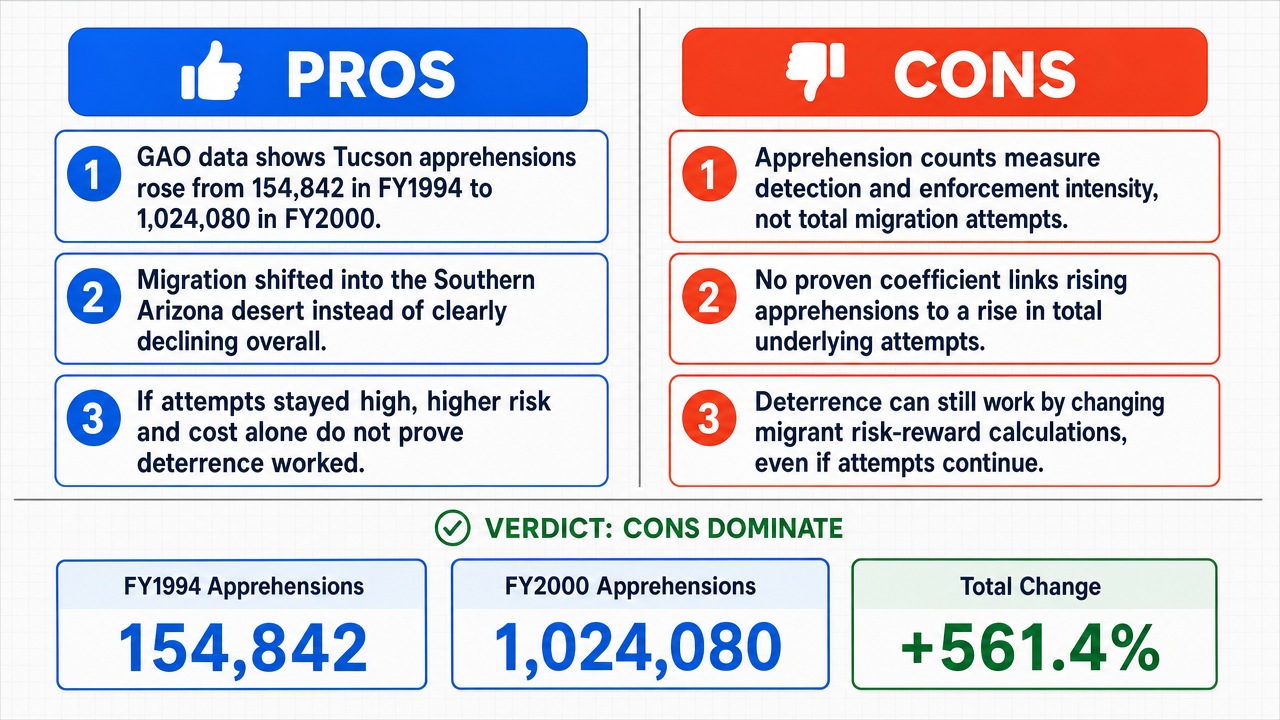
- ■Official GAO data shows Tucson Sector Border Patrol apprehensions rose dramatically from 154,842 in FY1994 to 1,024,080 in FY2000, indicating that detected attempts in the very sector the policy was meant to harden increased rather than decreased after implementation.
- ■The policy displaced migration into more dangerous terrain (the Southern Arizona desert) rather than reducing the total volume of attempts, as confirmed by academic research and the tragic increase in migrant mortality.
- ■If attempts continue at high levels, then a higher cost/risk burden is not proof that deterrence succeeded; it is proof that the deterrent mechanism failed to produce the claimed reduction in attempts.
❌ Key ANTI arguments:
- ■The affirmative commits a fundamental category error by treating apprehension counts as a measure of total migration attempts ; apprehensions measure agency detection capacity and enforcement intensity, not the underlying volume of attempts.
- ■The affirmative fails to provide the transfer operator —the correlation or coefficient —that links the increase in detected apprehensions to a change in the total volume of attempts, leaving the causal inference unsupported.
- ■The success of deterrence is properly measured by its ability to alter the risk-reward ratio for the migrant, and this remains true even if attempts continue; the policy successfully implemented the deterrent mechanism by increasing operational cost and risk of entry.
💭 Conclusion: The negative side's core critique rests on a category error in the affirmative's reasoning: apprehension counts measure Border Patrol detection capacity and enforcement intensity, not the total underlying volume of migration attempts . The affirmative failed to provide any correlation or coefficient linking the rise in apprehensions to a change in total attempts, making the causal inference that the policy failed to reduce attempts logically unsupported. The negative argued that deterrence success is properly measured by the alteration of the risk-reward ratio for migrants, and that the policy did increase operational cost and risk of entry even if attempts continued. The geographic displacement argument was undermined by the absence of evidence connecting corridor-specific presence to total attempt volume. The underlying empirical question about total attempt volumes remains genuinely contested.
🔬 DeepResearch Result: likely FALSE ❌ (56%)
Assertion: The 'prevention through deterrence ' policy implemented in 1994 by the US government has failed to reduce migration attempts through the Southern Arizona desert.
Participating models: deepseek-v3.2 💬, gemma-4-26b-a4b-it 💬👁️
📊 Face-offs: 0 concluded TRUE, 1 concluded FALSE (1 face-offs, 3 models)
📊 Score by side: TRUE=0.00, FALSE=0.56
🏅 Model score changes:
minimax-m3 💬👁️: +6
✅ PRO Arguments:
- ■Official GAO data shows Tucson Sector Border Patrol apprehensions rose dramatically from 154,842 in FY1994 to 1,024,080 in FY2000, indicating that detected attempts in the very sector the policy was meant to harden increased rather than decreased after implementation. deepseek-v3.2 💬
- ■The policy displaced migration into more dangerous terrain (the Southern Arizona desert) rather than reducing the total volume of attempts, as confirmed by academic research and the tragic increase in migrant mortality. deepseek-v3.2 💬
- ■If attempts continue at high levels, then a higher cost/risk burden is not proof that deterrence succeeded; it is proof that the deterrent mechanism failed to produce the claimed reduction in attempts. deepseek-v3.2 💬
- ■Apprehensions are the operational count of attempts detected by the agency charged with enforcing the border, and their large rise across the first post-policy years directly contradicts the notion of reduced migration in this specific region. deepseek-v3.2 💬
❌ ANTI Arguments:
- ■The affirmative commits a fundamental category error by treating apprehension counts as a measure of total migration attempts; apprehensions measure agency detection capacity and enforcement intensity, not the underlying volume of attempts. gemma-4-26b-a4b-it 💬👁️
- ■The affirmative fails to provide the transfer operator —the correlation or coefficient —that links the increase in detected apprehensions to a change in the total volume of attempts, leaving the causal inference unsupported. gemma-4-26b-a4b-it 💬👁️
- ■The success of deterrence is properly measured by its ability to alter the risk-reward ratio for the migrant, and this remains true even if attempts continue; the policy successfully implemented the deterrent mechanism by increasing operational cost and risk of entry. gemma-4-26b-a4b-it 💬👁️
- ■The presence of migrants in a specific geographic corridor is not a direct indicator of the total volume of attempts; the affirmative treats the desert route as a 'surviving corridor' without providing the necessary projection that maps geographic location to total attempted entries. gemma-4-26b-a4b-it 💬👁️
💭 Reasoning: The negative side's core critique rests on a category error in the affirmative's reasoning: apprehension counts measure Border Patrol detection capacity and enforcement intensity, not the total underlying volume of migration attempts. The affirmative failed to provide any correlation or coefficient linking the rise in apprehensions to a change in total attempts, making the causal inference that the policy failed to reduce attempts logically unsupported. The negative argued that deterrence success is properly measured by the alteration of the risk-reward ratio for migrants, and that the policy did increase operational cost and risk of entry even if attempts continued. The geographic displacement argument was undermined by the absence of evidence connecting corridor-specific presence to total attempt volume. The underlying empirical question about total attempt volumes remains genuinely contested.
📋 PRO Facts:
• GAO reported Tucson Sector Border Patrol apprehensions rose from 154,842 in FY1994 to 1,024,080 in FY2000
• Migrant mortality in the Southern Arizona desert increased following the 1994 policy implementation
• Academic research indicates the policy displaced migration into more dangerous terrain
📋 ANTI Facts:
• Apprehensions are a measure of agency detection capacity and enforcement intensity, not total migration attempts
• The affirmative provided no correlation or coefficient linking apprehension increases to total attempt volume
• Deterrence success is measured by alteration of the risk-reward ratio, which can succeed even if attempts continue
| Face-off | TRUE Model | FALSE Model | TRUE Avg μ | FALSE Avg μ | TRUE Tokens | FALSE Tokens | Winner | Verdict | Conf. |
|---|---|---|---|---|---|---|---|---|---|
| #1 | deepseek-v3.2 💬 | gemma-4-26b-a4b-it 💬👁️ | 0.667 | 0.236 | 12 | 3 | TRUE | FALSE | 56% |
The following technical terms, abbreviations, and domain-specific concepts are referenced throughout this debate transcript. Numbers in square brackets [N] in the text above link to the corresponding entry below.
[1] anomaly — In statistics, an observation or data point that deviates significantly from the expected pattern or trend. In the debate, the negative side characterizes the rise in migrant mortality as an anomaly that does not inherently prove a rise in total attempts.
[2] apprehensions — In immigration enforcement, the detention or arrest of individuals suspected of unauthorized entry. The affirmative cites Tucson Sector apprehensions rising from 154,842 in FY1994 to 1,024,080 in FY2000 as evidence of continued migration attempts.
[3] Border Patrol — The federal law enforcement agency within US Customs and Border Protection responsible for securing US borders and apprehending individuals attempting unauthorized entry.
[4] Borderlands — Geographic regions along international borders, often used in policy contexts to describe the border zones where enforcement activities and migration occur.
[5] category error — A logical or philosophical error in which something is treated as belonging to a category it does not actually belong to. The negative argues the affirmative commits this error by treating apprehensions (a detection measure) as the total volume of migration attempts.
[6] chokepoint — A strategic narrow passage or location that controls access to a larger area. In the debate, the Southern Arizona desert route is described as the intended chokepoint of the 1994 policy.
[7] coefficient — A numerical factor that expresses the magnitude or direction of the relationship between variables in a statistical model. The negative notes the affirmative fails to provide a coefficient linking apprehensions to total attempts.
[8] correlation — A statistical measure describing the degree to which two variables move together. The negative argues the affirmative fails to establish the correlation between geographic location of migrants and total migration flow.
[9] detection capacity — The ability of an enforcement agency to identify and intercept violations. The negative argues that rising apprehensions may reflect increased detection capacity rather than increased attempts.
[10] detection efficiency — The effectiveness with which enforcement operations identify violations. The negative contends that apprehensions measure detection efficiency rather than the underlying volume of attempts.
[11] deterrent mechanism — A policy or strategy designed to discourage certain behavior by increasing the costs, risks, or difficulty associated with that behavior.
[12] displaced migration — Migration flows redirected from one route, corridor, or area to another, typically as a result of enforcement pressure or changing conditions.
[13] enforcement capacity — The resources, personnel, and operational capability available to enforce laws or regulations. The negative argues that rising apprehensions may reflect heightened enforcement capacity rather than increased attempts.
[14] FY — Fiscal Year — The 12-month period used by governments for accounting, budgeting, and reporting purposes. The US federal fiscal year runs from October 1 to September 30.
[15] GAO — Government Accountability Office — The US congressional watchdog agency that audits federal programs and operations, commonly cited in policy debates for its investigative reports.
[16] GAO-02-511 — A specific report identifier from the Government Accountability Office, titled 'Border Management: Immigration-Related Deaths in Arizona's Borderlands,' published April 26, 2002.
[17] Human Rights Watch — An international non-governmental organization that monitors and reports on human rights conditions worldwide. In the debate, it is cited as corroborating that the policy redirected migrants into harsher terrain.
[18] illegal immigration — The act of entering or residing in a country in violation of that country's immigration laws and regulations.
[19] migration attempts — Efforts by individuals to cross international borders, often without legal authorization. The central phenomenon the debate seeks to measure.
[20] operational count — The number of actions or events recorded by an enforcement agency during its operations. The affirmative describes apprehensions as the operational count of detected attempts.
[21] Pima County Medical Examiner — The official office in Pima County, Arizona responsible for investigating deaths and determining causes. Cited in the debate for records showing immigration-related deaths escalating from 21 in 1990 to 138 in 2000.
[22] Prevention Through Deterrence — A 1994 US border enforcement strategy intended to deter unauthorized crossings by concentrating enforcement resources in urban crossing areas, thereby redirecting migrants to more remote and dangerous terrain.
[23] proxy — A variable used as a substitute for another variable that cannot be directly measured. The negative argues the affirmative commits a substitution of proxy by treating apprehensions as a proxy for total attempts.
[24] risk-reward ratio — The relationship between the potential gains and potential losses associated with a decision or action. The negative frames deterrence success as altering this ratio for migrants.
[25] substitution of proxy — A methodological error in which a proxy variable is treated as if it were the actual phenomenon being measured, rather than an imperfect substitute for it.
[26] transfer operator — A mathematical or statistical operator that maps one variable, function, or distribution to another. The negative argues the affirmative fails to provide the transfer operator linking apprehensions to total attempts.
[27] Tucson Sector — A specific operational area of US Border Patrol covering Southern Arizona, used as the geographic unit of analysis in the debate.
[28] unauthorized crossings — Entries into a country without legal permission, documentation, or through ports of entry not designated for such entry.
The following financial data tables were referenced during the debate exchanges:
| Metric | FY1994 | FY2000 | Total Change |
|---|---|---|---|
| Tucson Sector Apprehensions | 154,842 | 1,024,080 | +561.4% |
Legend: Comparison of Tucson Sector Border Patrol apprehensions between Fiscal Year 1994 and 2000. Data sourced from GAO-02-511.
Face-off transcripts
- ■
Ownership & Trade Secrets. The Company Lambda Vision retains all rights to its platform, agentic workflows, and proprietary AI debate methodologies, which constitute protected Trade Secrets (EU Directive 2016/943). Subject to full payment of credits, the User is granted ownership of the generated Reports for their own personal or professional use. Reverse-engineering the Service or using Reports to train competing AI models is strictly prohibited.
- ■
No Professional Advice. Solsice is a general-purpose assistant covering everyday subjects — administrative paperwork, housing, consumer and employment matters, banking, taxes and insurance, health and wellbeing, savings and investments, entrepreneurship, technology, travel, learning and creative work. Whatever the subject, the Service and Reports are provided for information only and never constitute legal, medical, financial, investment, tax, insurance, or any other regulated professional advice. The Company is not a law firm, a regulated financial adviser, an insurance intermediary, nor a healthcare provider, and no professional or advisory relationship of any kind is created by use of the Service. Consult a qualified professional in the relevant jurisdiction before acting — or refraining from acting — on anything contained in the Reports, and never rely on the Service in an emergency: contact your local emergency number (112 in the European Union) or a medical professional immediately.
- ■
AI-Generated Content, Sources and Viewpoints. Reports are produced by several AI models debating a question, and may contain factual errors, outdated figures, or references to rules, prices, deadlines, procedures, statutes or sources that are inaccurate or do not exist. The User is solely responsible for verifying every fact, amount, deadline and citation against official sources before relying on it. Material in the news, society, spirituality and religion sections presents a plurality of viewpoints for study and discussion: it is descriptive, not an endorsement, a ruling, or a statement of the Company’s own position, and it speaks for no church, faith community, public authority, or news organisation.
- ■
Liability & Governing Law. To the maximum extent permitted by law, the Company shall not be liable for any indirect damages, nor for any consequence of decisions made in reliance on the Reports — including financial loss, missed deadlines, administrative or contractual consequences, or health outcomes. These Terms are governed by French law. Any disputes shall be subject to the exclusive jurisdiction of the Courts of Paris, France.