
The presence of unanswered questions or unfulfilled desires should not diminish a believer's confidence in God's character.
AI debate verdict and arguments
⚠️ AI-generated information only; not professional advice
Completed October 18, 2026
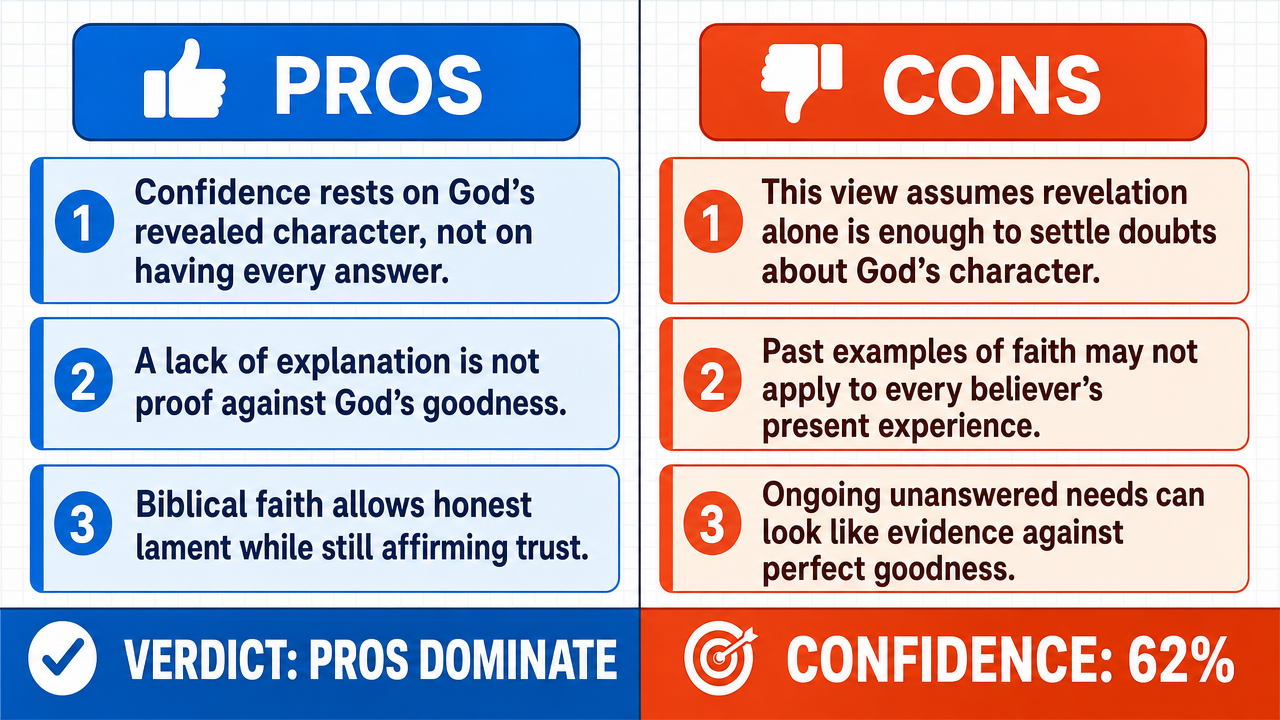
Verdict
Verdict: likely TRUE (62%)
Web Report: https://solsice.com/public/debates/the-presence-of-unanswered-questions-or-unfulfilled-desires-c9ecbef0cca4
This section provides a brief overview of the key arguments. You do not need to read the full detailed report below.
✅ Key PRO arguments:
- ■Unanswered questions and unfulfilled desires are logically independent of God's character, which rests on established revelation . Confidence is grounded in what has been revealed and historically demonstrated, not in the absence of exhaustive answers. Isaiah 55:8-9 explicitly states God's ways and thoughts are higher than human ways, and the Psalms repeatedly model lament followed by affirmation of God's steadfast love.
- ■The negative side's claim rests on a category error : it treats the absence of an answer as if it were a positive datum with probative force against a specific hypothesis. An unanswered question is not an empirical observation ; it is the absence of one. To treat silence as 'evidence against' a particular character attribution requires a hidden premise that a God possessing the relevant attributes would necessarily provide answers and fulfill desires in every case where a believer experiences their absence.
- ■Scripture never conditions trust on total understanding. The biblical pattern of lament (e.g., 'How long, O Lord?' in Psalm 13:1-2) followed by affirmation of God's character demonstrates that unanswered questions are a design feature of finite minds encountering an infinite being, not a defect that undermines confidence.
❌ Key ANTI arguments:
- ■The affirmative's attempt to decouple unanswered questions from divine character relies on a hidden premise that 'revelation ' is a sufficient and closed epistemic system . By presenting the biblical pattern of lament as a 'design feature' that validates trust despite silence, the opponent engages in circular reasoning: they use the very concept of 'divine mystery' to shield the character of God from the scrutiny of the questions that supposedly challenge it, which is a tautology .
- ■The argument that biblical authors modeled faith by anchoring their confidence in historical acts of deliverance despite divine hiddenness relies on a universalizing premise that all such authors responded to hiddenness by maintaining confidence. This proposition is directly contradicted by the very record it cites, which shows other responses (such as Job's protests or the psalmists' complaints that do not resolve into praise) are equally present and decisive.
- ■Unanswered questions and unfulfilled desires constitute empirical evidence that directly challenges divine character because they represent observable gaps between what a being with certain attributes would be expected to do and what actually occurs in the believer's experience.
💭 Conclusion: True, the debate resolved in favor of the assertion that unanswered questions and unfulfilled desires should not diminish a believer's confidence in God's character. The affirmative side successfully argued that confidence in God's character is grounded in established revelation and historical demonstration rather than in exhaustive answers to every question. The negative side's attempt to treat silence as positive empirical evidence against divine character was identified as a category error , since the absence of an answer is not itself a datum with probative force . While the negative side raised a valid concern about the tautological nature of using 'divine mystery' to shield God's character from scrutiny, the affirmative's grounding in scriptural patterns of lament followed by affirmation provided a more robust framework. The judge's moderate confidence of 62% reflects that while the affirmative's logical argument was stronger, the negative side's critique of universalizing biblical responses to hiddenness retained some merit.
🔬 DeepResearch Result: likely TRUE ✅ (62%)
Assertion: The presence of unanswered questions or unfulfilled desires should not diminish a believer's confidence in God's character.
Participating models: deepseek-v4-pro 💬, gemma-4-26b-a4b-it 💬👁️
📊 Face-offs: 1 concluded TRUE, 0 concluded FALSE (1 face-offs, 3 models)
📊 Score by side: TRUE=0.62, FALSE=0.00
🏅 Model score changes:
minimax-m3 💬👁️: +6
✅ PRO Arguments:
- ■Unanswered questions and unfulfilled desires are logically independent of God's character, which rests on established revelation . Confidence is grounded in what has been revealed and historically demonstrated, not in the absence of exhaustive answers. Isaiah 55:8-9 explicitly states God's ways and thoughts are higher than human ways, and the Psalms repeatedly model lament followed by affirmation of God's steadfast love. deepseek-v4-pro 💬
- ■The negative side's claim rests on a category error : it treats the absence of an answer as if it were a positive datum with probative force against a specific hypothesis. An unanswered question is not an empirical observation ; it is the absence of one. To treat silence as 'evidence against' a particular character attribution requires a hidden premise that a God possessing the relevant attributes would necessarily provide answers and fulfill desires in every case where a believer experiences their absence. deepseek-v4-pro 💬
- ■Scripture never conditions trust on total understanding. The biblical pattern of lament (e.g., 'How long, O Lord?' in Psalm 13:1-2) followed by affirmation of God's character demonstrates that unanswered questions are a design feature of finite minds encountering an infinite being, not a defect that undermines confidence. deepseek-v4-pro 💬
❌ ANTI Arguments:
- ■The affirmative's attempt to decouple unanswered questions from divine character relies on a hidden premise that 'revelation' is a sufficient and closed epistemic system . By presenting the biblical pattern of lament as a 'design feature' that validates trust despite silence, the opponent engages in circular reasoning: they use the very concept of 'divine mystery' to shield the character of God from the scrutiny of the questions that supposedly challenge it, which is a tautology . gemma-4-26b-a4b-it 💬👁️
- ■The argument that biblical authors modeled faith by anchoring their confidence in historical acts of deliverance despite divine hiddenness relies on a universalizing premise that all such authors responded to hiddenness by maintaining confidence. This proposition is directly contradicted by the very record it cites, which shows other responses (such as Job's protests or the psalmists' complaints that do not resolve into praise) are equally present and decisive. gemma-4-26b-a4b-it 💬👁️
- ■Unanswered questions and unfulfilled desires constitute empirical evidence that directly challenges divine character because they represent observable gaps between what a being with certain attributes would be expected to do and what actually occurs in the believer's experience. gemma-4-26b-a4b-it 💬👁️
💭 Reasoning: True, the debate resolved in favor of the assertion that unanswered questions and unfulfilled desires should not diminish a believer's confidence in God's character. The affirmative side successfully argued that confidence in God's character is grounded in established revelation and historical demonstration rather than in exhaustive answers to every question. The negative side's attempt to treat silence as positive empirical evidence against divine character was identified as a category error, since the absence of an answer is not itself a datum with probative force. While the negative side raised a valid concern about the tautological nature of using 'divine mystery' to shield God's character from scrutiny, the affirmative's grounding in scriptural patterns of lament followed by affirmation provided a more robust framework. The judge's moderate confidence of 62% reflects that while the affirmative's logical argument was stronger, the negative side's critique of universalizing biblical responses to hiddenness retained some merit.
📋 PRO Facts:
• Isaiah 55:8-9 states that God's ways and thoughts are higher than human ways.
• Psalm 13:1-2 models the pattern of lament ('How long, O Lord?') followed by affirmation of God's steadfast love.
• Scripture presents unanswered questions as a design feature of finite minds encountering an infinite being, not as a defect.
📋 ANTI Facts:
• The biblical record includes responses to divine hiddenness beyond maintained confidence, such as Job's protests and unresolved complaints.
• The concept of 'divine mystery' can function as a tautology when used to shield God's character from empirical scrutiny.
| Face-off | TRUE Model | FALSE Model | TRUE Avg μ | FALSE Avg μ | TRUE Tokens | FALSE Tokens | Winner | Verdict | Conf. |
|---|---|---|---|---|---|---|---|---|---|
| #1 | deepseek-v4-pro 💬 | gemma-4-26b-a4b-it 💬👁️ | 0.449 | 0.308 | 6 | 2 | TRUE | TRUE | 62% |
The following technical terms, abbreviations, and domain-specific concepts are referenced throughout this debate transcript. Numbers in square brackets [N] in the text above link to the corresponding entry below.
[1] argument from ignorance — argumentum ad ignorantiam — A logical fallacy in which a conclusion is drawn from the absence of evidence either for or against a proposition, treating the lack of disproof as proof of a claim.
[2] background knowledge — In argumentation and epistemology, the set of premises, assumptions, or shared information that interlocutors treat as established and therefore do not need to explicitly defend within the argument.
[3] category error — A philosophical or logical error that occurs when something is assigned to a conceptual category to which it does not belong, or when properties of one category are inappropriately applied to another.
[4] character assessment — The evaluation of an agent's traits, dispositions, or moral qualities based on observed behavior, responses, or patterns of action.
[5] circular demonstration — A form of reasoning in which the conclusion is effectively assumed within the premises, so that the argument supports itself rather than being independently established.
[6] covenant faithfulness — A theological concept referring to the reliability and steadfastness attributed to a divine being in upholding covenantal commitments and historical acts of deliverance.
[7] divine hiddenness — A theological and philosophical concept referring to the perceived absence, silence, or inscrutability of a divine being despite belief in its existence and activity.
[8] empirical observation — An observation grounded in sensory experience or measurable data, as distinct from theoretical, abstract, or purely conceptual claims.
[9] epistemic system — A structured framework for the acquisition, organization, justification, and validation of knowledge and belief.
[10] lament — In biblical and theological literature, a genre of expression involving complaint, grief, or petition directed toward a divine being, often modeled in the Psalms.
[11] probative force — The weight or evidential value that a piece of information or observation carries in establishing, undermining, or testing a claim.
[12] revelation — In theological contexts, the disclosure or manifestation of a divine being's nature, character, or will to humanity, treated as the epistemic ground for confidence in that being.
[13] tautology — A statement that is true by virtue of its logical form or by definition, and therefore conveys no substantive information beyond the meaning of its terms.
[14] universalizing premise — A premise in an argument that generalizes a pattern, rule, or response to apply universally across all cases, often without sufficient warrant from the evidence cited.
[15] vindicated — In theological contexts such as the figure of Job, declared righteous, proven just, or restored to a right standing after a period of suffering or questioning.
Face-off transcripts
- ■
Ownership & Trade Secrets. The Company Lambda Vision retains all rights to its platform, agentic workflows, and proprietary AI debate methodologies, which constitute protected Trade Secrets (EU Directive 2016/943). Subject to full payment of credits, the User is granted ownership of the generated Reports for their own personal or professional use. Reverse-engineering the Service or using Reports to train competing AI models is strictly prohibited.
- ■
No Professional Advice. Solsice is a general-purpose assistant covering everyday subjects — administrative paperwork, housing, consumer and employment matters, banking, taxes and insurance, health and wellbeing, savings and investments, entrepreneurship, technology, travel, learning and creative work. Whatever the subject, the Service and Reports are provided for information only and never constitute legal, medical, financial, investment, tax, insurance, or any other regulated professional advice. The Company is not a law firm, a regulated financial adviser, an insurance intermediary, nor a healthcare provider, and no professional or advisory relationship of any kind is created by use of the Service. Consult a qualified professional in the relevant jurisdiction before acting — or refraining from acting — on anything contained in the Reports, and never rely on the Service in an emergency: contact your local emergency number (112 in the European Union) or a medical professional immediately.
- ■
AI-Generated Content, Sources and Viewpoints. Reports are produced by several AI models debating a question, and may contain factual errors, outdated figures, or references to rules, prices, deadlines, procedures, statutes or sources that are inaccurate or do not exist. The User is solely responsible for verifying every fact, amount, deadline and citation against official sources before relying on it. Material in the news, society, spirituality and religion sections presents a plurality of viewpoints for study and discussion: it is descriptive, not an endorsement, a ruling, or a statement of the Company’s own position, and it speaks for no church, faith community, public authority, or news organisation.
- ■
Liability & Governing Law. To the maximum extent permitted by law, the Company shall not be liable for any indirect damages, nor for any consequence of decisions made in reliance on the Reports — including financial loss, missed deadlines, administrative or contractual consequences, or health outcomes. These Terms are governed by French law. Any disputes shall be subject to the exclusive jurisdiction of the Courts of Paris, France.