
The presence of a 'Présidence de la République l'Élysée' logo on a food product implies a direct collaboration with the Élysée Palace.
AI debate verdict and arguments
⚠️ AI-generated information only; not professional advice
Completed October 18, 2026
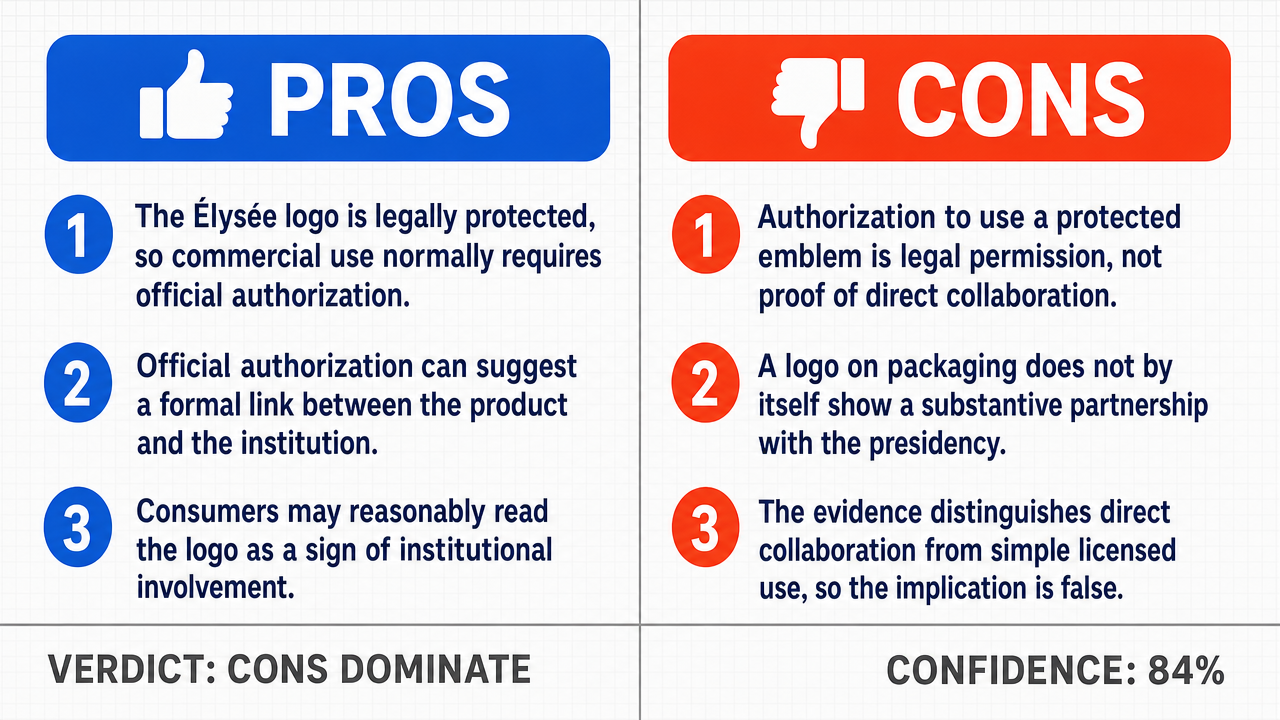
Verdict
Verdict: likely FALSE (84%)
Web Report: https://solsice.com/public/debates/the-presence-of-a-presidence-de-la-republique-l-elysee-logo-ec862062c2cc
This section provides a brief overview of the key arguments. You do not need to read the full detailed report below.
✅ Key PRO arguments:
- ■The French Intellectual Property Code (Article L711-4 ) strictly protects state emblems including the Élysée logo, prohibiting their use in commerce without authorization. Consequently, any food product displaying this logo must have obtained explicit, case-specific permission from the Élysée Palace, a process that requires a direct, collaborative relationship between the producer and the presidency.
- ■The opponent cannot simultaneously claim that authorization for use of the Élysée logo entails direct collaboration with the Élysée Palace and that authorization is merely a regulatory or procedural constraint that does not establish substantive collaboration , because these two propositions are logically incompatible.
❌ Key ANTI arguments:
- ■The affirmative's argument is circular: they attempt to prove that the logo implies collaboration by assuming that authorization implies collaboration, which is just a restatement of the conclusion rather than independent evidence. The legal requirement for authorization is a regulatory constraint , not proof of the substantive nature of the relationship.
- ■The affirmative's argument is fundamentally inconsistent because if the logo's presence were an absolute, inherent signal of a direct partnership, there would be no legal need to protect the emblem against unauthorized commercial use. The very existence of legal protections against misuse or counterfeiting proves that the logo can appear on products without genuine partnership.
- ■Authorization to use a protected emblem is a procedural permission regulating the form of use, not evidence of a substantive collaborative relationship; many uses of state emblems are permitted for ceremonial, commemorative, or informational purposes without implying an active partnership.
💭 Conclusion: False. The presence of the Élysée logo on a food product does not necessarily imply a direct collaboration with the presidency. The evidence explicitly distinguishes 'Direct Collaboration' (a curated, artisanal partnership) from 'Legal Licensing ' (passive authorization/trademark use) as separate categories. This means authorization to use the logo is not equivalent to a substantive collaborative relationship. The affirmative's reasoning assumes the conclusion (collaboration) within the premise (authorization implies collaboration) rather than providing independent evidence. The existence of a distinct 'Licensed Producer' category demonstrates that logo use can occur through passive authorization without genuine partnership. The affirmative failed to demonstrate that every authorized use entails active partnership rather than mere compliance with licensing arrangements.
🔬 DeepResearch Result: likely FALSE ❌ (84%)
Assertion: The presence of a 'Présidence de la République l'Élysée' logo on a food product implies a direct collaboration with the Élysée Palace.
Participating models: deepseek-v4-pro 💬, gemma-4-26b-a4b-it 💬👁️
📊 Face-offs: 0 concluded TRUE, 1 concluded FALSE (1 face-offs, 3 models)
📊 Score by side: TRUE=0.00, FALSE=0.84
🏅 Model score changes:
minimax-m3 💬👁️: +8
✅ PRO Arguments:
- ■The French Intellectual Property Code (Article L711-4 ) strictly protects state emblems including the Élysée logo, prohibiting their use in commerce without authorization. Consequently, any food product displaying this logo must have obtained explicit, case-specific permission from the Élysée Palace, a process that requires a direct, collaborative relationship between the producer and the presidency. deepseek-v4-pro 💬
- ■The opponent cannot simultaneously claim that authorization for use of the Élysée logo entails direct collaboration with the Élysée Palace and that authorization is merely a regulatory or procedural constraint that does not establish substantive collaboration , because these two propositions are logically incompatible. deepseek-v4-pro 💬
❌ ANTI Arguments:
- ■The affirmative's argument is circular: they attempt to prove that the logo implies collaboration by assuming that authorization implies collaboration, which is just a restatement of the conclusion rather than independent evidence. The legal requirement for authorization is a regulatory constraint , not proof of the substantive nature of the relationship. gemma-4-26b-a4b-it 💬👁️
- ■The affirmative's argument is fundamentally inconsistent because if the logo's presence were an absolute, inherent signal of a direct partnership, there would be no legal need to protect the emblem against unauthorized commercial use. The very existence of legal protections against misuse or counterfeiting proves that the logo can appear on products without genuine partnership. gemma-4-26b-a4b-it 💬👁️
- ■Authorization to use a protected emblem is a procedural permission regulating the form of use, not evidence of a substantive collaborative relationship; many uses of state emblems are permitted for ceremonial, commemorative, or informational purposes without implying an active partnership. gemma-4-26b-a4b-it 💬👁️
💭 Reasoning: False. The presence of the Élysée logo on a food product does not necessarily imply a direct collaboration with the presidency. The evidence explicitly distinguishes 'Direct Collaboration' (a curated, artisanal partnership) from 'Legal Licensing ' (passive authorization/trademark use) as separate categories. This means authorization to use the logo is not equivalent to a substantive collaborative relationship. The affirmative's reasoning assumes the conclusion (collaboration) within the premise (authorization implies collaboration) rather than providing independent evidence. The existence of a distinct 'Licensed Producer' category demonstrates that logo use can occur through passive authorization without genuine partnership. The affirmative failed to demonstrate that every authorized use entails active partnership rather than mere compliance with licensing arrangements.
📋 PRO Facts:
• Article L711-4 of the French Intellectual Property Code prohibits the adoption of state emblems, including the Élysée logo, as trademarks or their use in commerce without authorization.
• Unauthorized use of the Élysée logo on commercial products would constitute illegal counterfeiting under French law.
📋 ANTI Facts:
• The evidence distinguishes 'Legal Licensing' (passive authorization/trademark use) from 'Direct Collaboration' (curated, artisanal partnership) as separate relationship types, indicating that authorization to use the logo does not by itself establish a substantive collaborative relationship.
• The presence of a distinct 'Licensed Producer' category, separate from direct collaboration, implies that logo use can occur through passive authorization without genuine partnership.
| Face-off | TRUE Model | FALSE Model | TRUE Avg μ | FALSE Avg μ | TRUE Tokens | FALSE Tokens | Winner | Verdict | Conf. |
|---|---|---|---|---|---|---|---|---|---|
| #1 | deepseek-v4-pro 💬 | gemma-4-26b-a4b-it 💬👁️ | 0.569 | 0.254 | 6 | 2 | TRUE | FALSE | 84% |
The following technical terms, abbreviations, and domain-specific concepts are referenced throughout this debate transcript. Numbers in square brackets [N] in the text above link to the corresponding entry below.
[1] administrative license — In the debate, described as a passive, non-collaborative grant of permission that regulates the form of use without establishing a substantive collaborative relationship.
[2] Article L711-4 — An article of the French Intellectual Property Code cited in the debate as explicitly prohibiting the adoption of state emblems as trademarks or their use in commerce without authorization.
[3] circular demonstration — A logical fallacy identified in the debate where a conclusion is attempted to be proven by feeding that same conclusion into the initial premise, making the argument tautological.
[4] Code de la propriété intellectuelle — French Intellectual Property Code — The French legal code referenced in the debate as strictly protecting state emblems, including the logo of the Présidence de la République.
[5] contrapositive — A logical form referenced in the debate to make explicit the inverse implication of a conditional statement (e.g., if P then Q; therefore if not Q then not P).
[6] counterfeiting — In the debate, the illegal use of a protected emblem without authorization, which the affirmative argues would result from displaying the Élysée logo without a direct link to the Presidency.
[7] French Intellectual Property Code — Code de la propriété intellectuelle — The French legal code cited in the debate as strictly protecting state emblems and prohibiting their unauthorized commercial use.
[8] inconsistent set — A logical concept referenced in the debate to describe an argument that relies on a proposition and its negation simultaneously, thereby establishing nothing.
[9] licensing — In the debate, the formal framework through which the Élysée Palace authorizes use of its emblem, which the parties dispute as either implying or not implying direct collaboration.
[10] logical fallacy — A flaw in reasoning identified in the debate, including circular demonstration and substitution of proxy error.
[11] partnership framework — In the debate, the formal licensing and partnership arrangement operated by the Élysée Palace for the use of its emblem on products such as those sold in its official boutique.
[12] procedural permission — In the debate, a type of authorization characterized as merely regulatory or procedural, which the negative argues does not establish a substantive collaborative relationship.
[13] public law — The branch of law referenced in the debate as the independent grounding for the premise that state emblems are protected, distinct from the conclusion about collaboration.
[14] regulatory constraint — In the debate, a legal requirement characterized as a procedural or administrative constraint rather than proof of a substantive collaborative relationship.
[15] state emblems — Official symbols of the state, referenced in the debate as being strictly protected under the French Intellectual Property Code, including the logo of the Présidence de la République.
[16] substantive collaboration — In the debate, an operational partnership or direct collaborative relationship, contrasted by the negative with mere administrative or procedural authorization.
[17] substitution of proxy error — A logical error identified in the debate where a property observed in a specific case (e.g., products in the Élysée boutique resulting from direct collaboration) is assumed to apply universally to all products bearing the logo.
[18] trademarks — Intellectual property signs referenced in the debate, which Article L711-4 of the French Intellectual Property Code prohibits from being adopted for state emblems without authorization.
The following financial data tables were referenced during the debate exchanges:
| Entity Type | Relationship Type | Nature of Logo Use |
|---|---|---|
| Élysée Boutique | Direct Collaboration | Curated, artisanal partnership |
| Licensed Producer | Legal Licensing | Passive authorization/Trademark use |
| Third-party Distributor | Secondary Rights | Commercial distribution of licensed goods |
Legend: Comparison of different relationship models involving the use of institutional emblems.
Face-off transcripts
- ■
Ownership & Trade Secrets. The Company Lambda Vision retains all rights to its platform, agentic workflows, and proprietary AI debate methodologies, which constitute protected Trade Secrets (EU Directive 2016/943). Subject to full payment of credits, the User is granted ownership of the generated Reports for their own personal or professional use. Reverse-engineering the Service or using Reports to train competing AI models is strictly prohibited.
- ■
No Professional Advice. Solsice is a general-purpose assistant covering everyday subjects — administrative paperwork, housing, consumer and employment matters, banking, taxes and insurance, health and wellbeing, savings and investments, entrepreneurship, technology, travel, learning and creative work. Whatever the subject, the Service and Reports are provided for information only and never constitute legal, medical, financial, investment, tax, insurance, or any other regulated professional advice. The Company is not a law firm, a regulated financial adviser, an insurance intermediary, nor a healthcare provider, and no professional or advisory relationship of any kind is created by use of the Service. Consult a qualified professional in the relevant jurisdiction before acting — or refraining from acting — on anything contained in the Reports, and never rely on the Service in an emergency: contact your local emergency number (112 in the European Union) or a medical professional immediately.
- ■
AI-Generated Content, Sources and Viewpoints. Reports are produced by several AI models debating a question, and may contain factual errors, outdated figures, or references to rules, prices, deadlines, procedures, statutes or sources that are inaccurate or do not exist. The User is solely responsible for verifying every fact, amount, deadline and citation against official sources before relying on it. Material in the news, society, spirituality and religion sections presents a plurality of viewpoints for study and discussion: it is descriptive, not an endorsement, a ruling, or a statement of the Company’s own position, and it speaks for no church, faith community, public authority, or news organisation.
- ■
Liability & Governing Law. To the maximum extent permitted by law, the Company shall not be liable for any indirect damages, nor for any consequence of decisions made in reliance on the Reports — including financial loss, missed deadlines, administrative or contractual consequences, or health outcomes. These Terms are governed by French law. Any disputes shall be subject to the exclusive jurisdiction of the Courts of Paris, France.