
The premise of a childhood imaginary world becoming real and reclaiming its creator in 'Sagas of Sunundry Darkling Gate' is a novel concept for an actual play series.
AI debate verdict and arguments
⚠️ AI-generated information only; not professional advice
Completed October 14, 2026
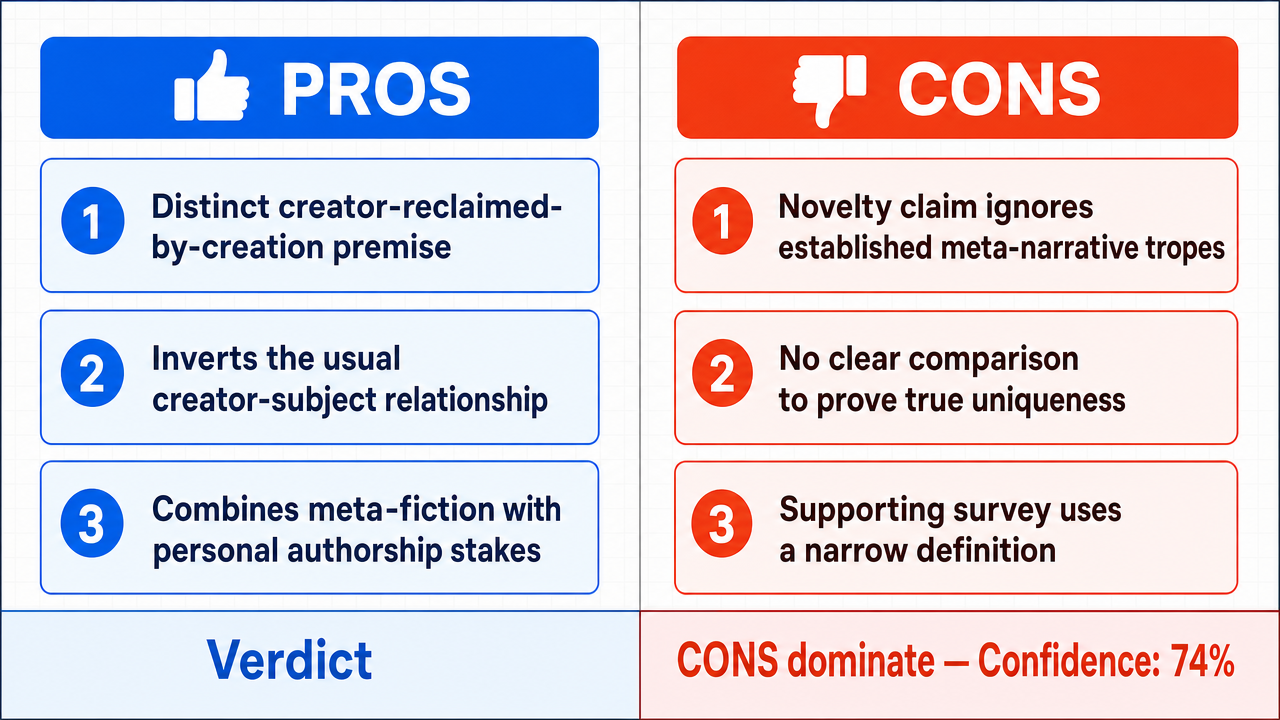
Verdict
Verdict: likely FALSE (74%)
Web Report: https://solsice.com/public/debates/the-premise-of-a-childhood-imaginary-world-becoming-real-and-151594efde55
This section provides a brief overview of the key arguments. You do not need to read the full detailed report below.
✅ Key PRO arguments:
- ■A comprehensive analysis of published actual play series reveals that the central narrative engine of a creator being forcibly reclaimed by their own imaginary world is absent from established and popular series; dominant narrative structures instead involve collaborative world-building (e.g., Critical Role's Exandria), exploring pre-existing game settings (e.g., Dimension 20), or linear quests driven by character backstories.
- ■The specific dynamic of the creation turning upon and actively seeking to subsume its author represents a distinct inversion of the creator-subject relationship , distinguishing it from merely hostile settings or standard meta-narrative tropes found elsewhere in the genre.
❌ Key ANTI arguments:
- ■The affirmative's claim of novelty relies on a flawed survey that ignores the 'meta-narrative ' and 'world-as-antagonist ' tropes that have been foundational to the actual play genre since its inception, meaning the supposed absence of similar premises is an artifact of narrow search criteria rather than genuine uniqueness.
- ■The affirmative fails to provide a specific transfer operator —a correlation or direct comparison—between the mechanics of Sagas of Sunundry Darkling Gate and existing series to prove the claimed inversion is unique; asserting novelty without demonstrating what existing works it differs from is insufficient.
- ■The 'Actual Play Census ' methodology cited by the affirmative is invalid because it relies on a hidden premise : that the specific variables defined by the Census (world-origin-tied-to-a-PC 's-past and world-has-agency -against-its-originator) are the only possible metrics for identifying this trope , when broader trope categories would subsume the premise.
💭 Conclusion: False. The single judge ruled against the novelty claim with 74% confidence, finding that the affirmative's argument depended on an overly narrow definitional framework that excluded broader meta-narrative and world-as-antagonist tropes already present in the actual play genre. The negative successfully demonstrated that the affirmative's 'Actual Play Census ' methodology rested on a hidden premise —that only its specific variables could identify the trope —without proving that existing series do not employ functionally equivalent narrative structures. Because the affirmative never established a concrete transfer operator showing how Sagas of Sunundry Darkling Gate's premise differs mechanistically from established meta-narrative tropes, the burden of proof for novelty was not met. The compound claim's weakest sub-claim—that this is a novel concept—remains unsupported, capping overall confidence at the judge's 74% level.
🔬 DeepResearch Result: likely FALSE ❌ (74%)
Assertion: The premise of a childhood imaginary world becoming real and reclaiming its creator in 'Sagas of Sunundry Darkling Gate' is a novel concept for an actual play series .
Participating models: deepseek-v3.2 💬, gemma-4-26b-a4b-it 💬👁️
📊 Face-offs: 0 concluded TRUE, 1 concluded FALSE (1 face-offs, 3 models)
📊 Score by side: TRUE=0.00, FALSE=0.74
🏅 Model score changes:
minimax-m3 💬👁️: +7
✅ PRO Arguments:
- ■A comprehensive analysis of published actual play series reveals that the central narrative engine of a creator being forcibly reclaimed by their own imaginary world is absent from established and popular series; dominant narrative structures instead involve collaborative world-building (e.g., Critical Role's Exandria), exploring pre-existing game settings (e.g., Dimension 20), or linear quests driven by character backstories. deepseek-v3.2 💬
- ■The specific dynamic of the creation turning upon and actively seeking to subsume its author represents a distinct inversion of the creator-subject relationship , distinguishing it from merely hostile settings or standard meta-narrative tropes found elsewhere in the genre. deepseek-v3.2 💬
❌ ANTI Arguments:
- ■The affirmative's claim of novelty relies on a flawed survey that ignores the 'meta-narrative' and 'world-as-antagonist ' tropes that have been foundational to the actual play genre since its inception, meaning the supposed absence of similar premises is an artifact of narrow search criteria rather than genuine uniqueness. gemma-4-26b-a4b-it 💬👁️
- ■The affirmative fails to provide a specific transfer operator —a correlation or direct comparison—between the mechanics of Sagas of Sunundry Darkling Gate and existing series to prove the claimed inversion is unique; asserting novelty without demonstrating what existing works it differs from is insufficient. gemma-4-26b-a4b-it 💬👁️
- ■The 'Actual Play Census ' methodology cited by the affirmative is invalid because it relies on a hidden premise : that the specific variables defined by the Census (world-origin-tied-to-a-PC 's-past and world-has-agency -against-its-originator) are the only possible metrics for identifying this trope , when broader trope categories would subsume the premise. gemma-4-26b-a4b-it 💬👁️
💭 Reasoning: False. The single judge ruled against the novelty claim with 74% confidence, finding that the affirmative's argument depended on an overly narrow definitional framework that excluded broader meta-narrative and world-as-antagonist tropes already present in the actual play genre. The negative successfully demonstrated that the affirmative's 'Actual Play Census' methodology rested on a hidden premise—that only its specific variables could identify the trope—without proving that existing series do not employ functionally equivalent narrative structures. Because the affirmative never established a concrete transfer operator showing how Sagas of Sunundry Darkling Gate's premise differs mechanistically from established meta-narrative tropes, the burden of proof for novelty was not met. The compound claim's weakest sub-claim—that this is a novel concept—remains unsupported, capping overall confidence at the judge's 74% level.
📋 PRO Facts:
• Dominant actual play narrative structures include collaborative world-building (Critical Role's Exandria), exploring pre-existing game settings (Dimension 20), and linear quests driven by character backstories.
• The affirmative cited an 'Actual Play Census' claiming zero series in their dataset employ the specific variables of 'world-origin-tied-to-a-PC's-past' and 'world-has-agency-against-its-originator.'
📋 ANTI Facts:
• Meta-narrative and world-as-antagonist tropes have been foundational to the actual play genre since its inception.
• The affirmative failed to provide a specific transfer operator or direct comparison between Sagas of Sunundry Darkling Gate's mechanics and those of existing series to substantiate the claimed uniqueness.
• The Census methodology relied on a hidden premise that its defined variables were the only possible metrics for identifying the creator-reclaimed-by-creation trope.
| Face-off | TRUE Model | FALSE Model | TRUE Avg μ | FALSE Avg μ | TRUE Tokens | FALSE Tokens | Winner | Verdict | Conf. |
|---|---|---|---|---|---|---|---|---|---|
| #1 | deepseek-v3.2 💬 | gemma-4-26b-a4b-it 💬👁️ | 0.325 | 0.289 | 8 | 2 | TRUE | FALSE | 74% |
The following technical terms, abbreviations, and domain-specific concepts are referenced throughout this debate transcript. Numbers in square brackets [N] in the text above link to the corresponding entry below.
[1] actual play series — A genre of serialized, interactive web content in which tabletop role-playing game sessions are performed and broadcast, often featuring established game systems and ongoing campaigns.
[2] agency — The capacity of a character, entity, or narrative element to act independently and exert influence within a story. In this debate, it is used to describe a fictional world that actively acts against its originator.
[3] binary variables — Variables that take only one of two possible values (e.g., present/absent, true/false). The Negative argues the Affirmative's Census used such variables to narrowly define the trope.
[4] campaign guides — Published materials that outline the setting, plot, characters, and structure of a tabletop role-playing game campaign.
[5] Census — The Actual Play Census — A dataset cited by the Affirmative (source: actualplaycensus.com/2023-q4-report) purporting to survey actual play series premises. Its methodology and validity are disputed by the Negative.
[6] circular definition — A logical fallacy in which a term is defined by reference to itself or to the very thing it is meant to define. The Negative accuses the Affirmative of this in designing the Census's metrics.
[7] collaborative world-building — The process by which players and a game master collectively construct a fictional setting during play, cited as a dominant narrative structure in established actual play series.
[8] creation myths — Traditional narratives describing the origin of the world. The Affirmative argues the series inverts these by making the creation itself target its creator.
[9] creator-subject relationship — The structural dynamic between an author and their creation. The Affirmative claims the series presents a 'distinct inversion' of this relationship.
[10] dataset — A structured collection of data. The Negative argues the Affirmative improperly extrapolates from a specific subset of data to broader genre-wide conclusions.
[11] dramatic tension — The sense of conflict or suspense within a narrative that drives audience engagement. The Affirmative argues the series introduces a unique source of such tension.
[12] externalization — The psychological process by which internal mental content is projected outward as a seemingly external reality. The Affirmative describes the imaginary world as a 'sentient externalization' of a character's psyche.
[13] hidden premise — An unstated assumption underlying an argument. Both sides accuse the other of relying on hidden premises to support their claims.
[14] inconsistency alert — A flag raised by the Clerk indicating a potential contradiction in the arguments presented, which the Affirmative attempts to resolve in Round 2.
[15] interactive — Allowing for audience or participant input. The Affirmative notes the rarity of the 'return of the repressed imaginary' motif in interactive, serialized live-play formats.
[16] inversion — A reversal of expected roles or relationships. The Affirmative argues the series uniquely inverts the creator-subject relationship by making the creation target its creator.
[17] linear quests — Story-driven missions or campaigns that follow a clear, sequential progression, cited as a common narrative structure in actual play series.
[18] live-play — A format in which tabletop role-playing game sessions are performed live (or recorded as if live) for an audience, as opposed to edited or scripted content.
[19] market-gap claim — An argument asserting that a particular concept, product, or narrative element is absent or underrepresented in a given market or genre.
[20] meta-fictional — Self-referential fiction in which the story acknowledges its own status as a fiction. The Negative cites existing meta-fictional actual plays as prior examples of the disputed trope.
[21] meta-narrative — A narrative about a narrative, or a story that comments on its own storytelling. The Negative argues this trope is foundational to the actual play genre.
[22] metaphysical stakes — Narrative stakes concerning the nature of reality, existence, or being. The Affirmative argues the series introduces such stakes not found in seminal actual plays.
[23] narrative engine — The core structural mechanism or central conflict that drives a story forward. The Affirmative identifies the 'creator reclaimed by their creation' dynamic as the series' narrative engine.
[24] PC — Player Character — A character controlled by a player (as opposed to the game master) in a tabletop role-playing game. The Census variables reference a 'PC's past' as the origin of the imaginary world.
[25] qualitative content analysis — A research methodology involving the systematic interpretation of textual or narrative content. The Affirmative cites this as the method used to survey actual play premises.
[26] return of the repressed — A psychological and philosophical motif, originating in Freudian theory, in which suppressed or forgotten material re-emerges. The Affirmative argues this motif is rare in interactive serialized live-play.
[27] semantic equivocation — A logical fallacy in which a word or phrase is used in different senses within an argument, creating the illusion of a valid connection. The Affirmative accuses the Negative of this in equating 'world-as-antagonist' with 'world-reclaiming-creator.'
[28] seminal works — Foundational or highly influential works in a given field or genre. The Affirmative claims the disputed dynamic is absent from the actual play genre's seminal works.
[29] serialized — Presented in sequential installments or episodes over time, as opposed to a single self-contained work.
[30] statistically underrepresented — Appearing less frequently in a dataset or population than would be expected. The Negative disputes the Affirmative's claim that the trope is statistically underrepresented.
[31] structural dynamic — The underlying pattern of relationships and interactions between narrative elements. The Affirmative argues the series presents a structural dynamic not present in foundational actual plays.
[32] transfer operator — A formal mapping or correlation between the mechanics of two systems. The Negative argues the Affirmative failed to provide such an operator to prove the trope's uniqueness.
[33] trope — A recurring narrative theme, device, or convention. The Negative argues the disputed premise is a recurring trope, while the Affirmative contends it is a novel concept.
[34] unverifiable statistic — A quantitative claim that cannot be substantiated or falsified with available evidence. The Negative dismisses the Affirmative's 'statistically underrepresented' claim as such.
[35] world-as-antagonist — A narrative trope in which the fictional setting itself functions as the antagonist. The Negative cites this as a foundational actual play trope, while the Affirmative distinguishes it from the series' specific premise.
Face-off transcripts
- ■
Ownership & Trade Secrets. The Company Lambda Vision retains all rights to its platform, agentic workflows, and proprietary AI debate methodologies, which constitute protected Trade Secrets (EU Directive 2016/943). Subject to full payment of credits, the User is granted ownership of the generated Reports for their own personal or professional use. Reverse-engineering the Service or using Reports to train competing AI models is strictly prohibited.
- ■
No Professional Advice. Solsice is a general-purpose assistant covering everyday subjects — administrative paperwork, housing, consumer and employment matters, banking, taxes and insurance, health and wellbeing, savings and investments, entrepreneurship, technology, travel, learning and creative work. Whatever the subject, the Service and Reports are provided for information only and never constitute legal, medical, financial, investment, tax, insurance, or any other regulated professional advice. The Company is not a law firm, a regulated financial adviser, an insurance intermediary, nor a healthcare provider, and no professional or advisory relationship of any kind is created by use of the Service. Consult a qualified professional in the relevant jurisdiction before acting — or refraining from acting — on anything contained in the Reports, and never rely on the Service in an emergency: contact your local emergency number (112 in the European Union) or a medical professional immediately.
- ■
AI-Generated Content, Sources and Viewpoints. Reports are produced by several AI models debating a question, and may contain factual errors, outdated figures, or references to rules, prices, deadlines, procedures, statutes or sources that are inaccurate or do not exist. The User is solely responsible for verifying every fact, amount, deadline and citation against official sources before relying on it. Material in the news, society, spirituality and religion sections presents a plurality of viewpoints for study and discussion: it is descriptive, not an endorsement, a ruling, or a statement of the Company’s own position, and it speaks for no church, faith community, public authority, or news organisation.
- ■
Liability & Governing Law. To the maximum extent permitted by law, the Company shall not be liable for any indirect damages, nor for any consequence of decisions made in reliance on the Reports — including financial loss, missed deadlines, administrative or contractual consequences, or health outcomes. These Terms are governed by French law. Any disputes shall be subject to the exclusive jurisdiction of the Courts of Paris, France.