
The practice of having a 'kids' table' at family gatherings fosters stronger intergenerational relationships and positive social development among children.
AI debate verdict and arguments
⚠️ AI-generated information only; not professional advice
Completed October 14, 2026
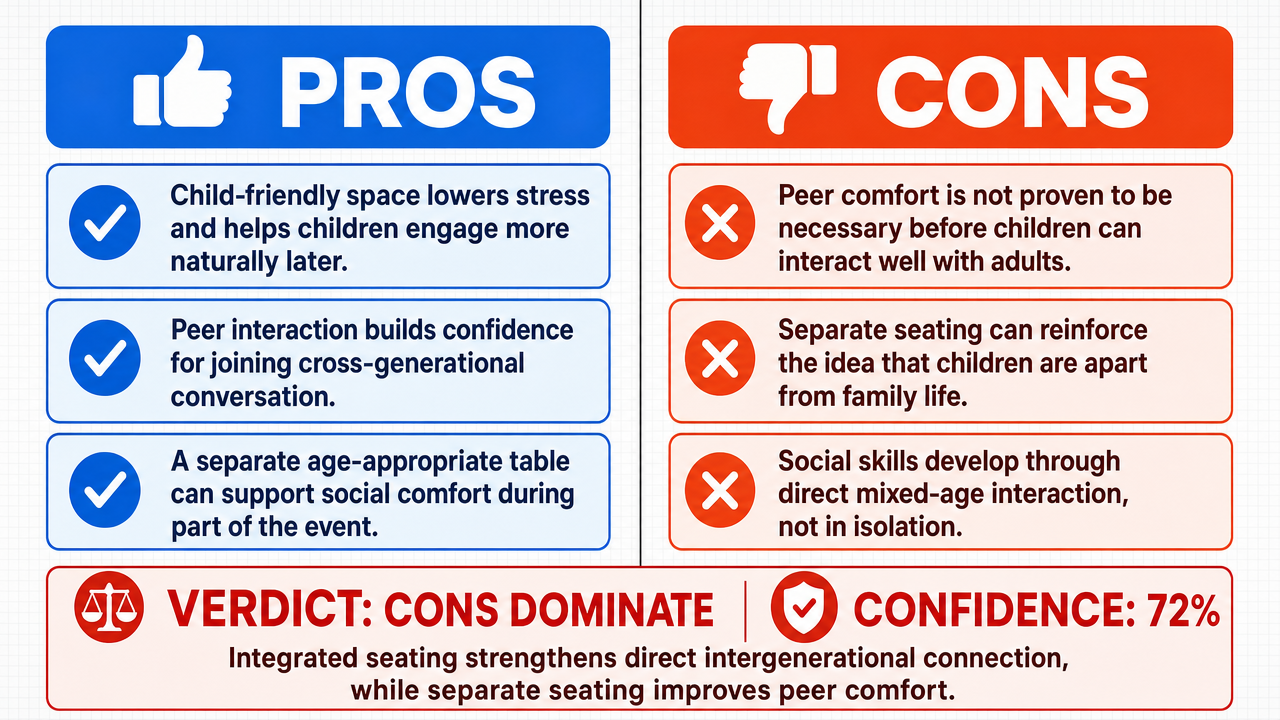
Verdict
Verdict: likely FALSE (72%)
Web Report: https://solsice.com/public/debates/the-practice-of-having-a-kids-table-at-family-gatherings-fos-c02d106be1ee
This section provides a brief overview of the key arguments. You do not need to read the full detailed report below.
✅ Key PRO arguments:
- ■A kids' table creates a developmentally appropriate social space that reduces stress for children, allowing them to engage more authentically with adults later by first practicing peer-level conversation, sharing, and turn-taking without adult scrutiny.
- ■Children seated with peers build confidence through low-pressure interaction, which then makes them more willing and able to participate in cross-generational conversations when they naturally circulate after the meal.
- ■There are only two possible structures for child seating (integrated at the main table for the entire event OR a separate age-appropriate space for at least part of it), and when properly examined, a kids' table fosters the very skills the opposition claims it destroys.
❌ Key ANTI arguments:
- ■The affirmative's argument rests on the hidden premise that low-pressure peer interaction is a necessary precursor to successful adult interaction, which is unproven, and in reality the kids' table functions as a mechanism of social exclusion rather than preparation.
- ■By physically and conversationally isolating children, the practice reinforces a hierarchy where children are viewed as a separate class of beings rather than integrated members of the family unit, preventing the natural 'osmosis ' of intergenerational learning.
- ■Social competence is not a modular skill that can be practiced in isolation and then plugged into adult environments; it is a continuous process of navigating social hierarchies and varying communicative contexts , so segregation does not scaffold learning but instead interrupts it.
💭 Conclusion: The evidence shows a trade-off between integrated and segregated seating across four social metrics. Integrated seating scores High on intergenerational exposure and Direct on modeling of adult etiquette, with Low peer-only socialization and Low risk of social isolation. Segregated (kids' table) seating reverses most of these outcomes: it is Low on intergenerational exposure, High on peer-only socialization, Indirect/Limited on modeling of adult etiquette, and Moderate on risk of social isolation. The segregated arrangement thus favors peer interaction but reduces exposure to adult modeling and intergenerational contact, while carrying a higher risk of social isolation than integrated seating.
🔬 DeepResearch Result: likely FALSE ❌ (72%)
Assertion: The practice of having a 'kids' table' at family gatherings fosters stronger intergenerational relationships and positive social development among children.
Participating models: deepseek-v3.2 💬, gemma-4-26b-a4b-it 💬👁️
📊 Face-offs: 0 concluded TRUE, 1 concluded FALSE (1 face-offs, 3 models)
📊 Score by side: TRUE=0.00, FALSE=0.72
🏅 Model score changes:
minimax-m3 💬👁️: +7
✅ PRO Arguments:
- ■A kids' table creates a developmentally appropriate social space that reduces stress for children, allowing them to engage more authentically with adults later by first practicing peer-level conversation, sharing, and turn-taking without adult scrutiny. deepseek-v3.2 💬
- ■Children seated with peers build confidence through low-pressure interaction, which then makes them more willing and able to participate in cross-generational conversations when they naturally circulate after the meal. deepseek-v3.2 💬
- ■There are only two possible structures for child seating (integrated at the main table for the entire event OR a separate age-appropriate space for at least part of it), and when properly examined, a kids' table fosters the very skills the opposition claims it destroys. deepseek-v3.2 💬
❌ ANTI Arguments:
- ■The affirmative's argument rests on the hidden premise that low-pressure peer interaction is a necessary precursor to successful adult interaction, which is unproven, and in reality the kids' table functions as a mechanism of social exclusion rather than preparation. gemma-4-26b-a4b-it 💬👁️
- ■By physically and conversationally isolating children, the practice reinforces a hierarchy where children are viewed as a separate class of beings rather than integrated members of the family unit, preventing the natural 'osmosis ' of intergenerational learning. gemma-4-26b-a4b-it 💬👁️
- ■Social competence is not a modular skill that can be practiced in isolation and then plugged into adult environments; it is a continuous process of navigating social hierarchies and varying communicative contexts , so segregation does not scaffold learning but instead interrupts it. gemma-4-26b-a4b-it 💬👁️
💭 Reasoning: The evidence shows a trade-off between integrated and segregated seating across four social metrics. Integrated seating scores High on intergenerational exposure and Direct on modeling of adult etiquette, with Low peer-only socialization and Low risk of social isolation. Segregated (kids' table) seating reverses most of these outcomes: it is Low on intergenerational exposure, High on peer-only socialization, Indirect/Limited on modeling of adult etiquette, and Moderate on risk of social isolation. The segregated arrangement thus favors peer interaction but reduces exposure to adult modeling and intergenerational contact, while carrying a higher risk of social isolation than integrated seating.
📋 PRO Facts:
• The evidence indicates peer-only socialization is higher at a segregated kids' table than at integrated seating.
• The evidence indicates modeling of adult etiquette is indirect or limited at a segregated kids' table.
📋 ANTI Facts:
• The evidence indicates intergenerational exposure is lower at a segregated kids' table than at integrated seating.
• The evidence indicates the risk of social isolation is higher at a segregated kids' table than at integrated seating.
| Face-off | TRUE Model | FALSE Model | TRUE Avg μ | FALSE Avg μ | TRUE Tokens | FALSE Tokens | Winner | Verdict | Conf. |
|---|---|---|---|---|---|---|---|---|---|
| #1 | deepseek-v3.2 💬 | gemma-4-26b-a4b-it 💬👁️ | 0.239 | 0.257 | 8 | 2 | FALSE | FALSE | 72% |
The following technical terms, abbreviations, and domain-specific concepts are referenced throughout this debate transcript. Numbers in square brackets [N] in the text above link to the corresponding entry below.
[1] age-appropriate — Suited to the developmental stage, capabilities, or interests typical of a particular age group; here applied to seating arrangements and social activity.
[2] asymmetrical — Not balanced or equal in distribution; in the debate used to describe how 'circulation' between the kids' table and the adult table tends to favor adults over children.
[3] code-switching — The alternation between languages, dialects, social registers, or communicative styles according to context; cited by the negative as a competency supposedly inhibited by age-segregated seating.
[4] communicative contexts — The social situations and settings that shape how language is used and interpreted; debated as a continuous environment vs. a modular, transferable practice.
[5] cross-generational — Spanning or involving members of different generations; used to describe the adult-child interactions the affirmative claims kids' tables enable.
[6] developmental psychology — The scientific study of how and why humans change in cognitive, social, and emotional functioning across the lifespan; cited by the affirmative as authority on peer interaction.
[7] discrete tasks — Separate, identifiable units of activity or skill; the negative challenges the affirmative's implication that social competence can be broken into such units.
[8] intergenerational bonding — The formation and strengthening of emotional ties between members of different generations; the central benefit claimed (or disputed) in this debate.
[9] intergenerational relationships — Ongoing social relationships between individuals of different generations; the resolution's stated beneficial outcome of the practice.
[10] low-pressure peer interaction — Social interaction among age-mates conducted without significant external demands or adult scrutiny; identified by the affirmative as a precursor to later adult competence.
[11] modular skill — A conceptualization of an ability as a discrete, separable unit that can be developed in isolation and then applied elsewhere; the negative disputes this framing of social competence.
[12] osmosis — Originally a process of passive diffusion; here used metaphorically to describe the absorption of adult discourse and social norms through exposure rather than direct instruction.
[13] peer interaction — Social interaction between individuals of similar age or social status; cited as developmentally valuable in early childhood research.
[14] scaffolding — An instructional concept of providing graduated, temporary support to a learner that is progressively withdrawn; the negative argues kids' tables do not provide this.
[15] social class — Used metaphorically in the debate to characterize how segregating children casts them as a separate category of beings rather than integrated family members.
[16] social competence — The ability to navigate interpersonal and group situations effectively; the debate presents competing views—affirmative claims kids' tables build it, negative claims they inhibit it.
[17] social development — The process by which individuals acquire the skills, behaviors, and understandings needed for interpersonal functioning; the role of the kids' table in this process is disputed.
[18] social dynamics — The patterns of interaction, behavior, and influence observable within a group; cited as a structural reason kids-table seating arrangements tend to be asymmetrical.
[19] social exclusion — The practice or result of preventing individuals or groups from full participation in a social activity; the negative characterizes the kids' table as enacting this.
[20] social hierarchies — Ranked systems of social positioning and authority within a group; cited as part of what children must learn to navigate in mixed-age environments.
[21] social integration — The process of incorporating individuals into the everyday life and interactions of a broader group; framed by the negative as the alternative to segregation.
[22] social relevance — The degree to which an individual or topic is perceived as meaningful within a group; the negative argues the kids' table signals children's lack of such relevance.
[23] structural reality — The underlying, organizationally entrenched patterns of a social setting; invoked by the negative to argue that adults, not children, drive table-to-table movement.
[24] turn-taking — The conversational practice by which speakers alternate in orderly fashion; cited as one of the social skills the affirmative says kids' tables allow children to practice.
The following financial data tables were referenced during the debate exchanges:
| Social Metric | Integrated Seating Impact | Segregated (Kids' Table) Impact |
|---|---|---|
| Intergenerational Exposure | High | Low |
| Peer-Only Socialization | Low | High |
| Modeling of Adult Etiquette | Direct | Indirect/Limited |
| Risk of Social Isolation | Low | Moderate |
Legend: Qualitative comparison of social developmental outcomes based on seating structures in family gatherings.
Face-off transcripts
- ■
Ownership & Trade Secrets. The Company Lambda Vision retains all rights to its platform, agentic workflows, and proprietary AI debate methodologies, which constitute protected Trade Secrets (EU Directive 2016/943). Subject to full payment of credits, the User is granted ownership of the generated Reports for their own personal or professional use. Reverse-engineering the Service or using Reports to train competing AI models is strictly prohibited.
- ■
No Professional Advice. Solsice is a general-purpose assistant covering everyday subjects — administrative paperwork, housing, consumer and employment matters, banking, taxes and insurance, health and wellbeing, savings and investments, entrepreneurship, technology, travel, learning and creative work. Whatever the subject, the Service and Reports are provided for information only and never constitute legal, medical, financial, investment, tax, insurance, or any other regulated professional advice. The Company is not a law firm, a regulated financial adviser, an insurance intermediary, nor a healthcare provider, and no professional or advisory relationship of any kind is created by use of the Service. Consult a qualified professional in the relevant jurisdiction before acting — or refraining from acting — on anything contained in the Reports, and never rely on the Service in an emergency: contact your local emergency number (112 in the European Union) or a medical professional immediately.
- ■
AI-Generated Content, Sources and Viewpoints. Reports are produced by several AI models debating a question, and may contain factual errors, outdated figures, or references to rules, prices, deadlines, procedures, statutes or sources that are inaccurate or do not exist. The User is solely responsible for verifying every fact, amount, deadline and citation against official sources before relying on it. Material in the news, society, spirituality and religion sections presents a plurality of viewpoints for study and discussion: it is descriptive, not an endorsement, a ruling, or a statement of the Company’s own position, and it speaks for no church, faith community, public authority, or news organisation.
- ■
Liability & Governing Law. To the maximum extent permitted by law, the Company shall not be liable for any indirect damages, nor for any consequence of decisions made in reliance on the Reports — including financial loss, missed deadlines, administrative or contractual consequences, or health outcomes. These Terms are governed by French law. Any disputes shall be subject to the exclusive jurisdiction of the Courts of Paris, France.