
The popular video-sharing platform is prioritizing content that is either very short (around 8 minutes) or very long (30 minutes plus).
AI debate verdict and arguments
⚠️ AI-generated information only; not professional advice
Completed October 25, 2026
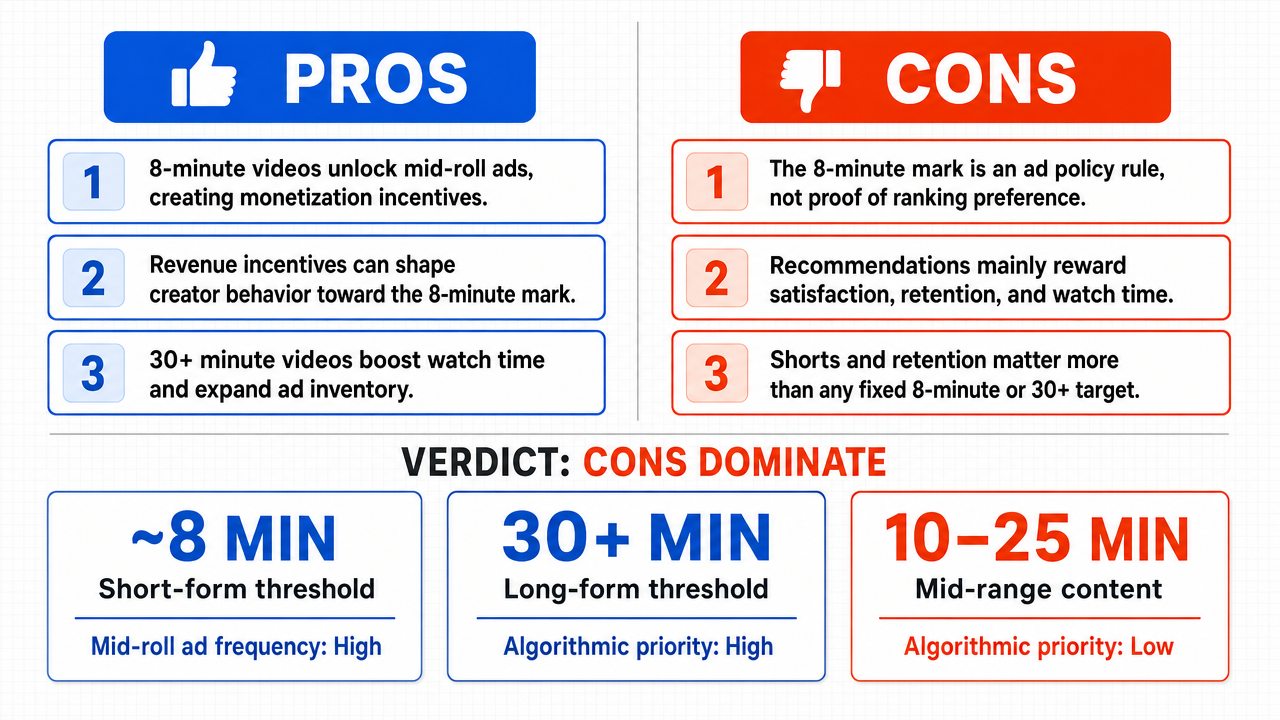
Verdict
Verdict: likely FALSE (84%)
Web Report: https://solsice.com/public/debates/the-popular-video-sharing-platform-is-prioritizing-content-t-61d9f33033e3
This section provides a brief overview of the key arguments. You do not need to read the full detailed report below.
✅ Key PRO arguments:
- ■Algorithmic incentives drive a bimodal distribution favoring short-form engagement and long-form monetization , because the 8-minute mark enables mid-roll ad insertion that significantly increases Average Revenue Per User (ARPU ), creating a feedback loop where the algorithm prioritizes videos just long enough to trigger high-value ad breaks.
- ■The 8-minute threshold cannot be purely a policy constraint decoupled from the recommendation engine , because if the platform's revenue model depends on serving mid-roll ads, the algorithm cannot be agnostic to the duration that enables those ads without optimizing for a metric (Watch Time ) that fails to translate into the platform's primary economic objective (Ad Revenue).
- ■Long-form content (30+ minutes) serves as a high-engagement anchor that maximizes session time and ad inventory, reinforcing the bimodal distribution claim.
❌ Key ANTI arguments:
- ■The 8-minute threshold is a policy constraint for mid-roll advertisement insertion, not a driver of the recommendation engine ; YouTube's algorithm prioritizes 'Watch Time ' and 'Audience Retention ' as primary ranking signals, meaning a 10-minute video with high retention will rank higher than an 8-minute video with low retention.
- ■The algorithm does not push creators to the 8-minute mark; it rewards content that keeps users on the platform regardless of specific ad slot configuration, and empirical data on video length distribution contradicts the existence of a 'dead zone ' or bimodal prioritization.
- ■The platform prioritizes retention and short-form verticals (such as Shorts ) rather than the 8-minute mark or 30+ minutes, and the opponent's conflation of monetization policy with algorithmic ranking is a fundamental category error.
💭 Conclusion: False. The assertion that the platform prioritizes a bimodal distribution of content around 8 minutes and 30+ minutes is not supported by the available evidence. The 8-minute threshold is a policy constraint for mid-roll ad insertion, not a ranking signal in the recommendation algorithm, which primarily optimizes for Watch Time and Audience Retention . The pro side's argument conflates monetization policy with algorithmic ranking, a category error that the judge found unpersuasive. Furthermore, as a compound claim joined by 'or,' both sub-claims must be independently supported, and neither the 8-minute prioritization nor the 30+ minute prioritization was convincingly demonstrated. The empirical video length distribution data referenced by the anti side further undermines the bimodal hypothesis.
🔬 DeepResearch Result: likely FALSE ❌ (84%)
Assertion: The popular video-sharing platform is prioritizing content that is either very short (around 8 minutes) or very long (30 minutes plus).
Participating models: gemma-4-26b-a4b-it 💬👁️, glm-4.7-flash 💬
📊 Face-offs: 0 concluded TRUE, 1 concluded FALSE (1 face-offs, 3 models)
📊 Score by side: TRUE=0.00, FALSE=0.84
🏅 Model score changes:
minimax-m3 💬👁️: +8
✅ PRO Arguments:
- ■Algorithmic incentives drive a bimodal distribution favoring short-form engagement and long-form monetization , because the 8-minute mark enables mid-roll ad insertion that significantly increases Average Revenue Per User (ARPU ), creating a feedback loop where the algorithm prioritizes videos just long enough to trigger high-value ad breaks. gemma-4-26b-a4b-it 💬👁️
- ■The 8-minute threshold cannot be purely a policy constraint decoupled from the recommendation engine , because if the platform's revenue model depends on serving mid-roll ads, the algorithm cannot be agnostic to the duration that enables those ads without optimizing for a metric (Watch Time ) that fails to translate into the platform's primary economic objective (Ad Revenue). gemma-4-26b-a4b-it 💬👁️
- ■Long-form content (30+ minutes) serves as a high-engagement anchor that maximizes session time and ad inventory, reinforcing the bimodal distribution claim. gemma-4-26b-a4b-it 💬👁️
❌ ANTI Arguments:
- ■The 8-minute threshold is a policy constraint for mid-roll advertisement insertion, not a driver of the recommendation engine; YouTube's algorithm prioritizes 'Watch Time' and 'Audience Retention ' as primary ranking signals, meaning a 10-minute video with high retention will rank higher than an 8-minute video with low retention. glm-4.7-flash 💬
- ■The algorithm does not push creators to the 8-minute mark; it rewards content that keeps users on the platform regardless of specific ad slot configuration, and empirical data on video length distribution contradicts the existence of a 'dead zone ' or bimodal prioritization. glm-4.7-flash 💬
- ■The platform prioritizes retention and short-form verticals (such as Shorts ) rather than the 8-minute mark or 30+ minutes, and the opponent's conflation of monetization policy with algorithmic ranking is a fundamental category error. glm-4.7-flash 💬
💭 Reasoning: False. The assertion that the platform prioritizes a bimodal distribution of content around 8 minutes and 30+ minutes is not supported by the available evidence. The 8-minute threshold is a policy constraint for mid-roll ad insertion, not a ranking signal in the recommendation algorithm, which primarily optimizes for Watch Time and Audience Retention. The pro side's argument conflates monetization policy with algorithmic ranking, a category error that the judge found unpersuasive. Furthermore, as a compound claim joined by 'or,' both sub-claims must be independently supported, and neither the 8-minute prioritization nor the 30+ minute prioritization was convincingly demonstrated. The empirical video length distribution data referenced by the anti side further undermines the bimodal hypothesis.
📋 PRO Facts:
• The 8-minute mark enables mid-roll advertisement insertion, transitioning from single-ad to multi-ad formats .
• Mid-roll ad insertion is associated with increased Average Revenue Per User (ARPU).
📋 ANTI Facts:
• YouTube's algorithm prioritizes 'Watch Time' and 'Audience Retention' as primary ranking signals over duration-based metrics.
• The 8-minute threshold is a policy constraint for ad insertion, not a ranking signal in the recommendation engine.
• Empirical data on video length distribution contradicts the existence of a bimodal 'dead zone' or prioritization pattern.
| Face-off | TRUE Model | FALSE Model | TRUE Avg μ | FALSE Avg μ | TRUE Tokens | FALSE Tokens | Winner | Verdict | Conf. |
|---|---|---|---|---|---|---|---|---|---|
| #1 | gemma-4-26b-a4b-it 💬👁️ | glm-4.7-flash 💬 | 0.184 | 0.248 | 4 | 4 | FALSE | FALSE | 84% |
The following technical terms, abbreviations, and domain-specific concepts are referenced throughout this debate transcript. Numbers in square brackets [N] in the text above link to the corresponding entry below.
[1] Ad revenue density — advertising revenue density — The amount of advertising revenue generated per unit of content (e.g., per minute or per video), used to evaluate how efficiently a piece of content monetizes.
[2] Algorithmic incentives — The behavioral signals or content characteristics that a platform's algorithm rewards with greater visibility, shaping how creators produce content.
[3] ARPU — Average Revenue Per User — A key business metric that measures the average revenue generated from each user, commonly used to evaluate platform monetization efficiency.
[4] Audience Retention — A platform metric measuring the percentage of a video that viewers watch on average, indicating how engaging the content is throughout its duration.
[5] Bimodal distribution — A statistical distribution characterized by two distinct peaks or modes, suggesting that content clusters around two favored duration ranges rather than being evenly spread.
[6] Completion Rate — The percentage of viewers who watch a video from start to finish, used as a ranking signal by recommendation algorithms.
[7] Dead zone — In the context of this debate, a hypothetical range of video durations (e.g., mid-length content) that is algorithmically disadvantaged or marginalized.
[8] Engagement — A broad metric encompassing user interactions such as watch time, likes, comments, shares, and clicks, often used as a proxy for content quality.
[9] Feedback loop — A cyclical process in which an algorithm's outputs (e.g., promoted content) influence user behavior, which in turn becomes new input data that further shapes the algorithm's decisions.
[10] Long-form content — Video content of extended duration (in this debate, 30 minutes or more), typically associated with deeper engagement and multiple ad insertion points.
[11] Mid-roll advertisement — An advertisement inserted in the middle of a video rather than at the beginning or end, typically enabled only when a video exceeds a certain duration threshold (commonly cited as 8 minutes).
[12] Monetization — The process by which a platform or creator converts content views into revenue, typically through advertising, subscriptions, or other income streams.
[13] Multi-ad formats — Video configurations that allow multiple advertisements to be inserted at various points (pre-roll, mid-roll, post-roll), increasing total ad inventory per video.
[14] Objective function — In optimization and machine learning, the mathematical function that an algorithm seeks to maximize or minimize; in this debate, framed as the platform's economic goal (e.g., ad revenue).
[15] Organic traffic — Viewers who discover content through unpaid channels such as search results, recommendations, or direct navigation, as opposed to paid promotion.
[16] Ranking signal — Any metric or feature (e.g., watch time, retention, click-through rate) that a recommendation algorithm uses to order and prioritize content in user feeds.
[17] Recommendation engine — The algorithmic system that selects and orders content for individual users based on behavioral data, preferences, and platform objectives.
[18] Revenue trigger — A specific condition or threshold (such as video duration) that enables a monetization feature, such as the activation of mid-roll ad slots.
[19] Short-form content — Brief video content, typically under one minute in the case of vertical short-form features, designed for rapid consumption and high-volume viewing.
[20] Shorts — YouTube's short-form vertical video feature, designed as a competitor to similar short-video platforms and optimized for mobile, brief consumption.
[21] Single-ad formats — Video configurations that permit only one advertisement placement (typically pre-roll or post-roll), generally applied to shorter videos that do not meet mid-roll eligibility thresholds.
[22] User retention — A metric measuring the platform's ability to keep users engaged and returning over time, often used as a key performance indicator for platform health.
[23] Watch Time — The total accumulated minutes that users spend watching content on a platform, cited in the debate as a primary ranking signal and competitive metric.
The following financial data tables were referenced during the debate exchanges:
| Content Category | Primary Metric | Revenue Driver | Algorithmic Priority |
|---|---|---|---|
| Short-form (~8 min) | View Velocity | Mid-roll Ad Frequency | High |
| Mid-range (10-25 min) | Retention Rate | Standard Ad Placement | Low |
| Long-form (30+ min) | Total Watch Time | High-Value Sponsorships/Deep Ads | High |
Legend: Comparative analysis of content categories based on platform performance metrics and monetization structures. Priority levels indicate algorithmic visibility trends.
Face-off transcripts
- ■
Ownership & Trade Secrets. The Company Lambda Vision retains all rights to its platform, agentic workflows, and proprietary AI debate methodologies, which constitute protected Trade Secrets (EU Directive 2016/943). Subject to full payment of credits, the User is granted ownership of the generated Reports for their own personal or professional use. Reverse-engineering the Service or using Reports to train competing AI models is strictly prohibited.
- ■
No Professional Advice. Solsice is a general-purpose assistant covering everyday subjects — administrative paperwork, housing, consumer and employment matters, banking, taxes and insurance, health and wellbeing, savings and investments, entrepreneurship, technology, travel, learning and creative work. Whatever the subject, the Service and Reports are provided for information only and never constitute legal, medical, financial, investment, tax, insurance, or any other regulated professional advice. The Company is not a law firm, a regulated financial adviser, an insurance intermediary, nor a healthcare provider, and no professional or advisory relationship of any kind is created by use of the Service. Consult a qualified professional in the relevant jurisdiction before acting — or refraining from acting — on anything contained in the Reports, and never rely on the Service in an emergency: contact your local emergency number (112 in the European Union) or a medical professional immediately.
- ■
AI-Generated Content, Sources and Viewpoints. Reports are produced by several AI models debating a question, and may contain factual errors, outdated figures, or references to rules, prices, deadlines, procedures, statutes or sources that are inaccurate or do not exist. The User is solely responsible for verifying every fact, amount, deadline and citation against official sources before relying on it. Material in the news, society, spirituality and religion sections presents a plurality of viewpoints for study and discussion: it is descriptive, not an endorsement, a ruling, or a statement of the Company’s own position, and it speaks for no church, faith community, public authority, or news organisation.
- ■
Liability & Governing Law. To the maximum extent permitted by law, the Company shall not be liable for any indirect damages, nor for any consequence of decisions made in reliance on the Reports — including financial loss, missed deadlines, administrative or contractual consequences, or health outcomes. These Terms are governed by French law. Any disputes shall be subject to the exclusive jurisdiction of the Courts of Paris, France.