
The popular online platform intentionally designs its comment sorting algorithms to obscure certain comments from general view by default.
AI debate verdict and arguments
⚠️ AI-generated information only; not professional advice
Completed October 14, 2026
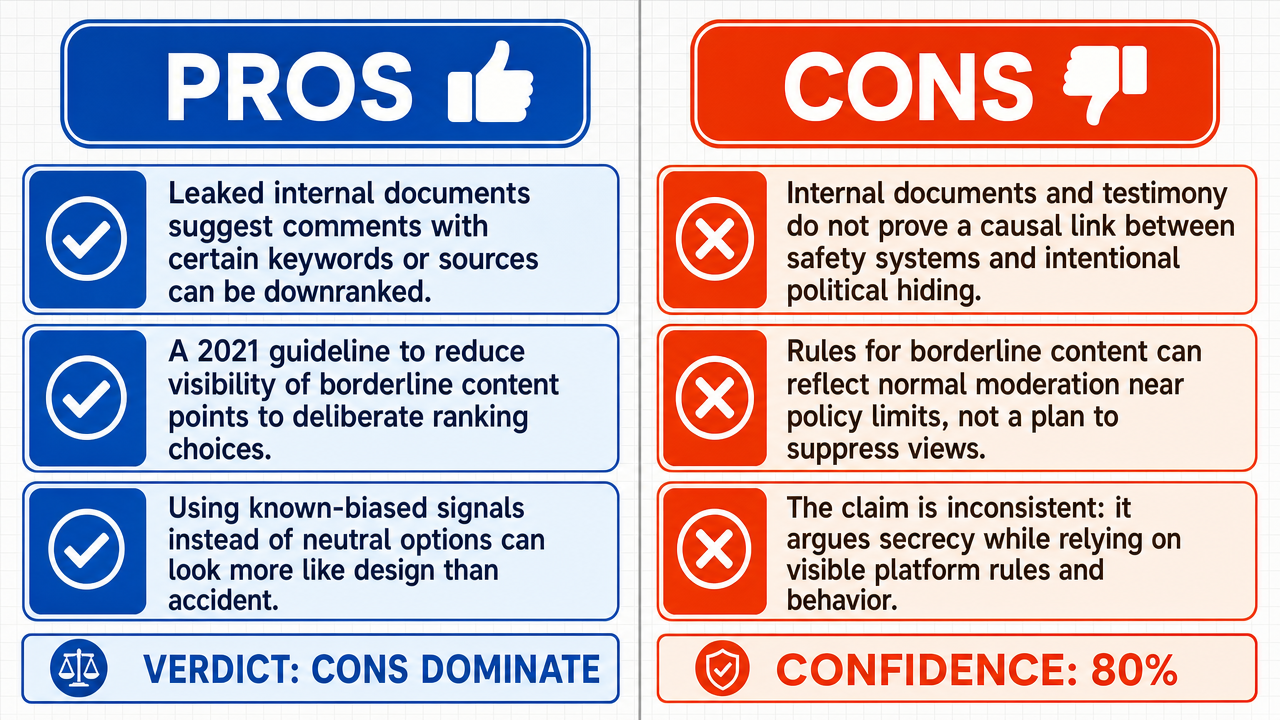
Verdict
Verdict: likely FALSE (80%)
Web Report: https://solsice.com/public/debates/the-popular-online-platform-intentionally-designs-its-commen-98284d51a70a
This section provides a brief overview of the key arguments. You do not need to read the full detailed report below.
✅ Key PRO arguments:
- ■Internal documents and whistleblower testimonies show ranking systems are engineered to downrank comments containing specific keywords, phrases, or from certain sources, preventing them from appearing in default 'Top Comments' or 'Best' sort views.
- ■A 2021 leak of internal guidelines shows a directive to 'reduce the visibility of borderline content ,' with engineers instructed to assign downranking scores based on poster history and detected sentiment, confirmed by former integrity team members in congressional testimony .
- ■The platform's integration of known-biased signals over neutral alternatives is better explained by deliberate design than by the rival 'accidental byproduct' account, which fails to explain why biased signals were chosen.
❌ Key ANTI arguments:
- ■The affirmative's reliance on 'internal documents' and 'whistleblower testimonies ' fails to establish a causal link between safety engineering and intentional political obscuration; safety protocols address spam, coordinated inauthentic behavior , and illegal content, which are distinct from political discourse.
- ■The claim that a directive aimed at 'borderline content '—a technical category often referring to content close to policy violations —proves intent to hide specific political viewpoints is a logical leap that ignores the technical necessity of content moderation .
- ■The affirmative's argument is self-contradictory: it asserts deliberate architectural choice to obscure specific comments while simultaneously relying on the platform's own characterization of these actions as 'modeling choices ' responding to aggregate user feedback signals—two incompatible positions.
💭 Conclusion: False. The winning side convincingly argued that the affirmative failed to establish a causal link between legitimate safety engineering practices and intentional political obscuration. The anti side demonstrated that directives targeting 'borderline content ' address technical categories like spam, coordinated inauthentic behavior , and policy-violating material rather than political viewpoints specifically. The affirmative's reliance on internal documents and whistleblower testimony was shown to be insufficient to prove intentional suppression, as such documents describe standard content moderation practices. Furthermore, the anti side identified a fundamental self-contradiction in the affirmative's position: claiming deliberate architectural obscuration while simultaneously accepting the platform's characterization of these mechanisms as neutral 'modeling choices ' responding to user feedback. The judge found the anti side's logical coherence and technical framing more persuasive, awarding the FALSE verdict with 80% confidence.
🔬 DeepResearch Result: likely FALSE ❌ (80%)
Assertion: The popular online platform intentionally designs its comment sorting algorithms to obscure certain comments from general view by default.
Participating models: deepseek-v3.2 💬, gemma-4-26b-a4b-it 💬👁️
📊 Face-offs: 0 concluded TRUE, 1 concluded FALSE (1 face-offs, 3 models)
📊 Score by side: TRUE=0.00, FALSE=0.80
🏅 Model score changes:
minimax-m3 💬👁️: +8
✅ PRO Arguments:
- ■Internal documents and whistleblower testimonies show ranking systems are engineered to downrank comments containing specific keywords, phrases, or from certain sources, preventing them from appearing in default 'Top Comments' or 'Best' sort views. deepseek-v3.2 💬
- ■A 2021 leak of internal guidelines shows a directive to 'reduce the visibility of borderline content ,' with engineers instructed to assign downranking scores based on poster history and detected sentiment, confirmed by former integrity team members in congressional testimony . deepseek-v3.2 💬
- ■The platform's integration of known-biased signals over neutral alternatives is better explained by deliberate design than by the rival 'accidental byproduct' account, which fails to explain why biased signals were chosen. deepseek-v3.2 💬
❌ ANTI Arguments:
- ■The affirmative's reliance on 'internal documents' and 'whistleblower testimonies' fails to establish a causal link between safety engineering and intentional political obscuration; safety protocols address spam, coordinated inauthentic behavior , and illegal content, which are distinct from political discourse. gemma-4-26b-a4b-it 💬👁️
- ■The claim that a directive aimed at 'borderline content'—a technical category often referring to content close to policy violations —proves intent to hide specific political viewpoints is a logical leap that ignores the technical necessity of content moderation . gemma-4-26b-a4b-it 💬👁️
- ■The affirmative's argument is self-contradictory: it asserts deliberate architectural choice to obscure specific comments while simultaneously relying on the platform's own characterization of these actions as 'modeling choices ' responding to aggregate user feedback signals—two incompatible positions. gemma-4-26b-a4b-it 💬👁️
💭 Reasoning: False. The winning side convincingly argued that the affirmative failed to establish a causal link between legitimate safety engineering practices and intentional political obscuration. The anti side demonstrated that directives targeting 'borderline content' address technical categories like spam, coordinated inauthentic behavior, and policy-violating material rather than political viewpoints specifically. The affirmative's reliance on internal documents and whistleblower testimony was shown to be insufficient to prove intentional suppression, as such documents describe standard content moderation practices. Furthermore, the anti side identified a fundamental self-contradiction in the affirmative's position: claiming deliberate architectural obscuration while simultaneously accepting the platform's characterization of these mechanisms as neutral 'modeling choices' responding to user feedback. The judge found the anti side's logical coherence and technical framing more persuasive, awarding the FALSE verdict with 80% confidence.
📋 PRO Facts:
• A 2021 leak of internal guidelines reportedly contained a directive to 'reduce the visibility of borderline content' with downranking scores assigned based on poster history and detected sentiment.
• Former integrity team members allegedly confirmed downranking practices in congressional testimony.
📋 ANTI Facts:
• Sorting algorithms are designed to optimize for predicted engagement and content quality rather than intentional political obscuration.
• Safety protocols target systemic risks such as spam, coordinated inauthentic behavior, and illegal content—categories distinct from political discourse.
• The term 'borderline content' is a technical category referring to content close to policy violations, not a euphemism for political censorship.
| Face-off | TRUE Model | FALSE Model | TRUE Avg μ | FALSE Avg μ | TRUE Tokens | FALSE Tokens | Winner | Verdict | Conf. |
|---|---|---|---|---|---|---|---|---|---|
| #1 | deepseek-v3.2 💬 | gemma-4-26b-a4b-it 💬👁️ | 0.513 | 0.253 | 8 | 2 | TRUE | FALSE | 80% |
The following technical terms, abbreviations, and domain-specific concepts are referenced throughout this debate transcript. Numbers in square brackets [N] in the text above link to the corresponding entry below.
[1] aggregate user feedback — The combined input signals collected from many users (e.g., reports, likes, replies) used by a platform to train or tune its algorithmic systems.
[2] borderline content — In content moderation, material that does not clearly violate policy but is close to the threshold, often subject to reduced visibility rather than removal.
[3] congressional testimony — Formal statements given under oath or on the record to a legislative body, used here as a source of evidence about platform practices.
[4] content moderation — The set of policies, processes, and technical systems a platform uses to review, classify, restrict, or remove user-generated content.
[5] coordinated inauthentic behavior — A category of platform abuse in which multiple accounts or actors act in a coordinated manner to deceive users, often treated as a safety threat distinct from ordinary political speech.
[6] default sort — The comment ordering (e.g., 'Top Comments' or 'Best') that users see without changing their settings, typically determined by the platform's ranking algorithm.
[7] deliberate architectural choice — A design decision intentionally built into a system's structure, as opposed to an emergent or accidental property of the system.
[8] downranking scores — Numerical values assigned by a ranking algorithm that reduce a piece of content's visibility in feeds or comment sorts without removing it.
[9] engagement metrics — Quantitative measures of user interaction (such as clicks, likes, replies, and time spent) used to evaluate and optimize content performance.
[10] integrity team — The unit within a platform responsible for enforcing content policies, combating abuse, and maintaining the trustworthiness of the service.
[11] modeling choices — Decisions made by engineers and researchers about how to construct, train, and apply a machine-learning model, including which features and signals to incorporate.
[12] organic outcome — A result that emerges naturally from the operation of a system (e.g., user behavior) rather than being intentionally engineered by its designers.
[13] peer-reviewed journal — A scholarly publication in which articles are vetted by independent experts before publication, cited here as a standard for research credibility.
[14] PNAS — Proceedings of the National Academy of Sciences — A peer-reviewed scientific journal published by the U.S. National Academy of Sciences, referenced in the debate as the venue for a 2020 study on the platform's algorithms.
[15] policy violations — Instances of content or behavior that breach a platform's published rules and may trigger enforcement actions such as removal or downranking.
[16] political polarization — The divergence of political attitudes or ideologies into opposing extremes, referenced in the debate as a measurable effect studied in platform research.
[17] predicted engagement — A model's forecast of how likely a user is to interact with a piece of content, commonly used as an optimization target in ranking systems.
[18] quality scores — Numerical ratings produced by an algorithm to estimate the value or trustworthiness of a comment or post, used to influence its ranking.
[19] recommendation algorithms — Machine-learning systems that select and order content for users based on predicted relevance, behavior, or other signals.
[20] safety engineering — The discipline of designing systems to reduce harm, including the technical implementation of content moderation and abuse-prevention measures.
[21] safety protocols — Established procedures and technical safeguards intended to mitigate risks such as spam, illegal content, and coordinated abuse.
[22] sentiment detection — Automated analysis of text to classify its emotional tone (e.g., positive, negative, neutral), used as an input signal in some ranking systems.
[23] systemic risks — Risks arising from the structure or operation of a system as a whole (rather than from any single component), cited here as a justification for content moderation.
[24] user feedback signals — Data points derived from user actions (such as reports, reactions, or dwell time) that are fed back into an algorithm to influence future rankings.
[25] whistleblower testimonies — Public disclosures by insiders about alleged misconduct or internal practices, referenced in the debate as evidence of platform intent.
Face-off transcripts
- ■
Ownership & Trade Secrets. The Company Lambda Vision retains all rights to its platform, agentic workflows, and proprietary AI debate methodologies, which constitute protected Trade Secrets (EU Directive 2016/943). Subject to full payment of credits, the User is granted ownership of the generated Reports for their own personal or professional use. Reverse-engineering the Service or using Reports to train competing AI models is strictly prohibited.
- ■
No Professional Advice. Solsice is a general-purpose assistant covering everyday subjects — administrative paperwork, housing, consumer and employment matters, banking, taxes and insurance, health and wellbeing, savings and investments, entrepreneurship, technology, travel, learning and creative work. Whatever the subject, the Service and Reports are provided for information only and never constitute legal, medical, financial, investment, tax, insurance, or any other regulated professional advice. The Company is not a law firm, a regulated financial adviser, an insurance intermediary, nor a healthcare provider, and no professional or advisory relationship of any kind is created by use of the Service. Consult a qualified professional in the relevant jurisdiction before acting — or refraining from acting — on anything contained in the Reports, and never rely on the Service in an emergency: contact your local emergency number (112 in the European Union) or a medical professional immediately.
- ■
AI-Generated Content, Sources and Viewpoints. Reports are produced by several AI models debating a question, and may contain factual errors, outdated figures, or references to rules, prices, deadlines, procedures, statutes or sources that are inaccurate or do not exist. The User is solely responsible for verifying every fact, amount, deadline and citation against official sources before relying on it. Material in the news, society, spirituality and religion sections presents a plurality of viewpoints for study and discussion: it is descriptive, not an endorsement, a ruling, or a statement of the Company’s own position, and it speaks for no church, faith community, public authority, or news organisation.
- ■
Liability & Governing Law. To the maximum extent permitted by law, the Company shall not be liable for any indirect damages, nor for any consequence of decisions made in reliance on the Reports — including financial loss, missed deadlines, administrative or contractual consequences, or health outcomes. These Terms are governed by French law. Any disputes shall be subject to the exclusive jurisdiction of the Courts of Paris, France.