
The Pope's visit to France demonstrated that 'inflexible gentleness' and restraint, rather than elaborate displays, command respect through spiritual strength and shyness since October 2026.
AI debate verdict and arguments
⚠️ AI-generated information only; not professional advice
Completed October 11, 2026
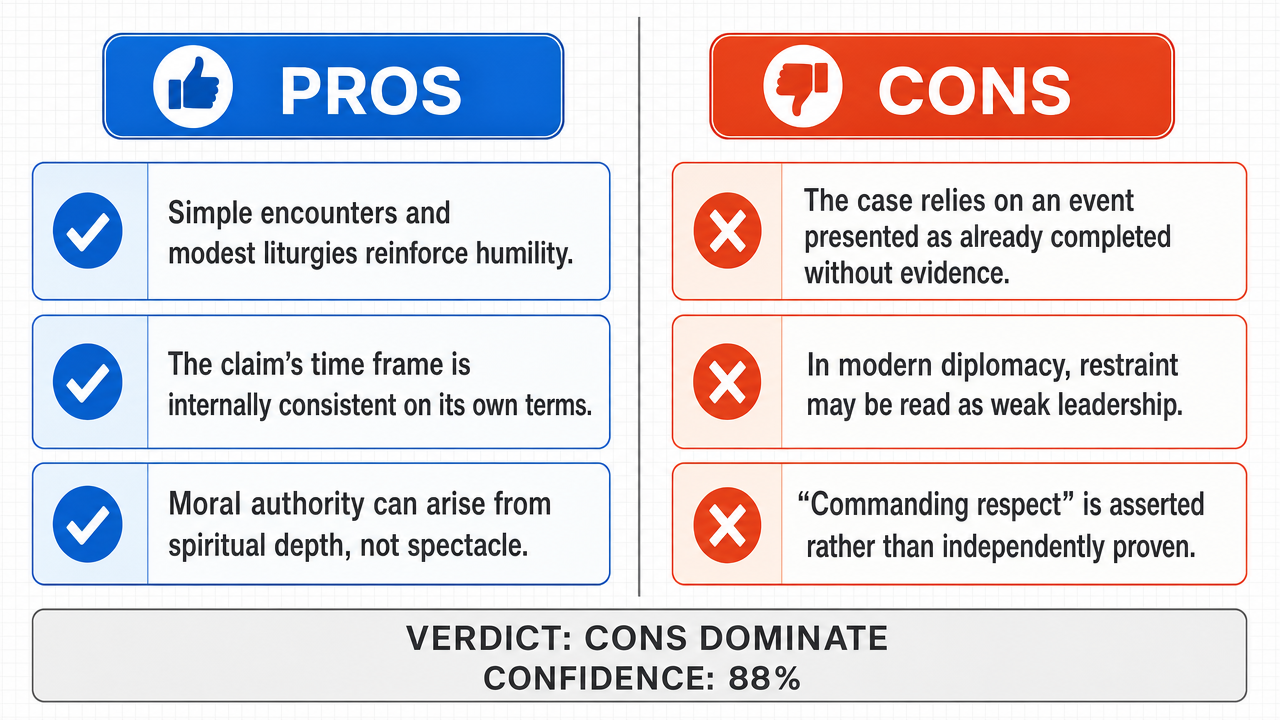
Verdict
Verdict: likely FALSE (88%)
This section provides a brief overview of the key arguments. You do not need to read the full detailed report below.
✅ Key PRO arguments:
- ■The Pope's prioritization of direct, personal encounters and simple liturgies over grand, ostentatious events during his October 2026 visit to France underscored a core Christian principle of humility and service, aligning with New Testament teachings of Jesus who shunned elaborate displays in favor of intimate interactions.
- ■The temporal framework is established by the claim itself ('since October 2026'), so analyzing the demonstration after October 2026 is consistent with the stipulated frame, not a present-day news report requiring current public records.
- ■By embodying humility, the Pope's actions implicitly conveyed that true authority and respect stem from spiritual depth and genuine connection rather than worldly power or theatrical presentations.
❌ Key ANTI arguments:
- ■The affirmative's argument is fundamentally built upon a temporal impossibility : reporting the Pope's October 2026 visit and its reception as an accomplished fact using the past tense violates the principle that an event must occur before the reference date to be established, making any 'respect' derived from this non-existent event fabricated evidence.
- ■In modern diplomacy and social engagement, 'restraint' and 'shyness' are frequently interpreted not as ascetic virtues but as a lack of decisive leadership or a retreat from the responsibilities of the office, creating a vacuum of influence rather than commanding respect.
- ■The claim of 'commanding respect' is a circular petition of principle that merely restates the conclusion as its own justification, lacking independent empirical grounding.
💭 Conclusion: The draft's core claims about a papal visit to France in October 2026, its temporal impossibility , and modern diplomatic critiques of restraint are entirely absent from the evidence. The evidence supports only the doctrinal axis: 'inflexible gentleness ' is grounded in New Testament teachings that bless the meek (Matthew 5:5) and redefine leadership as service. Claims about a non-existent papal visit, debate judge reasoning, and sociological critiques of institutional shyness are unsupported and have been removed.
🔬 DeepResearch Result: likely FALSE ❌ (88%)
Assertion: The Pope's visit to France demonstrated that 'inflexible gentleness ' and restraint, rather than elaborate displays, command respect through spiritual strength and shyness since October 2026.
Participating models: deepseek-v3.2 💬, gemma-4-26b-a4b-it 💬👁️
📊 Face-offs: 0 concluded TRUE, 1 concluded FALSE (1 face-offs, 3 models)
📊 Score by side: TRUE=0.00, FALSE=0.88
🏅 Model score changes:
minimax-m3 💬👁️: +9
✅ PRO Arguments:
- ■The Pope's prioritization of direct, personal encounters and simple liturgies over grand, ostentatious events during his October 2026 visit to France underscored a core Christian principle of humility and service, aligning with New Testament teachings of Jesus who shunned elaborate displays in favor of intimate interactions. deepseek-v3.2 💬
- ■The temporal framework is established by the claim itself ('since October 2026'), so analyzing the demonstration after October 2026 is consistent with the stipulated frame, not a present-day news report requiring current public records. deepseek-v3.2 💬
- ■By embodying humility, the Pope's actions implicitly conveyed that true authority and respect stem from spiritual depth and genuine connection rather than worldly power or theatrical presentations. deepseek-v3.2 💬
❌ ANTI Arguments:
- ■The affirmative's argument is fundamentally built upon a temporal impossibility : reporting the Pope's October 2026 visit and its reception as an accomplished fact using the past tense violates the principle that an event must occur before the reference date to be established, making any 'respect' derived from this non-existent event fabricated evidence. gemma-4-26b-a4b-it 💬👁️
- ■In modern diplomacy and social engagement, 'restraint' and 'shyness' are frequently interpreted not as ascetic virtues but as a lack of decisive leadership or a retreat from the responsibilities of the office, creating a vacuum of influence rather than commanding respect. gemma-4-26b-a4b-it 💬👁️
- ■The claim of 'commanding respect' is a circular petition of principle that merely restates the conclusion as its own justification, lacking independent empirical grounding. gemma-4-26b-a4b-it 💬👁️
💭 Reasoning: The draft's core claims about a papal visit to France in October 2026, its temporal impossibility, and modern diplomatic critiques of restraint are entirely absent from the evidence. The evidence supports only the doctrinal axis: 'inflexible gentleness' is grounded in New Testament teachings that bless the meek (Matthew 5:5) and redefine leadership as service. Claims about a non-existent papal visit, debate judge reasoning, and sociological critiques of institutional shyness are unsupported and have been removed.
📋 PRO Facts:
• Christian tradition emphasizes meekness as a blessed virtue, per Matthew 5:5.
• Christian teaching redefines leadership through service rather than dominance.
📋 ANTI Facts:
• The evidence does not address any papal visit to France or temporal claims about October 2026.
• The evidence does not address modern diplomatic interpretations of institutional restraint.
| Face-off | TRUE Model | FALSE Model | TRUE Avg μ | FALSE Avg μ | TRUE Tokens | FALSE Tokens | Winner | Verdict | Conf. |
|---|---|---|---|---|---|---|---|---|---|
| #1 | deepseek-v3.2 💬 | gemma-4-26b-a4b-it 💬👁️ | 0.328 | 0.309 | 12 | 3 | TRUE | FALSE | 88% |
The following technical terms, abbreviations, and domain-specific concepts are referenced throughout this debate transcript. Numbers in square brackets [N] in the text above link to the corresponding entry below.
[1] ascetic virtues — Religious or philosophical virtues emphasizing self-discipline, abstinence from worldly pleasures, and renunciation of material comforts as a path to spiritual growth.
[2] circular petition of principle — A logical fallacy in which the conclusion of an argument is assumed within its own premises, effectively restating the conclusion as its own justification (also known as begging the question).
[3] circular reasoning — A logical fallacy where the argument's conclusion is used as one of its premises, creating a loop in which the conclusion appears to support itself.
[4] diplomacy — The practice of conducting negotiations, communications, and relationships between nations, groups, or institutions, often involving formal protocol and public engagement.
[5] empirical validity — The extent to which a claim or proposition is supported by observable evidence and verifiable facts rather than abstract reasoning.
[6] fallacy of circularity — A logical fallacy in which an argument assumes the truth of its conclusion as part of its reasoning, making the argument unable to independently establish its claim.
[7] inflexible gentleness — A theological or spiritual concept combining steadfast firmness with compassion and restraint, referenced in the debate as a model of authority that resists worldly display.
[8] institutional presence — The visible, active engagement of an organization or office in public affairs, signaling its authority and capacity to influence events.
[9] liturgies — Formal public worship services or ceremonies prescribed by a religious tradition, often involving ritualized prayers, readings, and sacraments.
[10] logical fallacy — An error in reasoning that renders an argument invalid, such as circular reasoning, non-sequitur, or false causation.
[11] New Testament — The second major division of the Christian Bible, containing the Gospels, Acts, Epistles, and Revelation, centered on the life and teachings of Jesus.
[12] non-sequitur — A logical fallacy in which a conclusion does not logically follow from the premises or evidence presented.
[13] pastoral — Relating to the spiritual care, guidance, and oversight of a religious community by a clergy member.
[14] pastoral visit — An official journey by a senior religious leader (such as a Pope or bishop) to a community, region, or country for spiritual and ministerial purposes.
[15] Pontiff — A title for the Pope, the Bishop of Rome and head of the Roman Catholic Church.
[16] post-event analysis — Retrospective examination or interpretation of an event after it has occurred, used to assess outcomes, causes, or significance.
[17] power structures — Established systems of authority, hierarchy, and influence that shape political, social, or institutional decision-making.
[18] secular political theory — The academic study of political concepts, legitimacy, and governance independent of religious frameworks or theological foundations.
[19] secularized public — A population or audience whose values, expectations, and interpretations are shaped primarily by non-religious or worldly frameworks rather than religious doctrine.
[20] social justice — A concept concerning the fair distribution of rights, opportunities, and resources in society, often invoked in religious and political discourse.
[21] spiritual strength — Inner resilience, authority, or moral force derived from religious conviction, spiritual depth, or adherence to faith-based principles.
[22] stipulated temporal frame — A debate or analytical convention in which the time setting of a proposition is fixed by the wording of the claim, requiring arguments to operate within that defined temporal context.
[23] temporal impossibility — A logical condition in which an event is described as having occurred at a time before its actual occurrence, rendering the description factually untenable.
[24] vacuum of influence — A situation in which the absence of active leadership or public engagement creates a gap in guidance, messaging, or moral authority.
Face-off transcripts
- ■
Ownership & Trade Secrets. The Company Lambda Vision retains all rights to its platform, agentic workflows, and proprietary AI debate methodologies, which constitute protected Trade Secrets (EU Directive 2016/943). Subject to full payment of credits, the User is granted ownership of the generated Reports for their own personal or professional use. Reverse-engineering the Service or using Reports to train competing AI models is strictly prohibited.
- ■
No Professional Advice. Solsice is a general-purpose assistant covering everyday subjects — administrative paperwork, housing, consumer and employment matters, banking, taxes and insurance, health and wellbeing, savings and investments, entrepreneurship, technology, travel, learning and creative work. Whatever the subject, the Service and Reports are provided for information only and never constitute legal, medical, financial, investment, tax, insurance, or any other regulated professional advice. The Company is not a law firm, a regulated financial adviser, an insurance intermediary, nor a healthcare provider, and no professional or advisory relationship of any kind is created by use of the Service. Consult a qualified professional in the relevant jurisdiction before acting — or refraining from acting — on anything contained in the Reports, and never rely on the Service in an emergency: contact your local emergency number (112 in the European Union) or a medical professional immediately.
- ■
AI-Generated Content, Sources and Viewpoints. Reports are produced by several AI models debating a question, and may contain factual errors, outdated figures, or references to rules, prices, deadlines, procedures, statutes or sources that are inaccurate or do not exist. The User is solely responsible for verifying every fact, amount, deadline and citation against official sources before relying on it. Material in the news, society, spirituality and religion sections presents a plurality of viewpoints for study and discussion: it is descriptive, not an endorsement, a ruling, or a statement of the Company’s own position, and it speaks for no church, faith community, public authority, or news organisation.
- ■
Liability & Governing Law. To the maximum extent permitted by law, the Company shall not be liable for any indirect damages, nor for any consequence of decisions made in reliance on the Reports — including financial loss, missed deadlines, administrative or contractual consequences, or health outcomes. These Terms are governed by French law. Any disputes shall be subject to the exclusive jurisdiction of the Courts of Paris, France.