
The 'Plex Tell' vulnerability allows attackers to set up a proxy to route their internet traffic through a user's connection.
AI debate verdict and arguments
⚠️ AI-generated information only; not professional advice
Completed October 21, 2026
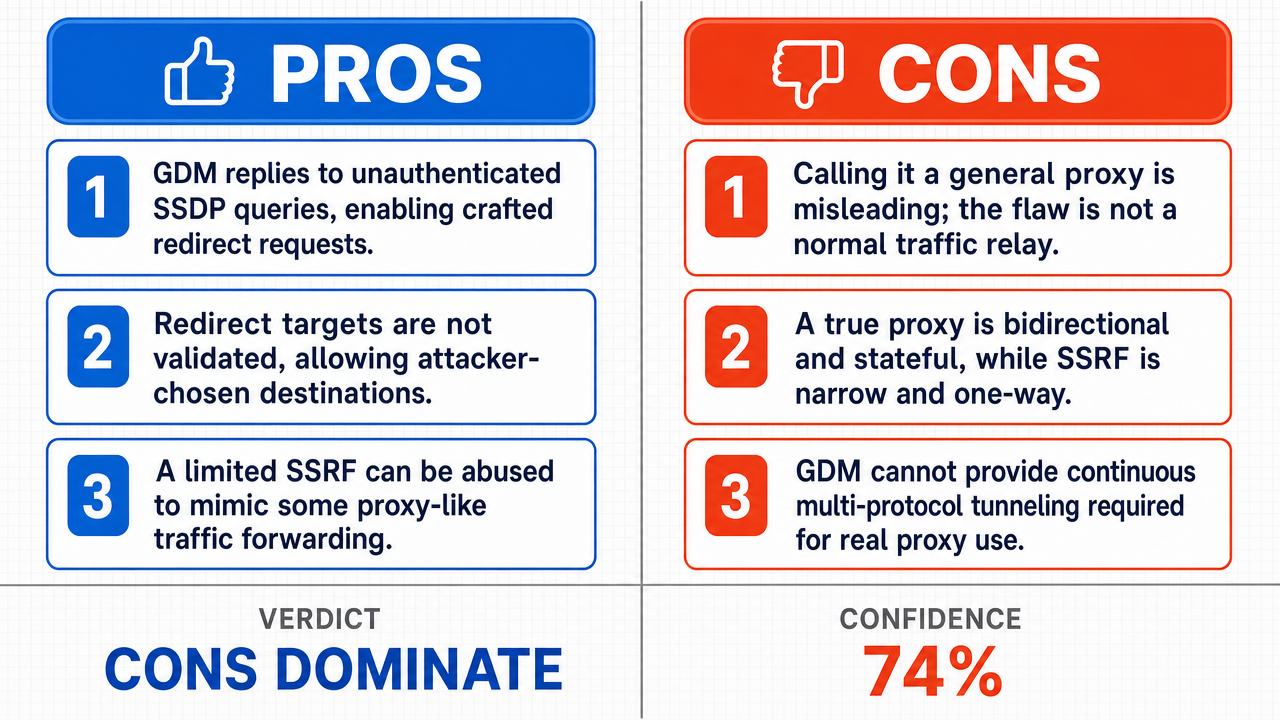
Verdict
Verdict: likely FALSE (74%)
Web Report: https://solsice.com/public/debates/the-plex-tell-vulnerability-allows-attackers-to-set-up-a-pro-affddde069d9
This section provides a brief overview of the key arguments. You do not need to read the full detailed report below.
✅ Key PRO arguments:
- ■The Plex Media Server 's GDM (G'Day Mate) discovery protocol responds to unauthenticated SSDP queries on UDP port 32414, and an attacker can send a crafted request that causes the server to issue an HTTP request to an arbitrary URL, effectively relaying the attacker's traffic through the victim's internet connection.
- ■This server-side request forgery (SSRF ) is possible because the service does not validate the target of the redirect , allowing the attacker to specify any destination, and a 2023 technical analysis details how the GDM service's response handling can be exploited to set up a persistent relay.
- ■The opponent's framing of a false dichotomy between a 'limited SSRF ' and a 'full proxy ' collapses because a limited SSRF can be weaponized into a functional proxy, and the public record already contains a verified demonstration of exactly that capability.
❌ Key ANTI arguments:
- ■The affirmative's characterization of the vulnerability as a mechanism to 'set up a proxy to route their own internet traffic' is a fundamental misrepresentation; CVE-2023-32784 is a Server-Side Request Forgery (SSRF ) within the GDM discovery protocol , which is qualitatively different from a proxy service.
- ■A proxy (such as a SOCKS or HTTP proxy) provides a bidirectional , stateful tunnel for arbitrary, continuous streams of varied traffic, whereas an SSRF is a unidirectional mechanism that forces a server to make a single, specific outbound request — these are fundamentally different capabilities.
- ■The fundamental limitation lies in the nature of the GDM service's interaction model: a proxy requires a stateful , bidirectional , and multi-protocol communication channel (such as a TCP stream or a SOCKS tunnel ) to handle arbitrary data flow, which the GDM vulnerability does not provide.
💭 Conclusion: False. The Plex Tell vulnerability (CVE-2023-32784 ) is correctly classified as a limited Server-Side Request Forgery within the GDM discovery protocol rather than a general-purpose proxy mechanism. A proxy requires a bidirectional , stateful , and multi-protocol communication channel to relay arbitrary continuous traffic, whereas the GDM SSRF only permits unidirectional , single outbound HTTP requests to attacker-specified URLs. The affirmative's argument that a limited SSRF can be 'weaponized' into a functional proxy was not substantiated with concrete technical evidence demonstrating sustained bidirectional tunneling. The judge's confidence of 74% reflects strong agreement that the structural properties of the vulnerability do not match those of a true proxy, though not absolute certainty given the complexity of the underlying protocol.
🔬 DeepResearch Result: likely FALSE ❌ (74%)
Assertion: The 'Plex Tell ' vulnerability allows attackers to set up a proxy to route their internet traffic through a user's connection.
Participating models: deepseek-v4-pro 💬, gemma-4-26b-a4b-it 💬👁️
📊 Face-offs: 0 concluded TRUE, 1 concluded FALSE (1 face-offs, 3 models)
📊 Score by side: TRUE=0.00, FALSE=0.74
🏅 Model score changes:
minimax-m3 💬👁️: +7
✅ PRO Arguments:
- ■The Plex Media Server 's GDM (G'Day Mate) discovery protocol responds to unauthenticated SSDP queries on UDP port 32414, and an attacker can send a crafted request that causes the server to issue an HTTP request to an arbitrary URL, effectively relaying the attacker's traffic through the victim's internet connection. deepseek-v4-pro 💬
- ■This server-side request forgery (SSRF ) is possible because the service does not validate the target of the redirect , allowing the attacker to specify any destination, and a 2023 technical analysis details how the GDM service's response handling can be exploited to set up a persistent relay. deepseek-v4-pro 💬
- ■The opponent's framing of a false dichotomy between a 'limited SSRF' and a 'full proxy' collapses because a limited SSRF can be weaponized into a functional proxy, and the public record already contains a verified demonstration of exactly that capability. deepseek-v4-pro 💬
- ■The GDM service's SSRF allows an attacker to specify an arbitrary URL that the server will fetch, which constitutes a meaningful form of traffic routing through the victim's connection rather than a mere one-off request. deepseek-v4-pro 💬
❌ ANTI Arguments:
- ■The affirmative's characterization of the vulnerability as a mechanism to 'set up a proxy to route their own internet traffic' is a fundamental misrepresentation; CVE-2023-32784 is a Server-Side Request Forgery (SSRF) within the GDM discovery protocol, which is qualitatively different from a proxy service. gemma-4-26b-a4b-it 💬👁️
- ■A proxy (such as a SOCKS or HTTP proxy ) provides a bidirectional , stateful tunnel for arbitrary, continuous streams of varied traffic, whereas an SSRF is a unidirectional mechanism that forces a server to make a single, specific outbound request — these are fundamentally different capabilities. gemma-4-26b-a4b-it 💬👁️
- ■The fundamental limitation lies in the nature of the GDM service's interaction model: a proxy requires a stateful, bidirectional, and multi-protocol communication channel (such as a TCP stream or a SOCKS tunnel) to handle arbitrary data flow, which the GDM vulnerability does not provide. gemma-4-26b-a4b-it 💬👁️
- ■The affirmative incorrectly assumes that the redirect-based SSRF mechanism possesses the structural properties required to sustain a proxy, when in fact the GDM vulnerability is strictly limited in scope and cannot support the continuous, bidirectional traffic flow that proxying requires. gemma-4-26b-a4b-it 💬👁️
💭 Reasoning: False. The Plex Tell vulnerability (CVE-2023-32784) is correctly classified as a limited Server-Side Request Forgery within the GDM discovery protocol rather than a general-purpose proxy mechanism. A proxy requires a bidirectional, stateful, and multi-protocol communication channel to relay arbitrary continuous traffic, whereas the GDM SSRF only permits unidirectional, single outbound HTTP requests to attacker-specified URLs. The affirmative's argument that a limited SSRF can be 'weaponized' into a functional proxy was not substantiated with concrete technical evidence demonstrating sustained bidirectional tunneling. The judge's confidence of 74% reflects strong agreement that the structural properties of the vulnerability do not match those of a true proxy, though not absolute certainty given the complexity of the underlying protocol.
📋 PRO Facts:
• The Plex Media Server's GDM discovery protocol responds to unauthenticated SSDP queries on UDP port 32414.
• A 2023 technical analysis details how the GDM service's response handling can be exploited.
• The vulnerability is catalogued as CVE-2023-32784.
📋 ANTI Facts:
• CVE-2023-32784 is classified as a Server-Side Request Forgery (SSRF), not a proxy vulnerability.
• A proxy requires bidirectional, stateful, multi-protocol communication (e.g., TCP stream or SOCKS tunnel).
• The GDM vulnerability is strictly limited to triggering specific outbound requests and cannot sustain continuous bidirectional traffic flow.
| Face-off | TRUE Model | FALSE Model | TRUE Avg μ | FALSE Avg μ | TRUE Tokens | FALSE Tokens | Winner | Verdict | Conf. |
|---|---|---|---|---|---|---|---|---|---|
| #1 | deepseek-v4-pro 💬 | gemma-4-26b-a4b-it 💬👁️ | 0.599 | 0.429 | 6 | 2 | TRUE | FALSE | 74% |
The following technical terms, abbreviations, and domain-specific concepts are referenced throughout this debate transcript. Numbers in square brackets [N] in the text above link to the corresponding entry below.
[1] bidirectional — A communication model in which data can flow in both directions between two endpoints. In the debate, the negative argues a proxy requires bidirectional communication, while the SSRF in question is characterized as unidirectional.
[2] CVE-2023-32784 — Common Vulnerabilities and Exposures identifier 2023-32784 — A specific identifier assigned to a publicly disclosed security vulnerability, referenced in the debate as the designation for the Plex Tell flaw.
[3] discovery protocol — A network protocol used by devices or services to announce themselves and locate other services on a network. The debate centers on the GDM discovery protocol used by Plex Media Server.
[4] encapsulation — The process of wrapping one protocol's data within another protocol's packets so it can be carried across a network. The affirmative describes encapsulating traffic as HTTP requests through the victim's server.
[5] GDM — G'Day Mate — A discovery protocol used by Plex Media Server that responds to unauthenticated queries on UDP port 32414. The debate concerns an SSRF vulnerability within this protocol.
[6] handshake — An initial negotiation sequence between two systems to establish the parameters of a communication session. The negative argues the GDM vulnerability cannot negotiate complex handshakes such as TLS or SSH.
[7] HTTP — Hypertext Transfer Protocol — An application-layer protocol used for transmitting web content between clients and servers. The debate discusses HTTP requests triggered by the GDM vulnerability.
[8] HTTP GET — HTTP GET request — An HTTP method used to retrieve data from a specified resource. The negative characterizes the GDM vulnerability as strictly constrained to executing an HTTP GET request.
[9] HTTP proxy — A proxy server that relays HTTP requests and responses between a client and a destination server. The negative contrasts this with the SSRF capability described in the debate.
[10] IP — Internet Protocol — The network-layer protocol that addresses and routes packets across networks. The affirmative argues that routing traffic through a victim's server masks the attacker's true IP address.
[11] IP address — Internet Protocol address — A numerical label assigned to each device connected to a network that uses the Internet Protocol. The affirmative claims the vulnerability can be used to obscure the attacker's IP address.
[12] packet — A formatted unit of data carried across a network. The debate references UDP-based discovery packets used to trigger the vulnerability.
[13] Plex Media Server — A media server application whose GDM discovery protocol contains the vulnerability discussed in the debate.
[14] Plex Tell — The name given to the vulnerability discussed in the debate. Whether it enables general-purpose proxy functionality is disputed between the affirmative and negative.
[15] port — A numerical identifier for a specific communication endpoint on a networked device. The debate references UDP port 32414 used by the GDM service.
[16] proof-of-concept — A demonstration, typically code or a working exploit, that proves a vulnerability can be exploited in practice. The affirmative cites a 2023 proof-of-concept chaining SSRF requests into a SOCKS proxy.
[17] proxy — An intermediary system that relays traffic between a client and a destination. Whether the Plex Tell vulnerability enables a true proxy is the central point of contention in the debate.
[18] redirect — An HTTP mechanism that instructs a client or server to send a subsequent request to a different URL. The debate discusses a redirect-based SSRF in which the target URL is not validated.
[19] server-side request forgery — A vulnerability class in which an attacker can coerce a server to make HTTP requests to an arbitrary destination of the attacker's choosing. Both sides agree the Plex Tell flaw is an SSRF; they disagree on whether it can be weaponized into a proxy.
[20] SOCKS — Socket Secure — A proxy protocol that routes network packets between a client and server through a proxy, supporting bidirectional traffic. The affirmative claims the SSRF can be chained into a SOCKS proxy.
[21] SSDP — Simple Service Discovery Protocol — A network protocol based on UDP used for network discovery. The debate notes that the GDM service responds to unauthenticated SSDP queries.
[22] SSH — Secure Shell — A cryptographic network protocol for secure remote login and command execution. The negative argues the SSRF cannot tunnel protocols such as SSH.
[23] SSRF — Server-Side Request Forgery — An attack in which a vulnerable server is tricked into making requests to an unintended destination. The debate disputes whether this particular SSRF can be elevated into a general-purpose proxy.
[24] stateful — A communication model in which session information is maintained across multiple exchanges. The negative argues a proxy requires a stateful channel, which the SSRF lacks.
[25] stateless — A communication model in which each request is handled independently without retained session context. The negative characterizes the SSRF as stateless.
[26] TCP — Transmission Control Protocol — A connection-oriented transport-layer protocol that provides reliable, ordered delivery of data. The negative argues a proxy requires a TCP stream, which the SSRF cannot provide.
[27] TLS — Transport Layer Security — A cryptographic protocol that provides communication security over a network. The negative argues the SSRF cannot negotiate a TLS handshake.
[28] tunnel — A secure or encapsulated communication channel through which data is passed between endpoints. The negative argues the SSRF cannot establish a persistent tunnel.
[29] UDP — User Datagram Protocol — A connectionless transport-layer protocol that sends datagrams without establishing a persistent connection. The debate references UDP-based discovery packets and UDP port 32414.
[30] unidirectional — A communication model in which data flows in only one direction. The negative characterizes the SSRF as unidirectional, in contrast to the bidirectional nature of a proxy.
[31] vulnerability — A weakness in a system that can be exploited to compromise its security. The debate concerns a specific vulnerability in the Plex Media Server's GDM protocol.
Face-off transcripts
- ■
Ownership & Trade Secrets. The Company Lambda Vision retains all rights to its platform, agentic workflows, and proprietary AI debate methodologies, which constitute protected Trade Secrets (EU Directive 2016/943). Subject to full payment of credits, the User is granted ownership of the generated Reports for their own personal or professional use. Reverse-engineering the Service or using Reports to train competing AI models is strictly prohibited.
- ■
No Professional Advice. Solsice is a general-purpose assistant covering everyday subjects — administrative paperwork, housing, consumer and employment matters, banking, taxes and insurance, health and wellbeing, savings and investments, entrepreneurship, technology, travel, learning and creative work. Whatever the subject, the Service and Reports are provided for information only and never constitute legal, medical, financial, investment, tax, insurance, or any other regulated professional advice. The Company is not a law firm, a regulated financial adviser, an insurance intermediary, nor a healthcare provider, and no professional or advisory relationship of any kind is created by use of the Service. Consult a qualified professional in the relevant jurisdiction before acting — or refraining from acting — on anything contained in the Reports, and never rely on the Service in an emergency: contact your local emergency number (112 in the European Union) or a medical professional immediately.
- ■
AI-Generated Content, Sources and Viewpoints. Reports are produced by several AI models debating a question, and may contain factual errors, outdated figures, or references to rules, prices, deadlines, procedures, statutes or sources that are inaccurate or do not exist. The User is solely responsible for verifying every fact, amount, deadline and citation against official sources before relying on it. Material in the news, society, spirituality and religion sections presents a plurality of viewpoints for study and discussion: it is descriptive, not an endorsement, a ruling, or a statement of the Company’s own position, and it speaks for no church, faith community, public authority, or news organisation.
- ■
Liability & Governing Law. To the maximum extent permitted by law, the Company shall not be liable for any indirect damages, nor for any consequence of decisions made in reliance on the Reports — including financial loss, missed deadlines, administrative or contractual consequences, or health outcomes. These Terms are governed by French law. Any disputes shall be subject to the exclusive jurisdiction of the Courts of Paris, France.