
The 'Plex Tell' vulnerability allows attackers to execute code on a Plex server without requiring a password or user ID.
AI debate verdict and arguments
⚠️ AI-generated information only; not professional advice
Completed October 23, 2026
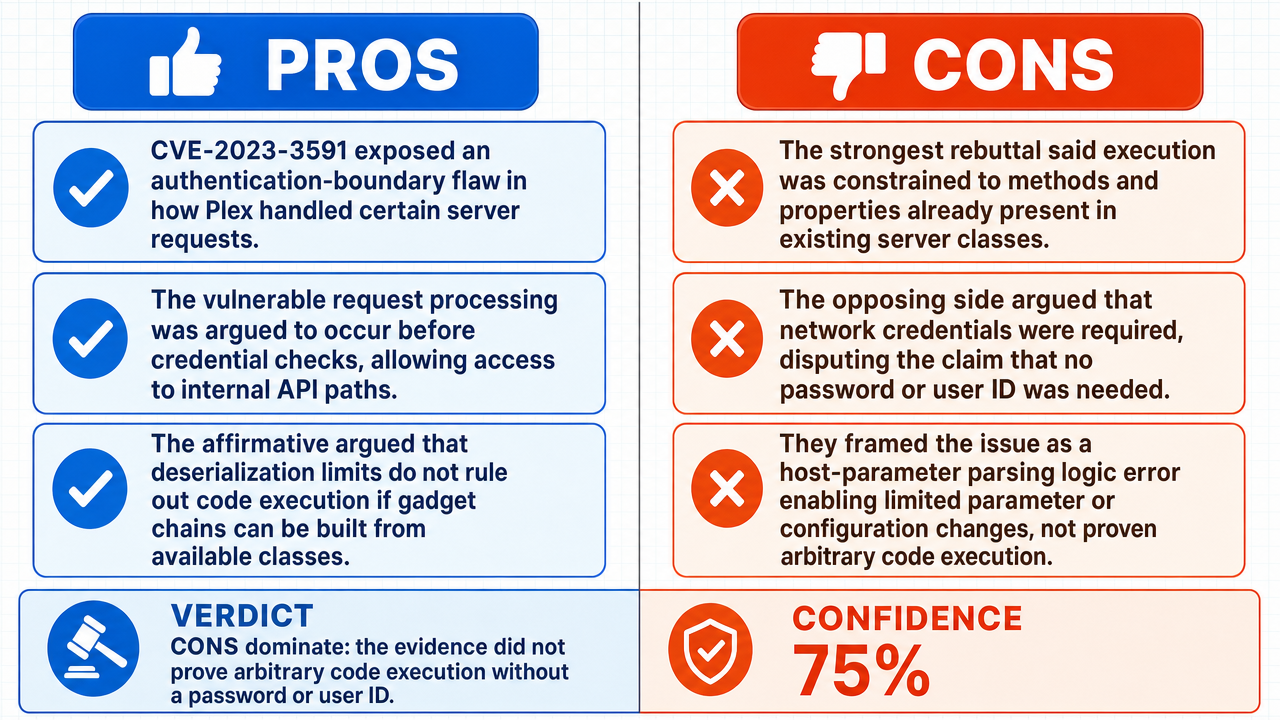
Verdict
Verdict: likely FALSE (75%)
Web Report: https://solsice.com/public/debates/the-plex-tell-vulnerability-allows-attackers-to-execute-code-9a333ff754dc
This section provides a brief overview of the key arguments. You do not need to read the full detailed report below.
✅ Key PRO arguments:
- ■The affirmative identified CVE -2023-3591 as an authentication-boundary failure caused by improper handling of specific Plex server requests, claiming that it could bypass normal login requirements.
- ■The affirmative argued that the vulnerable processing occurred before credential verification, allowing an attacker to interact with the internal API without supplying a valid password or user ID.
- ■The affirmative contended that restrictions inherent to deserialization do not prevent arbitrary code execution because attackers can construct gadget chains from legitimate code already present in the application's classpath .
❌ Key ANTI arguments:
- ■The winning side argued that CVE -2023-3591 permits only constrained execution through methods and properties available in the server's existing object classes , rather than arbitrary code execution.
- ■In its first round, the winning side stated that network credentials were required, directly challenging the assertion that exploitation required neither a password nor a user ID.
- ■In its second round, the winning side characterized the vulnerability as a logic error in host-parameter parsing that enabled parameter or configuration modification rather than arbitrary code execution.
💭 Conclusion: False: the winning side concluded that the evidence did not establish the assertion's combined claim of code execution without a password or user ID. Its strongest point was that exploitation through the available deserialization classes was constrained to existing methods and properties, making the claim of arbitrary execution an overstatement. The winner further described the flaw as host-parameter parsing that enabled parameter or configuration modification rather than direct arbitrary code execution. Although the affirmative argued that pre-authentication processing and gadget chains could remove the stated limitations, it did not establish that those generic deserialization assumptions applied to this Plex exploit. Accordingly, the compound claim is best rated FALSE with 75% confidence, reflecting the winning side and the weakest-supported authentication element.
🔬 DeepResearch Result: likely FALSE ❌ (75%)
Assertion: The 'Plex Tell ' vulnerability allows attackers to execute code on a Plex server without requiring a password or user ID.
Participating models: gemma-4-26b-a4b-it 💬👁️, glm-4.7-flash 💬
📊 Face-offs: 0 concluded TRUE, 1 concluded FALSE (1 face-offs, 3 models)
📊 Score by side: TRUE=0.00, FALSE=0.75
🏅 Model score changes:
minimax-m3 💬👁️: +8
✅ PRO Arguments:
- ■The affirmative identified CVE -2023-3591 as an authentication-boundary failure caused by improper handling of specific Plex server requests, claiming that it could bypass normal login requirements. gemma-4-26b-a4b-it 💬👁️
- ■The affirmative argued that the vulnerable processing occurred before credential verification, allowing an attacker to interact with the internal API without supplying a valid password or user ID. gemma-4-26b-a4b-it 💬👁️
- ■The affirmative contended that restrictions inherent to deserialization do not prevent arbitrary code execution because attackers can construct gadget chains from legitimate code already present in the application's classpath . gemma-4-26b-a4b-it 💬👁️
- ■The affirmative treated the vulnerability as a critical flaw that could facilitate arbitrary command execution on affected Plex servers. gemma-4-26b-a4b-it 💬👁️
❌ ANTI Arguments:
- ■The winning side argued that CVE-2023-3591 permits only constrained execution through methods and properties available in the server's existing object classes , rather than arbitrary code execution. glm-4.7-flash 💬
- ■In its first round, the winning side stated that network credentials were required, directly challenging the assertion that exploitation required neither a password nor a user ID. glm-4.7-flash 💬
- ■In its second round, the winning side characterized the vulnerability as a logic error in host-parameter parsing that enabled parameter or configuration modification rather than arbitrary code execution. glm-4.7-flash 💬
- ■The winning side emphasized that the exploit remained within the privilege boundary of the Plex service user and did not automatically provide administrative or unrestricted system control . glm-4.7-flash 💬
- ■The winning side treated the affirmative's gadget-chain theory as a general deserialization possibility rather than proof that suitable exploitable gadgets existed in the affected Plex environment. glm-4.7-flash 💬
💭 Reasoning: False: the winning side concluded that the evidence did not establish the assertion's combined claim of code execution without a password or user ID. Its strongest point was that exploitation through the available deserialization classes was constrained to existing methods and properties, making the claim of arbitrary execution an overstatement. The winner further described the flaw as host-parameter parsing that enabled parameter or configuration modification rather than direct arbitrary code execution. Although the affirmative argued that pre-authentication processing and gadget chains could remove the stated limitations, it did not establish that those generic deserialization assumptions applied to this Plex exploit. Accordingly, the compound claim is best rated FALSE with 75% confidence, reflecting the winning side and the weakest-supported authentication element.
📋 PRO Facts:
• The debate identified CVE-2023-3591 as the relevant Plex Tell vulnerability.
• The affirmative described the flaw as improper request handling occurring before normal credential verification.
• The affirmative asserted that exploitation could reach internal API functionality without a valid password or user ID.
• The affirmative cited deserialization gadget chains as a standard mechanism for escalating restricted deserialization into arbitrary command execution.
• Only one debate was held, and it was decided in favor of FALSE with 75% judge confidence.
📋 ANTI Facts:
• The winning side said exploitation was limited to methods and properties exposed by object classes available on the target server.
• The winning side's first-round position was that network credentials were required.
• The winning side's second-round account described a host-parameter parsing logic error affecting unauthenticated requests.
• The winning side characterized the practical impact as parameter or configuration modification and emphasized that the Plex service user's privilege level constrained the result.
• The winning side did not accept that generic deserialization gadget-chain theory demonstrated arbitrary code execution in this specific vulnerability.
| Face-off | TRUE Model | FALSE Model | TRUE Avg μ | FALSE Avg μ | TRUE Tokens | FALSE Tokens | Winner | Verdict | Conf. |
|---|---|---|---|---|---|---|---|---|---|
| #1 | gemma-4-26b-a4b-it 💬👁️ | glm-4.7-flash 💬 | 0.533 | 0.422 | 4 | 4 | TRUE | FALSE | 75% |
The following technical terms, abbreviations, and domain-specific concepts are referenced throughout this debate transcript. Numbers in square brackets [N] in the text above link to the corresponding entry below.
[1] access control mechanism — A security mechanism that controls who can access a system. In the debate, it refers to Plex's primary access control mechanism that the vulnerability is said to render moot.
[2] administrative user — A user account with elevated privileges. In the debate, it is contrasted with the Plex service user to explain the privilege boundary.
[3] arbitrary code — Code that an attacker can independently define and execute. The debate disputes whether CVE-2023-3591 permits arbitrary code execution or only constrained execution.
[4] attack surface — The set of points where an unauthorized user can attempt to interact with a system. In the debate, it is described as confined to the class hierarchy of the target system.
[5] authentication boundary — The point at which a system verifies user credentials. In the debate, the vulnerability is said to exist at a level preceding credential verification.
[6] class hierarchy — The organization of classes in object-oriented programming. In the debate, the attack surface is described as confined to this hierarchy.
[7] classpath — A parameter that specifies the location of user-defined classes and packages. In the debate, it is mentioned as the location where gadget chains reside.
[8] command execution primitives — Basic functions that allow execution of system commands. In the debate, Runtime.exec() is cited as an example in Java-based environments.
[9] configuration modification — Changes to system settings. In the debate, it is described as the limited scope of CVE-2023-3591, as opposed to full system control.
[10] CVE — Common Vulnerabilities and Exposures — A system that provides a reference method for publicly known information-security vulnerabilities, cited in the debate via the CVE Mitre database.
[11] CVE-2023-3591 — The specific CVE identifier assigned to the Plex vulnerability discussed in the debate, also referred to as the 'Plex Tell' vulnerability.
[12] deserialization — The process of converting serialized data back into an object. In the debate, it is discussed as the mechanism exploited in the vulnerability.
[13] gadget chains — Sequences of existing, legitimate code snippets within an application's classpath that can be chained together to achieve code execution. In the debate, described as a standard pathway to arbitrary code execution.
[14] host operating system — The underlying operating system on which an application runs. In the debate, it is distinguished from application-level login.
[15] host parameter — A specific parameter in HTTP requests. In the debate, the vulnerability is described as a logic error in the parsing of this parameter.
[16] input validation — The process of checking input data against expected formats. In the debate, it is mentioned as a common cause of such vulnerabilities.
[17] insecure deserialization — A vulnerability that occurs when untrusted data is used to abuse the logic of an application. In the debate, it is described as the mechanism exploited in CVE-2023-3591.
[18] internal API — internal Application Programming Interface — An application programming interface used internally by a system. In the debate, the attacker is said to interact with the server's internal API.
[19] logic error — A bug that causes a program to operate incorrectly. In the debate, CVE-2023-3591 is described as a logic error in parameter parsing.
[20] network credentials — Authentication information required to access a network. In the debate, they are described as necessary to exploit the vulnerability.
[21] network layer authentication — Authentication that occurs at the network level. In the debate, it is distinguished from application-level login.
[22] object classes — Templates for creating objects in object-oriented programming. In the debate, the attacker is described as limited to the methods and properties of deserialized objects.
[23] OWASP — Open Web Application Security Project — A nonprofit foundation that works to improve software security, cited in the debate as a source on deserialization exploits.
[24] parameter parsing — The process of analyzing and interpreting parameters in a request. In the debate, the vulnerability involves a flaw in host parameter parsing.
[25] Plex Media Server — A media server application. The software affected by the vulnerability discussed in the debate.
[26] Plex service user — The user account under which the Plex service runs. In the debate, the exploit is said to operate under this context rather than the administrative user.
[27] Plex Tell — The name given in the debate to the vulnerability identified as CVE-2023-3591 affecting Plex Media Server.
[28] privilege boundary — The separation between different levels of access rights. In the debate, it is described as the transfer point between server vulnerability and system compromise.
[29] RCE — Remote Code Execution — The ability for an attacker to execute code on a remote system. In the debate, it is described as the result of exploiting the vulnerability.
[30] Remote Code Execution — RCE — A vulnerability that allows an attacker to execute code on a remote system. In the debate, it is described as the result of exploiting the vulnerability.
[31] Runtime.exec() — A Java method that executes system commands. In the debate, it is cited as an example of command execution primitives.
[32] system control — Full administrative control over a system. In the debate, it is contrasted with configuration modification as the scope of the exploit.
[33] unauthenticated — Without authentication or credentials. In the debate, it describes the nature of the attack, though the parties dispute whether network credentials are still required.
Face-off transcripts
- ■
Ownership & Trade Secrets. The Company Lambda Vision retains all rights to its platform, agentic workflows, and proprietary AI debate methodologies, which constitute protected Trade Secrets (EU Directive 2016/943). Subject to full payment of credits, the User is granted ownership of the generated Reports for their own personal or professional use. Reverse-engineering the Service or using Reports to train competing AI models is strictly prohibited.
- ■
No Professional Advice. Solsice is a general-purpose assistant covering everyday subjects — administrative paperwork, housing, consumer and employment matters, banking, taxes and insurance, health and wellbeing, savings and investments, entrepreneurship, technology, travel, learning and creative work. Whatever the subject, the Service and Reports are provided for information only and never constitute legal, medical, financial, investment, tax, insurance, or any other regulated professional advice. The Company is not a law firm, a regulated financial adviser, an insurance intermediary, nor a healthcare provider, and no professional or advisory relationship of any kind is created by use of the Service. Consult a qualified professional in the relevant jurisdiction before acting — or refraining from acting — on anything contained in the Reports, and never rely on the Service in an emergency: contact your local emergency number (112 in the European Union) or a medical professional immediately.
- ■
AI-Generated Content, Sources and Viewpoints. Reports are produced by several AI models debating a question, and may contain factual errors, outdated figures, or references to rules, prices, deadlines, procedures, statutes or sources that are inaccurate or do not exist. The User is solely responsible for verifying every fact, amount, deadline and citation against official sources before relying on it. Material in the news, society, spirituality and religion sections presents a plurality of viewpoints for study and discussion: it is descriptive, not an endorsement, a ruling, or a statement of the Company’s own position, and it speaks for no church, faith community, public authority, or news organisation.
- ■
Liability & Governing Law. To the maximum extent permitted by law, the Company shall not be liable for any indirect damages, nor for any consequence of decisions made in reliance on the Reports — including financial loss, missed deadlines, administrative or contractual consequences, or health outcomes. These Terms are governed by French law. Any disputes shall be subject to the exclusive jurisdiction of the Courts of Paris, France.