
The Pinochet dictatorship primarily used international adoptions as a means to control the impoverished population.
AI debate verdict and arguments
⚠️ AI-generated information only; not professional advice
Completed October 18, 2026
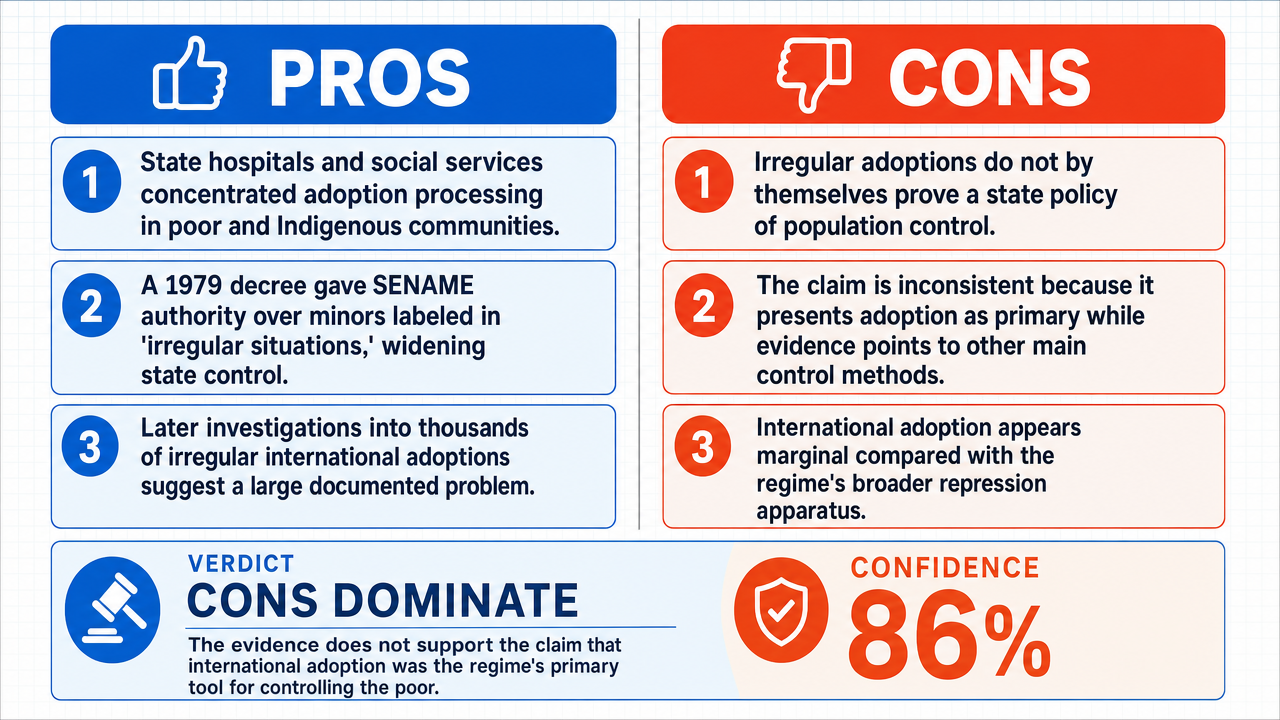
Verdict
Verdict: likely FALSE (86%)
Web Report: https://solsice.com/public/debates/the-pinochet-dictatorship-primarily-used-international-adopt-becda7d521b4
This section provides a brief overview of the key arguments. You do not need to read the full detailed report below.
✅ Key PRO arguments:
- ■Between 1973 and 1990, state-run hospitals, public maternity wards, and social services concentrated adoption processing in low-income and indigenous neighborhoods, with mothers later testifying they were told their newborns had died only to discover the children had been registered as abandoned and sent abroad to Europe or North America.
- ■SENAME was created by Decree Law 2,465 of 1979 to administer minors in 'irregular situations ,' a legal category built around material or moral abandonment , under which a mother's poverty could itself be processed as abandonment and become a legal trigger for separating her from her child, providing a direct administrative connection between poverty and child removal.
- ■A 2015 BBC account reported that Chilean prosecutors reopened investigations into thousands of irregular international adoptions, suggesting a scale large enough to constitute a structural rather than incidental phenomenon.
❌ Key ANTI arguments:
- ■The affirmative commits a fundamental substitution of proxy , using the existence of irregular adoptions to claim a systemic policy of population control without providing the necessary transfer operator —the statistical correlation or administrative link —that connects these specific criminal acts to a centralized regime objective of controlling the impoverished population.
- ■The affirmative's claim is logically inconsistent because it asserts that international adoption was the principal social-control mechanism while simultaneously relying on the established historical fact that the regime's primary mechanisms of social control were direct political repression , including systematic detention, torture, and extrajudicial killings —making it impossible for international adoption to have been the dominant operational logic .
- ■International adoption was a marginal phenomenon relative to the regime's well-documented apparatus of repression, and the documented cases of irregular adoptions , while serious human rights violations, do not establish that adoption was the primary or dominant tool of social control over the impoverished population.
💭 Conclusion: False. The assertion that the Pinochet dictatorship primarily used international adoptions as a means to control the impoverished population is not supported by the evidence presented. The affirmative failed to provide a credible transfer operator linking documented irregular adoptions to a centralized regime policy of population control , instead relying on the existence of criminal acts to imply systemic intent. The regime's primary and well-documented mechanisms of social control were direct political repression , including detention, torture, and extrajudicial killings , which logically precludes international adoption from being the dominant operational logic . While the affirmative raised a plausible administrative link through SENAME and Decree Law 2,465 of 1979, this legal framework alone does not establish that international adoption was the principal rather than a secondary or incidental tool. The historical record consistently identifies physical and political violence as the regime's main instruments of control over the population.
🔬 DeepResearch Result: likely FALSE ❌ (86%)
Assertion: The Pinochet dictatorship primarily used international adoptions as a means to control the impoverished population.
Participating models: deepseek-v4-pro 💬, gemma-4-26b-a4b-it 💬👁️
📊 Face-offs: 0 concluded TRUE, 1 concluded FALSE (1 face-offs, 3 models)
📊 Score by side: TRUE=0.00, FALSE=0.86
🏅 Model score changes:
minimax-m3 💬👁️: +9
✅ PRO Arguments:
- ■Between 1973 and 1990, state-run hospitals, public maternity wards, and social services concentrated adoption processing in low-income and indigenous neighborhoods, with mothers later testifying they were told their newborns had died only to discover the children had been registered as abandoned and sent abroad to Europe or North America. deepseek-v4-pro 💬
- ■SENAME was created by Decree Law 2,465 of 1979 to administer minors in 'irregular situations ,' a legal category built around material or moral abandonment , under which a mother's poverty could itself be processed as abandonment and become a legal trigger for separating her from her child, providing a direct administrative connection between poverty and child removal. deepseek-v4-pro 💬
- ■A 2018 BBC account reported that Chilean prosecutors reopened investigations into thousands of irregular international adoptions, suggesting a scale large enough to constitute a structural rather than incidental phenomenon. deepseek-v4-pro 💬
❌ ANTI Arguments:
- ■The affirmative commits a fundamental substitution of proxy , using the existence of irregular adoptions to claim a systemic policy of population control without providing the necessary transfer operator —the statistical correlation or administrative link —that connects these specific criminal acts to a centralized regime objective of controlling the impoverished population. gemma-4-26b-a4b-it 💬👁️
- ■The affirmative's claim is logically inconsistent because it asserts that international adoption was the principal social-control mechanism while simultaneously relying on the established historical fact that the regime's primary mechanisms of social control were direct political repression , including systematic detention, torture, and extrajudicial killings —making it impossible for international adoption to have been the dominant operational logic . gemma-4-26b-a4b-it 💬👁️
- ■International adoption was a marginal phenomenon relative to the regime's well-documented apparatus of repression, and the documented cases of irregular adoptions, while serious human rights violations, do not establish that adoption was the primary or dominant tool of social control over the impoverished population. gemma-4-26b-a4b-it 💬👁️
💭 Reasoning: False. The assertion that the Pinochet dictatorship primarily used international adoptions as a means to control the impoverished population is not supported by the evidence presented. The affirmative failed to provide a credible transfer operator linking documented irregular adoptions to a centralized regime policy of population control, instead relying on the existence of criminal acts to imply systemic intent. The regime's primary and well-documented mechanisms of social control were direct political repression, including detention, torture, and extrajudicial killings, which logically precludes international adoption from being the dominant operational logic. While the affirmative raised a plausible administrative link through SENAME and Decree Law 2,465 of 1979, this legal framework alone does not establish that international adoption was the principal rather than a secondary or incidental tool. The historical record consistently identifies physical and political violence as the regime's main instruments of control over the population.
📋 PRO Facts:
• SENAME was created by Decree Law 2,465 of 1979 to administer minors in 'irregular situations,' a legal category built around material or moral abandonment.
• A 2015 BBC account reported that Chilean prosecutors reopened investigations into thousands of irregular international adoptions.
• Mothers later testified that they were told their newborns had died, only to discover that the children had been registered as abandoned and sent abroad to Europe or North America.
📋 ANTI Facts:
• The Pinochet regime's primary mechanisms of social control were direct political repression, including systematic detention, torture, and extrajudicial killings.
• The affirmative cited approximately 20,000 irregular adoptions but failed to demonstrate these were a structural component of state policy rather than isolated criminal acts.
• International adoption was a marginal phenomenon relative to the regime's well-documented apparatus of repression.
| Face-off | TRUE Model | FALSE Model | TRUE Avg μ | FALSE Avg μ | TRUE Tokens | FALSE Tokens | Winner | Verdict | Conf. |
|---|---|---|---|---|---|---|---|---|---|
| #1 | deepseek-v4-pro 💬 | gemma-4-26b-a4b-it 💬👁️ | 0.465 | 0.249 | 6 | 2 | TRUE | FALSE | 86% |
The following technical terms, abbreviations, and domain-specific concepts are referenced throughout this debate transcript. Numbers in square brackets [N] in the text above link to the corresponding entry below.
[1] administrative link — A connection established through bureaucratic or legal procedures, used in the debate to argue that irregular adoptions were tied to centralized state policy rather than isolated crimes.
[2] administrative separation — The removal of individuals from families or communities through bureaucratic or legal procedures, described in the debate as a form of population control.
[3] antecedent — In logic, the conditional clause of a proposition (e.g., 'if P' in 'if P, then Q'); used in the debate to refer to the underlying premise that international adoption was the dominant operational logic.
[4] birth records — Official documents recording the birth of an individual; mentioned in the debate as having been falsified by civil registry workers during the Pinochet regime.
[5] centralized state policy — A policy directed and coordinated by the central government, as opposed to local or fragmented initiatives; the affirmative argues irregular adoptions were part of such a policy.
[6] civil registry — A government office responsible for recording vital events such as births, marriages, and deaths; workers there are alleged to have falsified records during the dictatorship.
[7] congressional investigative commission — A legislative body established to investigate specific issues or events; cited in the debate as having documented irregularities in adoptions during the Pinochet era.
[8] criminal exploitations — The use of illegal means to benefit from a situation or system; the negative frames irregular adoptions as isolated criminal exploitations of a broken system rather than state policy.
[9] Decreto Ley 2465 — Decree Law 2,465 of 1979 — A Chilean decree law issued in 1979 that created SENAME and established the legal category of minors in 'irregular situations,' including material or moral abandonment.
[10] demographic removal — The reduction of a population through administrative or coercive means; used in the debate to describe the alleged effect of international adoptions on poor households.
[11] direct political repression — The use of force or coercion by a state to suppress political opposition; the negative argues this was the regime's primary social-control mechanism, not adoption.
[12] extrajudicial killings — Executions conducted without due process of law; cited in the debate as part of the regime's primary mode of maintaining order.
[13] foreign adoption — The legal process by which a child is adopted by individuals in another country; described in the debate as the destination for children transferred through irregular procedures.
[14] irregular adoptions — Adoptions that occurred outside normal legal procedures; the affirmative cites a figure of 20,000 such cases abroad during the Pinochet dictatorship.
[15] irregular situations — A legal category under Chilean Decree Law 2465 built around material or moral abandonment, which the affirmative argues allowed poverty itself to trigger child separation.
[16] legal trigger — A condition or event that activates a legal consequence or procedure; in the debate, a mother's poverty is described as functioning as a legal trigger for separating her from her child.
[17] logical contradiction — A statement or set of statements that are inconsistent with each other; the negative argues the affirmative's claim is logically incoherent.
[18] material or moral abandonment — A legal concept referring to the failure to provide material support or moral guidance to a dependent person; the core of the 'irregular situations' category under Decreto Ley 2465.
[19] military regime — A government headed by military leaders, typically established through a coup or other extra-constitutional means; refers to the Pinochet government (1973–1990).
[20] mutually exclusive propositions — Propositions that cannot both be true at the same time; the negative argues the affirmative asserts two such propositions simultaneously.
[21] negation — The logical operation that reverses the truth value of a proposition; used in the debate in the phrase 'proposition and its negation.'
[22] operational logic — The underlying principle or rationale guiding the functioning of a system or policy; the debate centers on whether adoption or direct repression was the regime's dominant operational logic.
[23] population control — Policies or practices aimed at influencing the size or composition of a population; the affirmative frames international adoption as a form of population control against the poor.
[24] principal administrative tool — The primary mechanism through which a government implements its policies; the affirmative claims international adoption functioned as such a tool.
[25] proxy — A variable used as a substitute for another variable that is difficult to measure directly; the negative accuses the affirmative of a 'substitution of proxy' in its reasoning.
[26] SENAME — Servicio Nacional de Menores — Chile's National Service for Minors, created by Decreto Ley 2465 of 1979 to administer minors in 'irregular situations.'
[27] social-control mechanism — A method used by a state or authority to regulate or manage the behavior of a population; the debate disputes whether international adoption was such a mechanism.
[28] statistical correlation — A measure of the relationship between two variables; the negative argues the affirmative fails to provide a statistical correlation linking irregular adoptions to state policy.
[29] structural component — A fundamental or essential element of a system or policy; the negative argues irregular adoptions were not shown to be a structural component of state policy.
[30] substitution of proxy — A logical or analytical error where one variable is substituted for another without adequate justification; the negative's term for the affirmative's reasoning.
[31] systemic policy — A policy that is embedded in and enforced by the structures of a system; the negative argues the affirmative has not proven adoptions were a systemic policy.
[32] transfer operator — A logical mechanism connecting premises to conclusions; the negative argues the affirmative lacks a transfer operator linking irregular adoptions to a centralized regime objective.
Face-off transcripts
- ■
Ownership & Trade Secrets. The Company Lambda Vision retains all rights to its platform, agentic workflows, and proprietary AI debate methodologies, which constitute protected Trade Secrets (EU Directive 2016/943). Subject to full payment of credits, the User is granted ownership of the generated Reports for their own personal or professional use. Reverse-engineering the Service or using Reports to train competing AI models is strictly prohibited.
- ■
No Professional Advice. Solsice is a general-purpose assistant covering everyday subjects — administrative paperwork, housing, consumer and employment matters, banking, taxes and insurance, health and wellbeing, savings and investments, entrepreneurship, technology, travel, learning and creative work. Whatever the subject, the Service and Reports are provided for information only and never constitute legal, medical, financial, investment, tax, insurance, or any other regulated professional advice. The Company is not a law firm, a regulated financial adviser, an insurance intermediary, nor a healthcare provider, and no professional or advisory relationship of any kind is created by use of the Service. Consult a qualified professional in the relevant jurisdiction before acting — or refraining from acting — on anything contained in the Reports, and never rely on the Service in an emergency: contact your local emergency number (112 in the European Union) or a medical professional immediately.
- ■
AI-Generated Content, Sources and Viewpoints. Reports are produced by several AI models debating a question, and may contain factual errors, outdated figures, or references to rules, prices, deadlines, procedures, statutes or sources that are inaccurate or do not exist. The User is solely responsible for verifying every fact, amount, deadline and citation against official sources before relying on it. Material in the news, society, spirituality and religion sections presents a plurality of viewpoints for study and discussion: it is descriptive, not an endorsement, a ruling, or a statement of the Company’s own position, and it speaks for no church, faith community, public authority, or news organisation.
- ■
Liability & Governing Law. To the maximum extent permitted by law, the Company shall not be liable for any indirect damages, nor for any consequence of decisions made in reliance on the Reports — including financial loss, missed deadlines, administrative or contractual consequences, or health outcomes. These Terms are governed by French law. Any disputes shall be subject to the exclusive jurisdiction of the Courts of Paris, France.