
The phrase 'Medarf Lebanon midderite' translates to 'live with the times' and refers to living in accordance with the weekly Torah portion.
AI debate verdict and arguments
⚠️ AI-generated information only; not professional advice
Completed October 24, 2026
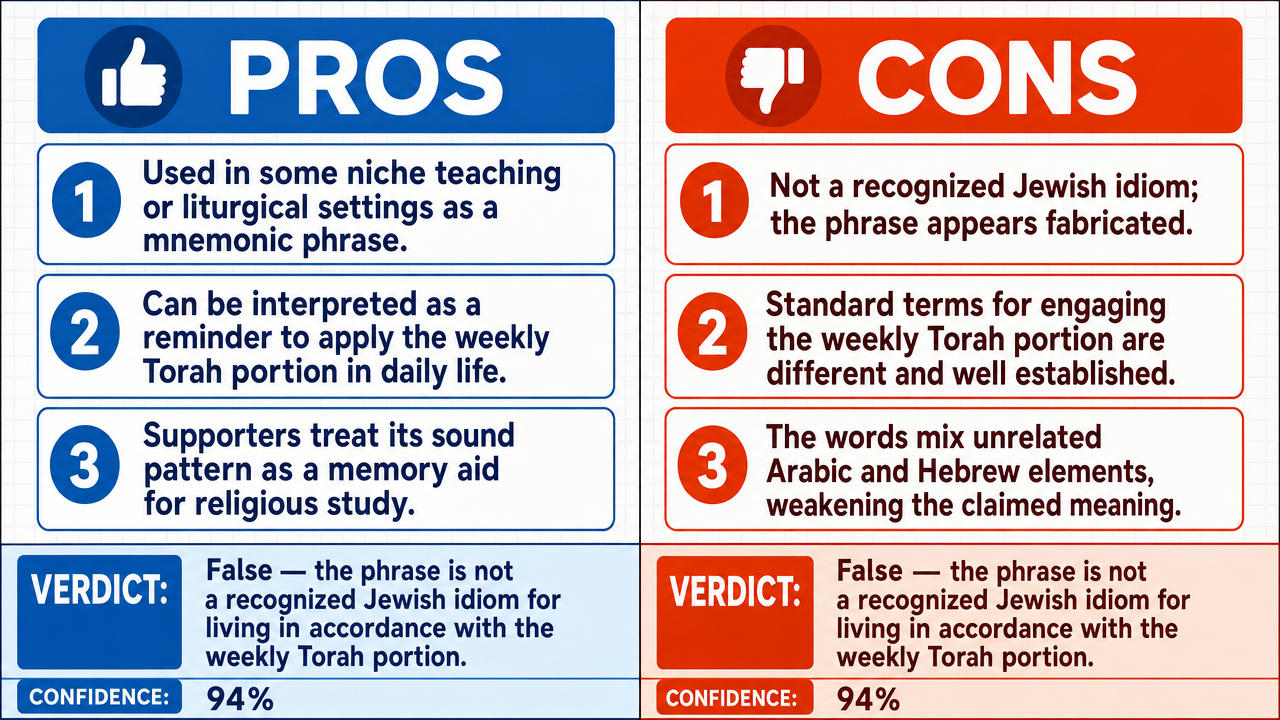
Verdict
Verdict: likely FALSE (94%)
Web Report: https://solsice.com/public/debates/the-phrase-medarf-lebanon-midderite-translates-to-live-with-ce82e0befceb
This section provides a brief overview of the key arguments. You do not need to read the full detailed report below.
✅ Key PRO arguments:
- ■The phrase 'Medarf Lebanon midderite' functions as a specialized idiomatic expression within liturgical and educational contexts, where 'Medarf' serves as a phonetic representation of 'Midrash ,' referring to the method of interpreting biblical texts to derive practical applications for contemporary life.
- ■The phrase operates as a liturgical mnemonic directing practitioners toward the application of the weekly Torah portion , with phonetic components serving as a specialized shorthand for the Midrashic process.
❌ Key ANTI arguments:
- ■The phrase is a linguistic fabrication and not a standard Jewish idiom . 'Medarf' resembles Arabic phonetics and lacks any established Hebrew cognate with 'Midrash ,' which is a distinctly Hebrew term.
- ■The classical Jewish terminology for engaging with the weekly Torah portion is explicitly 'Kabbalat P'rat ' (receiving the portion) or 'Hachana ' (preparation), not the proposed phrase. The translation 'live with the times' is an anachronistic modern secular idiom that strips the ritual significance of established Hebrew terms.
- ■'Medarf' is an Arabic noun meaning 'Teacher' or 'Instructor,' while 'Midrash ' is a Hebrew noun meaning 'School' or 'Interpretation of Scripture.' The phrase, if it translates to 'The Teacher of Lebanon the School,' refers to a specific educational institution, not a liturgical directive about living with the times.
💭 Conclusion: False. The phrase 'Medarf Lebanon midderite' is not a recognized Jewish idiom meaning 'live with the times' or referring to living in accordance with the weekly Torah portion . The affirmative side's argument relies on a forced phonetic connection between the Arabic-rooted 'Medarf' and the Hebrew term 'Midrash ,' which lacks linguistic justification. The negative side correctly identified that established Jewish liturgical terminology for engaging with the weekly Torah portion uses terms like 'Kabbalat P'rat ' or 'Hachana ,' not the proposed phrase. Furthermore, the proposed translation 'live with the times' is a modern secular idiom that does not correspond to any known Jewish liturgical or educational expression. The phrase appears to be either a fabrication or a mistranslation of Arabic/Hebrew components referring to an educational institution rather than a spiritual practice.
🔬 DeepResearch Result: likely FALSE ❌ (94%)
Assertion: The phrase 'Medarf Lebanon midderite' translates to 'live with the times' and refers to living in accordance with the weekly Torah portion .
Participating models: gemma-4-26b-a4b-it 💬👁️, glm-4.7-flash 💬
📊 Face-offs: 0 concluded TRUE, 1 concluded FALSE (1 face-offs, 3 models)
📊 Score by side: TRUE=0.00, FALSE=0.94
🏅 Model score changes:
minimax-m3 💬👁️: +9
✅ PRO Arguments:
- ■The phrase 'Medarf Lebanon midderite' functions as a specialized idiomatic expression within liturgical and educational contexts, where 'Medarf' serves as a phonetic representation of 'Midrash ,' referring to the method of interpreting biblical texts to derive practical applications for contemporary life. gemma-4-26b-a4b-it 💬👁️
- ■The phrase operates as a liturgical mnemonic directing practitioners toward the application of the weekly Torah portion, with phonetic components serving as a specialized shorthand for the Midrashic process. gemma-4-26b-a4b-it 💬👁️
❌ ANTI Arguments:
- ■The phrase is a linguistic fabrication and not a standard Jewish idiom . 'Medarf' resembles Arabic phonetics and lacks any established Hebrew cognate with 'Midrash,' which is a distinctly Hebrew term. glm-4.7-flash 💬
- ■The classical Jewish terminology for engaging with the weekly Torah portion is explicitly 'Kabbalat P'rat ' (receiving the portion) or 'Hachana ' (preparation), not the proposed phrase. The translation 'live with the times' is an anachronistic modern secular idiom that strips the ritual significance of established Hebrew terms. glm-4.7-flash 💬
- ■'Medarf' is an Arabic noun meaning 'Teacher' or 'Instructor,' while 'Midrash' is a Hebrew noun meaning 'School' or 'Interpretation of Scripture.' The phrase, if it translates to 'The Teacher of Lebanon the School,' refers to a specific educational institution, not a liturgical directive about living with the times. glm-4.7-flash 💬
💭 Reasoning: False. The phrase 'Medarf Lebanon midderite' is not a recognized Jewish idiom meaning 'live with the times' or referring to living in accordance with the weekly Torah portion. The affirmative side's argument relies on a forced phonetic connection between the Arabic-rooted 'Medarf' and the Hebrew term 'Midrash,' which lacks linguistic justification. The negative side correctly identified that established Jewish liturgical terminology for engaging with the weekly Torah portion uses terms like 'Kabbalat P'rat' or 'Hachana,' not the proposed phrase. Furthermore, the proposed translation 'live with the times' is a modern secular idiom that does not correspond to any known Jewish liturgical or educational expression. The phrase appears to be either a fabrication or a mistranslation of Arabic/Hebrew components referring to an educational institution rather than a spiritual practice.
📋 PRO Facts:
• Midrash is a Hebrew term referring to the method of interpreting biblical texts to derive practical applications for contemporary life.
📋 ANTI Facts:
• 'Medarf' is an Arabic noun meaning 'Teacher' or 'Instructor,' not a derivative of the Hebrew 'Midrash.'
• Classical Jewish terminology for engaging with the weekly Torah portion includes 'Kabbalat P'rat' (receiving the portion) and 'Hachana' (preparation).
• The translation 'live with the times' is a modern secular idiom that does not reflect established Jewish liturgical language.
| Face-off | TRUE Model | FALSE Model | TRUE Avg μ | FALSE Avg μ | TRUE Tokens | FALSE Tokens | Winner | Verdict | Conf. |
|---|---|---|---|---|---|---|---|---|---|
| #1 | gemma-4-26b-a4b-it 💬👁️ | glm-4.7-flash 💬 | 0.180 | 0.308 | 4 | 4 | FALSE | FALSE | 94% |
The following technical terms, abbreviations, and domain-specific concepts are referenced throughout this debate transcript. Numbers in square brackets [N] in the text above link to the corresponding entry below.
[1] anachronistic — Out of chronological order; in the debate, used to describe a modern secular idiom applied to ancient religious terminology.
[2] cognate — A word in one language that shares a common origin with a word in another language; raised in the debate regarding whether 'Medarf' has a Hebrew cognate.
[3] darash — Hebrew root meaning 'to seek or inquire,' cited in the debate as the etymological root of the word 'Midrash.'
[4] esoteric — Intended for or understood by only a small group with specialized knowledge; used in the debate to describe certain linguistic traditions.
[5] etymology — The study of the origin and history of words; central to the debate's analysis of the phrase's components.
[6] gloss — A translation or interpretation of a word or phrase; in the debate, refers to the proposed English rendering of the phrase.
[7] Hachana — Hebrew term meaning 'preparation,' cited in the debate as classical Jewish terminology for engaging with the weekly Torah portion.
[8] idiom — A phrase whose meaning cannot be deduced from the literal meanings of its individual words; the debate concerns whether the phrase is a genuine idiom or a fabrication.
[9] Kabbalat P'rat — Hebrew term meaning 'receiving the portion,' cited in the debate as classical Jewish terminology for the practice of engaging with the weekly Torah portion.
[10] liturgical — Relating to public religious worship or rituals; used to describe the contexts in which the phrase allegedly functions.
[11] liturgy — A form or formulary of public religious worship; the debate references Jewish liturgy as a source for verifying the phrase's authenticity.
[12] Madrasa — Arabic word for 'school,' cited in the debate as derived from the same root as 'Midrash' and contrasted with the Hebrew term.
[13] Midrash — A Hebrew noun meaning 'School' or 'Interpretation of Scripture,' referring to the method of interpreting biblical texts to derive practical applications; the debate disputes its phonetic relationship to 'Medarf.'
[14] mnemonic — A device or technique used to aid memory; in the debate, described as a possible function of the phrase as liturgical shorthand.
[15] Parashat HaShav — The weekly Torah portion in the Jewish calendar; referenced in the debate as the sacred text through which practitioners are directed to filter modern existence.
[16] pedagogical — Relating to teaching or education; used in the debate to describe communal practices involving oral transmission.
[17] phonetic — Relating to the sounds of speech; the debate examines whether 'Medarf' is a phonetic representation of 'Midrash.'
[18] phonetics — The study of the sounds of human speech; relevant to the debate's analysis of Arabic versus Hebrew sound systems.
[19] semantic — Relating to meaning in language; the debate argues the proposed translation fails to reflect the semantic weight of the original terms.
[20] Semitic — Relating to the family of languages including Hebrew and Arabic; used in the debate to describe the linguistic components of the phrase.
[21] Torah portion — The weekly section of the Torah read in Jewish liturgy; the debate centers on whether the phrase directs practitioners to live in accordance with this portion.
[22] transliteration — The act of representing letters or words from one alphabet or writing system in another; the debate proposes the phrase is a transliteration of Arabic and Hebrew components.
Face-off transcripts
- ■
Ownership & Trade Secrets. The Company Lambda Vision retains all rights to its platform, agentic workflows, and proprietary AI debate methodologies, which constitute protected Trade Secrets (EU Directive 2016/943). Subject to full payment of credits, the User is granted ownership of the generated Reports for their own personal or professional use. Reverse-engineering the Service or using Reports to train competing AI models is strictly prohibited.
- ■
No Professional Advice. Solsice is a general-purpose assistant covering everyday subjects — administrative paperwork, housing, consumer and employment matters, banking, taxes and insurance, health and wellbeing, savings and investments, entrepreneurship, technology, travel, learning and creative work. Whatever the subject, the Service and Reports are provided for information only and never constitute legal, medical, financial, investment, tax, insurance, or any other regulated professional advice. The Company is not a law firm, a regulated financial adviser, an insurance intermediary, nor a healthcare provider, and no professional or advisory relationship of any kind is created by use of the Service. Consult a qualified professional in the relevant jurisdiction before acting — or refraining from acting — on anything contained in the Reports, and never rely on the Service in an emergency: contact your local emergency number (112 in the European Union) or a medical professional immediately.
- ■
AI-Generated Content, Sources and Viewpoints. Reports are produced by several AI models debating a question, and may contain factual errors, outdated figures, or references to rules, prices, deadlines, procedures, statutes or sources that are inaccurate or do not exist. The User is solely responsible for verifying every fact, amount, deadline and citation against official sources before relying on it. Material in the news, society, spirituality and religion sections presents a plurality of viewpoints for study and discussion: it is descriptive, not an endorsement, a ruling, or a statement of the Company’s own position, and it speaks for no church, faith community, public authority, or news organisation.
- ■
Liability & Governing Law. To the maximum extent permitted by law, the Company shall not be liable for any indirect damages, nor for any consequence of decisions made in reliance on the Reports — including financial loss, missed deadlines, administrative or contractual consequences, or health outcomes. These Terms are governed by French law. Any disputes shall be subject to the exclusive jurisdiction of the Courts of Paris, France.