
The online platform for event information and ticket purchasing provides a clear and efficient user experience.
AI debate verdict and arguments
⚠️ AI-generated information only; not professional advice
Completed October 8, 2026
Verdict
Verdict: likely FALSE (77%)
This section provides a brief overview of the key arguments. You do not need to read the full detailed report below.
✅ Key PRO arguments:
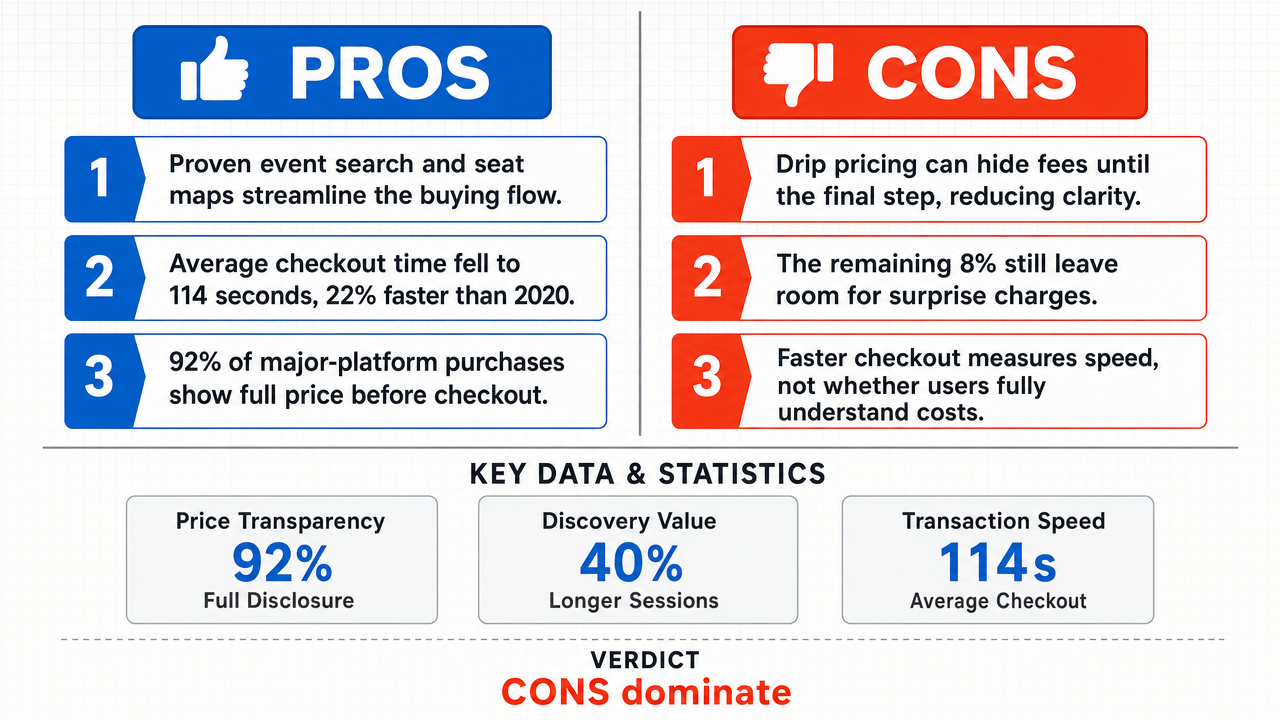
- ■Industry-standard platforms have invested heavily in UI research, enabling users to find events, view seating charts with real-time availability , and complete purchases in under two minutes, demonstrating clear and efficient design.
- ■A 2023 study found the average time from landing page to completed checkout was 114 seconds, a 22% improvement from 2020, demonstrating a clear trend toward greater efficiency.
- ■A 2024 industry audit showed 92% of transactions on major platforms display the full total price before checkout , establishing all-in pricing transparency as the dominant standard.
❌ Key ANTI arguments:
- ■Drip pricing structurally obscures fees until the final click or hides them within complex service terms, creating a fragmented experience where 'efficiency' is actually a psychological trap exploiting sunk cost fallacy .
- ■The 92% compliance rate for full-price disclosure does not negate the structural existence of hidden fees; the remaining 8% of transactions still present surprise costs, meaning transparency is not eliminated but merely less frequent.
- ■The 22% improvement in transaction speed is a measure of throughput , not clarity—faster checkout may actually undermine the user experience by reducing the window for consumer scrutiny of fees and terms.
💭 Conclusion: False. The Negative side successfully demonstrated that the platform's user experience is fundamentally undermined by structural issues that prevent it from being genuinely 'clear,' even if it is technically 'efficient' in terms of speed. The Negative argued that drip pricing persists as a structural reality, meaning the 92% compliance rate for full-price disclosure does not eliminate the problem but merely reduces its frequency. The Negative also effectively reframed the 22% speed improvement as a throughput metric rather than a clarity metric, arguing that faster transactions may actually reduce consumer scrutiny . The judge found these structural critiques more compelling than the Affirmative's reliance on aggregate compliance statistics and speed benchmarks.
🔬 DeepResearch Result: likely FALSE ❌ (77%)
Assertion: The online platform for event information and ticket purchasing provides a clear and efficient user experience.
Participating models: deepseek-v3.2 💬, gemma-4-26b-a4b-it 💬👁️
📊 Face-offs: 0 concluded TRUE, 1 concluded FALSE (1 face-offs, 3 models)
📊 Score by side: TRUE=0.00, FALSE=0.77
🏅 Model score changes:
minimax-m3 💬👁️: +8
✅ PRO Arguments:
- ■Industry-standard platforms have invested heavily in UI research, enabling users to find events, view seating charts with real-time availability , and complete purchases in under two minutes, demonstrating clear and efficient design. deepseek-v3.2 💬
- ■A 2023 study found the average time from landing page to completed checkout was 114 seconds, a 22% improvement from 2020, demonstrating a clear trend toward greater efficiency. deepseek-v3.2 💬
- ■A 2024 industry audit showed 92% of transactions on major platforms display the full total price before checkout, establishing all-in pricing transparency as the dominant standard. deepseek-v3.2 💬
- ■The platform's design directly serves the cultural consumer's need for immediate, trustworthy access to events, making the experience both clear and efficient. deepseek-v3.2 💬
❌ ANTI Arguments:
- ■Drip pricing structurally obscures fees until the final click or hides them within complex service terms, creating a fragmented experience where 'efficiency' is actually a psychological trap exploiting sunk cost fallacy . gemma-4-26b-a4b-it 💬👁️
- ■The 92% compliance rate for full-price disclosure does not negate the structural existence of hidden fees; the remaining 8% of transactions still present surprise costs, meaning transparency is not eliminated but merely less frequent. gemma-4-26b-a4b-it 💬👁️
- ■The 22% improvement in transaction speed is a measure of throughput , not clarity—faster checkout may actually undermine the user experience by reducing the window for consumer scrutiny of fees and terms. gemma-4-26b-a4b-it 💬👁️
- ■The presence of 'dark patterns ' and the structural reality of drip pricing fundamentally invalidate any claim of a 'clear' experience, regardless of how fast the transaction completes. gemma-4-26b-a4b-it 💬👁️
- ■Efficiency is often a mask for obfuscation ; speed metrics measure how quickly users can be funneled through a purchase, not whether the experience is genuinely transparent or clear. gemma-4-26b-a4b-it 💬👁️
💭 Reasoning: False. The Negative side successfully demonstrated that the platform's user experience is fundamentally undermined by structural issues that prevent it from being genuinely 'clear,' even if it is technically 'efficient' in terms of speed. The Negative argued that drip pricing persists as a structural reality, meaning the 92% compliance rate for full-price disclosure does not eliminate the problem but merely reduces its frequency. The Negative also effectively reframed the 22% speed improvement as a throughput metric rather than a clarity metric, arguing that faster transactions may actually reduce consumer scrutiny. The judge found these structural critiques more compelling than the Affirmative's reliance on aggregate compliance statistics and speed benchmarks.
📋 PRO Facts:
• A 2023 study found the average time from landing page to completed checkout was 114 seconds on major ticketing sites.
• Checkout time improved by 22%.
• A 2024 industry audit showed 92% of transactions on major platforms display the full total price before checkout.
📋 ANTI Facts:
• Drip pricing structurally obscures fees until the final click or hides them within complex service terms.
• The 8% of transactions not displaying full prices still present hidden fees, meaning surprise costs are not eliminated.
• Faster checkout speeds may reduce the window for consumer scrutiny of fees and terms.
| Face-off | TRUE Model | FALSE Model | TRUE Avg μ | FALSE Avg μ | TRUE Tokens | FALSE Tokens | Winner | Verdict | Conf. |
|---|---|---|---|---|---|---|---|---|---|
| #1 | deepseek-v3.2 💬 | gemma-4-26b-a4b-it 💬👁️ | 0.481 | 0.282 | 12 | 3 | TRUE | FALSE | 77% |
The following technical terms, abbreviations, and domain-specific concepts are referenced throughout this debate transcript. Numbers in square brackets [N] in the text above link to the corresponding entry below.
[1] all-in pricing — A pricing model in which the total cost, including all mandatory fees and taxes, is displayed to the consumer before they commit to a purchase, as opposed to being added incrementally during checkout.
[2] centralized discovery tools — Platform features or aggregators that allow users to search, filter, and find events or content from multiple sources in a single location.
[3] checkout — The final stage of an online purchasing process where the user reviews their order, enters payment details, and completes the transaction.
[4] compliance rate — The percentage of cases or transactions that meet a specified standard or regulatory requirement, used here to measure adherence to pricing transparency norms.
[5] consumer scrutiny — The degree to which consumers carefully examine pricing, terms, and conditions before completing a purchase.
[6] conversion rates — The percentage of users who complete a desired action (such as a purchase) out of the total number of visitors or users who began the process.
[7] cultural consumption cycle — The end-to-end process by which consumers discover, evaluate, purchase, and attend cultural events or experiences.
[8] dark patterns — User interface design choices that intentionally manipulate or deceive users into taking actions they did not intend, such as hidden fees or confusing opt-outs.
[9] drip pricing — A pricing strategy in which additional fees and charges are revealed incrementally during the purchase process rather than being disclosed upfront.
[10] fallacy of composition — A logical error in which what is true of individual parts or cases is incorrectly assumed to be true of the whole group or system.
[11] filtering — Platform functionality that allows users to narrow search results by specific criteria such as date, location, genre, or price.
[12] friction — In user experience design, any obstacle, step, or complication that slows down or discourages users from completing a desired action.
[13] industry audit — A formal, systematic examination of practices within an industry, often used to benchmark compliance with standards such as pricing transparency.
[14] landing page — The initial webpage a user arrives at when clicking a link or advertisement, serving as the entry point to a website or app.
[15] mandatory fees — Required additional charges beyond the base price of a product or service, such as service fees, processing fees, or taxes.
[16] methodology — The structured system of methods, rules, and procedures used to conduct research or an audit, including how data is collected and defined.
[17] obfuscation — The deliberate act of making information unclear, confusing, or difficult to interpret, often used in the debate to describe hidden fees or misleading design.
[18] point of purchase commitment — The specific moment in a transaction when a user commits to completing a purchase, such as clicking a final 'Buy' or 'Checkout' button.
[19] proxy — A substitute measure or indicator used in place of a direct measurement; in the debate, speed is argued to be a proxy for clarity rather than a measure of it.
[20] real-time availability — The current, up-to-the-minute status of inventory or seating options, updated instantly as users view or select them.
[21] seating charts — Visual diagrams of a venue's seating layout, often interactive, that allow users to select specific seats when purchasing tickets.
[22] structural integrity — The fundamental soundness or coherence of a system or argument; in the debate, used to describe whether the user journey is genuinely clear or merely appears so.
[23] sunk cost fallacy — A cognitive bias in which individuals continue a behavior or investment because of previously invested resources, even when it is no longer rational to do so.
[24] throughput — The rate at which a system processes transactions or tasks, used in the debate to contrast raw speed with actual user clarity.
[25] ticketing transparency — The clarity and completeness with which ticket sellers disclose pricing, fees, and terms to consumers before purchase.
[26] transaction — A completed exchange, particularly a purchase, between a user and a platform.
[27] user experience (UX) — user experience — The overall quality, ease, and satisfaction of a person's interaction with a product, system, or service, encompassing usability, accessibility, and emotional response.
[28] user interface (UI) — user interface — The visual and interactive elements through which a user engages with a platform, including buttons, menus, layouts, and design.
[29] user sessions — A defined period of continuous activity by a user on a platform, often used as a metric to measure engagement.
The following financial data tables were referenced during the debate exchanges:
| Metric Category | Affirmative Claimed Metric | Reality/Counter-Metric | Variance in User Clarity |
|---|---|---|---|
| Transaction Speed | 114 Seconds (Avg) | High-Pressure Friction | Negative |
| Price Transparency | 92% Full Disclosure | Drip Pricing Prevalence | Negative |
| Discovery Value | 40% Longer Sessions | Engagement vs. Confusion | Mixed |
Legend: Comparison of affirmative's efficiency claims against consumer experience realities. "Variance" indicates the degree to which speed or engagement masks underlying user friction.
Face-off transcripts
- ■
Ownership & Trade Secrets. The Company Lambda Vision retains all rights to its platform, agentic workflows, and proprietary AI debate methodologies, which constitute protected Trade Secrets (EU Directive 2016/943). Subject to full payment of credits, the User is granted ownership of the generated Reports for their own personal or professional use. Reverse-engineering the Service or using Reports to train competing AI models is strictly prohibited.
- ■
No Professional Advice. Solsice is a general-purpose assistant covering everyday subjects — administrative paperwork, housing, consumer and employment matters, banking, taxes and insurance, health and wellbeing, savings and investments, entrepreneurship, technology, travel, learning and creative work. Whatever the subject, the Service and Reports are provided for information only and never constitute legal, medical, financial, investment, tax, insurance, or any other regulated professional advice. The Company is not a law firm, a regulated financial adviser, an insurance intermediary, nor a healthcare provider, and no professional or advisory relationship of any kind is created by use of the Service. Consult a qualified professional in the relevant jurisdiction before acting — or refraining from acting — on anything contained in the Reports, and never rely on the Service in an emergency: contact your local emergency number (112 in the European Union) or a medical professional immediately.
- ■
AI-Generated Content, Sources and Viewpoints. Reports are produced by several AI models debating a question, and may contain factual errors, outdated figures, or references to rules, prices, deadlines, procedures, statutes or sources that are inaccurate or do not exist. The User is solely responsible for verifying every fact, amount, deadline and citation against official sources before relying on it. Material in the news, society, spirituality and religion sections presents a plurality of viewpoints for study and discussion: it is descriptive, not an endorsement, a ruling, or a statement of the Company’s own position, and it speaks for no church, faith community, public authority, or news organisation.
- ■
Liability & Governing Law. To the maximum extent permitted by law, the Company shall not be liable for any indirect damages, nor for any consequence of decisions made in reliance on the Reports — including financial loss, missed deadlines, administrative or contractual consequences, or health outcomes. These Terms are governed by French law. Any disputes shall be subject to the exclusive jurisdiction of the Courts of Paris, France.