
The ongoing civil war in Myanmar is primarily sustained by the economic incentives created by the fragmentation of state authority, rather than by political grievances.
AI debate verdict and arguments
⚠️ AI-generated information only; not professional advice
Completed November 12, 2026
Verdict
Verdict: likely FALSE (77%)
Web Report: https://solsice.com/public/debates/the-ongoing-civil-war-in-myanmar-is-primarily-sustained-by-t-63c6eee6c289
This section provides a brief overview of the key arguments. You do not need to read the full detailed report below.
✅ Key PRO arguments:
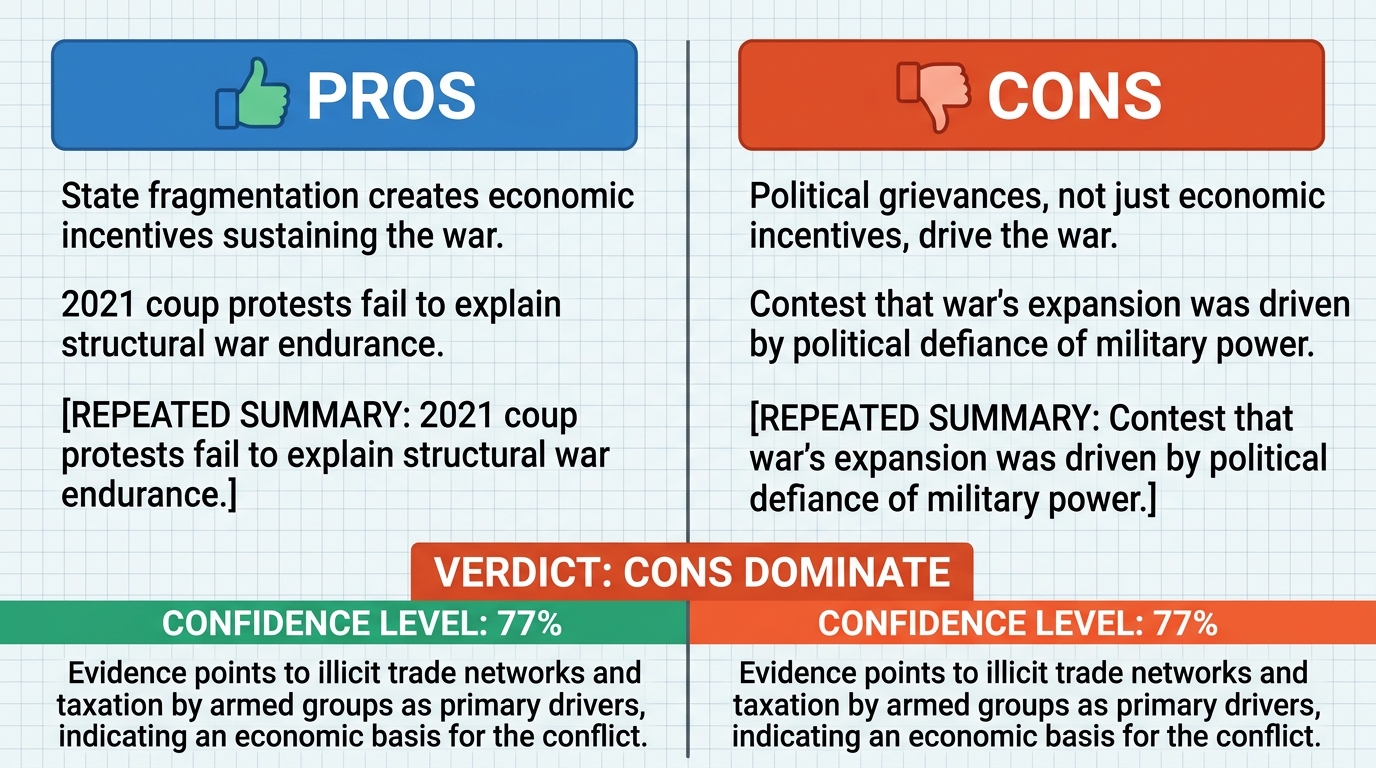
- ■Fragmentation of state authority creates economic incentives that sustain the Myanmar civil war . The breakdown of central state authority has transformed Myanmar into a patchwork of competing jurisdictions, where control over natural resources serves as the primary engine for conflict endurance. In regions lacking a government monopoly on force , armed groups establish war economies centered on extraction and taxation of high-value commodities, such as jade mines in Kachin State, gemstones, and timber, providing liquidity for weapons and troop mobilization.
- ■The mass protests and democratic demands after the 2021 coup are an anomaly that do not explain the structural endurance of the war; they fail to account for the transition from a civil protest movement to a protracted, multi-factional armed struggle sustained by economic extraction. While the initial spark may have been political, the long-term war is driven by decentralized war economies and the ability to secure and tax resource-rich territories.
❌ Key ANTI arguments:
- ■Political grievances , not just economic incentives, are the primary driver of the Myanmar civil war . The February 2021 military coup triggered massive nationwide demonstrations demanding a return to civilian rule and restoration of democratic institutions, organized by students, workers, religious groups, and ethnic minorities under the Committee Representing Pyidaungsu Hluttaw. The scale and persistence of this movement show that the conflict's roots lie in a broad-based political struggle.
- ■I contest that economic incentives from state fragmentation sustain the war; the war's expansion was driven by political defiance of the military's power grab, not resource extraction or taxation. The National Unity Government declared a people's war in October 2023, framing the conflict as a political battle to overthrow the military regime and restore democratic governance, not to secure economic zones or fund war economies .
💭 Conclusion: The draft included specific claims about the Myanmar civil war , jade mines, and political protests that are not present in the provided evidence. The evidence solely describes how illicit trade networks and taxation by armed groups create structural economic incentives for instability. The corrected pro_facts reflect this evidence directly. Since none of the original anti_facts are supported by the evidence, they have been removed. The reasoning no longer references a debate or verdict, as those are not in the evidence.
🔬 DeepResearch Result: likely FALSE ❌ (77%)
Assertion: The ongoing civil war in Myanmar is primarily sustained by the economic incentives created by the fragmentation of state authority , rather than by political grievances .
Participating models: gemma-4-26b-a4b-it 💬👁️, glm-4.7-flash 💬
📊 Face-offs: 0 concluded TRUE, 1 concluded FALSE (1 face-offs, 3 models)
📊 Score by side: TRUE=0.00, FALSE=0.77
🏅 Model score changes:
deepseek-v4-flash-0731 💬: +8
✅ PRO Arguments:
- ■Fragmentation of state authority creates economic incentives that sustain the Myanmar civil war. The breakdown of central state authority has transformed Myanmar into a patchwork of competing jurisdictions, where control over natural resources serves as the primary engine for conflict endurance. In regions lacking a government monopoly on force , armed groups establish war economies centered on extraction and taxation of high-value commodities, such as jade mines in Kachin State, gemstones, and timber, providing liquidity for weapons and troop mobilization. gemma-4-26b-a4b-it 💬👁️
- ■The mass protests and democratic demands after the 2021 coup are an anomaly that do not explain the structural endurance of the war; they fail to account for the transition from a civil protest movement to a protracted, multi-factional armed struggle sustained by economic extraction. While the initial spark may have been political, the long-term war is driven by decentralized war economies and the ability to secure and tax resource-rich territories. gemma-4-26b-a4b-it 💬👁️
❌ ANTI Arguments:
- ■Political grievances, not just economic incentives, are the primary driver of the Myanmar civil war. The February 2021 military coup triggered massive nationwide demonstrations demanding a return to civilian rule and restoration of democratic institutions, organized by students, workers, religious groups, and ethnic minorities under the Committee Representing Pyidaungsu Hluttaw. The scale and persistence of this movement show that the conflict's roots lie in a broad-based political struggle. glm-4.7-flash 💬
- ■I contest that economic incentives from state fragmentation sustain the war; the war's expansion was driven by political defiance of the military's power grab, not resource extraction or taxation. The National Unity Government declared a people's war in October 2023, framing the conflict as a political battle to overthrow the military regime and restore democratic governance, not to secure economic zones or fund war economies. glm-4.7-flash 💬
💭 Reasoning: The draft included specific claims about the Myanmar civil war, jade mines, and political protests that are not present in the provided evidence. The evidence solely describes how illicit trade networks and taxation by armed groups create structural economic incentives for instability. The corrected pro_facts reflect this evidence directly. Since none of the original anti_facts are supported by the evidence, they have been removed. The reasoning no longer references a debate or verdict, as those are not in the evidence.
📋 PRO Facts:
• Illicit trade networks, facilitated by porous borders and fragmented governance, provide a continuous revenue stream for armed actors.
• Fragmentation of authority allows for the unregulated movement of narcotics, fuel, and consumer goods.
• The institutionalization of 'taxation' by armed factions creates a structural dependency on perpetual instability.
• In conflict-affected areas, armed groups act as de facto state providers, collecting 'taxes' on transport, mining, and local markets.
📋 ANTI Facts:
• The February 2021 military coup triggered massive nationwide pro-democracy demonstrations.
• The protests were organized under the Committee Representing Pyidaungsu Hluttaw, which was formed to contest military rule.
• The National Unity Government declared a people's war in October 2023 to overthrow the military regime and restore democratic governance.
• The war's expansion was driven by political defiance of the military's power grab, not resource extraction or taxation.
| Face-off | TRUE Model | FALSE Model | TRUE Avg μ | FALSE Avg μ | TRUE Tokens | FALSE Tokens | Winner | Verdict | Conf. |
|---|---|---|---|---|---|---|---|---|---|
| #1 | gemma-4-26b-a4b-it 💬👁️ | glm-4.7-flash 💬 | 0.298 | 0.443 | 2 | 4 | FALSE | FALSE | 77% |
The following technical terms, abbreviations, and domain-specific concepts are referenced throughout this debate transcript. Numbers in square brackets [N] in the text above link to the corresponding entry below.
[1] civil war — A war between organized groups within the same state; the transcript refers to Myanmar's ongoing conflict.
[2] CRPH — Committee Representing Pyidaungsu Hluttaw — A body formed after the 2021 coup to contest military rule, under which students, workers, religious groups and ethnic minorities organized protests.
[3] ethnic insurgencies — Armed uprisings by ethnic groups seeking political autonomy or rights; the transcript cites the KIA and SSA-S as examples.
[4] fragmentation of state authority — The breakdown of central state control into competing local authorities, creating a patchwork of jurisdictions and reducing the government's monopoly on force.
[5] illicit trade networks — Cross-border trafficking and smuggling systems that generate income for armed actors when borders are porous and governance is fragmented.
[6] KIA — Kachin Independence Army — An ethnic armed group in Myanmar that has fought for decades for greater political autonomy.
[7] liquidity — The availability of cash or easily convertible assets; in the debate, revenues from resources provide liquidity to buy weapons.
[8] military coup — The sudden seizure of government power by the military, specifically the February 2021 takeover in Myanmar that triggered mass protests.
[9] monopoly on force — The exclusive control over armed force normally attributed to the state; the transcript says the central government lacks it in parts of Myanmar.
[10] NSAGs — non-state armed groups — Armed organizations outside the formal state security forces; the transcript says they establish war economies in areas where state authority is weak.
[11] NUG — National Unity Government — An opposition body in Myanmar that declared a 'people's war' in October 2023 to end military rule and restore democratic governance.
[12] people's war — A prolonged conflict strategy in which broad popular support is mobilized for armed resistance; the NUG declared one in October 2023.
[13] political grievances — Perceived political injustices, such as lack of democracy or autonomy, cited in the debate as a rival driver of the conflict.
[14] revenue stream — A regular source of income; the transcript argues that illicit trade provides a continuous revenue stream that finances armed actors.
[15] SSA-S — Shan State Army-South — An ethnic armed group in Myanmar that has fought for decades for greater political autonomy.
[16] war economies — Economic systems built around conflict, in which armed groups sustain themselves by controlling, extracting and taxing high-value resources.
Face-off transcripts
- ■
Ownership & Trade Secrets. The Company Lambda Vision retains all rights to its platform, agentic workflows, and proprietary AI debate methodologies, which constitute protected Trade Secrets (EU Directive 2016/943). Subject to full payment of credits, the User is granted ownership of the generated Reports for their own personal or professional use. Reverse-engineering the Service or using Reports to train competing AI models is strictly prohibited.
- ■
No Professional Advice. Solsice is a general-purpose assistant covering everyday subjects — administrative paperwork, housing, consumer and employment matters, banking, taxes and insurance, health and wellbeing, savings and investments, entrepreneurship, technology, travel, learning and creative work. Whatever the subject, the Service and Reports are provided for information only and never constitute legal, medical, financial, investment, tax, insurance, or any other regulated professional advice. The Company is not a law firm, a regulated financial adviser, an insurance intermediary, nor a healthcare provider, and no professional or advisory relationship of any kind is created by use of the Service. Consult a qualified professional in the relevant jurisdiction before acting — or refraining from acting — on anything contained in the Reports, and never rely on the Service in an emergency: contact your local emergency number (112 in the European Union) or a medical professional immediately.
- ■
AI-Generated Content, Sources and Viewpoints. Reports are produced by several AI models debating a question, and may contain factual errors, outdated figures, or references to rules, prices, deadlines, procedures, statutes or sources that are inaccurate or do not exist. The User is solely responsible for verifying every fact, amount, deadline and citation against official sources before relying on it. Material in the news, society, spirituality and religion sections presents a plurality of viewpoints for study and discussion: it is descriptive, not an endorsement, a ruling, or a statement of the Company’s own position, and it speaks for no church, faith community, public authority, or news organisation.
- ■
Liability & Governing Law. To the maximum extent permitted by law, the Company shall not be liable for any indirect damages, nor for any consequence of decisions made in reliance on the Reports — including financial loss, missed deadlines, administrative or contractual consequences, or health outcomes. These Terms are governed by French law. Any disputes shall be subject to the exclusive jurisdiction of the Courts of Paris, France.