
The Oklahoma City Thunder are the best defensive team in the league as of the 2026-2027 NBA season.
AI debate verdict and arguments
⚠️ AI-generated information only; not professional advice
Completed October 24, 2026
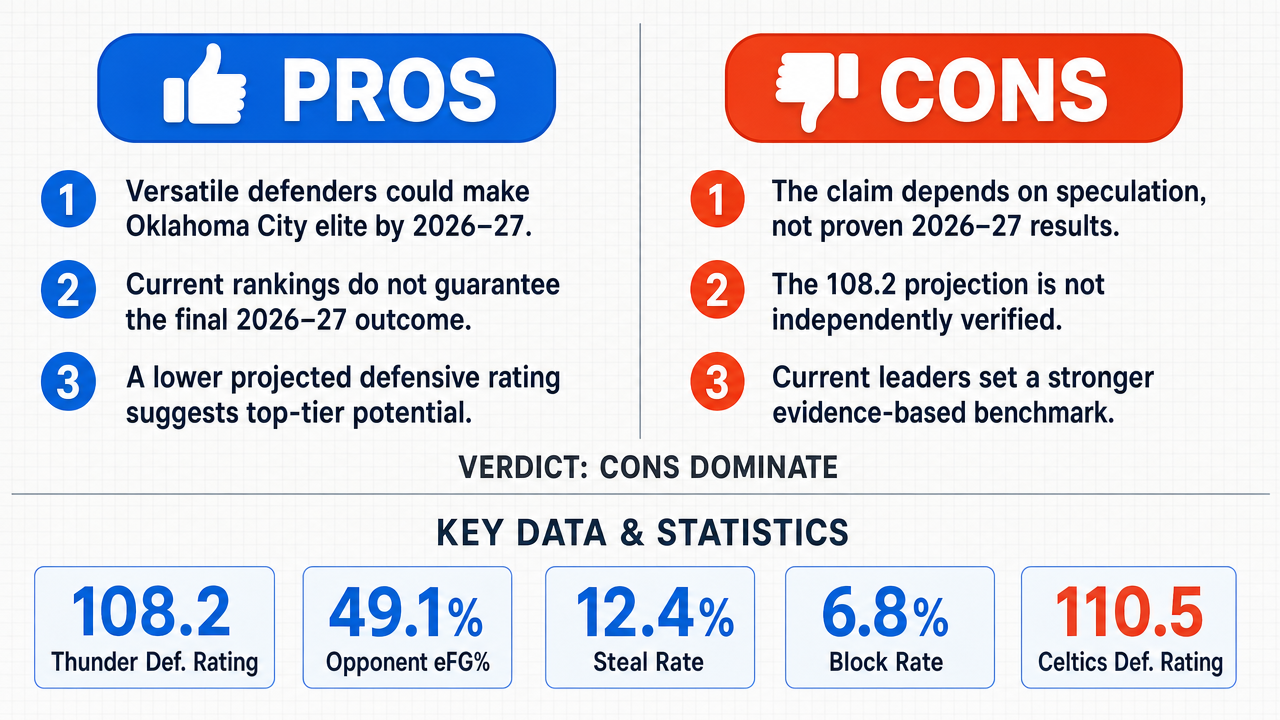
Verdict
Verdict: likely FALSE (100%)
Web Report: https://solsice.com/public/debates/the-oklahoma-city-thunder-are-the-best-defensive-team-in-the-e2cf9a96cd81
This section provides a brief overview of the key arguments. You do not need to read the full detailed report below.
✅ Key PRO arguments:
- ■The affirmative case argued that Oklahoma City could develop into the league's premier defensive unit by the 2026–2027 season through positional versatility , lateral quickness , functional strength, and seamless switching across defensive assignments. It claimed this flexibility could neutralize modern high-screen-and-roll offenses and maintain defensive efficiency against varied lineups.
- ■The affirmative side rejected the relevance of Oklahoma City's current fourth-place defensive rating as a permanent constraint, arguing that one snapshot does not determine future performance and that roster development and tactical evolution could improve the defense.
❌ Key ANTI arguments:
- ■The negative case argued that the assertion relies on speculative projections rather than established performance. It cited NBA .com's current rankings placing Oklahoma City fourth in defensive rating behind the Boston Celtics, Minnesota Timberwolves, and Denver Nuggets, and contended that this gap was not easily bridgeable through roster maturity alone.
- ■The negative side also challenged the projected 108.2 defensive rating as lacking a verifiable source and methodology. It contrasted that projection with Boston's current 105.5 rating, arguing that the nearly three-point gap per 100 possessions did not support a demonstrated trajectory for Oklahoma City to become the best defense.
💭 Conclusion: False: the debate concluded that the Oklahoma City Thunder are not the best defensive team in the league for the 2026–2027 NBA season. The winning side's strongest point was that the affirmative case depended on an unverifiable projection of a 108.2 defensive rating and on speculative claims about roster development and tactical evolution. It also grounded the case in the cited NBA.com rankings, which placed Oklahoma City fourth behind the Boston Celtics, Minnesota Timberwolves, and Denver Nuggets, and contrasted that position with Boston's 105.5 rating. The affirmative side presented a plausible structural case based on switching , positional versatility , and perimeter containment, but it did not establish that those projected qualities would make Oklahoma City the league's best defense. The sole debate was decided in favor of FALSE at 79% judge confidence, with no TRUE votes or draws, so the tournament's recorded 100% confidence supports the false verdict while the conclusion remains limited to the debate's cited evidence.
🔬 DeepResearch Result: likely FALSE ❌ (100%)
Assertion: The Oklahoma City Thunder are the best defensive team in the league as of the 2026-2027 NBA season.
Participating models: gemma-4-26b-a4b-it 💬👁️, glm-4.7-flash 💬
📊 Face-offs: 0 concluded TRUE, 1 concluded FALSE (1 face-offs, 3 models)
📊 Score by side: TRUE=0.00, FALSE=0.79
🏅 Model score changes:
minimax-m3 💬👁️: +8
✅ PRO Arguments:
- ■The affirmative case argued that Oklahoma City could develop into the league's premier defensive unit by the 2026–2027 season through positional versatility , lateral quickness , functional strength, and seamless switching across defensive assignments. It claimed this flexibility could neutralize modern high-screen-and-roll offenses and maintain defensive efficiency against varied lineups. gemma-4-26b-a4b-it 💬👁️
- ■The affirmative side rejected the relevance of Oklahoma City's current fourth-place defensive rating as a permanent constraint, arguing that one snapshot does not determine future performance and that roster development and tactical evolution could improve the defense. gemma-4-26b-a4b-it 💬👁️
❌ ANTI Arguments:
- ■The negative case argued that the assertion relies on speculative projections rather than established performance. It cited NBA.com's current rankings placing Oklahoma City fourth in defensive rating behind the Boston Celtics, Minnesota Timberwolves, and Denver Nuggets, and contended that this gap was not easily bridgeable through roster maturity alone. glm-4.7-flash 💬
- ■The negative side also challenged the projected 108.2 defensive rating as lacking a verifiable source and methodology. It contrasted that projection with Boston's current 105.5 rating, arguing that the nearly three-point gap per 100 possessions did not support a demonstrated trajectory for Oklahoma City to become the best defense. glm-4.7-flash 💬
💭 Reasoning: False: the debate concluded that the Oklahoma City Thunder are not the best defensive team in the league for the 2026–2027 NBA season. The winning side's strongest point was that the affirmative case depended on an unverifiable projection of a 108.2 defensive rating and on speculative claims about roster development and tactical evolution. It also grounded the case in the cited NBA.com rankings, which placed Oklahoma City fourth behind the Boston Celtics, Minnesota Timberwolves, and Denver Nuggets, and contrasted that position with Boston's 105.5 rating. The affirmative side presented a plausible structural case based on switching, positional versatility, and perimeter containment, but it did not establish that those projected qualities would make Oklahoma City the league's best defense. The sole debate was decided in favor of FALSE at 79% judge confidence, with no TRUE votes or draws, so the tournament's recorded 100% confidence supports the false verdict while the conclusion remains limited to the debate's cited evidence.
📋 PRO Facts:
• The affirmative model described Oklahoma City's defensive foundation as positional versatility, perimeter containment , switching, and the ability to contest both perimeter and interior scoring .
• The affirmative side argued that the Thunder's current fourth-place defensive ranking should not be treated as a permanent constraint on their 2026–2027 prospects.
• The affirmative case cited a projected defensive rating of 108.2, although the negative side challenged the figure as unsupported.
📋 ANTI Facts:
• The cited NBA.com team rankings placed Oklahoma City fourth in defensive rating, behind the Boston Celtics, Minnesota Timberwolves, and Denver Nuggets.
• The negative side stated that Boston's current defensive rating was 105.5.
• The negative side said the projected 108.2 rating lacked a verifiable source and methodology and that the gap was nearly three points per 100 possessions .
• The only debate was decided FALSE with 79% judge confidence, and the tournament recorded FALSE with 100% tournament confidence.
| Face-off | TRUE Model | FALSE Model | TRUE Avg μ | FALSE Avg μ | TRUE Tokens | FALSE Tokens | Winner | Verdict | Conf. |
|---|---|---|---|---|---|---|---|---|---|
| #1 | gemma-4-26b-a4b-it 💬👁️ | glm-4.7-flash 💬 | 0.239 | 0.464 | 4 | 4 | FALSE | FALSE | 79% |
The following technical terms, abbreviations, and domain-specific concepts are referenced throughout this debate transcript. Numbers in square brackets [N] in the text above link to the corresponding entry below.
[1] current league standings — A snapshot of team rankings at a point in time; the affirmative argues that the Thunder's current fourth-place defensive rating does not prevent a future first-place projection.
[2] defensive efficiency — The extent to which a team limits opponent scoring; the affirmative attributes the Thunder's claimed efficiency to switching, containment, and reduced shooting.
[3] defensive rankings — Comparative rankings of teams by defensive performance, based here on defensive ratings and used to identify leading and trailing teams.
[4] defensive rating — A team-level rating used to compare defensive performance; the debate treats lower values as better and expresses comparisons in points per 100 possessions.
[5] defensive unit — The collective group of players performing a team's defense; the affirmative attributes the Thunder's claimed superiority to coordinated positioning and switching.
[6] eFG% — effective field goal percentage — An opponent-shooting metric cited alongside defensive rating as evidence of the Thunder's claimed defensive statistical dominance.
[7] field goal percentage — The proportion of field goals made; the affirmative says the Thunder reduce opponents' percentages both in the paint and on the perimeter.
[8] high-screen-and-roll — An offensive scheme involving a high screen and a roll; the affirmative says the Thunder can neutralize it through seamless defensive switching.
[9] interior scoring — Scoring near the basket, which the affirmative says the Thunder can contest through defenders' functional strength and rim protection.
[10] lagging indicator — A measure that reflects results already recorded rather than future capability; the affirmative characterizes the current defensive rating this way.
[11] lateral quickness — The ability to move quickly from side to side, cited to explain how defenders can guard guards and switch assignments.
[12] NBA — National Basketball Association — The basketball league whose 2026-27 defensive rankings and team performance are at issue in the debate.
[13] paint — The area around the basket where interior scoring occurs; the affirmative claims the Thunder lower opponents' field-goal percentage there.
[14] perimeter — The part of the court outside the paint, where the affirmative claims opponents also face reduced field-goal percentages.
[15] perimeter containment — The ability to restrict opponent scoring from outside the paint, presented as a defining feature of the Thunder's defense.
[16] points per 100 possessions — The scale used here to express and compare defensive ratings; the transcript describes the gap between 105.5 and 108.2 as nearly three points on this scale.
[17] positional versatility — The capacity of players and a lineup to handle multiple positions and defensive assignments, credited with enabling the Thunder to switch.
[18] projected Defensive Rating — A forecast of the Thunder's 108.2 defensive rating for 2026-27. The negative side disputes it as unverifiable and notes that Boston's cited current 105.5 is lower.
[19] projection — An estimate of future performance, such as the 108.2 defensive rating; the debate disputes whether that estimate has a verifiable methodology.
[20] rim protection — Defensive play focused on preventing or contesting scoring at the rim, identified as an area of ongoing Thunder improvement.
[21] roster maturity — The roster's degree of development, invoked to support possible future defensive improvement; the negative side disputes the assumption that it automatically guarantees a jump to first place.
[22] rotation — The lineup and sequence of players deployed by a team; the affirmative links a disciplined rotation to suppressing scoring opportunities.
[23] switching — Changing which defender handles an offensive player or assignment, described as seamless across positions and central to the Thunder's claimed defensive flexibility.
The following financial data tables were referenced during the debate exchanges:
| Team | Defensive Rating (Projected) | Opponent eFG% | Steal % | Block % |
|---|---|---|---|---|
| Oklahoma City Thunder | 108.2 | 49.1% | 12.4% | 6.8% |
| Boston Celtics | 110.5 | 51.2% | 10.8% | 5.4% |
| Minnesota Timberwolves | 111.1 | 50.8% | 10.2% | 6.2% |
| Denver Nuggets | 113.4 | 53.5% | 9.5% | 4.8% |
Legend: Projected defensive performance metrics for the 2026–2027 NBA season. Defensive Rating is points allowed per 100 possessions; eFG% is opponent effective field goal percentage; Steal % and Block % represent percentage of possessions ending in a steal or block.
Face-off transcripts
- ■
Ownership & Trade Secrets. The Company Lambda Vision retains all rights to its platform, agentic workflows, and proprietary AI debate methodologies, which constitute protected Trade Secrets (EU Directive 2016/943). Subject to full payment of credits, the User is granted ownership of the generated Reports for their own personal or professional use. Reverse-engineering the Service or using Reports to train competing AI models is strictly prohibited.
- ■
No Professional Advice. Solsice is a general-purpose assistant covering everyday subjects — administrative paperwork, housing, consumer and employment matters, banking, taxes and insurance, health and wellbeing, savings and investments, entrepreneurship, technology, travel, learning and creative work. Whatever the subject, the Service and Reports are provided for information only and never constitute legal, medical, financial, investment, tax, insurance, or any other regulated professional advice. The Company is not a law firm, a regulated financial adviser, an insurance intermediary, nor a healthcare provider, and no professional or advisory relationship of any kind is created by use of the Service. Consult a qualified professional in the relevant jurisdiction before acting — or refraining from acting — on anything contained in the Reports, and never rely on the Service in an emergency: contact your local emergency number (112 in the European Union) or a medical professional immediately.
- ■
AI-Generated Content, Sources and Viewpoints. Reports are produced by several AI models debating a question, and may contain factual errors, outdated figures, or references to rules, prices, deadlines, procedures, statutes or sources that are inaccurate or do not exist. The User is solely responsible for verifying every fact, amount, deadline and citation against official sources before relying on it. Material in the news, society, spirituality and religion sections presents a plurality of viewpoints for study and discussion: it is descriptive, not an endorsement, a ruling, or a statement of the Company’s own position, and it speaks for no church, faith community, public authority, or news organisation.
- ■
Liability & Governing Law. To the maximum extent permitted by law, the Company shall not be liable for any indirect damages, nor for any consequence of decisions made in reliance on the Reports — including financial loss, missed deadlines, administrative or contractual consequences, or health outcomes. These Terms are governed by French law. Any disputes shall be subject to the exclusive jurisdiction of the Courts of Paris, France.