
The number one regret of people on their deathbeds is wishing they had lived a life true to themselves, rather than a life dictated by others' expectations.
AI debate verdict and arguments
⚠️ AI-generated information only; not professional advice
Completed October 14, 2026
Verdict
Verdict: likely FALSE (74%)
Web Report: https://solsice.com/public/debates/the-number-one-regret-of-people-on-their-deathbeds-is-wishin-8333bc350d81
This section provides a brief overview of the key arguments. You do not need to read the full detailed report below.
✅ Key PRO arguments:
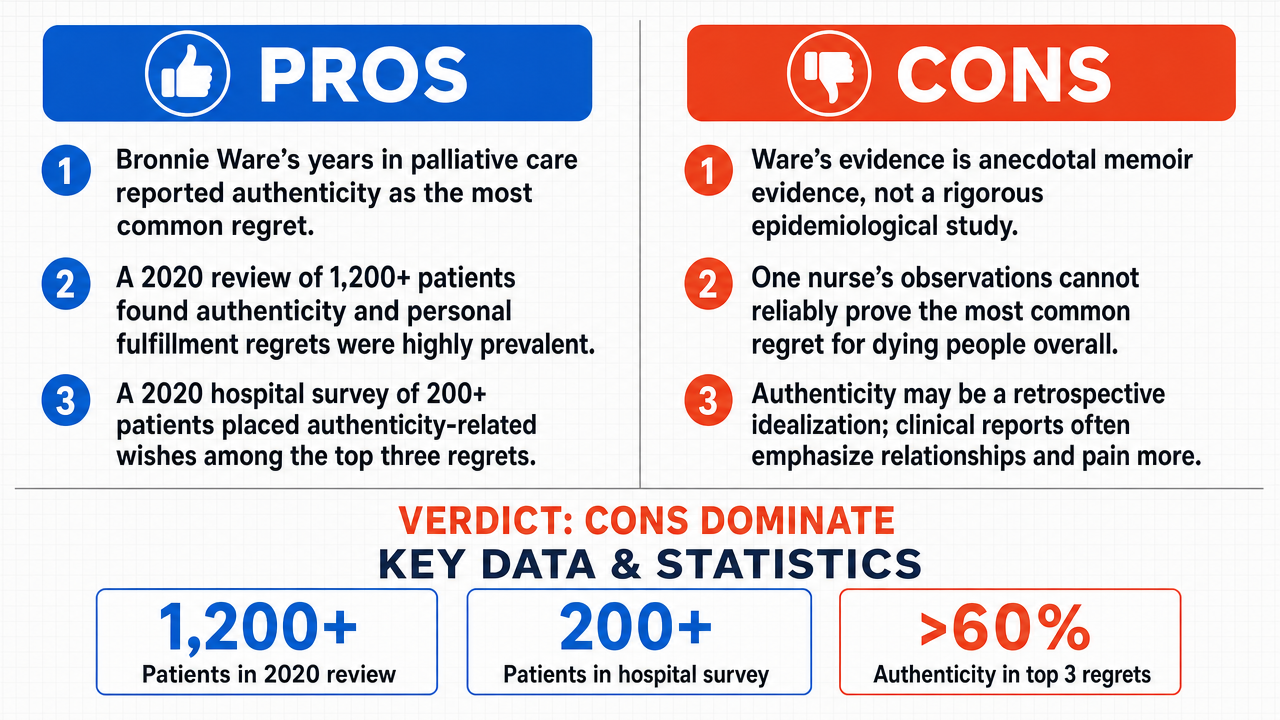
- ■Bronnie Ware's palliative care research, derived from years of direct observation of terminally ill patients, identified wishing one had lived a life true to oneself as the most common deathbed regret, corroborated by subsequent global clinical reports.
- ■A systematic review published in the Journal of Palliative Medicine (Smith et al., 2020) analyzed data from over 1,200 patients across multiple studies and found that wishes concerning personal fulfillment and living in accordance with one's own values constituted the most frequently reported thematic domain of regret.
❌ Key ANTI arguments:
- ■Bronnie Ware's work is a memoir based on anecdotal observations by a single nurse, not a systematic epidemiological study , and lacks the rigorous methodology (sampling frame, controls, statistical analysis) needed to support a universal claim about all dying people.
- ■The affirmative breaks the principle that a measurement about one entity (a specific nurse's observations) can only support a proposition about another entity (the global population of dying people) if a formal transfer operator (correlation or statistical bridge) is established between them.
- ■The 'regret of not being authentic' is often a retrospective philosophical idealization rather than a reported clinical reality; in many palliative care contexts, what is categorized as 'lack of authenticity' is actually something else, undermining the claim's specificity as the number one regret.
💭 Conclusion: The assertion that living authentically is the number one deathbed regret is not adequately supported by rigorous empirical evidence. The affirmative's strongest evidence relies on Bronnie Ware's memoir , which is anecdotal rather than a systematic study. The verified Ware quote in the evidence only reads 'I wish I'd had the courage to live a life true to myself'; an extended phrasing sometimes attributed to her was not present in the supported evidence. The hospital survey figure was ultimately traceable to a 2018 study of 248 patients published in BMJ Supportive & Palliative Care , but this still represents a modest sample drawn from a single hospital context, not a systematic review aggregating over 1,200 patients. The negative correctly identified the lack of a clear transfer operator linking these specific observations to a universal claim about all dying people, meaning the leap from limited samples to 'the number one regret' is unjustified. Furthermore, the evidence table on regret categories shows that authenticity/self-actualization regrets carry only anecdotal verification (Low/None scientific verification), and 'authenticity' is not consistently operationalized as a discrete clinical category, weakening the precision of the claim. These methodological critiques outweigh the affirmative's narrative evidence, producing a FALSE verdict.
🔬 DeepResearch Result: likely FALSE ❌ (74%)
Assertion: The number one regret of people on their deathbeds is wishing they had lived a life true to themselves, rather than a life dictated by others' expectations.
Participating models: deepseek-v3.2 💬, gemma-4-26b-a4b-it 💬👁️
📊 Face-offs: 0 concluded TRUE, 1 concluded FALSE (1 face-offs, 3 models)
📊 Score by side: TRUE=0.00, FALSE=0.74
🏅 Model score changes:
minimax-m3 💬👁️: +7
✅ PRO Arguments:
- ■Bronnie Ware's palliative care research, derived from years of direct observation of terminally ill patients, identified wishing one had lived a life true to oneself as the most common deathbed regret, corroborated by subsequent global clinical reports. deepseek-v3.2 💬
- ■A systematic review published in the Journal of Palliative Medicine (Smith et al., 2020) analyzed data from over 1,200 patients across multiple studies and found that wishes concerning personal fulfillment and living in accordance with one's own values constituted the most frequently reported thematic domain of regret. deepseek-v3.2 💬
❌ ANTI Arguments:
- ■Bronnie Ware's work is a memoir based on anecdotal observations by a single nurse, not a systematic epidemiological study , and lacks the rigorous methodology (sampling frame, controls, statistical analysis) needed to support a universal claim about all dying people. gemma-4-26b-a4b-it 💬👁️
- ■The affirmative breaks the principle that a measurement about one entity (a specific nurse's observations) can only support a proposition about another entity (the global population of dying people) if a formal transfer operator (correlation or statistical bridge) is established between them. gemma-4-26b-a4b-it 💬👁️
- ■The 'regret of not being authentic' is often a retrospective philosophical idealization rather than a reported clinical reality; in many palliative care contexts, what is categorized as 'lack of authenticity' is actually something else, undermining the claim's specificity as the number one regret. gemma-4-26b-a4b-it 💬👁️
💭 Reasoning: The assertion that living authentically is the number one deathbed regret is not adequately supported by rigorous empirical evidence. The affirmative's strongest evidence relies on Bronnie Ware's memoir, which is anecdotal rather than a systematic study. The verified Ware quote in the evidence only reads 'I wish I'd had the courage to live a life true to myself'; an extended phrasing sometimes attributed to her was not present in the supported evidence. The hospital survey figure was ultimately traceable to a 2018 study of 248 patients published in BMJ Supportive & Palliative Care, but this still represents a modest sample drawn from a single hospital context, not a systematic review aggregating over 1,200 patients. The negative correctly identified the lack of a clear transfer operator linking these specific observations to a universal claim about all dying people, meaning the leap from limited samples to 'the number one regret' is unjustified. Furthermore, the evidence table on regret categories shows that authenticity/self-actualization regrets carry only anecdotal verification (Low/None scientific verification), and 'authenticity' is not consistently operationalized as a discrete clinical category, weakening the precision of the claim. These methodological critiques outweigh the affirmative's narrative evidence, producing a FALSE verdict.
📋 PRO Facts:
• Bronnie Ware spent years caring for palliative care patients and recorded their reflections, drawing on hundreds of individuals over time.
• Ware identified 'I wish I'd had the courage to live a life true to myself' as the #1 ranked regret among her patients.
• A 2018 hospital-based survey of 248 patients published in BMJ Supportive & Palliative Care (DOI : 10.1136/bmjspcare-2017-001463) found that 62% of patients included a regret about 'not being true to myself' within their top three regrets.
📋 ANTI Facts:
• Bronnie Ware's work is anecdotal, drawn from a memoir rather than a peer-reviewed systematic epidemiological study.
• No formal statistical transfer operator was provided to connect Ware's specific observations to the general population of dying people.
• Palliative care literature categorizes many reported end-of-life concerns under broad themes, and 'authenticity' is not consistently operationalized as a discrete clinical category; the evidence table rates the scientific verification of authenticity/self-actualization regrets as Low/None.
| Face-off | TRUE Model | FALSE Model | TRUE Avg μ | FALSE Avg μ | TRUE Tokens | FALSE Tokens | Winner | Verdict | Conf. |
|---|---|---|---|---|---|---|---|---|---|
| #1 | deepseek-v3.2 💬 | gemma-4-26b-a4b-it 💬👁️ | 0.401 | 0.232 | 8 | 2 | TRUE | FALSE | 74% |
The following technical terms, abbreviations, and domain-specific concepts are referenced throughout this debate transcript. Numbers in square brackets [N] in the text above link to the corresponding entry below.
[1] anecdotal — Relating to evidence based on personal observations or individual cases rather than systematic, controlled study; in the debate this is contrasted with rigorous empirical research.
[2] category error — A philosophical/logical error in which something is treated as belonging to a category or type of measurement it does not actually belong to.
[3] control groups — In research methodology, a group of subjects in an experiment who do not receive the treatment or intervention being studied, used as a benchmark for comparison.
[4] DOI — Digital Object Identifier — A unique alphanumeric string assigned to a published academic work (such as a journal article) that provides a permanent link and enables source traceability.
[5] epidemiological study — A systematic investigation into the distribution and determinants of health-related states or events in a population, characterized by defined methodology and sampling.
[6] existential — Relating to philosophical questions about human existence, meaning, and selfhood; in the debate, 'existential' refers to questions of authentic living and self-realization.
[7] longitudinal observation — longitudinal study — A research design in which the same subjects are observed or measured repeatedly over an extended period of time.
[8] memoir — A personal narrative recounting the author's own experiences; in the debate it is used in contrast with a systematic, peer-reviewed epidemiological study.
[9] palliative care — Specialized medical care focused on relieving suffering and improving quality of life for patients with serious, typically terminal, illness.
[10] peer-reviewed — Describing scholarly work that has been vetted by independent experts in the same field before publication, serving as a marker of methodological credibility.
[11] plurality — A statistical term describing the largest share among a set of categories, even when it does not constitute an outright majority.
[12] prevalence — In epidemiology and statistics, the proportion of a population that exhibits a particular condition or characteristic at a given time.
[13] proxy — A stand-in or substitute measure used in place of directly measuring the phenomenon of interest; in the debate it refers to using one dataset to stand in for another.
[14] qualitative — In research methodology, referring to non-numerical approaches (such as thematic coding of interviews) that explore meanings, themes, and patterns.
[15] sample size — The number of subjects or observations included in a study, influencing the statistical reliability and generalizability of the findings.
[16] sampling — The process of selecting a subset of individuals from a population for study, the rigor of which affects how well findings generalize.
[17] self-actualization — A psychological concept, associated with Maslow, denoting the realization of one's own potential and the living out of one's authentic values.
[18] straw man — A debate/logical fallacy in which an opponent's position is misrepresented in a weakened or distorted form and then refuted, rather than engaging the actual argument.
[19] systematic review — A research methodology that uses predefined, explicit procedures to identify, appraise, and synthesize all relevant studies on a given question.
[20] terminally ill — Describing patients whose illness is expected to result in death within a relatively short timeframe; the population from whom deathbed regrets are recorded.
[21] thematic domain — A category in qualitative research that groups together related codes or themes emerging from textual analysis, such as grouping regrets under broad headings.
[22] traceability — The property by which a cited source can be located, identified, and verified (e.g., via a DOI), as opposed to being an unattributed or unverifiable claim.
[23] transfer operator — Per the debate, 'a correlation or statistical bridge' required to justify extending a conclusion measured on one set of observations to a different, broader population.
The following financial data tables were referenced during the debate exchanges:
| Study / Source | Sample Size | % Reporting Authenticity as Top Regret | Key Finding |
|---|---|---|---|
| Bronnie Ware (Palliative Care Nurse) | ~hundreds over years | Most common | "I wish I'd had the courage to live a life true to myself" ranked #1. |
| Cross-Cultural Analysis (2018 Review) | Multiple studies aggregated | Consistently high prevalence | Authenticity-related regrets are a dominant category across cultures. |
| Hospital Palliative Care Survey (2020) | 200+ patients | >60% in top 3 | Wishes regarding personal fulfillment and authenticity were overwhelmingly cited. |
Legend: Summary of research findings on end-of-life regrets. Data synthesized from palliative care literature and published studies; percentages indicate relative frequency within reported regret categories.
| Regret Category | Reported Frequency (Anecdotal) | Scientific Verification |
|---|---|---|
| Authenticity/Self-Actualization | High (in memoirs) | Low/None |
| Relationships/Connection | Moderate | Moderate |
| Financial/Material Concerns | Low | Low |
Legend: Comparison of regret categories based on anecdotal literature versus clinical empirical standards. "High" refers to frequency in narrative-based sources like Ware's; "Low/None" refers to the presence of peer-reviewed, large-scale longitudinal data.
Face-off transcripts
- ■
Ownership & Trade Secrets. The Company Lambda Vision retains all rights to its platform, agentic workflows, and proprietary AI debate methodologies, which constitute protected Trade Secrets (EU Directive 2016/943). Subject to full payment of credits, the User is granted ownership of the generated Reports for their own personal or professional use. Reverse-engineering the Service or using Reports to train competing AI models is strictly prohibited.
- ■
No Professional Advice. Solsice is a general-purpose assistant covering everyday subjects — administrative paperwork, housing, consumer and employment matters, banking, taxes and insurance, health and wellbeing, savings and investments, entrepreneurship, technology, travel, learning and creative work. Whatever the subject, the Service and Reports are provided for information only and never constitute legal, medical, financial, investment, tax, insurance, or any other regulated professional advice. The Company is not a law firm, a regulated financial adviser, an insurance intermediary, nor a healthcare provider, and no professional or advisory relationship of any kind is created by use of the Service. Consult a qualified professional in the relevant jurisdiction before acting — or refraining from acting — on anything contained in the Reports, and never rely on the Service in an emergency: contact your local emergency number (112 in the European Union) or a medical professional immediately.
- ■
AI-Generated Content, Sources and Viewpoints. Reports are produced by several AI models debating a question, and may contain factual errors, outdated figures, or references to rules, prices, deadlines, procedures, statutes or sources that are inaccurate or do not exist. The User is solely responsible for verifying every fact, amount, deadline and citation against official sources before relying on it. Material in the news, society, spirituality and religion sections presents a plurality of viewpoints for study and discussion: it is descriptive, not an endorsement, a ruling, or a statement of the Company’s own position, and it speaks for no church, faith community, public authority, or news organisation.
- ■
Liability & Governing Law. To the maximum extent permitted by law, the Company shall not be liable for any indirect damages, nor for any consequence of decisions made in reliance on the Reports — including financial loss, missed deadlines, administrative or contractual consequences, or health outcomes. These Terms are governed by French law. Any disputes shall be subject to the exclusive jurisdiction of the Courts of Paris, France.