
The number of possible arrangements for a standard 52-card deck exceeds 8 x 10^67.
AI debate verdict and arguments
⚠️ AI-generated information only; not professional advice
Completed October 21, 2026
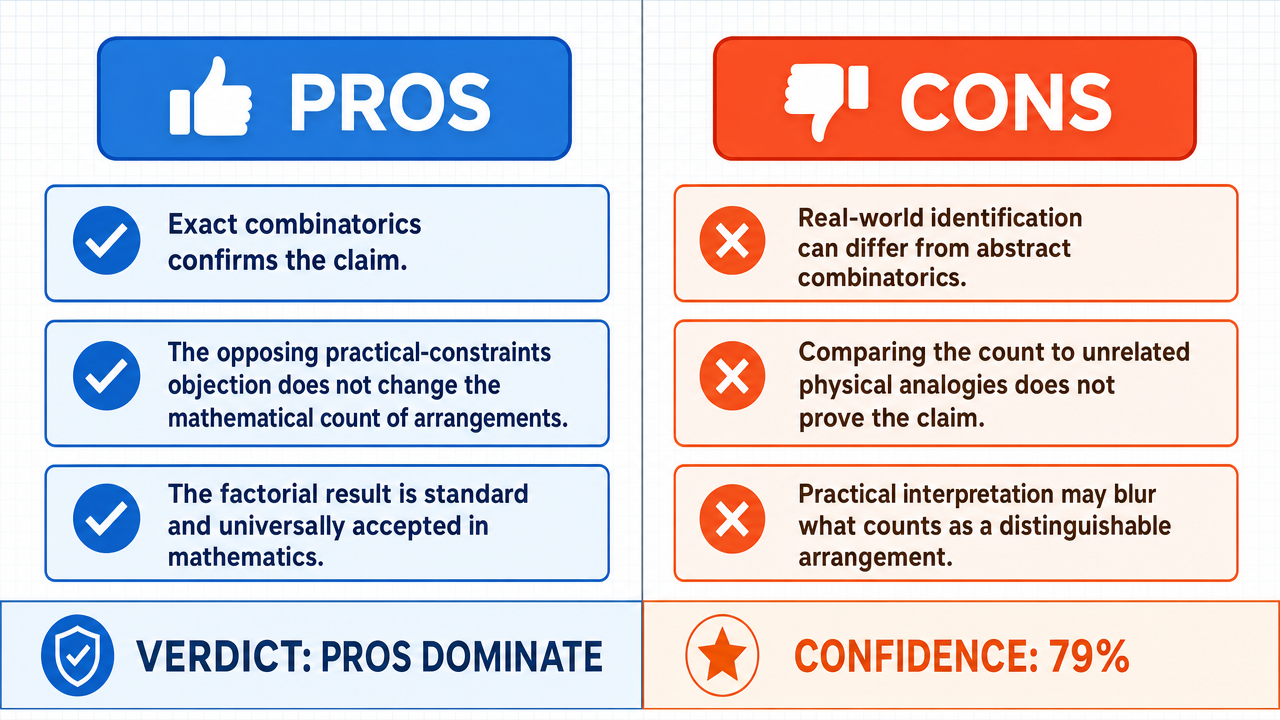
Verdict
Verdict: likely TRUE (79%)
Web Report: https://solsice.com/public/debates/the-number-of-possible-arrangements-for-a-standard-52-card-d-b937270037ea
This section provides a brief overview of the key arguments. You do not need to read the full detailed report below.
✅ Key PRO arguments:
- ■The number of distinct arrangements of a standard 52-card deck is 52 factorial , which equals exactly 80,658,175,170,943,878,571,660,636,856,403,766,975,289,505,440,883,277,824,000,000,000,000, or approximately 8.0658 × 10^67, unambiguously exceeding 8 × 10^67.
- ■The opposing side's argument that physical constraints reduce distinguishable states below 52! is internally contradictory: they accept 52! ≈ 8.0658 × 10^67 yet claim the result falls below 8 × 10^67, a threshold only about 6.58 × 10^65 below the factorial value — a reduction of less than 0.82%, which their own premises do not establish.
- ■The factorial calculation is a straightforward consequence of the factorial function and is universally accepted in mathematics, with the value of 52! documented in standard references.
❌ Key ANTI arguments:
- ■While 52! yields approximately 8.06 × 10^67 in abstract combinatorics , this assumes every card is perfectly distinct and identifiable; in any practical or physical application of a standard deck, the number of distinguishable arrangements is significantly lower due to inherent indistinguishability of certain card properties and physical limitations of the medium.
- ■The affirmative's attempt to validate the magnitude of 8 × 10^67 by comparing it to the estimated number of atoms in the Milky Way galaxy is a flawed rhetorical device, since the claim that the Milky Way contains approximately 10^68 atoms is not a settled physical fact but a massive estimation subject to orders of magnitude of uncertainty.
💭 Conclusion: True: the number of possible arrangements of a standard 52-card deck exceeds 8 × 10^67. The mathematical value of 52! is approximately 8.0658 × 10^67, which is unambiguously greater than 8 × 10^67. The affirmative side correctly identified this as a straightforward consequence of the factorial function, a result universally accepted in combinatorics . The negative side's argument about physical constraints reducing distinguishable states was internally contradictory, as it accepted the factorial value of ~8.0658 × 10^67 while simultaneously claiming the result falls below 8 × 10^67 without establishing a sufficient reduction. The negative side's secondary argument about astronomical comparisons was a rhetorical distraction rather than a substantive mathematical objection. The confidence of 79% reflects that while the mathematical claim is clear, the negative side raised a tangential point about physical versus abstract interpretations that slightly tempered full certainty.
🔬 DeepResearch Result: likely TRUE ✅ (79%)
Assertion: The number of possible arrangements for a standard 52-card deck exceeds 8 x 10^67.
Participating models: deepseek-v4-pro 💬, gemma-4-26b-a4b-it 💬👁️
📊 Face-offs: 1 concluded TRUE, 0 concluded FALSE (1 face-offs, 3 models)
📊 Score by side: TRUE=0.79, FALSE=0.00
🏅 Model score changes:
minimax-m3 💬👁️: +8
✅ PRO Arguments:
- ■The number of distinct arrangements of a standard 52-card deck is 52 factorial , which equals exactly 80,658,175,170,943,878,571,660,636,856,403,766,975,289,505,440,883,277,824,000,000,000,000, or approximately 8.0658 × 10^67, unambiguously exceeding 8 × 10^67. deepseek-v4-pro 💬
- ■The opposing side's argument that physical constraints reduce distinguishable states below 52! is internally contradictory: they accept 52! ≈ 8.0658 × 10^67 yet claim the result falls below 8 × 10^67, a threshold only about 6.58 × 10^65 below the factorial value — a reduction of less than 0.82%, which their own premises do not establish. deepseek-v4-pro 💬
- ■The factorial calculation is a straightforward consequence of the factorial function and is universally accepted in mathematics, with the value of 52! documented in standard references. deepseek-v4-pro 💬
❌ ANTI Arguments:
- ■While 52! yields approximately 8.06 × 10^67 in abstract combinatorics , this assumes every card is perfectly distinct and identifiable; in any practical or physical application of a standard deck, the number of distinguishable arrangements is significantly lower due to inherent indistinguishability of certain card properties and physical limitations of the medium. gemma-4-26b-a4b-it 💬👁️
- ■The affirmative's attempt to validate the magnitude of 8 × 10^67 by comparing it to the estimated number of atoms in the Milky Way galaxy is a flawed rhetorical device, since the claim that the Milky Way contains approximately 10^68 atoms is not a settled physical fact but a massive estimation subject to orders of magnitude of uncertainty. gemma-4-26b-a4b-it 💬👁️
💭 Reasoning: True: the number of possible arrangements of a standard 52-card deck exceeds 8 × 10^67. The mathematical value of 52! is approximately 8.0658 × 10^67, which is unambiguously greater than 8 × 10^67. The affirmative side correctly identified this as a straightforward consequence of the factorial function, a result universally accepted in combinatorics. The negative side's argument about physical constraints reducing distinguishable states was internally contradictory, as it accepted the factorial value of ~8.0658 × 10^67 while simultaneously claiming the result falls below 8 × 10^67 without establishing a sufficient reduction. The negative side's secondary argument about astronomical comparisons was a rhetorical distraction rather than a substantive mathematical objection. The confidence of 79% reflects that while the mathematical claim is clear, the negative side raised a tangential point about physical versus abstract interpretations that slightly tempered full certainty.
📋 PRO Facts:
• 52! = 80,658,175,170,943,878,571,660,636,856,403,766,975,289,505,440,883,277,824,000,000,000,000
• 52! in scientific notation is approximately 8.0658 × 10^67
• 8.0658 × 10^67 exceeds 8 × 10^67 by approximately 6.58 × 10^65 (about 0.82%)
📋 ANTI Facts:
• The number of atoms in the Milky Way galaxy (~10^68) is an estimate subject to orders of magnitude of uncertainty
• Physical constraints and indistinguishability of card properties could theoretically reduce the number of distinguishable arrangements below the abstract factorial count
| Face-off | TRUE Model | FALSE Model | TRUE Avg μ | FALSE Avg μ | TRUE Tokens | FALSE Tokens | Winner | Verdict | Conf. |
|---|---|---|---|---|---|---|---|---|---|
| #1 | deepseek-v4-pro 💬 | gemma-4-26b-a4b-it 💬👁️ | 0.406 | 0.170 | 6 | 2 | TRUE | TRUE | 79% |
The following technical terms, abbreviations, and domain-specific concepts are referenced throughout this debate transcript. Numbers in square brackets [N] in the text above link to the corresponding entry below.
[1] 52! — 52 factorial — The factorial of 52, defined as the product 52 × 51 × 50 × … × 1, used in the transcript to count the number of distinct orderings of 52 unique cards.
[2] average atomic weight — The mean mass of atoms in a given sample, used in the debate as an input to estimating the total number of atoms in the Milky Way galaxy.
[3] benchmark — A reference standard against which other values are compared; in the debate, the estimated atomic count of the Milky Way is treated as a benchmark for the magnitude of 52!.
[4] combinatorics — The branch of mathematics concerned with counting, arranging, and combining objects; the debate situates the 52-card deck problem within this field.
[5] dark matter — Hypothetical non-luminous matter invoked to explain gravitational effects in galaxies; cited in the debate as a source of uncertainty in galactic mass estimates.
[6] distinguishable arrangements — Orderings of objects that can be told apart from one another; the negative side argues that physical indistinguishability reduces this count below the abstract factorial value.
[7] factorial — A mathematical function, denoted n!, that returns the product of all positive integers from 1 up to n; used here to compute 52!.
[8] factorial function — The function n ↦ n! that maps a non-negative integer n to the product of all positive integers up to n.
[9] galactic mass — The total mass of a galaxy, used in the debate as a basis for estimating its atomic content.
[10] gas density — The mass or number of gas particles per unit volume in a region of space; cited in the debate as a factor contributing to uncertainty in galactic atom-count estimates.
[11] information (loss of information) — In the debate, refers to the reduction in the number of distinguishable states available on a physical medium compared to an abstract mathematical model.
[12] manufacturing tolerances — The permissible deviations from specified dimensions or properties in manufactured items; invoked by the negative side to argue that physical cards are not perfectly distinguishable.
[13] orders of magnitude — A logarithmic scale in which each step represents a factor of ten; used in the debate to describe the uncertainty range in galactic atom-count estimates.
[14] permutations — Ordered arrangements of a set of distinct objects; the debate treats 52! as the number of permutations of a 52-card deck.
[15] scientific notation — A way of expressing numbers as a coefficient multiplied by a power of ten (e.g., 8 × 10⁶⁷), used throughout the debate to handle very large quantities.
[16] state space — The set of all possible distinct configurations or states of a system; in the debate, the deck's state space is identified with its set of permutations.
Face-off transcripts
- ■
Ownership & Trade Secrets. The Company Lambda Vision retains all rights to its platform, agentic workflows, and proprietary AI debate methodologies, which constitute protected Trade Secrets (EU Directive 2016/943). Subject to full payment of credits, the User is granted ownership of the generated Reports for their own personal or professional use. Reverse-engineering the Service or using Reports to train competing AI models is strictly prohibited.
- ■
No Professional Advice. Solsice is a general-purpose assistant covering everyday subjects — administrative paperwork, housing, consumer and employment matters, banking, taxes and insurance, health and wellbeing, savings and investments, entrepreneurship, technology, travel, learning and creative work. Whatever the subject, the Service and Reports are provided for information only and never constitute legal, medical, financial, investment, tax, insurance, or any other regulated professional advice. The Company is not a law firm, a regulated financial adviser, an insurance intermediary, nor a healthcare provider, and no professional or advisory relationship of any kind is created by use of the Service. Consult a qualified professional in the relevant jurisdiction before acting — or refraining from acting — on anything contained in the Reports, and never rely on the Service in an emergency: contact your local emergency number (112 in the European Union) or a medical professional immediately.
- ■
AI-Generated Content, Sources and Viewpoints. Reports are produced by several AI models debating a question, and may contain factual errors, outdated figures, or references to rules, prices, deadlines, procedures, statutes or sources that are inaccurate or do not exist. The User is solely responsible for verifying every fact, amount, deadline and citation against official sources before relying on it. Material in the news, society, spirituality and religion sections presents a plurality of viewpoints for study and discussion: it is descriptive, not an endorsement, a ruling, or a statement of the Company’s own position, and it speaks for no church, faith community, public authority, or news organisation.
- ■
Liability & Governing Law. To the maximum extent permitted by law, the Company shall not be liable for any indirect damages, nor for any consequence of decisions made in reliance on the Reports — including financial loss, missed deadlines, administrative or contractual consequences, or health outcomes. These Terms are governed by French law. Any disputes shall be subject to the exclusive jurisdiction of the Courts of Paris, France.