
The new Apple TV 4K, priced at €349, offers sufficient value and performance upgrades to justify its significant price increase over the previous model.
AI debate verdict and arguments
⚠️ AI-generated information only; not professional advice
Completed October 14, 2026
Verdict
Verdict: likely FALSE (80%)
Web Report: https://solsice.com/public/debates/the-new-apple-tv-4k-priced-at-349-offers-sufficient-value-an-1e56ec7443c9
This section provides a brief overview of the key arguments. You do not need to read the full detailed report below.
✅ Key PRO arguments:
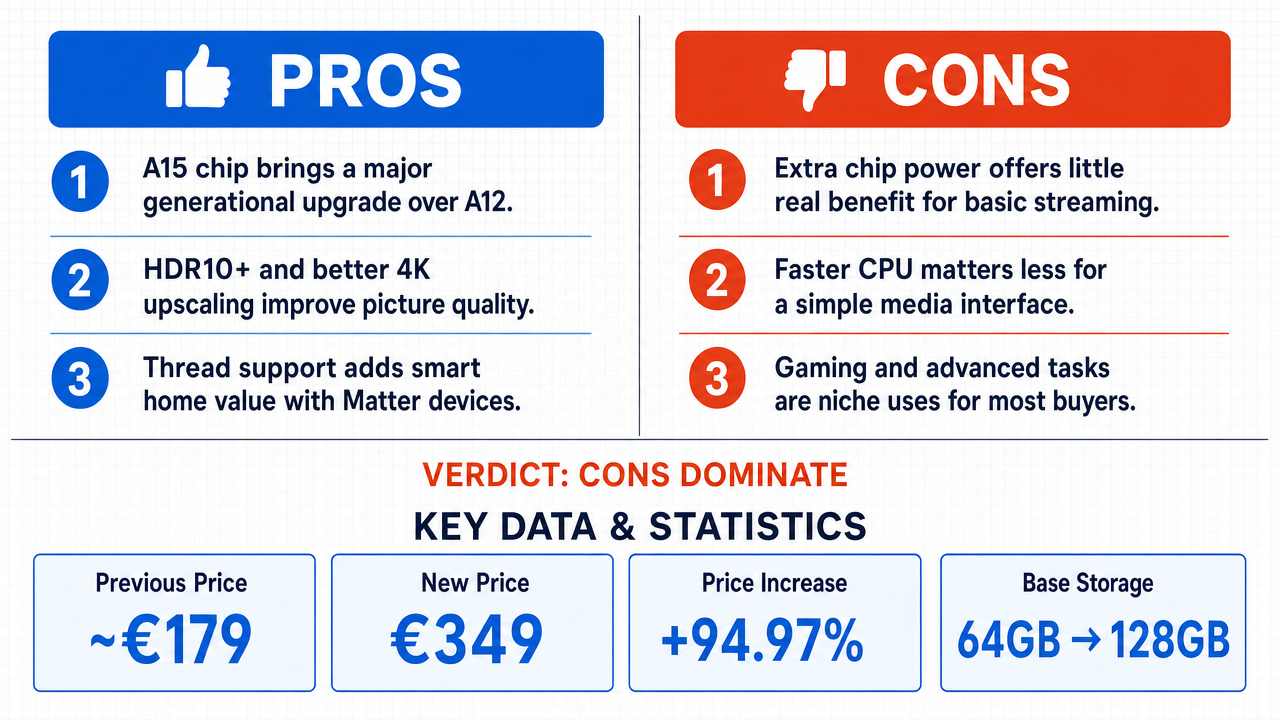
- ■The A15 Bionic chip represents a substantial generational leap from the A12 in the prior model, delivering up to 50% faster graphics performance and superior CPU efficiency, enabling high-fidelity gaming at sustained frame rates and more complex computational tasks for video processing.
- ■The new chip powers enhanced HDR10+ support and smoother 4K upscaling via the latest video pipeline , directly improving visual fidelity for users.
- ■The inclusion of a Thread radio for Matter -based smart home functionality adds significant value beyond raw streaming performance, expanding the device's utility as a home hub.
❌ Key ANTI arguments:
- ■The reliance on the A15 Bionic chip as a primary value driver conflates theoretical peak performance with actual user utility, since the primary function of a media streamer is video decoding , which the previous A12 -based model already performs with high efficiency for all current 4K HDR standards.
- ■The marginal benefit of faster CPU cycles is largely irrelevant for a device whose interface is a passive menu system and whose main output is linear playback, making the performance gains theoretical rather than practical.
- ■The assertion that the A15 enables 'high-fidelity gaming' and 'complex computational tasks' appeals to an unobserved range of usage; for the vast majority of Apple TV users, the device is utilized for media consumption, where the A12 's decoding capabilities are already sufficient.
💭 Conclusion: False. The price increase to €349 is not justified because the performance upgrades, while real on paper, do not translate into meaningful user-perceived value for the device's primary use case of media streaming. The A15 Bionic chip's computational headroom exceeds what is needed for 4K HDR video decoding , which the previous A12 already handled efficiently. The affirmative's argument conflates benchmark performance with practical utility, failing to demonstrate that the upgrades address any actual bottleneck in the streaming experience. Consequently, the additional cost represents payment for theoretical capability rather than tangible improvements that justify the significant price premium.
🔬 DeepResearch Result: likely FALSE ❌ (80%)
Assertion: The new Apple TV 4K , priced at €349, offers sufficient value and performance upgrades to justify its significant price increase over the previous model.
Participating models: deepseek-v3.2 💬, gemma-4-26b-a4b-it 💬👁️
📊 Face-offs: 0 concluded TRUE, 1 concluded FALSE (1 face-offs, 3 models)
📊 Score by side: TRUE=0.00, FALSE=0.80
🏅 Model score changes:
minimax-m3 💬👁️: +8
✅ PRO Arguments:
- ■The A15 Bionic chip represents a substantial generational leap from the A12 in the prior model, delivering up to 50% faster graphics performance and superior CPU efficiency, enabling high-fidelity gaming at sustained frame rates and more complex computational tasks for video processing. deepseek-v3.2 💬
- ■The new chip powers enhanced HDR10+ support and smoother 4K upscaling via the latest video pipeline , directly improving visual fidelity for users. deepseek-v3.2 💬
- ■The inclusion of a Thread radio for Matter -based smart home functionality adds significant value beyond raw streaming performance, expanding the device's utility as a home hub. deepseek-v3.2 💬
- ■The performance and feature upgrades collectively represent a meaningful generational improvement that warrants the €349 price point relative to the previous model. deepseek-v3.2 💬
❌ ANTI Arguments:
- ■The reliance on the A15 Bionic chip as a primary value driver conflates theoretical peak performance with actual user utility, since the primary function of a media streamer is video decoding , which the previous A12-based model already performs with high efficiency for all current 4K HDR standards. gemma-4-26b-a4b-it 💬👁️
- ■The marginal benefit of faster CPU cycles is largely irrelevant for a device whose interface is a passive menu system and whose main output is linear playback, making the performance gains theoretical rather than practical. gemma-4-26b-a4b-it 💬👁️
- ■The assertion that the A15 enables 'high-fidelity gaming' and 'complex computational tasks' appeals to an unobserved range of usage; for the vast majority of Apple TV users, the device is utilized for media consumption, where the A12's decoding capabilities are already sufficient. gemma-4-26b-a4b-it 💬👁️
- ■The '50% faster graphics' benchmark does not translate to user-perceived value for the core streaming use case, meaning the price increase is not justified by marginal functional improvements that most users will never notice. gemma-4-26b-a4b-it 💬👁️
💭 Reasoning: False. The price increase to €349 is not justified because the performance upgrades, while real on paper, do not translate into meaningful user-perceived value for the device's primary use case of media streaming. The A15 Bionic chip's computational headroom exceeds what is needed for 4K HDR video decoding, which the previous A12 already handled efficiently. The affirmative's argument conflates benchmark performance with practical utility, failing to demonstrate that the upgrades address any actual bottleneck in the streaming experience. Consequently, the additional cost represents payment for theoretical capability rather than tangible improvements that justify the significant price premium.
📋 PRO Facts:
• The new Apple TV 4K features an A15 Bionic chip, a generational upgrade from the A12 in the prior model.
• Apple's published specifications claim up to 50% faster graphics performance with the A15 chip.
• The new model includes a Thread radio for smart home connectivity.
• The new model supports HDR10+ and smoother 4K upscaling.
• The new Apple TV 4K is priced at €349.
📋 ANTI Facts:
• The previous A12-based Apple TV 4K already performs video decoding efficiently for all current 4K HDR standards.
• The primary function of a media streamer is video decoding and linear playback, not computational-heavy tasks.
• The A12 chip was already sufficient for standard streaming workflows.
• Benchmark gains in graphics performance do not necessarily translate to user-perceived improvements in media consumption.
• The price increase represents a significant premium over the previous model for upgrades most users will not notice in typical use.
| Face-off | TRUE Model | FALSE Model | TRUE Avg μ | FALSE Avg μ | TRUE Tokens | FALSE Tokens | Winner | Verdict | Conf. |
|---|---|---|---|---|---|---|---|---|---|
| #1 | deepseek-v3.2 💬 | gemma-4-26b-a4b-it 💬👁️ | 0.537 | 0.337 | 8 | 2 | TRUE | FALSE | 80% |
The following technical terms, abbreviations, and domain-specific concepts are referenced throughout this debate transcript. Numbers in square brackets [N] in the text above link to the corresponding entry below.
[1] 4K — 4K resolution — A display resolution standard referring to approximately 4,000 pixels of horizontal resolution, commonly used for high-definition video content.
[2] 4K upscaling — The process of converting lower-resolution video content to approximate 4K resolution, often using computational techniques such as machine learning.
[3] A12 — Apple A12 Bionic chip — Apple's A12 Bionic system-on-chip, used in the previous generation Apple TV 4K model referenced in the debate.
[4] A15 Bionic — Apple A15 Bionic chip — Apple's A15 Bionic system-on-chip used in the new Apple TV 4K, claimed in the debate to deliver up to 50% faster graphics performance than the prior A12.
[5] bitrates — The rate at which data (such as video) is transmitted or processed, typically measured in bits per second; identified in the debate as a potential limiting factor for streaming quality.
[6] computational headroom — The amount of extra processing capacity available beyond what is currently being used by a device.
[7] computational throughput — The amount of computational work a processor can perform in a given time period.
[8] CPU — Central Processing Unit — The primary processor in a computing device responsible for executing general-purpose instructions.
[9] decoding — video decoding — In the context of video, the process of converting compressed video data into a format suitable for display playback.
[10] floating-point performance — A measure of a processor's ability to perform calculations involving decimal numbers, often used to gauge GPU capabilities.
[11] GPU — Graphics Processing Unit — A specialized processor designed to handle rendering, graphics, and parallel computational tasks.
[12] HDR — High Dynamic Range — A video standard that provides greater contrast, brightness, and color range than standard dynamic range content.
[13] HDR10+ — High Dynamic Range 10 Plus — A specific High Dynamic Range video standard that adds dynamic metadata to optimize picture quality on a scene-by-scene or frame-by-frame basis.
[14] machine learning — A computational approach where systems learn patterns from data rather than following explicitly programmed instructions; cited in the debate as enabling 4K upscaling.
[15] Matter — Matter smart home standard — A smart home connectivity standard that allows compatible devices from different manufacturers to interoperate within a connected home ecosystem.
[16] media streamer — A device primarily designed to receive and play streaming media content from the internet.
[17] network bandwidth — The maximum rate at which data can be transmitted over a network connection, identified in the debate as a potential bottleneck for streaming quality.
[18] smart home hub — A central device that coordinates and controls various smart home devices within a connected home ecosystem.
[19] Thread — Thread networking protocol — A low-power mesh networking protocol designed for smart home devices, mentioned in the debate as enabling Matter-based smart home control.
[20] UI — User Interface — The visual and interactive elements through which a user interacts with a device.
[21] video pipeline — The sequence of processing stages through which video data passes from source to display.
The following financial data tables were referenced during the debate exchanges:
| Feature | Previous Model (A12) | New Model (A15) | Value Delta |
|---|---|---|---|
| Base Storage | 64GB | 128GB | +100% |
| Connectivity | Wi-Fi/BT | Wi-Fi/BT/Thread | Incremental |
| Estimated Price | ~€179 | €349 | +94.97% |
Legend: Comparison of key specifications and price points between the previous and new Apple TV 4K models. Price delta is an approximation based on typical market positioning.
Face-off transcripts
- ■
Ownership & Trade Secrets. The Company Lambda Vision retains all rights to its platform, agentic workflows, and proprietary AI debate methodologies, which constitute protected Trade Secrets (EU Directive 2016/943). Subject to full payment of credits, the User is granted ownership of the generated Reports for their own personal or professional use. Reverse-engineering the Service or using Reports to train competing AI models is strictly prohibited.
- ■
No Professional Advice. Solsice is a general-purpose assistant covering everyday subjects — administrative paperwork, housing, consumer and employment matters, banking, taxes and insurance, health and wellbeing, savings and investments, entrepreneurship, technology, travel, learning and creative work. Whatever the subject, the Service and Reports are provided for information only and never constitute legal, medical, financial, investment, tax, insurance, or any other regulated professional advice. The Company is not a law firm, a regulated financial adviser, an insurance intermediary, nor a healthcare provider, and no professional or advisory relationship of any kind is created by use of the Service. Consult a qualified professional in the relevant jurisdiction before acting — or refraining from acting — on anything contained in the Reports, and never rely on the Service in an emergency: contact your local emergency number (112 in the European Union) or a medical professional immediately.
- ■
AI-Generated Content, Sources and Viewpoints. Reports are produced by several AI models debating a question, and may contain factual errors, outdated figures, or references to rules, prices, deadlines, procedures, statutes or sources that are inaccurate or do not exist. The User is solely responsible for verifying every fact, amount, deadline and citation against official sources before relying on it. Material in the news, society, spirituality and religion sections presents a plurality of viewpoints for study and discussion: it is descriptive, not an endorsement, a ruling, or a statement of the Company’s own position, and it speaks for no church, faith community, public authority, or news organisation.
- ■
Liability & Governing Law. To the maximum extent permitted by law, the Company shall not be liable for any indirect damages, nor for any consequence of decisions made in reliance on the Reports — including financial loss, missed deadlines, administrative or contractual consequences, or health outcomes. These Terms are governed by French law. Any disputes shall be subject to the exclusive jurisdiction of the Courts of Paris, France.