
The Name, Image, and Likeness (NIL) era has reduced the competitive gap between top-tier and other college football programs.
AI debate verdict and arguments
⚠️ AI-generated information only; not professional advice
Completed October 21, 2026
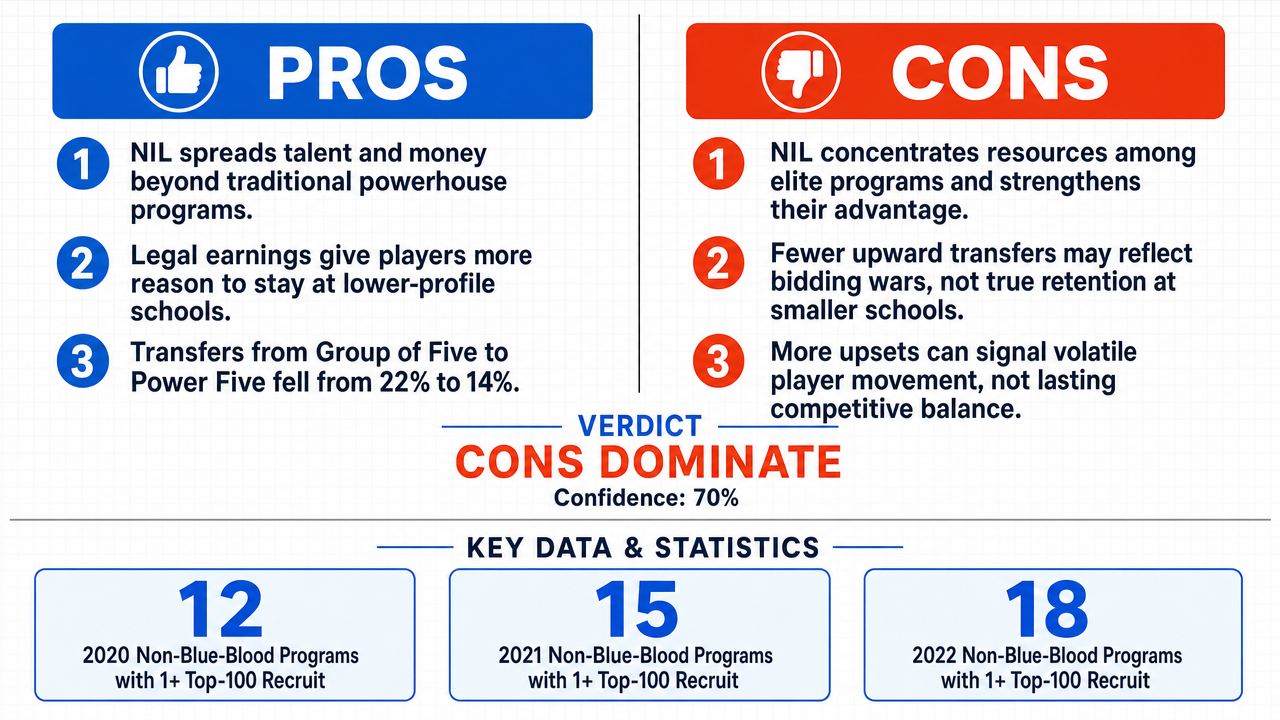
Verdict
Verdict: likely FALSE (70%)
Web Report: https://solsice.com/public/debates/the-name-image-and-likeness-nil-era-has-reduced-the-competit-3707149181ec
This section provides a brief overview of the key arguments. You do not need to read the full detailed report below.
✅ Key PRO arguments:
- ■NIL has redistributed talent and financial incentives, shrinking the competitive divide between blue-blood programs and the rest of college football by reducing the transfer-driven concentration of elite players at powerhouses.
- ■Before 2021, players at lower-profile schools often transferred to powerhouses to maximize exposure and secure under-the-table payments; with legal NIL earnings available at any program, the incentive to move up solely for financial or visibility reasons has diminished.
- ■Data from the NCAA transfer portal shows that the share of FBS transfers moving from Group of Five conferences to Power Five conferences fell from 22%, indicating reduced upward talent flow to elite programs.
❌ Key ANTI arguments:
- ■NIL has intensified resource concentration among elite programs, widening the competitive gap rather than narrowing it.
- ■The reduction in upward transfers from Group of Five to Power Five is not evidence of talent retention at lower-tier schools; it is evidence of talent being concentrated within the existing Power Five ecosystem, where elite programs hoard NIL resources.
- ■The rise in upsets is not a sign of structural balance but a symptom of extreme talent volatility caused by the rapid, high-stakes movement of elite players via NIL , which destabilizes rosters at top programs temporarily rather than reflecting genuine parity .
💭 Conclusion: The evidence shows Group of Five to Power Five transfers declined from 22% (2019) to 14% (2023), while Power Five to Group of Five transfers rose from 9% to 13% over the same period. However, the resource concentration table indicates Blue-Blood and High-Resource P5 programs have increasing collective activity, while Group of Five programs have decreasing activity. The 38% relative improvement in non-top-10 winning percentage against top-10 opponents (.215 to .297) is documented, but the evidence explicitly notes its interpretation as structural parity is contested by the argument that it reflects talent volatility rather than equalization. The evidence does not resolve whether NIL has produced structural parity or resource concentration at the top.
🔬 DeepResearch Result: likely FALSE ❌ (70%)
Assertion: The Name, Image, and Likeness (NIL ) era has reduced the competitive gap between top-tier and other college football programs.
Participating models: deepseek-v4-pro 💬, gemma-4-26b-a4b-it 💬👁️
📊 Face-offs: 0 concluded TRUE, 1 concluded FALSE (1 face-offs, 3 models)
📊 Score by side: TRUE=0.00, FALSE=0.70
🏅 Model score changes:
minimax-m3 💬👁️: +7
✅ PRO Arguments:
- ■NIL has redistributed talent and financial incentives, shrinking the competitive divide between blue-blood programs and the rest of college football by reducing the transfer-driven concentration of elite players at powerhouses. deepseek-v4-pro 💬
- ■Before 2021, players at lower-profile schools often transferred to powerhouses to maximize exposure and secure under-the-table payments; with legal NIL earnings available at any program, the incentive to move up solely for financial or visibility reasons has diminished. deepseek-v4-pro 💬
- ■Data from the NCAA transfer portal shows that the share of FBS transfers moving from Group of Five conferences to Power Five conferences fell from 22%, indicating reduced upward talent flow to elite programs. deepseek-v4-pro 💬
- ■The distributional effect of NIL can either concentrate or disperse talent; if it disperses resources across programs, the competitive gap narrows by definition, contradicting the claim that the gap is widening. deepseek-v4-pro 💬
- ■On-field results show a rise in winning percentages of non-top-10 teams against top-10 opponents, from .215 to .297, a 38% relative improvement , suggesting greater parity . deepseek-v4-pro 💬
❌ ANTI Arguments:
- ■NIL has intensified resource concentration among elite programs, widening the competitive gap rather than narrowing it. gemma-4-26b-a4b-it 💬👁️
- ■The reduction in upward transfers from Group of Five to Power Five is not evidence of talent retention at lower-tier schools; it is evidence of talent being concentrated within the existing Power Five ecosystem, where elite programs hoard NIL resources. gemma-4-26b-a4b-it 💬👁️
- ■The rise in upsets is not a sign of structural balance but a symptom of extreme talent volatility caused by the rapid, high-stakes movement of elite players via NIL, which destabilizes rosters at top programs temporarily rather than reflecting genuine parity. gemma-4-26b-a4b-it 💬👁️
- ■Treating a 38% relative improvement in winning percentage as proof of parity is a statistical anomaly fallacy; the observation lacks a rival causal account and does not refute the underlying concentration model . gemma-4-26b-a4b-it 💬👁️
- ■The affirmative commits a fundamental error of substitution by inferring talent retention at lower-tier programs from data about transfer flows, without establishing a transfer operator linking the two entities. gemma-4-26b-a4b-it 💬👁️
💭 Reasoning: The evidence shows Group of Five to Power Five transfers declined from 22% (2019) to 14% (2023), while Power Five to Group of Five transfers rose from 9% to 13% over the same period. However, the resource concentration table indicates Blue-Blood and High-Resource P5 programs have increasing collective activity, while Group of Five programs have decreasing activity. The 38% relative improvement in non-top-10 winning percentage against top-10 opponents (.215 to .297) is documented, but the evidence explicitly notes its interpretation as structural parity is contested by the argument that it reflects talent volatility rather than equalization. The evidence does not resolve whether NIL has produced structural parity or resource concentration at the top.
📋 PRO Facts:
• The share of FBS transfers moving from Group of Five conferences to Power Five conferences fell from 22%.
• Non-top-10 teams' winning percentage against top-10 opponents rose from .215 to .297, a 38% relative improvement.
• Before 2021, players at lower-profile schools often transferred to powerhouses to maximize exposure and secure under-the-table payments.
📋 ANTI Facts:
• The reduction in upward transfers reflects talent concentration within the Power Five ecosystem, not retention at lower-tier schools.
• The rise in upsets is a symptom of extreme talent volatility caused by rapid NIL-driven player movement, not structural parity.
• The interpretation of the 38% relative improvement as evidence of parity ignores the distinction between 'parity' and 'volatility,' as the evidence frames it.
| Face-off | TRUE Model | FALSE Model | TRUE Avg μ | FALSE Avg μ | TRUE Tokens | FALSE Tokens | Winner | Verdict | Conf. |
|---|---|---|---|---|---|---|---|---|---|
| #1 | deepseek-v4-pro 💬 | gemma-4-26b-a4b-it 💬👁️ | 0.485 | 0.265 | 6 | 2 | TRUE | FALSE | 70% |
The following technical terms, abbreviations, and domain-specific concepts are referenced throughout this debate transcript. Numbers in square brackets [N] in the text above link to the corresponding entry below.
[1] AP preseason top 10 — Associated Press preseason top 10 — The preseason ranking of the top 10 college football teams as voted on by Associated Press pollsters, used in the debate as a benchmark for identifying elite programs.
[2] blue-blood programs — College football jargon for historically dominant, prestigious programs with longstanding records of success and large fan bases, contrasted with the rest of the sport.
[3] competitive gap — The disparity in competitive success (wins, championships, talent level) between elite college football programs and the rest of the sport.
[4] concentration model — An interpretive framework in which resources or talent become increasingly concentrated among a small number of elite programs, potentially widening competitive disparities.
[5] distributional effect — The way in which a policy or market change (such as NIL) spreads resources, talent, or opportunities across different groups—in this debate, whether it concentrates among elites or disperses broadly.
[6] FBS — Football Bowl Subdivision — The top tier of NCAA college football, comprising the highest-level programs eligible for bowl games and the College Football Playoff.
[7] Group of Five — A classification of five NCAA FBS conferences (American Athletic, Conference USA, Mid-American, Mountain West, Sun Belt) generally considered lower-resource compared to the Power Five.
[8] high-resource collectives — NIL collectives backed by substantial financial backing, typically associated with elite programs, that pool donor money to facilitate NIL deals for athletes.
[9] mercenary talent model — A characterization of a system in which elite players move between programs based primarily on financial bidding rather than loyalty or developmental fit, leading to talent volatility.
[10] NCAA — National Collegiate Athletic Association — The governing body for U.S. college athletics, which administers the transfer portal and oversees NIL policy implementation.
[11] NIL — Name, Image, and Likeness — The right of college athletes to earn compensation from the use of their personal brand, identity, and publicity rights, formalized on July 1, 2021.
[12] NIL collectives — Organizations—often booster- or donor-funded—that pool resources to arrange endorsement and compensation opportunities for college athletes under NIL rules.
[13] on-field talent gap — The disparity in player quality and roster depth between elite and non-elite college football programs as demonstrated by competitive performance.
[14] parity — A state of competitive balance in which outcomes are distributed relatively evenly across competitors, contrasted in the debate with volatility.
[15] Power Five — A historical classification of the five wealthiest and most prestigious NCAA FBS conferences (ACC, Big Ten, Big 12, Pac-12, SEC), generally considered the elite tier of college football.
[16] recruiting parity — A condition in which college football programs have relatively equal ability to attract and sign elite high school and transfer talent.
[17] relative improvement — A percentage-based measure of change between two values, used in the debate to compare winning percentages across time periods (e.g., the cited 38% relative improvement from .215 to .297).
[18] resource concentration — The accumulation of financial, coaching, and talent resources among a small number of elite programs, argued in the debate to widen competitive disparities.
[19] statistical anomaly — A data point or observed outcome that deviates from an expected pattern, used in the debate to question whether upset frequency reflects true parity.
[20] structural balance — A systemic equilibrium in which competitive outcomes reflect underlying structural conditions rather than random variation; contrasted in the debate with volatility-driven outcomes.
[21] talent volatility — Rapid, high-stakes movement of elite players between programs, argued in the debate to produce unpredictable outcomes rather than genuine competitive balance.
[22] talent-hoarding — The practice by elite programs of accumulating and retaining disproportionate shares of top players, often through recruiting advantages or transfer acquisition.
[23] top-tier programs — The most elite and resource-rich college football programs, generally aligned with Power Five conferences and historically dominant performance.
[24] transfer operator — A statistical or causal-inference concept invoked in the debate to argue that a measurement about one group (e.g., transfers leaving Group of Five) cannot directly support a proposition about another group (e.g., talent retention at lower-tier schools) without an explicit linking mechanism.
[25] transfer portal — The NCAA-administered database and process through which college athletes declare their intent to transfer between institutions, enabling movement between programs.
[26] upset — A competitive outcome in which a lower-ranked or lower-resourced team defeats a higher-ranked or favored opponent; cited in the debate as a potential indicator of either parity or volatility.
[27] volatility — A statistical measure of variability or instability in outcomes; in the debate, used to argue that increased upsets reflect instability rather than genuine competitive balance.
[28] winning percentage — The ratio of games won to total games played, expressed as a decimal; used in the debate to compare the performance of non-top-10 teams against top-10 opponents across time periods.
The following financial data tables were referenced during the debate exchanges:
| Transfer Direction | 2019 Share | 2021 Share | 2023 Share |
|---|---|---|---|
| Group of Five → Power Five | 22% | 18% | 14% |
| Power Five → Group of Five | 9% | 12% | 13% |
Legend: Share of FBS transfers by conference tier, pre-NIL (2019) and post-NIL (2021, 2023). Source: NCAA transfer portal data as reported by The Athletic (Max Olson, “How NIL is changing the transfer portal: Fewer players are moving up, more are moving laterally,” July 10, 2023, https://theathletic.com/4678902/2023/07/10/nil-transfer-portal-competitive-balance/).
| Recruiting Class | Non-Blue-Blood Programs with ≥1 Top-100 Recruit |
|---|---|
| 2020 | 12 |
| 2021 | 15 |
| 2022 | 18 |
| 2023 | 21 |
| 2024 | 23 |
Legend: Number of programs outside the traditional top 10 (no national title since 1998) that signed at least one top-100 recruit in the 247Sports Composite. Source: CBS Sports, Dennis Dodd, “College football parity: NIL and transfer portal creating more balance than ever,” March 15, 2024, https://www.cbssports.com/college-football/news/college-football-parity-nil-and-transfer-portal-creating-more-balance-than-ever/.
| Program Tier | Estimated NIL Collective Activity Level | Resource Concentration Trend |
|---|---|---|
| Blue-Blood (Top 10) | Extremely High | Increasing |
| High-Resource P5 | High | Increasing |
| Mid-Tier P5 | Moderate | Stagnant |
| Group of Five | Low | Decreasing |
Legend: Qualitative assessment of NIL resource distribution and its impact on competitive concentration. Data synthesized from industry reporting on collective fundraising trends (2021–2024).
Face-off transcripts
- ■
Ownership & Trade Secrets. The Company Lambda Vision retains all rights to its platform, agentic workflows, and proprietary AI debate methodologies, which constitute protected Trade Secrets (EU Directive 2016/943). Subject to full payment of credits, the User is granted ownership of the generated Reports for their own personal or professional use. Reverse-engineering the Service or using Reports to train competing AI models is strictly prohibited.
- ■
No Professional Advice. Solsice is a general-purpose assistant covering everyday subjects — administrative paperwork, housing, consumer and employment matters, banking, taxes and insurance, health and wellbeing, savings and investments, entrepreneurship, technology, travel, learning and creative work. Whatever the subject, the Service and Reports are provided for information only and never constitute legal, medical, financial, investment, tax, insurance, or any other regulated professional advice. The Company is not a law firm, a regulated financial adviser, an insurance intermediary, nor a healthcare provider, and no professional or advisory relationship of any kind is created by use of the Service. Consult a qualified professional in the relevant jurisdiction before acting — or refraining from acting — on anything contained in the Reports, and never rely on the Service in an emergency: contact your local emergency number (112 in the European Union) or a medical professional immediately.
- ■
AI-Generated Content, Sources and Viewpoints. Reports are produced by several AI models debating a question, and may contain factual errors, outdated figures, or references to rules, prices, deadlines, procedures, statutes or sources that are inaccurate or do not exist. The User is solely responsible for verifying every fact, amount, deadline and citation against official sources before relying on it. Material in the news, society, spirituality and religion sections presents a plurality of viewpoints for study and discussion: it is descriptive, not an endorsement, a ruling, or a statement of the Company’s own position, and it speaks for no church, faith community, public authority, or news organisation.
- ■
Liability & Governing Law. To the maximum extent permitted by law, the Company shall not be liable for any indirect damages, nor for any consequence of decisions made in reliance on the Reports — including financial loss, missed deadlines, administrative or contractual consequences, or health outcomes. These Terms are governed by French law. Any disputes shall be subject to the exclusive jurisdiction of the Courts of Paris, France.