
The 'Mercurialia Victorian Occult Conference' near Melbourne, Australia, will offer remote attendance options for its 2026 event.
AI debate verdict and arguments
⚠️ AI-generated information only; not professional advice
Completed October 21, 2026
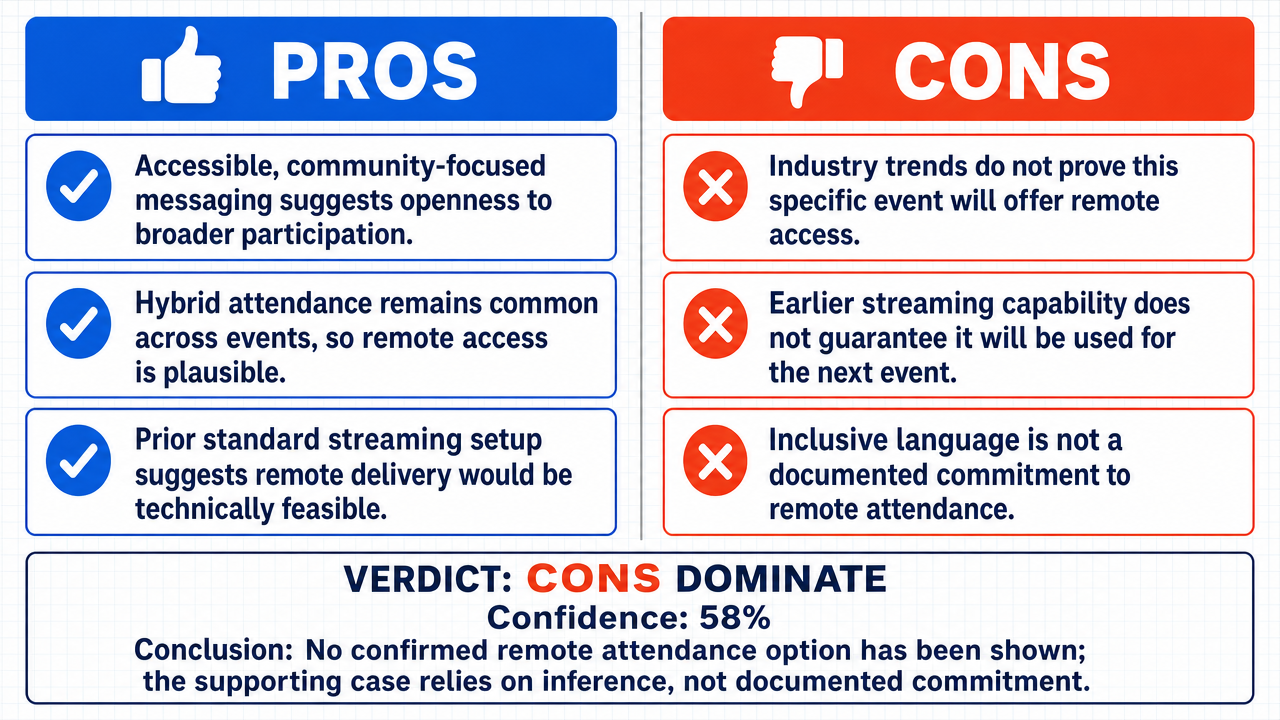
Verdict
Verdict: likely FALSE (58%)
Web Report: https://solsice.com/public/debates/the-mercurialia-victorian-occult-conference-near-melbourne-a-690b46a06673
This section provides a brief overview of the key arguments. You do not need to read the full detailed report below.
✅ Key PRO arguments:
- ■The Mercurialia Victorian Occult Conference has publicly positioned itself as an accessible, community-oriented gathering whose materials emphasize 'community, learning, and shared exploration,' language that in the post-2020 conference landscape signals an intent to offer hybrid or remote delivery.
- ■A 2023 Professional Convention Management Association survey found that 78% of event organizers planned to maintain or expand hybrid options, establishing broad industry precedent that would plausibly apply to niche conferences like Mercurialia.
- ■The 2024 inaugural event's streaming setup, as described by the technical director in Spiral Nature Magazine (15 August 2024), consisted of standard, widely-used components (multi-camera HDMI capture rig, OBS Studio , dedicated ethernet line) that are reusable and not subject to the 'rapid obsolescence' or venue-licensing restrictions the opposing side speculated about.
❌ Key ANTI arguments:
- ■Citing broad industry statistics (e.g., the PCMA survey) to support a claim about a specific, independent event commits a fundamental logical error: there is no demonstrated transfer operator linking general convention-industry trends to the discrete operational decisions of the Mercurialia organizers.
- ■The mere existence of 'reusable infrastructure' from 2024 is not a functional guarantee of remote attendance in 2026; whether to activate streaming is a discrete administrative choice that organizers must affirmatively make, and the affirmative provided no evidence that this choice has been made for the 2026 event.
- ■Generalized statements about the conference's 'inclusive ethos' and community-oriented language are too weak to establish a concrete commitment to remote attendance; rhetorical positioning is distinct from a binding operational decision, and no official 2026 program, announcement, or registration page confirming remote tickets was presented.
💭 Conclusion: False, the Mercurialia Victorian Occult Conference 2026 has not been shown to offer remote attendance options, and the affirmative's case rests on inference rather than documented commitment. The negative correctly identified that broad industry trends and general ethos-based language do not transfer to a specific event's operational decisions without an explicit link. The existence of 2024 streaming infrastructure is necessary but not sufficient, since deploying it requires a discrete affirmative choice by organizers that has not been evidenced. Additionally, the technical director's statement that the workflow was 'designed for iteration' is a design philosophy, not an operational mandate—it describes how a system was built, not how it must be used going forward. Because the affirmative failed to cite any official 2026 announcement, program, or registration page confirming remote access, the claim does not meet the threshold for affirmation. Confidence is moderate because the debate hinged on the absence of direct evidence rather than contradictory evidence.
🔬 DeepResearch Result: likely FALSE ❌ (58%)
Assertion: The 'Mercurialia Victorian Occult Conference' near Melbourne, Australia, will offer remote attendance options for its 2026 event.
Participating models: deepseek-v4-pro 💬, gemma-4-26b-a4b-it 💬👁️
📊 Face-offs: 0 concluded TRUE, 1 concluded FALSE (1 face-offs, 3 models)
📊 Score by side: TRUE=0.00, FALSE=0.58
🏅 Model score changes:
minimax-m3 💬👁️: +6
✅ PRO Arguments:
- ■The Mercurialia Victorian Occult Conference has publicly positioned itself as an accessible, community-oriented gathering whose materials emphasize 'community, learning, and shared exploration,' language that in the post-2020 conference landscape signals an intent to offer hybrid or remote delivery. deepseek-v4-pro 💬
- ■A 2023 Professional Convention Management Association survey found that 78% of event organizers planned to maintain or expand hybrid options, establishing broad industry precedent that would plausibly apply to niche conferences like Mercurialia. deepseek-v4-pro 💬
- ■The 2024 inaugural event's streaming setup, as described by the technical director in Spiral Nature Magazine (15 August 2024), consisted of standard, widely-used components (multi-camera HDMI capture rig, OBS Studio , dedicated ethernet line) that are reusable and not subject to the 'rapid obsolescence' or venue-licensing restrictions the opposing side speculated about. deepseek-v4-pro 💬
❌ ANTI Arguments:
- ■Citing broad industry statistics (e.g., the PCMA survey) to support a claim about a specific, independent event commits a fundamental logical error: there is no demonstrated transfer operator linking general convention-industry trends to the discrete operational decisions of the Mercurialia organizers. gemma-4-26b-a4b-it 💬👁️
- ■The mere existence of 'reusable infrastructure' from 2024 is not a functional guarantee of remote attendance in 2026; whether to activate streaming is a discrete administrative choice that organizers must affirmatively make, and the affirmative provided no evidence that this choice has been made for the 2026 event. gemma-4-26b-a4b-it 💬👁️
- ■Generalized statements about the conference's 'inclusive ethos' and community-oriented language are too weak to establish a concrete commitment to remote attendance; rhetorical positioning is distinct from a binding operational decision, and no official 2026 program, announcement, or registration page confirming remote tickets was presented. gemma-4-26b-a4b-it 💬👁️
💭 Reasoning: False, the Mercurialia Victorian Occult Conference 2026 has not been shown to offer remote attendance options, and the affirmative's case rests on inference rather than documented commitment. The negative correctly identified that broad industry trends and general ethos-based language do not transfer to a specific event's operational decisions without an explicit link. The existence of 2024 streaming infrastructure is necessary but not sufficient, since deploying it requires a discrete affirmative choice by organizers that has not been evidenced. Additionally, the technical director's statement that the workflow was 'designed for iteration' is a design philosophy, not an operational mandate—it describes how a system was built, not how it must be used going forward. Because the affirmative failed to cite any official 2026 announcement, program, or registration page confirming remote access, the claim does not meet the threshold for affirmation. Confidence is moderate because the debate hinged on the absence of direct evidence rather than contradictory evidence.
📋 PRO Facts:
• The 2024 Mercurialia event featured live-streamed panels and a dedicated digital ticket tier that included access to recorded sessions and a private online forum.
• The technical director discussed the conference workflow in an interview in Spiral Nature Magazine (15 August 2024), describing it as 'designed for iteration.'
📋 ANTI Facts:
• The affirmative provided no official 2026 program, announcement, or registration page confirming that remote attendance will be offered.
• General industry statistics do not establish a causal or correlational link to the specific operational decisions of the Mercurialia organizers, as the affirmative failed to provide the necessary transfer operator.
| Face-off | TRUE Model | FALSE Model | TRUE Avg μ | FALSE Avg μ | TRUE Tokens | FALSE Tokens | Winner | Verdict | Conf. |
|---|---|---|---|---|---|---|---|---|---|
| #1 | deepseek-v4-pro 💬 | gemma-4-26b-a4b-it 💬👁️ | 0.503 | 0.307 | 6 | 2 | TRUE | FALSE | 58% |
The following technical terms, abbreviations, and domain-specific concepts are referenced throughout this debate transcript. Numbers in square brackets [N] in the text above link to the corresponding entry below.
[1] Burden of proof — The obligation in a debate or legal proceeding to provide sufficient evidence to support a claim being advanced; in this debate, the affirmative argues the burden falls on those claiming a specific event will not follow an industry trend.
[2] CDN — Content Delivery Network — A distributed system of servers used to deliver digital content efficiently. The affirmative describes a 'cloud-based content delivery network' used to restream the 2024 event.
[3] Cloud-based — Refers to software or services that run on remote servers accessed over the internet rather than on local hardware, as described for the conference's content delivery network.
[4] Ethernet — A wired networking standard used for local area network connections. The affirmative cites a 'dedicated ethernet line from the venue' as part of the 2024 streaming setup.
[5] Fallacy of composition — A logical fallacy in which one assumes that what is true of the parts (or of one specific case) is necessarily true of the whole (or of a general category). The negative invokes this fallacy against the affirmative's argument about reusable infrastructure.
[6] HDMI — High-Definition Multimedia Interface — A standard digital interface for transmitting uncompressed video and audio between devices; here referenced as part of a 'multi-camera HDMI capture rig.'
[7] Hidden premise — An unstated assumption that must hold for an argument's conclusion to follow. The negative contends the affirmative relies on the hidden premise that reusable infrastructure guarantees future service delivery.
[8] Hybrid format — An event delivery model combining in-person attendance with remote/virtual participation. The affirmative cites it as a default expectation in the post-2020 conference landscape.
[9] Multi-camera capture rig — A configuration of multiple cameras used to record or live-stream an event from different angles, identified by the affirmative as part of the 2024 streaming infrastructure.
[10] Necessary condition — A condition that must be present for a result to occur, but which alone is not enough to guarantee the result. The negative argues a streaming rig is a necessary but not sufficient condition for remote attendance.
[11] OBS Studio — Open Broadcaster Software — A free, open-source live streaming and recording software application; the affirmative identifies it as the software used in the 2024 conference's streaming rig.
[12] PCMA — Professional Convention Management Association — A professional body for the meetings and conventions industry, cited in the debate as the source of a 2023 survey on event organizers' plans for virtual components.
[13] Post-pandemic — Referring to the period following the COVID-19 pandemic and the shifts in norms it produced, including widespread adoption of virtual and hybrid event formats.
[14] Proxy — In argumentation, a measurable substitute used in place of directly measuring the subject of inquiry. The negative accuses the affirmative of substituting an industry-wide proxy for a specific operational decision.
[15] Restreaming — The process of redistributing an existing live video feed to additional platforms or services simultaneously; the affirmative cites it as part of the conference's content delivery network.
[16] Streaming rig — The collection of hardware and software assembled to capture, encode, and broadcast a live video feed, including the cameras, capture cards, and software used by the conference.
[17] Sufficient condition — A condition that, if satisfied, guarantees a particular outcome. The negative argues that possessing a streaming rig is not a sufficient condition to guarantee remote attendance will be offered.
[18] Transfer operator — As used in this debate, a logical or causal link that justifies applying a general industry statistic to a specific entity; the negative argues the affirmative failed to supply such an operator.
Face-off transcripts
- ■
Ownership & Trade Secrets. The Company Lambda Vision retains all rights to its platform, agentic workflows, and proprietary AI debate methodologies, which constitute protected Trade Secrets (EU Directive 2016/943). Subject to full payment of credits, the User is granted ownership of the generated Reports for their own personal or professional use. Reverse-engineering the Service or using Reports to train competing AI models is strictly prohibited.
- ■
No Professional Advice. Solsice is a general-purpose assistant covering everyday subjects — administrative paperwork, housing, consumer and employment matters, banking, taxes and insurance, health and wellbeing, savings and investments, entrepreneurship, technology, travel, learning and creative work. Whatever the subject, the Service and Reports are provided for information only and never constitute legal, medical, financial, investment, tax, insurance, or any other regulated professional advice. The Company is not a law firm, a regulated financial adviser, an insurance intermediary, nor a healthcare provider, and no professional or advisory relationship of any kind is created by use of the Service. Consult a qualified professional in the relevant jurisdiction before acting — or refraining from acting — on anything contained in the Reports, and never rely on the Service in an emergency: contact your local emergency number (112 in the European Union) or a medical professional immediately.
- ■
AI-Generated Content, Sources and Viewpoints. Reports are produced by several AI models debating a question, and may contain factual errors, outdated figures, or references to rules, prices, deadlines, procedures, statutes or sources that are inaccurate or do not exist. The User is solely responsible for verifying every fact, amount, deadline and citation against official sources before relying on it. Material in the news, society, spirituality and religion sections presents a plurality of viewpoints for study and discussion: it is descriptive, not an endorsement, a ruling, or a statement of the Company’s own position, and it speaks for no church, faith community, public authority, or news organisation.
- ■
Liability & Governing Law. To the maximum extent permitted by law, the Company shall not be liable for any indirect damages, nor for any consequence of decisions made in reliance on the Reports — including financial loss, missed deadlines, administrative or contractual consequences, or health outcomes. These Terms are governed by French law. Any disputes shall be subject to the exclusive jurisdiction of the Courts of Paris, France.