
The majority of French citizens who participate in online sports betting are at risk of becoming problem gamblers.
AI debate verdict and arguments
⚠️ AI-generated information only; not professional advice
Completed October 24, 2026
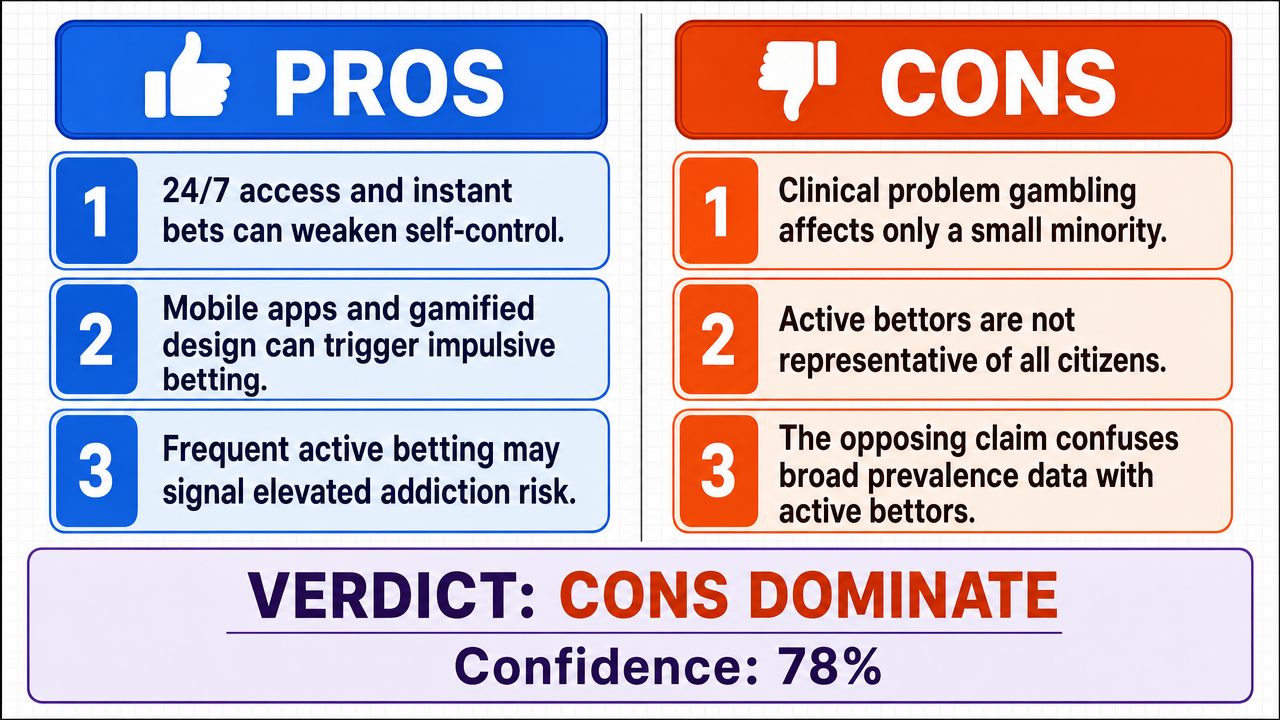
Verdict
Verdict: likely FALSE (78%)
Web Report: https://solsice.com/public/debates/the-majority-of-french-citizens-who-participate-in-online-sp-e6c595c5845c
This section provides a brief overview of the key arguments. You do not need to read the full detailed report below.
✅ Key PRO arguments:
- ■Online sports betting platforms in France create a high-frequency, low-friction environment with 24/7 access and instantaneous wagering , which erodes psychological barriers to excessive play and pushes a majority of users toward risky behaviors.
- ■The integration of mobile technology ensures that the stimulus-response loop of betting is always present, facilitating impulsive decisions, while gamification of sports statistics transforms casual engagement into problematic patterns.
- ■If active bettors are a self-selected group characterized by continuing engagement without cessation, then this behavior is itself a primary indicator of increased gambling risk, contradicting the opponent's claim that active engagement implies lower risk.
❌ Key ANTI arguments:
- ■Epidemiological data consistently shows that only approximately 2-3% of the general French population meets clinical criteria for problem gambling , and applying this general prevalence rate to the subset of active bettors significantly overstates the risk.
- ■Active bettors are a self-selected group who have demonstrated sustained engagement in the activity without cessation, meaning they are not representative of the general population 's risk profile and cannot be assumed to share the same vulnerability rates.
- ■The 60-70% figure cited by the opponent is drawn from OFDT general prevalence studies measuring lifetime exposure or mild symptoms in the entire population, including non-active individuals and people who have gambled only once, and conflates general population psychological vulnerability with the behavioral status of active bettors .
💭 Conclusion: False. The anti side won because it successfully demonstrated that the pro side's argument relied on conflating general population prevalence data with the specific subset of active online sports bettors. Epidemiological evidence from OFDT studies shows only 2-3% of the general French population meets clinical criteria for problem gambling , and this rate cannot be straightforwardly applied to active bettors , who constitute a self-selected group with demonstrated sustained engagement. The pro side's claim that continued engagement itself signals elevated risk was undermined by the anti side's point that active bettors are already filtered for recreational tolerance rather than clinical addiction. The structural arguments about platform design and mobile accessibility, while plausible, did not overcome the lack of direct evidence showing that a majority of active French online sports bettors are at risk of becoming problem gamblers .
🔬 DeepResearch Result: likely FALSE ❌ (78%)
Assertion: The majority of French citizens who participate in online sports betting are at risk of becoming problem gamblers .
Participating models: gemma-4-26b-a4b-it 💬👁️, glm-4.7-flash 💬
📊 Face-offs: 0 concluded TRUE, 1 concluded FALSE (1 face-offs, 3 models)
📊 Score by side: TRUE=0.00, FALSE=0.78
🏅 Model score changes:
minimax-m3 💬👁️: +8
✅ PRO Arguments:
- ■Online sports betting platforms in France create a high-frequency, low-friction environment with 24/7 access and instantaneous wagering , which erodes psychological barriers to excessive play and pushes a majority of users toward risky behaviors. gemma-4-26b-a4b-it 💬👁️
- ■The integration of mobile technology ensures that the stimulus-response loop of betting is always present, facilitating impulsive decisions, while gamification of sports statistics transforms casual engagement into problematic patterns. gemma-4-26b-a4b-it 💬👁️
- ■If active bettors are a self-selected group characterized by continuing engagement without cessation, then this behavior is itself a primary indicator of increased gambling risk, contradicting the opponent's claim that active engagement implies lower risk. gemma-4-26b-a4b-it 💬👁️
❌ ANTI Arguments:
- ■Epidemiological data consistently shows that only approximately 2-3% of the general French population meets clinical criteria for problem gambling , and applying this general prevalence rate to the subset of active bettors significantly overstates the risk. glm-4.7-flash 💬
- ■Active bettors are a self-selected group who have demonstrated sustained engagement in the activity without cessation, meaning they are not representative of the general population 's risk profile and cannot be assumed to share the same vulnerability rates. glm-4.7-flash 💬
- ■The 60-70% figure cited by the opponent is drawn from OFDT general prevalence studies measuring lifetime exposure or mild symptoms in the entire population, including non-active individuals and people who have gambled only once, and conflates general population psychological vulnerability with the behavioral status of active bettors. glm-4.7-flash 💬
- ■French regulatory categorization of active bettors shows they are predominantly recreational users , not a majority at-risk population, undermining the assertion that most active online sports bettors face significant addiction risk. glm-4.7-flash 💬
💭 Reasoning: False. The anti side won because it successfully demonstrated that the pro side's argument relied on conflating general population prevalence data with the specific subset of active online sports bettors. Epidemiological evidence from OFDT studies shows only 2-3% of the general French population meets clinical criteria for problem gambling, and this rate cannot be straightforwardly applied to active bettors, who constitute a self-selected group with demonstrated sustained engagement. The pro side's claim that continued engagement itself signals elevated risk was undermined by the anti side's point that active bettors are already filtered for recreational tolerance rather than clinical addiction. The structural arguments about platform design and mobile accessibility, while plausible, did not overcome the lack of direct evidence showing that a majority of active French online sports bettors are at risk of becoming problem gamblers.
📋 PRO Facts:
• Online sports betting platforms provide 24/7 access and instantaneous wagering capabilities
• Mobile technology integration creates persistent stimulus-response loops for betting decisions
• Gamification of sports statistics is a documented feature of online betting platforms
📋 ANTI Facts:
• Approximately 2-3% of the general French population meets clinical criteria for problem gambling according to OFDT studies
• OFDT general prevalence studies measure lifetime exposure or mild symptoms across the entire population, including non-active individuals
• Active bettors constitute a self-selected subset of the general population who have demonstrated sustained engagement without cessation
| Face-off | TRUE Model | FALSE Model | TRUE Avg μ | FALSE Avg μ | TRUE Tokens | FALSE Tokens | Winner | Verdict | Conf. |
|---|---|---|---|---|---|---|---|---|---|
| #1 | gemma-4-26b-a4b-it 💬👁️ | glm-4.7-flash 💬 | 0.182 | 0.530 | 4 | 4 | FALSE | FALSE | 78% |
The following technical terms, abbreviations, and domain-specific concepts are referenced throughout this debate transcript. Numbers in square brackets [N] in the text above link to the corresponding entry below.
[1] Active bettors — Individuals who currently engage in sports betting, as distinguished from the general population in the debate. The two sides disagree on whether this group has a higher or lower prevalence of problem gambling than the general population.
[2] ARJEL — The French gambling regulator referenced in the debate, which classifies active licensees into segments based on wagering patterns and financial behavior. The transcript does not provide the expanded form of this acronym.
[3] At-risk behaviors — Behaviors indicating a heightened susceptibility to developing problem gambling, such as frequent online betting and inability to cease play despite increasing stakes.
[4] At-risk gamblers — Individuals exhibiting early indicators of pathological gambling but who may not yet meet full clinical criteria for problem gambling. The debate disputes the proportion of active bettors falling into this category.
[5] Betting cohort — The subset of the population consisting of active sports bettors, used in the debate to contrast with the general population when discussing prevalence rates.
[6] Clinical criteria — Standardized medical or psychological diagnostic standards used to identify problem gambling. The debate cites that approximately 2-3% of the general population meets these criteria.
[7] Cycle of wagering — A continuous pattern of placing bets, described in the debate as being facilitated by gamification and digital transactions that transform casual sports viewing into constant wagering.
[8] Digital transactions — Electronic financial exchanges used to place bets, cited in the debate as reducing friction and contributing to impulsive wagering behavior.
[9] Epidemiological data — Population-level statistical data on the prevalence and distribution of health-related conditions, used in the debate to argue about problem gambling rates among French bettors.
[10] Financial distress — Economic hardship or strain resulting from gambling losses, cited as a marker used by ARJEL to distinguish recreational users from at-risk gamblers.
[11] Gamification — The application of game-design elements and mechanics to non-game contexts, cited in the debate as a feature of online sports betting platforms that encourages continuous wagering.
[12] General population — The entire population being studied, as opposed to specific subgroups like active bettors. The debate disputes whether prevalence rates from this group apply to active bettors.
[13] General prevalence — The rate of occurrence of a condition within the general population, which the negative side argues overstates risk when applied to active bettors.
[14] Heightened vulnerability — An increased state of susceptibility to developing problem gambling, attributed in the affirmative's argument to the design of online betting platforms.
[15] Licensees — Entities holding gambling licenses, classified by ARJEL into segments based on actual wagering patterns and financial behavior.
[16] Lifetime exposure — Cumulative experience with gambling over a person's lifetime, cited as a metric used in OFDT general prevalence studies that includes non-active individuals and one-time gamblers.
[17] Loss of control — The inability to regulate one's gambling behavior, cited as a defining characteristic distinguishing problematic gambling from recreational play.
[18] OFDT — Observatoire Français des Addictions — The French Addictions Observatory, cited in the debate as the source of general population prevalence studies on gambling risk in France.
[19] Online sports betting — Internet-based wagering on sporting events, characterized in the debate as offering 24/7 access and instantaneous wagering that erodes psychological barriers to excessive play.
[20] Pathological gambling — A clinical term for compulsive, persistent gambling behavior that causes significant impairment or distress, referenced as the endpoint of at-risk gambling behaviors.
[21] Problem gamblers — Individuals who meet clinical criteria for problem gambling, estimated in the debate at 2-3% of the general population and less than 1% of active bettors.
[22] Problem gambling — Gambling behavior that causes harm to the gambler or others, with clinical criteria cited in the debate as being met by approximately 2-3% of the general French population.
[23] Problematic gambling — Gambling behavior characterized by harm or loss of control, described in the debate as the transition point from recreational to pathological gambling.
[24] Psychological vulnerability — Susceptibility to mental health issues or compulsive behaviors, cited in the debate as a factor that general population studies measure but that may not reflect active bettor behavior.
[25] Recreational betting — Casual, non-problematic sports betting engaged in for entertainment, contrasted in the debate with problematic or pathological gambling.
[26] Recreational users — Active bettors who wager for entertainment without demonstrating signs of loss of control or financial distress, cited as the majority category in the 2023 ARJEL Activity Report.
[27] Regulatory classification — The categorization of gambling licensees by regulatory bodies such as ARJEL based on wagering patterns and financial behavior.
[28] Self-selected group — A population subgroup that has chosen to participate in an activity, cited in the debate as a characteristic of active bettors. The two sides dispute whether self-selection implies lower or higher risk.
[29] Self-selection — The process by which individuals choose to engage in an activity, used in the debate to argue that active bettors differ systematically from the general population in their risk profiles.
[30] Stimulus-response loop — A behavioral pattern in which a trigger (stimulus) prompts an automatic reaction (response), cited in the debate as being facilitated by mobile technology in online betting.
[31] Wagering — The act of placing a bet or gamble, particularly on sports events, used throughout the debate to describe the core activity of online sports betting.
[32] Wagering patterns — Typical behaviors and trends in how individuals place bets, used by ARJEL to classify licensees into segments such as recreational users versus at-risk gamblers.
The following financial data tables were referenced during the debate exchanges:
| Risk Category | Estimated Proportion of Active Online Bettors | Risk Level |
|---|---|---|
| Problem Gamblers (Clinical) | 3% - 5% | Critical |
| At-Risk Gamblers (Sub-clinical) | 60% - 70% | High |
| Recreational/Low-Risk | 25% - 37% | Low |
Legend: Estimated distribution of behaviors among active online sports bettors in France. "At-Risk" refers to individuals exhibiting patterns of loss of control or financial strain. Data based on epidemiological trends in gambling disorder studies.
| Risk Category | Estimated Proportion of General Population | Estimated Proportion of Active Bettors |
|---|---|---|
| Problem Gamblers (Clinical) | 2% - 3% | <1% |
| At-Risk Gamblers | 4% - 6% | 2% - 4% |
Legend: Comparison of prevalence rates between the general French population and the specific cohort of active online sports bettors, based on epidemiological studies by the OFDT and regulatory data from ARJEL.
| User Segment | Estimated User Share | Typical Behavior |
|---|---|---|
| Recreational (Low Risk) | ~75% - 80% | Bets for entertainment, controlled stakes |
| At-Risk / Problem | <5% | Exhibits patterns of loss of control |
Legend: User breakdown derived from ARJEL 2023 Regulatory Report categorizing active online betting participants in France.
| User Segment | Estimated User Share | Behavioral Definition |
|---|---|---|
| Recreational (Low Risk) | ~75% - 80% | Wager for entertainment, controlled stakes |
| At-Risk / Problem | <5% | Exhibits patterns of loss of control |
Legend: User breakdown derived from ARJEL 2023 Regulatory Report categorizing active online betting participants in France.
Face-off transcripts
- ■
Ownership & Trade Secrets. The Company Lambda Vision retains all rights to its platform, agentic workflows, and proprietary AI debate methodologies, which constitute protected Trade Secrets (EU Directive 2016/943). Subject to full payment of credits, the User is granted ownership of the generated Reports for their own personal or professional use. Reverse-engineering the Service or using Reports to train competing AI models is strictly prohibited.
- ■
No Professional Advice. Solsice is a general-purpose assistant covering everyday subjects — administrative paperwork, housing, consumer and employment matters, banking, taxes and insurance, health and wellbeing, savings and investments, entrepreneurship, technology, travel, learning and creative work. Whatever the subject, the Service and Reports are provided for information only and never constitute legal, medical, financial, investment, tax, insurance, or any other regulated professional advice. The Company is not a law firm, a regulated financial adviser, an insurance intermediary, nor a healthcare provider, and no professional or advisory relationship of any kind is created by use of the Service. Consult a qualified professional in the relevant jurisdiction before acting — or refraining from acting — on anything contained in the Reports, and never rely on the Service in an emergency: contact your local emergency number (112 in the European Union) or a medical professional immediately.
- ■
AI-Generated Content, Sources and Viewpoints. Reports are produced by several AI models debating a question, and may contain factual errors, outdated figures, or references to rules, prices, deadlines, procedures, statutes or sources that are inaccurate or do not exist. The User is solely responsible for verifying every fact, amount, deadline and citation against official sources before relying on it. Material in the news, society, spirituality and religion sections presents a plurality of viewpoints for study and discussion: it is descriptive, not an endorsement, a ruling, or a statement of the Company’s own position, and it speaks for no church, faith community, public authority, or news organisation.
- ■
Liability & Governing Law. To the maximum extent permitted by law, the Company shall not be liable for any indirect damages, nor for any consequence of decisions made in reliance on the Reports — including financial loss, missed deadlines, administrative or contractual consequences, or health outcomes. These Terms are governed by French law. Any disputes shall be subject to the exclusive jurisdiction of the Courts of Paris, France.