
The Maeve Kennedy McKean Global Health Award project in Zanzibar on maternal mental health has sufficient generalizability to inform interventions across similar regions in Sub-Saharan Africa.
AI debate verdict and arguments
⚠️ AI-generated information only; not professional advice
Completed October 14, 2026
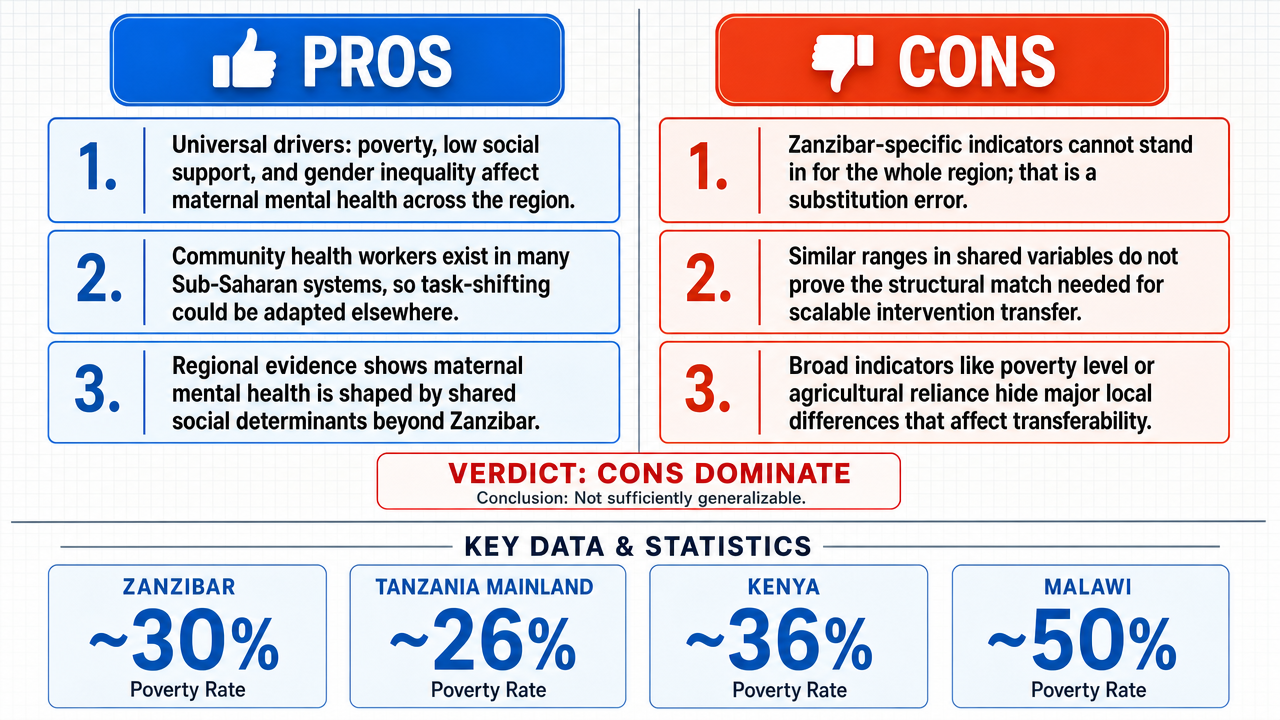
Verdict
Verdict: likely FALSE (82%)
Web Report: https://solsice.com/public/debates/the-maeve-kennedy-mckean-global-health-award-project-in-zanz-212ca9f556de
This section provides a brief overview of the key arguments. You do not need to read the full detailed report below.
✅ Key PRO arguments:
- ■The Zanzibar maternal mental health project addresses universal structural determinants of maternal mental health—poverty, low social support, and gender inequity —that are widespread across Sub-Saharan Africa rather than unique to Zanzibar, making findings transferable to similar low-resource settings .
- ■The presence of community health workers across other Sub-Saharan African regions means the core operational platform of the Zanzibar intervention—task-shifting mental health support to lay workers within primary care —exists in comparable settings.
- ■A systematic review of mental health in Sub-Saharan Africa confirms that the social determinants driving poor maternal mental health outcomes are regional rather than local, supporting transferability of the project's findings.
❌ Key ANTI arguments:
- ■The affirmative commits a fallacy of substitution by measuring specific socioeconomic indicators in Zanzibar and concluding they represent the entire Sub-Saharan African region, without providing a transfer operator proving these shared indicators function identically in different governance and social structures.
- ■Falling within a statistical range of shared variables does not equate to the structural identity required for clinical or systemic scalability, so Zanzibar's indicators being within a 'central range' of neighbors does not justify intervention transfer.
- ■Indicators such as 'moderate poverty' and 'reliance on agriculture' are too coarse to function as reliable transferability metrics because they mask meaningful differences in governance, social structure, and health-system architecture between Zanzibar and other Sub-Saharan African contexts.
💭 Conclusion: False. The Zanzibar maternal mental health project does not have sufficient generalizability to inform interventions across similar Sub-Saharan African regions, as the winning side successfully argued that the affirmative relied on a fallacy of substitution —using coarse shared indicators like poverty levels and reliance on agriculture as proxies for structural identity without demonstrating a transfer operator . The argument that falling within a statistical range of neighbors equates to scalability was effectively dismantled, since structural identity rather than statistical similarity is required for clinical and systemic transfer. Furthermore, Zanzibar's distinct archipelago geography and governance structure introduce variables that cannot be assumed to function identically elsewhere. The confidence in this verdict is moderated because the affirmative offered a reasonable counter that community health worker infrastructure is a shared regional feature, which the negation did not fully refute.
🔬 DeepResearch Result: likely FALSE ❌ (82%)
Assertion: The Maeve Kennedy McKean Global Health Award project in Zanzibar on maternal mental health has sufficient generalizability to inform interventions across similar regions in Sub-Saharan Africa .
Participating models: deepseek-v3.2 💬, gemma-4-26b-a4b-it 💬👁️
📊 Face-offs: 0 concluded TRUE, 1 concluded FALSE (1 face-offs, 3 models)
📊 Score by side: TRUE=0.00, FALSE=0.82
🏅 Model score changes:
minimax-m3 💬👁️: +8
✅ PRO Arguments:
- ■The Zanzibar maternal mental health project addresses universal structural determinants of maternal mental health—poverty, low social support, and gender inequity —that are widespread across Sub-Saharan Africa rather than unique to Zanzibar, making findings transferable to similar low-resource settings . deepseek-v3.2 💬
- ■The presence of community health workers across other Sub-Saharan African regions means the core operational platform of the Zanzibar intervention—task-shifting mental health support to lay workers within primary care —exists in comparable settings. deepseek-v3.2 💬
- ■A systematic review of mental health in Sub-Saharan Africa confirms that the social determinants driving poor maternal mental health outcomes are regional rather than local, supporting transferability of the project's findings. deepseek-v3.2 💬
❌ ANTI Arguments:
- ■The affirmative commits a fallacy of substitution by measuring specific socioeconomic indicators in Zanzibar and concluding they represent the entire Sub-Saharan African region, without providing a transfer operator proving these shared indicators function identically in different governance and social structures. gemma-4-26b-a4b-it 💬👁️
- ■Falling within a statistical range of shared variables does not equate to the structural identity required for clinical or systemic scalability, so Zanzibar's indicators being within a 'central range' of neighbors does not justify intervention transfer. gemma-4-26b-a4b-it 💬👁️
- ■Indicators such as 'moderate poverty' and 'reliance on agriculture' are too coarse to function as reliable transferability metrics because they mask meaningful differences in governance, social structure, and health-system architecture between Zanzibar and other Sub-Saharan African contexts. gemma-4-26b-a4b-it 💬👁️
- ■Zanzibar's specific socio-cultural and health-system variables—shaped by its archipelago geography, maritime trade economy, and particular governance arrangements—prevent broad regional generalizability of the maternal mental health intervention. gemma-4-26b-a4b-it 💬👁️
💭 Reasoning: False. The Zanzibar maternal mental health project does not have sufficient generalizability to inform interventions across similar Sub-Saharan African regions, as the winning side successfully argued that the affirmative relied on a fallacy of substitution—using coarse shared indicators like poverty levels and reliance on agriculture as proxies for structural identity without demonstrating a transfer operator. The argument that falling within a statistical range of neighbors equates to scalability was effectively dismantled, since structural identity rather than statistical similarity is required for clinical and systemic transfer. Furthermore, Zanzibar's distinct archipelago geography and governance structure introduce variables that cannot be assumed to function identically elsewhere. The confidence in this verdict is moderated because the affirmative offered a reasonable counter that community health worker infrastructure is a shared regional feature, which the negation did not fully refute.
📋 PRO Facts:
• The Zanzibar maternal mental health project identified high prevalence of perinatal depression linked to poverty, low social support, and gender inequity.
• A systematic review of mental health in Sub-Saharan Africa identifies social determinants as primary drivers of poor maternal mental health outcomes.
• Community health workers are present in multiple Sub-Saharan African health systems, providing a shared operational platform for task-shifted interventions.
📋 ANTI Facts:
• Zanzibar's socioeconomic indicators fall within a statistical range shared with East African neighbors but this does not establish structural identity.
• Indicators such as 'moderate poverty' and 'reliance on agriculture' are too coarse to serve as functional transferability metrics.
• Zanzibar's status as an archipelago with specific maritime trade patterns introduces socio-cultural and economic variables distinct from mainland Sub-Saharan African contexts.
| Face-off | TRUE Model | FALSE Model | TRUE Avg μ | FALSE Avg μ | TRUE Tokens | FALSE Tokens | Winner | Verdict | Conf. |
|---|---|---|---|---|---|---|---|---|---|
| #1 | deepseek-v3.2 💬 | gemma-4-26b-a4b-it 💬👁️ | 0.409 | 0.198 | 8 | 2 | TRUE | FALSE | 82% |
The following technical terms, abbreviations, and domain-specific concepts are referenced throughout this debate transcript. Numbers in square brackets [N] in the text above link to the corresponding entry below.
[1] CHWs — Community Health Workers — Lay health workers, typically from local communities, who are trained to provide health education, basic preventive care, and certain clinical services within primary healthcare systems, often in low-resource settings.
[2] clinical scalability — The capacity of a clinical intervention to be expanded and effectively implemented across broader populations, contexts, or health systems while maintaining its intended therapeutic benefit and safety profile.
[3] community health workers — CHWs — Lay health workers, typically from local communities, who are trained to provide health education, basic preventive care, and certain clinical services within primary healthcare systems, often in low-resource settings.
[4] East African — A regional geographic designation referring to countries in the eastern portion of the African continent, often grouped together in health and development research due to shared contextual features.
[5] fallacy of substitution — A logical error in which a term or concept in an argument is covertly replaced by a different (often more easily measured or more familiar) concept, undermining the validity of the conclusion.
[6] functional proxies — Variables used as stand-ins for other, harder-to-measure constructs; in this debate, coarse socioeconomic indicators are discussed as potential proxies for the determinants of maternal mental health.
[7] gender inequity — Systemic disparities in rights, resources, power, and opportunities between genders, identified in the debate as a structural driver of poor maternal mental health outcomes.
[8] generalizability — The extent to which findings, methodologies, or interventions from one study population or setting can be validly applied to other populations or settings; a central methodological concept.
[9] health-system architecture — The structural organization of a healthcare system, including its administrative layers, service delivery platforms, workforce composition, and governance arrangements.
[10] intervention model — A structured approach or framework for delivering a health intervention, including its components, delivery mechanism, and intended population.
[11] land-tenure systems — The rules, customs, and legal arrangements governing how land is owned, used, and transferred within a society; in the debate cited as a context-specific factor affecting maternal mental health determinants.
[12] longitudinal mapping — A research method that tracks and correlates variables or outcomes over extended periods of time, often used to assess whether relationships observed in one setting hold in another.
[13] low-resource settings — Environments—typically in low- and middle-income countries—characterized by constrained health system capacity, limited workforce, and inadequate infrastructure and supplies.
[14] maternal mental health — The field of mental health concerning the psychological well-being of women during pregnancy and the postpartum period, including conditions such as perinatal depression.
[15] perinatal depression — A depressive disorder occurring during pregnancy or within the first year after childbirth, influenced by biological, social, and economic factors.
[16] primary care — First-contact, community-level healthcare that provides accessible, comprehensive services; commonly the platform into which community health worker–based interventions are integrated.
[17] Sahel — A geographic belt across northern Sub-Saharan Africa characterized by semi-arid conditions and predominantly pastoralist livelihoods, cited in the debate as a structurally distinct context from Zanzibar.
[18] social determinants — social determinants of health — The conditions in which people are born, grow, live, work, and age—including poverty, social support, and gender norms—that shape health outcomes; identified in the debate as primary drivers of maternal mental health.
[19] statistical correlation — A quantitative measure of the degree to which two variables are associated; in the debate, the absence of a demonstrated correlation is argued to undermine claims of transferability.
[20] Sub-Saharan Africa — The geographic region of the African continent south of the Sahara, commonly used as a unit of analysis in global health and development research; treated by the affirmative as broadly comparable and by the negative as internally heterogeneous.
[21] systematic review — A research methodology that synthesizes evidence from multiple studies on a defined question according to explicit, reproducible criteria; cited in the debate as evidence that social determinants drive maternal mental health regionally.
[22] task-shifting — The delegation of clinical and health tasks from more specialized to less specialized health workers; endorsed by the WHO as a strategy to expand mental health service coverage in low-resource settings.
[23] transfer operator — In the context of generalizability, the statistical correlation or longitudinal mapping that would demonstrate findings function equivalently across different populations and contexts.
[24] West Africa — A regional geographic designation for the western portion of the African continent, cited in the debate as containing highly urbanized populations with structural features distinct from Zanzibar.
[25] WHO — World Health Organization — The United Nations specialized agency responsible for international public health, cited in the debate as endorsing the adaptation of community health worker–based mental health intervention models.
The following financial data tables were referenced during the debate exchanges:
| Region | Estimated Poverty Rate | Maternal Mortality Ratio (per 100k) | Skilled Birth Attendance |
|---|---|---|---|
| Zanzibar | ~30% | ~300 | ~80% |
| Tanzania Mainland | ~26% | ~400 | ~70% |
| Kenya | ~36% | ~350 | ~85% |
| Malawi | ~50% | ~350 | ~90% |
Legend: Comparative socioeconomic and health system indicators for Zanzibar and similar Sub-Saharan African regions. Data are approximate averages from recent national surveys and WHO reports, illustrating shared contextual challenges.
Face-off transcripts
- ■
Ownership & Trade Secrets. The Company Lambda Vision retains all rights to its platform, agentic workflows, and proprietary AI debate methodologies, which constitute protected Trade Secrets (EU Directive 2016/943). Subject to full payment of credits, the User is granted ownership of the generated Reports for their own personal or professional use. Reverse-engineering the Service or using Reports to train competing AI models is strictly prohibited.
- ■
No Professional Advice. Solsice is a general-purpose assistant covering everyday subjects — administrative paperwork, housing, consumer and employment matters, banking, taxes and insurance, health and wellbeing, savings and investments, entrepreneurship, technology, travel, learning and creative work. Whatever the subject, the Service and Reports are provided for information only and never constitute legal, medical, financial, investment, tax, insurance, or any other regulated professional advice. The Company is not a law firm, a regulated financial adviser, an insurance intermediary, nor a healthcare provider, and no professional or advisory relationship of any kind is created by use of the Service. Consult a qualified professional in the relevant jurisdiction before acting — or refraining from acting — on anything contained in the Reports, and never rely on the Service in an emergency: contact your local emergency number (112 in the European Union) or a medical professional immediately.
- ■
AI-Generated Content, Sources and Viewpoints. Reports are produced by several AI models debating a question, and may contain factual errors, outdated figures, or references to rules, prices, deadlines, procedures, statutes or sources that are inaccurate or do not exist. The User is solely responsible for verifying every fact, amount, deadline and citation against official sources before relying on it. Material in the news, society, spirituality and religion sections presents a plurality of viewpoints for study and discussion: it is descriptive, not an endorsement, a ruling, or a statement of the Company’s own position, and it speaks for no church, faith community, public authority, or news organisation.
- ■
Liability & Governing Law. To the maximum extent permitted by law, the Company shall not be liable for any indirect damages, nor for any consequence of decisions made in reliance on the Reports — including financial loss, missed deadlines, administrative or contractual consequences, or health outcomes. These Terms are governed by French law. Any disputes shall be subject to the exclusive jurisdiction of the Courts of Paris, France.