
The low fertility rate in South Korea, which fell to 0.72 children per woman in 2023, is primarily a consequence of the high gender pay gap and the resulting career sacrifices made by women after childbirth.
AI debate verdict and arguments
⚠️ AI-generated information only; not professional advice
Completed October 8, 2026
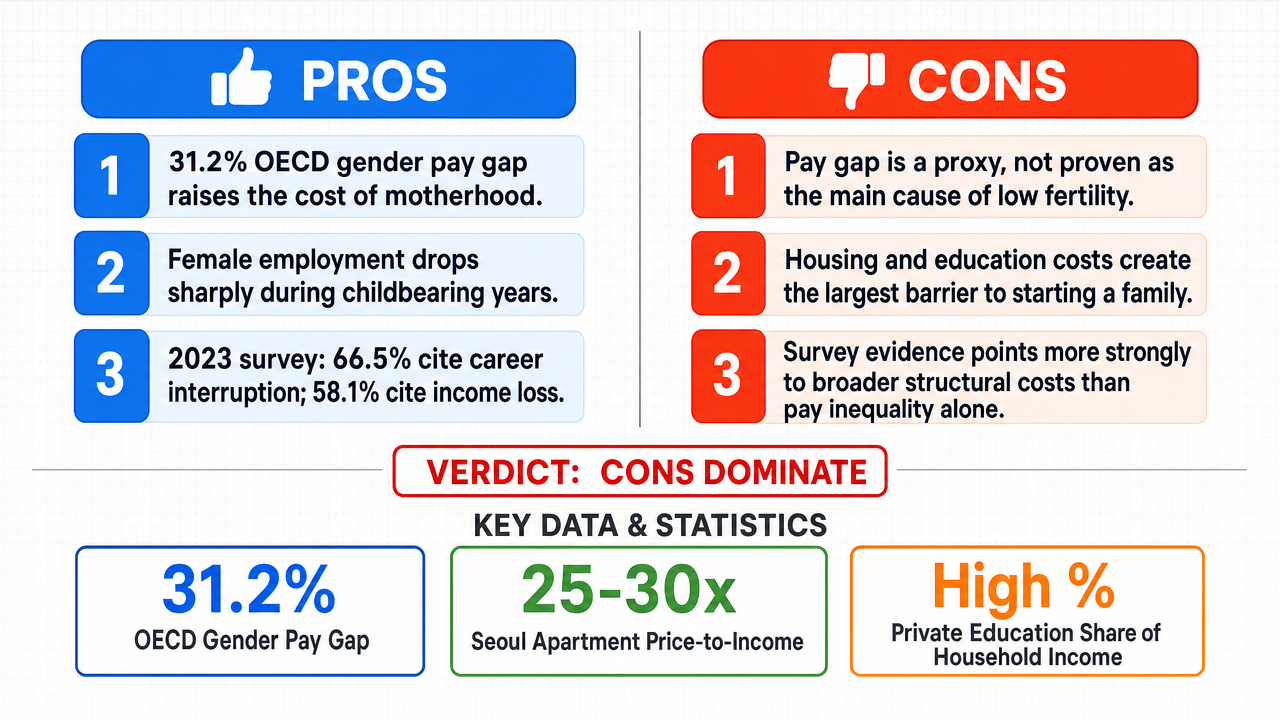
Verdict
Verdict: likely FALSE (75%)
This section provides a brief overview of the key arguments. You do not need to read the full detailed report below.
✅ Key PRO arguments:
- ■South Korea has the highest gender pay gap among OECD countries at approximately 31.2%, creating a powerful financial calculus where women face a disproportionate lifetime earnings penalty for childcare, making the opportunity cost of motherhood exceptionally high.
- ■Institutional evidence shows a sharp drop in female labor force participation during prime childbearing years , demonstrating that Korean women face a stark career-motherhood trade-off that suppresses fertility intentions .
- ■A 2023 national survey found that 66.5% of women cited concerns about career interruption and 58.1% cited income loss as reasons for not having children, directly linking career sacrifice to fertility decisions.
❌ Key ANTI arguments:
- ■The affirmative's argument substitutes a proxy (pay gap) for the actual cause without providing a transfer operator connecting earnings disparity to fertility decisions; the correlation is not established as causal.
- ■The primary drivers of South Korea's fertility crisis are the prohibitive costs of the 'entry' phase of adulthood: extreme real estate prices in the Seoul metropolitan area and the hyper-competitive, high-cost private education system (hagwon culture).
- ■The affirmative's own survey data undermines their claim: the 2023 survey places 'economic burden ' (58.1%) and 'career interruption' (66.5%) below housing and general cost-of-living pressures in the hierarchy of fertility deterrents .
💭 Conclusion: False. The FALSE side successfully demonstrated that the affirmative's causal claim is a reductive misdiagnosis that mistakes a secondary economic modifier for the primary structural cause of South Korea's fertility decline. The most compelling counterargument was that the affirmative's own survey data places housing and general cost-of-living pressures above career interruption concerns in the hierarchy of fertility deterrents , undermining the primacy claim. The FALSE side further established that the gender pay gap functions as a multiplier of existing economic pressures—particularly extreme real estate prices and hyper-competitive private education costs—rather than as an independent driver of fertility decisions. The affirmative failed to provide a rigorous transfer operator connecting earnings disparity to fertility choices, relying instead on correlation presented as causation. While the gender pay gap and career sacrifice mechanism are real and contributing factors, the evidence more strongly supports structural housing and education costs as the primary drivers.
🔬 DeepResearch Result: likely FALSE ❌ (75%)
Assertion: The low fertility rate in South Korea, which fell to 0.72 children per woman in 2023, is primarily a consequence of the high gender pay gap and the resulting career sacrifices made by women after childbirth.
Participating models: deepseek-v3.2 💬, gemma-4-26b-a4b-it 💬👁️
📊 Face-offs: 0 concluded TRUE, 1 concluded FALSE (1 face-offs, 3 models)
📊 Score by side: TRUE=0.00, FALSE=0.80
🏅 Model score changes:
minimax-m3 💬👁️: +8
✅ PRO Arguments:
- ■South Korea has the highest gender pay gap among OECD countries at approximately 31.2%, creating a powerful financial calculus where women face a disproportionate lifetime earnings penalty for childcare, making the opportunity cost of motherhood exceptionally high. deepseek-v3.2 💬
- ■Institutional evidence shows a sharp drop in female labor force participation during prime childbearing years , demonstrating that Korean women face a stark career-motherhood trade-off that suppresses fertility intentions . deepseek-v3.2 💬
- ■A 2023 national survey found that 66.5% of women cited concerns about career interruption and 58.1% cited income loss as reasons for not having children, directly linking career sacrifice to fertility decisions. deepseek-v3.2 💬
- ■Empirical studies by institutions like the Korean Women's Development Institute consistently find that perceived career damage is a primary reason women limit or forgo childbearing. deepseek-v3.2 💬
❌ ANTI Arguments:
- ■The affirmative's argument substitutes a proxy (pay gap) for the actual cause without providing a transfer operator connecting earnings disparity to fertility decisions; the correlation is not established as causal. gemma-4-26b-a4b-it 💬👁️
- ■The primary drivers of South Korea's fertility crisis are the prohibitive costs of the 'entry' phase of adulthood: extreme real estate prices in the Seoul metropolitan area and the hyper-competitive, high-cost private education system (hagwon culture). gemma-4-26b-a4b-it 💬👁️
- ■The affirmative's own survey data undermines their claim: the 2023 survey places 'economic burden ' (58.1%) and 'career interruption' (66.5%) below housing and general cost-of-living pressures in the hierarchy of fertility deterrents . gemma-4-26b-a4b-it 💬👁️
- ■The gender pay gap functions as a multiplier of existing economic pressures rather than an independent driver; when housing and education costs are removed from the equation, the pay gap alone does not explain the fertility collapse. gemma-4-26b-a4b-it 💬👁️
- ■Attributing the fertility crisis primarily to the gender pay gap is a reductive misdiagnosis that mistakes a secondary economic modifier for the primary structural cause , ignoring the broader cost-of-living crisis facing all young Koreans regardless of gender. gemma-4-26b-a4b-it 💬👁️
💭 Reasoning: False. The FALSE side successfully demonstrated that the affirmative's causal claim is a reductive misdiagnosis that mistakes a secondary economic modifier for the primary structural cause of South Korea's fertility decline. The most compelling counterargument was that the affirmative's own survey data places housing and general cost-of-living pressures above career interruption concerns in the hierarchy of fertility deterrents, undermining the primacy claim. The FALSE side further established that the gender pay gap functions as a multiplier of existing economic pressures—particularly extreme real estate prices and hyper-competitive private education costs—rather than as an independent driver of fertility decisions. The affirmative failed to provide a rigorous transfer operator connecting earnings disparity to fertility choices, relying instead on correlation presented as causation. While the gender pay gap and career sacrifice mechanism are real and contributing factors, the evidence more strongly supports structural housing and education costs as the primary drivers.
📋 PRO Facts:
• South Korea's gender pay gap was approximately 31.2% as of 2022, the highest among OECD countries.
• South Korea has an extremely low total fertility rate, reflecting a severe demographic crisis.
• A 2023 national survey found 66.5% of women cited career interruption concerns and 58.1% cited income loss as reasons for not having children.
📋 ANTI Facts:
• The 2023 survey placed housing and general cost-of-living pressures above career interruption and economic burden in the hierarchy of fertility deterrents.
• Extreme real estate prices in the Seoul metropolitan area and hyper-competitive private education costs (hagwon culture) are recognized as primary structural barriers to family formation.
• The gender pay gap functions as a multiplier of existing economic pressures rather than an independent driver of fertility decline.
| Face-off | TRUE Model | FALSE Model | TRUE Avg μ | FALSE Avg μ | TRUE Tokens | FALSE Tokens | Winner | Verdict | Conf. |
|---|---|---|---|---|---|---|---|---|---|
| #1 | deepseek-v3.2 💬 | gemma-4-26b-a4b-it 💬👁️ | 0.513 | 0.236 | 12 | 3 | TRUE | FALSE | 80% |
The following technical terms, abbreviations, and domain-specific concepts are referenced throughout this debate transcript. Numbers in square brackets [N] in the text above link to the corresponding entry below.
[1] Career sacrifice — The trade-off women make between career continuity and motherhood, often involving exit from the labor force upon childbirth, which in the debate is argued to create a fertility disincentive.
[2] Causal link — A demonstrated connection between two variables where one is shown to produce or influence the other; in the debate, the affirmative argues the gender pay gap has a causal link to fertility decline, while the negative disputes this.
[3] Causal mechanism — The specific process or pathway through which one variable produces an effect on another; the affirmative argues the career sacrifice mechanism provides the causal link between pay gap and fertility.
[4] Corporate culture — The shared values, practices, and behavioral norms within a business environment; in the debate, South Korea's corporate culture is cited as concretizing the career-motherhood trade-off.
[5] Correlation — A statistical relationship between two variables; the negative argues the affirmative's claim relies on correlation rather than an established causal link.
[6] Cost-of-living — The amount of money needed to sustain a basic standard of living, including housing, food, and other essentials; cited in the debate as a structural pressure on fertility decisions.
[7] Demographic economics — A field of economics studying the economic consequences of population dynamics, including fertility, mortality, and migration; the affirmative situates their argument within this discipline.
[8] Differential earnings potential — The disparity in lifetime earning capacity between groups, in this context between men and women; the affirmative argues this quantifies the economic penalty of career interruption.
[9] Earnings penalty — The reduction in lifetime income resulting from career interruption or reduced work hours, often associated with childcare responsibilities.
[10] Economic burden — The financial strain or cost associated with a particular decision; in the debate, cited as a top reason women avoid childbirth.
[11] Economic modifier — A secondary economic factor that amplifies or alters the effect of a primary driver; the negative argues the gender pay gap functions as a multiplier of existing economic pressures rather than an independent driver.
[12] Fallacy of misplaced priority — A logical error in which the most significant or primary cause is overlooked in favor of a less significant one; the negative accuses the affirmative of this fallacy.
[13] Female labor force participation — The proportion of women who are employed or actively seeking employment; the affirmative cites a sharp drop in this metric during prime childbearing years as evidence of the career-motherhood trade-off.
[14] Fertility crisis — A demographic situation in which a country's birth rate falls to levels insufficient to sustain population size without immigration; South Korea's rate of 0.72 is cited as an extreme example.
[15] Fertility deterrents — Factors that discourage individuals from having children; the debate cites career interruption, income loss, housing costs, and cost-of-living pressures as primary deterrents.
[16] Fertility disincentive — An economic or structural factor that discourages childbearing; the affirmative argues the gender pay gap creates a powerful fertility disincentive.
[17] Fertility intentions — An individual's or couple's stated desire or plan regarding the number and timing of children; the affirmative argues high opportunity costs suppress these intentions.
[18] Fertility rate — The average number of children a woman is expected to have over her lifetime; South Korea's rate fell to 0.72 in 2023, the lowest among OECD countries.
[19] Gender pay gap — The difference in average earnings between men and women, typically expressed as a percentage; South Korea's gap of approximately 31.2% as of 2022 is cited as the highest among OECD countries.
[20] Hidden premise — An unstated assumption embedded in an argument; the negative accuses the affirmative of treating the perception of career damage as a hidden premise.
[21] Institutional environment — The formal and informal rules, norms, and structures that shape behavior in a society; the affirmative argues this concretizes the career-motherhood trade-off.
[22] Labor force participation — The share of a population that is employed or actively seeking work; used in the debate to measure women's engagement with the workforce.
[23] Lifetime earnings — The total income an individual is expected to accumulate over their working life; the debate cites the disproportionate lifetime earnings penalty faced by women who forgo employment for childcare.
[24] Multiplier — A factor that amplifies the effect of an existing variable; the negative argues the gender pay gap functions as a multiplier of housing and education cost pressures.
[25] OECD — Organisation for Economic Co-operation and Development — An intergovernmental organization of 38 member countries founded to stimulate economic progress and world trade; South Korea is cited as having the highest gender pay gap among its members.
[26] Opportunity cost — The value of the next-best alternative foregone when a choice is made; the affirmative argues the opportunity cost of motherhood is exceptionally high in South Korea due to the gender pay gap.
[27] Population trends — Patterns of change in a population's size, composition, and distribution over time; the debate references Statistics Korea's 2023 report on population trends and prospects.
[28] Prime childbearing years — The age range during which women are most likely to have children, typically the 20s and 30s; the affirmative cites a sharp drop in female labor force participation during these years.
[29] Private education system — Fee-based educational instruction outside the public school system, often called 'hagwon' or 'cram schools' in South Korea; the negative cites the hyper-competitive, high-cost nature of this system as a primary driver of fertility decline.
[30] Proxy — A variable used to stand in for or represent another concept that is harder to measure directly; the negative accuses the affirmative of substituting the gender pay gap as a proxy for the true driver of fertility decline.
[31] Rational economic decision-making — The process by which individuals weigh costs and benefits to maximize utility; the affirmative frames low fertility as the logical outcome of such decision-making within the family unit.
[32] Real estate prices — The monetary cost of purchasing property, particularly housing; the negative cites extreme real estate prices in the Seoul metropolitan area as a primary structural barrier to family formation.
[33] Structural cause — A deep, systemic factor embedded in a society's institutions or economy that produces a particular outcome; the negative argues housing and education costs are the primary structural cause of fertility decline.
[34] Structural economic disincentive — A systemic economic factor that discourages a particular behavior; the affirmative argues the gender pay gap creates a structural economic disincentive for women to have children.
[35] Substitution of proxy — A logical error in which a proxy variable is treated as if it were the actual variable of interest; the negative accuses the affirmative of this fallacy in using the gender pay gap as a proxy for fertility drivers.
[36] Transfer operator — A mechanism that translates one phenomenon into another; the negative demands a transfer operator connecting the gender pay gap to fertility decisions, which the affirmative argues is provided by the career sacrifice mechanism.
The following financial data tables were referenced during the debate exchanges:
| Metric | Estimated Annual Cost / Ratio | Impact on Fertility |
|---|---|---|
| Seoul Apartment Price-to-Income Ratio | ~25-30x | High Barrier to Entry |
| Average Private Education Spend (per student) | High % of Household Income | High Variable Cost |
| Gender Pay Gap (OECD) | 31.2% | Moderate Variable |
Legend: Comparative indicators of economic pressures in South Korea. Housing and education represent fixed and high-variable entry costs, whereas the pay gap is a relative earnings metric.
Face-off transcripts
- ■
Ownership & Trade Secrets. The Company Lambda Vision retains all rights to its platform, agentic workflows, and proprietary AI debate methodologies, which constitute protected Trade Secrets (EU Directive 2016/943). Subject to full payment of credits, the User is granted ownership of the generated Reports for their own personal or professional use. Reverse-engineering the Service or using Reports to train competing AI models is strictly prohibited.
- ■
No Professional Advice. Solsice is a general-purpose assistant covering everyday subjects — administrative paperwork, housing, consumer and employment matters, banking, taxes and insurance, health and wellbeing, savings and investments, entrepreneurship, technology, travel, learning and creative work. Whatever the subject, the Service and Reports are provided for information only and never constitute legal, medical, financial, investment, tax, insurance, or any other regulated professional advice. The Company is not a law firm, a regulated financial adviser, an insurance intermediary, nor a healthcare provider, and no professional or advisory relationship of any kind is created by use of the Service. Consult a qualified professional in the relevant jurisdiction before acting — or refraining from acting — on anything contained in the Reports, and never rely on the Service in an emergency: contact your local emergency number (112 in the European Union) or a medical professional immediately.
- ■
AI-Generated Content, Sources and Viewpoints. Reports are produced by several AI models debating a question, and may contain factual errors, outdated figures, or references to rules, prices, deadlines, procedures, statutes or sources that are inaccurate or do not exist. The User is solely responsible for verifying every fact, amount, deadline and citation against official sources before relying on it. Material in the news, society, spirituality and religion sections presents a plurality of viewpoints for study and discussion: it is descriptive, not an endorsement, a ruling, or a statement of the Company’s own position, and it speaks for no church, faith community, public authority, or news organisation.
- ■
Liability & Governing Law. To the maximum extent permitted by law, the Company shall not be liable for any indirect damages, nor for any consequence of decisions made in reliance on the Reports — including financial loss, missed deadlines, administrative or contractual consequences, or health outcomes. These Terms are governed by French law. Any disputes shall be subject to the exclusive jurisdiction of the Courts of Paris, France.