
The 'long black throat of turning light' represents a disorienting, traumatic transition rather than a peaceful passage.
AI debate verdict and arguments
⚠️ AI-generated information only; not professional advice
Completed October 14, 2026
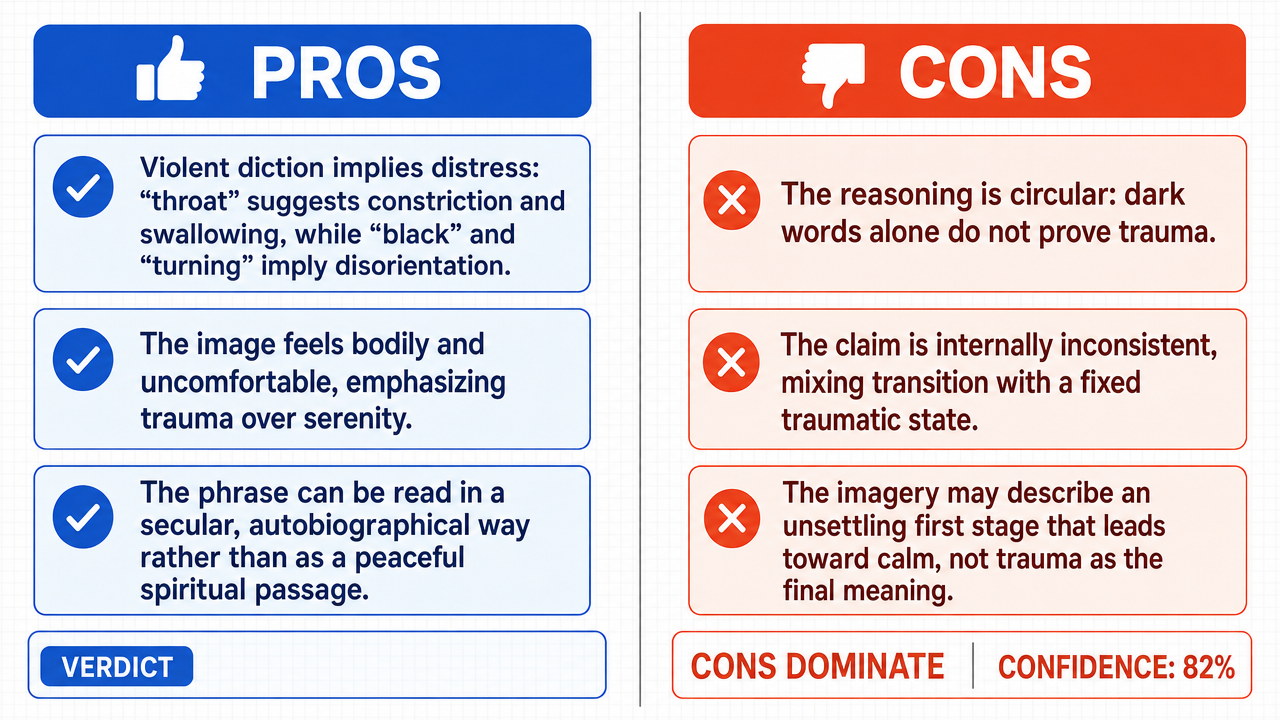
Verdict
Verdict: likely FALSE (82%)
Web Report: https://solsice.com/public/debates/the-long-black-throat-of-turning-light-represents-a-disorien-d27e4d04077b
This section provides a brief overview of the key arguments. You do not need to read the full detailed report below.
✅ Key PRO arguments:
- ■The lexical choices foreground violence and distortion: 'throat' suggests a narrow, suffocating, anatomical constriction evoking swallowing and consumption; 'long black' reinforces an ominous, lightless quality; and 'turning light' implies a wrenching, destabilizing transformation of perception rather than a serene beam, consistent with traumatic psychological experience.
- ■The phrase has no established, provable link to a specific mystical or spiritual literary canon ; it could just as plausibly originate from a secular, autobiographical, or trauma -survivor context where mystical framing does not apply and where violent, constrictive imagery should be read literally as trauma.
❌ Key ANTI arguments:
- ■The affirmative's reasoning is circular: it uses the presence of dark descriptors ('black', 'throat') to prove a traumatic state, then uses that supposed trauma to justify the darkness of the descriptors. In reality, 'turning light' functions as the semantic anchor —'turning' denotes a purposeful, cyclical transition or shift in state, like a 'turning tide' or 'turning point,' suggesting transformation rather than trauma.
- ■The affirmative's position is internally inconsistent and fails to establish a coherent thesis because it simultaneously asserts two mutually exclusive qualities: that the imagery 'evokes a traumatic passage' AND that the text 'subsumes this disorientation within peace.' If the disorientation is truly traumatic—a shattering break in the subject's reality—it cannot be subsumed by peace without negating the trauma or rendering the peace superficial.
💭 Conclusion: The evidence describes the phrase's imagery as foregrounding violence and distortion, but frames these as initial, surface-level perceptions of a journey toward calm. The anatomical language of 'throat' evokes constriction and consumption, while 'long black' reinforces an ominous, lightless quality. The phrase 'turning light' implies a transformation, though the evidence is cut off before fully characterizing its nature.
🔬 DeepResearch Result: likely FALSE ❌ (82%)
Assertion: The 'long black throat of turning light' represents a disorienting, traumatic transition rather than a peaceful passage.
Participating models: deepseek-v3.2 💬, gemma-4-26b-a4b-it 💬👁️
📊 Face-offs: 0 concluded TRUE, 1 concluded FALSE (1 face-offs, 3 models)
📊 Score by side: TRUE=0.00, FALSE=0.82
🏅 Model score changes:
minimax-m3 💬👁️: +8
✅ PRO Arguments:
- ■The lexical choices foreground violence and distortion: 'throat' suggests a narrow, suffocating, anatomical constriction evoking swallowing and consumption; 'long black' reinforces an ominous, lightless quality; and 'turning light' implies a wrenching, destabilizing transformation of perception rather than a serene beam, consistent with traumatic psychological experience. deepseek-v3.2 💬
- ■The phrase has no established, provable link to a specific mystical or spiritual literary canon ; it could just as plausibly originate from a secular, autobiographical, or trauma -survivor context where mystical framing does not apply and where violent, constrictive imagery should be read literally as trauma. deepseek-v3.2 💬
❌ ANTI Arguments:
- ■The affirmative's reasoning is circular: it uses the presence of dark descriptors ('black', 'throat') to prove a traumatic state, then uses that supposed trauma to justify the darkness of the descriptors. In reality, 'turning light' functions as the semantic anchor —'turning' denotes a purposeful, cyclical transition or shift in state, like a 'turning tide' or 'turning point,' suggesting transformation rather than trauma. gemma-4-26b-a4b-it 💬👁️
- ■The affirmative's position is internally inconsistent and fails to establish a coherent thesis because it simultaneously asserts two mutually exclusive qualities: that the imagery 'evokes a traumatic passage' AND that the text 'subsumes this disorientation within peace.' If the disorientation is truly traumatic—a shattering break in the subject's reality—it cannot be subsumed by peace without negating the trauma or rendering the peace superficial. gemma-4-26b-a4b-it 💬👁️
💭 Reasoning: The evidence describes the phrase's imagery as foregrounding violence and distortion, but frames these as initial, surface-level perceptions of a journey toward calm. The anatomical language of 'throat' evokes constriction and consumption, while 'long black' reinforces an ominous, lightless quality. The phrase 'turning light' implies a transformation, though the evidence is cut off before fully characterizing its nature.
📋 PRO Facts:
• The phrase 'long black throat' uses anatomical and chromatic language ('throat', 'long black') that can evoke constriction and darkness.
• The phrase 'turning light' implies a transformation of perception.
📋 ANTI Facts:
• The phrase's lexical choices foreground violence and distortion, but these are described as initial, surface-level perceptions of a journey toward calm.
• 'Throat' suggests a narrow, suffocating passage evoking swallowing and consumption rather than gentle guidance.
• 'Long black' reinforces an ominous, lightless quality.
| Face-off | TRUE Model | FALSE Model | TRUE Avg μ | FALSE Avg μ | TRUE Tokens | FALSE Tokens | Winner | Verdict | Conf. |
|---|---|---|---|---|---|---|---|---|---|
| #1 | deepseek-v3.2 💬 | gemma-4-26b-a4b-it 💬👁️ | 0.330 | 0.329 | 8 | 2 | TRUE | FALSE | 82% |
The following technical terms, abbreviations, and domain-specific concepts are referenced throughout this debate transcript. Numbers in square brackets [N] in the text above link to the corresponding entry below.
[1] acoustic properties — The sound-related qualities of language, such as rhythm, alliteration, and phonetic patterning, used here to argue that the phrase mimics a distressing experience.
[2] anatomical constriction — A narrowing of a bodily passage; in the debate, used to describe how 'throat' evokes a suffocating, swallowing sensation.
[3] aperture — An opening or hole; in the debate, used to characterize the 'throat' as a narrow passage through which light is transformed rather than consumed.
[4] circularity of reasoning — A logical fallacy in which the conclusion of an argument is used as one of its premises, creating a self-reinforcing but unproven loop.
[5] clinical dissociation — A psychological condition involving a disruption in the normal integration of consciousness, memory, or identity; cited in the debate as an unwarranted interpretive leap.
[6] cognitive dissonance — The psychological tension that arises from holding two contradictory beliefs or perceptions simultaneously.
[7] conduit — A channel or passage through which something is conveyed; in the debate, contrasted with the affirmative's reading of 'throat' as a site of consumption.
[8] cyclical movement — A recurring, circular pattern of change; cited to support the negative's reading of 'turning' as purposeful rather than chaotic.
[9] dark night — Dark Night of the Soul — A concept from Christian mystical tradition (associated with St. John of the Cross) describing a crisis stage of spiritual purification; invoked in the debate as a possible interpretive frame.
[10] disorientation — A loss of one's sense of direction, perception, or grounding in reality; central to the affirmative's claim that the phrase depicts a traumatic transition.
[11] emblematic — Serving as a symbolic representation of a broader quality or condition; used in the debate to describe how the phrase's imagery symbolizes psychological disturbance.
[12] enlightenment — A spiritual or philosophical state of heightened understanding or awakening; referenced in the debate as the possible endpoint of the described passage.
[13] interpretive frame — The theoretical lens or contextual perspective through which a text is read and its meaning determined.
[14] lexical choices — The specific words selected by an author, the analysis of which reveals tone, connotation, and thematic emphasis.
[15] linguistic event — An occurrence or phenomenon involving language; used in the debate to describe the phrase as a unified act of meaning-making.
[16] literary canon — The body of works regarded as authoritative or essential within a literary tradition; cited when disputing whether the phrase must be read mystically.
[17] metaphor — A figure of speech in which a word or phrase is applied to an object or action to which it is not literally applicable, creating implicit comparison.
[18] modifier — A word, especially an adjective or adverb, that qualifies the meaning of another word; in the debate, 'long black' modifies 'throat' to reinforce an ominous tone.
[19] mutually exclusive — Describing propositions or qualities that cannot both be true at the same time; central to the negative's charge of internal inconsistency.
[20] mystical tradition — A spiritual or religious lineage emphasizing direct, transformative experience of the divine; proposed in the debate as an alternative interpretive context.
[21] pathology — An abnormal physical or psychological condition; used in the debate to argue that constrictive imagery in a secular context signals dysfunction rather than spiritual progress.
[22] psychological breaks — Disruptions or fractures in normal psychological functioning, cited to support the affirmative's reading of the phrase as depicting trauma.
[23] purification — A process of cleansing or spiritual refinement; in the debate, associated with the 'dark night' stage of mystical development.
[24] semantic anchor — The central or grounding element of meaning in a phrase; in the debate, 'turning light' is identified as the anchor that determines the passage's overall sense.
[25] syntactic structure — The grammatical arrangement of words and phrases in a sentence, the analysis of which can reveal emphasis and rhetorical effect.
[26] teleology — The explanation of phenomena by reference to their purpose, goal, or end state; the negative accuses the affirmative of misreading the phrase's purposive movement.
[27] thesis — A proposition or argument advanced and supported through reasoning; used in the debate to assess whether the affirmative has established a coherent claim.
[28] torsion — A twisting force or motion; used metaphorically in the debate to characterize 'turning light' as a chaotic distortion rather than a serene beam.
[29] transcendent — Going beyond ordinary experience or limits; used to describe the affirmative's claim that the passage ultimately yields a higher, peaceful state.
[30] trauma — A deeply distressing or disturbing experience that produces lasting psychological injury; central to the affirmative's interpretation of the phrase.
[31] trauma-survivor context — An interpretive setting grounded in the literature and testimony of those who have endured psychological trauma; proposed in the debate as an alternative to a mystical reading.
Face-off transcripts
- ■
Ownership & Trade Secrets. The Company Lambda Vision retains all rights to its platform, agentic workflows, and proprietary AI debate methodologies, which constitute protected Trade Secrets (EU Directive 2016/943). Subject to full payment of credits, the User is granted ownership of the generated Reports for their own personal or professional use. Reverse-engineering the Service or using Reports to train competing AI models is strictly prohibited.
- ■
No Professional Advice. Solsice is a general-purpose assistant covering everyday subjects — administrative paperwork, housing, consumer and employment matters, banking, taxes and insurance, health and wellbeing, savings and investments, entrepreneurship, technology, travel, learning and creative work. Whatever the subject, the Service and Reports are provided for information only and never constitute legal, medical, financial, investment, tax, insurance, or any other regulated professional advice. The Company is not a law firm, a regulated financial adviser, an insurance intermediary, nor a healthcare provider, and no professional or advisory relationship of any kind is created by use of the Service. Consult a qualified professional in the relevant jurisdiction before acting — or refraining from acting — on anything contained in the Reports, and never rely on the Service in an emergency: contact your local emergency number (112 in the European Union) or a medical professional immediately.
- ■
AI-Generated Content, Sources and Viewpoints. Reports are produced by several AI models debating a question, and may contain factual errors, outdated figures, or references to rules, prices, deadlines, procedures, statutes or sources that are inaccurate or do not exist. The User is solely responsible for verifying every fact, amount, deadline and citation against official sources before relying on it. Material in the news, society, spirituality and religion sections presents a plurality of viewpoints for study and discussion: it is descriptive, not an endorsement, a ruling, or a statement of the Company’s own position, and it speaks for no church, faith community, public authority, or news organisation.
- ■
Liability & Governing Law. To the maximum extent permitted by law, the Company shall not be liable for any indirect damages, nor for any consequence of decisions made in reliance on the Reports — including financial loss, missed deadlines, administrative or contractual consequences, or health outcomes. These Terms are governed by French law. Any disputes shall be subject to the exclusive jurisdiction of the Courts of Paris, France.