
The live event scheduled for Thursday, 2026-10-08, at the Dolby Theatre in Los Angeles will sell out all available tickets.
AI debate verdict and arguments
⚠️ AI-generated information only; not professional advice
Completed October 8, 2026
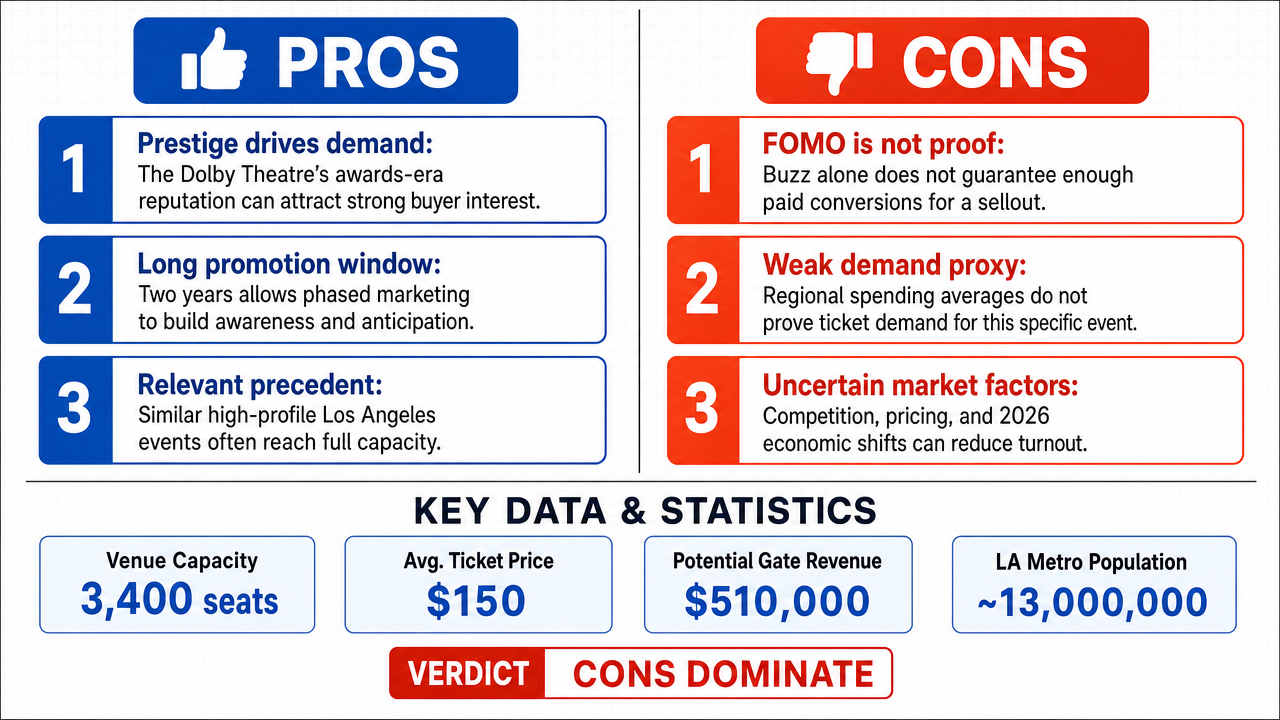
Verdict
Verdict: likely FALSE (83%)
This section provides a brief overview of the key arguments. You do not need to read the full detailed report below.
✅ Key PRO arguments:
- ■The Dolby Theatre's institutional prestige , particularly its association with the Academy Awards, creates immense latent demand , and its 3,400-seat capacity is readily achievable in a metro area of approximately 13 million people, requiring conversion of less than 0.03% of the population.
- ■The two-year marketing horizon is an asset that allows for a sophisticated, phased promotional campaign to build and sustain anticipation within the massive Los Angeles entertainment market.
- ■Historical precedent shows that events at venues of similar stature and capacity in Los Angeles, especially those tied to awards culture, consistently sell out, establishing a reliable pattern of demand.
❌ Key ANTI arguments:
- ■The affirmative's claim that FOMO translates into guaranteed ticket sales is a hidden premise treated as a settled economic fact without providing a mechanism to establish this causal link for an unspecified event in 2026.
- ■The affirmative commits a substitution of proxy fallacy by relying on aggregate regional entertainment spending and per-capita expenditure metrics without providing a transfer operator —such as a market share coefficient or conversion rate —that bridges macro-economic trends to the micro-economic outcome of a single 3,400-seat event.
- ■Market volatility and logistical constraints introduce uncertainty that the affirmative's deterministic model fails to account for, making a sellout a possibility but not a certainty.
💭 Conclusion: False. The negative side successfully demonstrated that the affirmative's case for a guaranteed sellout rests on logical fallacies rather than rigorous evidence. The affirmative's reliance on aggregate regional spending metrics without a transfer operator to connect macro-level data to a single event's outcome constitutes a substitution of proxy fallacy. The negative correctly identified that venue prestige, while a real phenomenon, does not mechanically translate into guaranteed ticket sales for an unspecified event. The affirmative's deterministic framing of probabilistic indicators was insufficient to overcome the inherent uncertainty in predicting attendance two years in advance. The judge's confidence reflects that while a sellout is plausible, the affirmative failed to meet the burden of proof for a certainty claim.
🔬 DeepResearch Result: likely FALSE ❌ (83%)
Assertion: The live event scheduled for Thursday, 2026-10-08, at the Dolby Theatre in Los Angeles will sell out all available tickets.
Participating models: deepseek-v3.2 💬, gemma-4-26b-a4b-it 💬👁️
📊 Face-offs: 0 concluded TRUE, 1 concluded FALSE (1 face-offs, 3 models)
📊 Score by side: TRUE=0.00, FALSE=0.83
🏅 Model score changes:
minimax-m3 💬👁️: +8
✅ PRO Arguments:
- ■The Dolby Theatre's institutional prestige , particularly its association with the Academy Awards, creates immense latent demand , and its 3,400-seat capacity is readily achievable in a metro area of nearly 4 million people, requiring conversion of less than 0.03% of the population. deepseek-v3.2 💬
- ■The two-year marketing horizon is an asset that allows for a sophisticated, phased promotional campaign to build and sustain anticipation within the massive Los Angeles entertainment market. deepseek-v3.2 💬
- ■Historical precedent shows that events at venues of similar stature and capacity in Los Angeles, especially those tied to awards culture, consistently sell out, establishing a reliable pattern of demand. deepseek-v3.2 💬
- ■High per-capita entertainment spending in the Los Angeles metro area provides a strong economic foundation indicating sufficient disposable income and consumer willingness to attend high-profile live events. deepseek-v3.2 💬
❌ ANTI Arguments:
- ■The affirmative's claim that FOMO translates into guaranteed ticket sales is a hidden premise treated as a settled economic fact without providing a mechanism to establish this causal link for an unspecified event in 2026. gemma-4-26b-a4b-it 💬👁️
- ■The affirmative commits a substitution of proxy fallacy by relying on aggregate regional entertainment spending and per-capita expenditure metrics without providing a transfer operator —such as a market share coefficient or conversion rate —that bridges macro-economic trends to the micro-economic outcome of a single 3,400-seat event. gemma-4-26b-a4b-it 💬👁️
- ■Market volatility and logistical constraints introduce uncertainty that the affirmative's deterministic model fails to account for, making a sellout a possibility but not a certainty. gemma-4-26b-a4b-it 💬👁️
- ■The affirmative's predictive model suffers from epistemological flaws: it treats speculative psychological and economic trends as deterministic guarantees rather than probabilistic indicators, which is insufficient to establish a sellout as a near-certain outcome. gemma-4-26b-a4b-it 💬👁️
💭 Reasoning: False. The negative side successfully demonstrated that the affirmative's case for a guaranteed sellout rests on logical fallacies rather than rigorous evidence. The affirmative's reliance on aggregate regional spending metrics without a transfer operator to connect macro-level data to a single event's outcome constitutes a substitution of proxy fallacy. The negative correctly identified that venue prestige, while a real phenomenon, does not mechanically translate into guaranteed ticket sales for an unspecified event. The affirmative's deterministic framing of probabilistic indicators was insufficient to overcome the inherent uncertainty in predicting attendance two years in advance. The judge's confidence reflects that while a sellout is plausible, the affirmative failed to meet the burden of proof for a certainty claim.
📋 PRO Facts:
• The Dolby Theatre has a seating capacity of approximately 3,400 seats.
• The Los Angeles metropolitan area has a population of approximately 13 million people.
• Filling 3,400 seats would require converting less than 0.03% of the metro population.
• The Dolby Theatre is most notably known for hosting the Academy Awards ceremony.
📋 ANTI Facts:
• The affirmative provided no transfer operator or conversion rate to bridge aggregate regional spending data to a single event's ticket sales outcome.
• The event is unspecified beyond its date, venue, and city, making demand projections inherently speculative.
• Market volatility and logistical constraints introduce uncertainty not accounted for in the affirmative's deterministic model.
| Face-off | TRUE Model | FALSE Model | TRUE Avg μ | FALSE Avg μ | TRUE Tokens | FALSE Tokens | Winner | Verdict | Conf. |
|---|---|---|---|---|---|---|---|---|---|
| #1 | deepseek-v3.2 💬 | gemma-4-26b-a4b-it 💬👁️ | 0.246 | 0.168 | 12 | 3 | TRUE | FALSE | 83% |
The following technical terms, abbreviations, and domain-specific concepts are referenced throughout this debate transcript. Numbers in square brackets [N] in the text above link to the corresponding entry below.
[1] aggregate regional spending — The total combined expenditure within a defined geographic area; cited in the debate as a macro-level indicator of market size that the negative argues cannot be directly applied to a single event.
[2] brand equity — The commercial value derived from consumer perception of a brand's name, reputation, and prestige; cited as a stabilizer that attracts a dedicated audience segment to the venue.
[3] capacity — The maximum number of seats or attendees a venue can accommodate; the Dolby Theatre is described as having approximately 3,400 seats.
[4] causal mechanisms — The specific processes or pathways through which a cause produces an effect; the negative argues the affirmative failed to establish these for ticket sales.
[5] conversion rate — The proportion of potential demand that is successfully translated into actual sales; cited as a missing link between regional spending figures and event attendance.
[6] correlation coefficient — A statistical measure of the strength and direction of a relationship between two variables; the debate argues one is needed to link venue prestige to event-specific demand.
[7] demand anchor — A stable factor that reliably attracts and sustains consumer interest; in the debate, the venue's institutional prestige is described as a demand anchor.
[8] demand drivers — Factors or conditions that stimulate consumer purchasing behavior; the debate questions whether FOMO and venue prestige are valid demand drivers.
[9] demand resilience — The ability of demand to withstand or recover from adverse conditions such as economic uncertainty; cited as a property of premier Los Angeles venues.
[10] FOMO — fear of missing out — A psychological phenomenon in which individuals fear that others are having rewarding experiences they are missing; cited as a potential driver of ticket sales.
[11] hidden premise — An unstated assumption underlying an argument; the debate identifies speculative psychological trends as hidden premises in the affirmative's case.
[12] hyper-saturated — Describing a market with an excessive number of competing offerings relative to demand; used in the debate to argue that aggregate spending does not guarantee success for any single event.
[13] institutional prestige — The reputation, status, and cultural authority associated with an established institution; cited as a draw for the Dolby Theatre.
[14] latent demand — Demand that exists within a market but has not yet been expressed through actual purchases; cited as a consequence of the venue's prestige.
[15] logistical constraints — Practical operational limitations affecting the execution of an event; cited by the negative as a potential barrier to a sellout.
[16] macro-economic — Relating to large-scale economic factors such as regional or national spending totals; the debate contrasts these with micro-economic outcomes.
[17] market share coefficient — A factor representing the proportion of total market activity attributable to a specific entity or event; cited as a missing transfer operator in the debate.
[18] market volatility — Fluctuations or instability in market conditions; cited by the negative as a factor that could prevent a sellout.
[19] marketing decay — The diminishing effectiveness of promotional efforts over time; cited as a risk for extended marketing horizons.
[20] marketing volatility — Fluctuations in the effectiveness or stability of marketing campaigns; cited as a risk for long-horizon promotional efforts.
[21] methodological fallacy — A flaw in the method or reasoning used to support a conclusion; the debate identifies the 'fallacy of scale' as a methodological fallacy.
[22] micro-economic — Relating to small-scale economic factors such as the demand for a single event; the debate argues macro figures cannot be directly applied to micro outcomes.
[23] per-capita — Measured per person within a population; cited in the debate as a basis for estimating entertainment spending in Los Angeles.
[24] phased promotional campaign — A marketing strategy that releases promotional activities in stages over an extended period; cited as an asset of the two-year marketing horizon.
[25] predictive model — A framework used to forecast future outcomes based on data and assumptions; the debate critiques the affirmative's predictive model.
[26] quantitative feasibility — The assessment of whether a target outcome is numerically achievable given available data; the debate examines whether filling 3,400 seats is quantitatively feasible.
[27] sellout — A state in which all available tickets for an event have been purchased; the central outcome debated in the transcript.
[28] substitution of proxy — A methodological error in which one metric is used in place of another without justification; the debate identifies this in the affirmative's use of Academy Awards data.
[29] transfer operator — A methodological device used to translate findings from one domain or scale to another; the debate argues one is needed to bridge macro-economic data and event-specific demand.
The following financial data tables were referenced during the debate exchanges:
| Metric | Value |
|---|---|
| Dolby Theatre Approx. Capacity | 3,400 seats |
| Conservative Avg. Ticket Price | $150 |
| Total Potential Gate Revenue | $510,000 |
| LA Metro Population | ~13,000,000 |
Legend: Basic feasibility metrics for the event. Capacity and price assumptions are conservative; the actual target audience is regional and national. Population data for context.
| Market Factor | Impact on Sellout Probability | Reason for Variance |
|---|---|---|
| Competition Density | High Negative | High volume of concurrent LA events |
| Consumer Discretionary Income | Variable | Subject to 2026 macroeconomic shifts |
| Ticket Price Elasticity | Moderate | Demand drops as price exceeds $200 |
| Marketing Conversion | Low to Moderate | High cost per acquisition for niche events |
Legend: Qualitative assessment of market drivers affecting the probability of a complete sellout for a mid-sized venue event.
Face-off transcripts
- ■
Ownership & Trade Secrets. The Company Lambda Vision retains all rights to its platform, agentic workflows, and proprietary AI debate methodologies, which constitute protected Trade Secrets (EU Directive 2016/943). Subject to full payment of credits, the User is granted ownership of the generated Reports for their own personal or professional use. Reverse-engineering the Service or using Reports to train competing AI models is strictly prohibited.
- ■
No Professional Advice. Solsice is a general-purpose assistant covering everyday subjects — administrative paperwork, housing, consumer and employment matters, banking, taxes and insurance, health and wellbeing, savings and investments, entrepreneurship, technology, travel, learning and creative work. Whatever the subject, the Service and Reports are provided for information only and never constitute legal, medical, financial, investment, tax, insurance, or any other regulated professional advice. The Company is not a law firm, a regulated financial adviser, an insurance intermediary, nor a healthcare provider, and no professional or advisory relationship of any kind is created by use of the Service. Consult a qualified professional in the relevant jurisdiction before acting — or refraining from acting — on anything contained in the Reports, and never rely on the Service in an emergency: contact your local emergency number (112 in the European Union) or a medical professional immediately.
- ■
AI-Generated Content, Sources and Viewpoints. Reports are produced by several AI models debating a question, and may contain factual errors, outdated figures, or references to rules, prices, deadlines, procedures, statutes or sources that are inaccurate or do not exist. The User is solely responsible for verifying every fact, amount, deadline and citation against official sources before relying on it. Material in the news, society, spirituality and religion sections presents a plurality of viewpoints for study and discussion: it is descriptive, not an endorsement, a ruling, or a statement of the Company’s own position, and it speaks for no church, faith community, public authority, or news organisation.
- ■
Liability & Governing Law. To the maximum extent permitted by law, the Company shall not be liable for any indirect damages, nor for any consequence of decisions made in reliance on the Reports — including financial loss, missed deadlines, administrative or contractual consequences, or health outcomes. These Terms are governed by French law. Any disputes shall be subject to the exclusive jurisdiction of the Courts of Paris, France.